 ProMapRanker
Which Customer Data Platforms Cdp Fits You? 8 Tools Compared


Marketing-led teams that require segmentation without engineering tickets · Pricing starts at: Custom
Key takeaways
- Number one here is BlueConic, a fit for marketing-led teams that require segmentation without engineering tickets.
- Before buying BlueConic, weigh this: custom pricing roughly $50,000 to $200,000 a year.
- Pricing for BlueConic, Tealium, Amperity and others is quote-based, which adds a sales step before you can compare cost.
- Just one of the 8 tools, Twilio Segment, has a free plan.
- For enterprises already standardized on Salesforce, Salesforce Data Cloud is worth a look.
Direct answer
If you need marketing-led teams that require segmentation without engineering tickets, BlueConic is the first tool to look at here. Look at Tealium for enterprises where compliance, consent and tag governance dominate, and at Amperity for retail and hospitality brands obsessed with identity resolution. Prices, free plans and limits for all 8 tools follow.
Quick comparison
| Pick | Great for | Pricing starts at | Free tier | |
|---|---|---|---|---|
| BlueConic | Marketing-led teams that require segmentation without engineering tickets | Custom | No | Visit |
 Tealium | Enterprises where compliance, consent and tag governance dominate | Custom | No | Visit |
 Amperity | Retail and hospitality brands obsessed with identity resolution | Custom | No | Visit |
 Twilio Segment | Engineering-led teams that want clean tracking plans and quick integrations | Free tier; Team from $120/month | Yes | Visit |
 Hightouch | Teams with a data warehouse that want activation without another data store | See website | Free trial | Visit |
 Treasure Data | Enterprises running AI and machine learning on customer data | Custom | No | Visit |
 Adobe Real-Time CDP | Enterprises invested in the Adobe Experience Cloud | Custom | No | Visit |
 Salesforce Data Cloud | Enterprises already standardized on Salesforce | Custom | No | Visit |
Customer Data Platforms Cdp profiles
ProMapRanker put together this guide to customer data platforms cdp for readers who want a clear shortlist without reading every vendor page. It compares 8 tools on starting price, free plans, who each one suits and where each one falls short.
BlueConic
Great for: Marketing-led teams that require segmentation without engineering tickets

Pick BlueConic if this describes you: marketing-led teams that require segmentation without engineering tickets. BlueConic's pitch is ownership: marketers build segments, orchestrate experiences and activate channels without filing engineering requests.
From a buyer's view, mid-market firms without large data engineering groups get productive quick. In practice, pricing is custom and firmly mid-market to enterprise. There is no fixed entry price for BlueConic; pricing comes through a quote. BlueConic has no free tier.
Strengths: No-code segmentation and activation. Where it is weaker: Custom pricing roughly $50,000 to $200,000 per year.
- Genuinely marketer-usable interface
- Behavioral data collection without heavy IT
- Enterprise data-science features are lighter
Tealium
Great for: Enterprises where compliance, consent and tag governance dominate

Tealium targets enterprises where compliance, consent and tag governance dominate. Tealium grew out of tag management into a full customer data hub, and that heritage displays in its governance strengths.
Downsides: Complexity overwhelms smaller teams.
In practice, consent enforcement, data-layer control and privacy compliance are first-class features instead of extras, which is why regulated industries and large multi-brand enterprises standardize on it. There is no fixed entry price for Tealium; pricing comes through a quote. Tealium has no free plan.
- 1,000+ integration marketplace
- Deep consent management and data governance
- Implementation takes months and commonly professional services
Amperity
Great for: Retail and hospitality brands obsessed with identity resolution
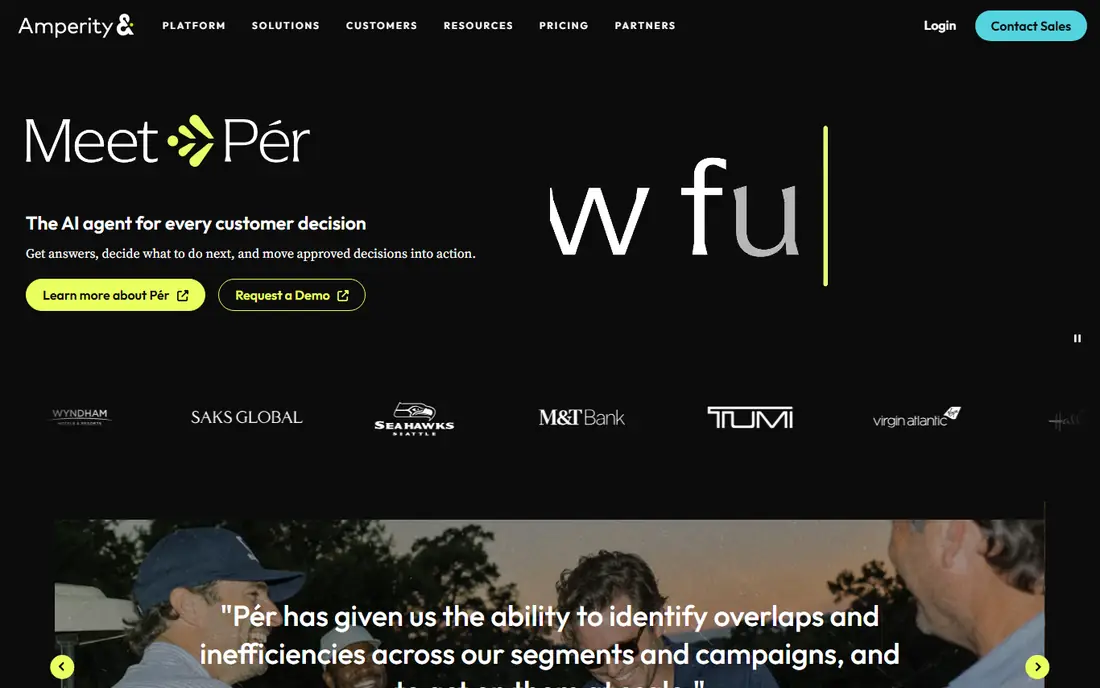
Amperity is designed for retail and hospitality brands obsessed with identity resolution. Amperity built its reputation on one hard problem: stitching together the fragmented identities of retail and hospitality customers across POS, e-commerce, loyalty and marketing systems.
Watch-outs: Implementation needs data cleanup first.
Where Amperity stands out: High customer ratings. Pricing is custom and enterprise, and buyers should know that no CDP fixes dirty source data: cleaning duplicates and standardizing formats at the source remains prerequisite work. There is no list price for Amperity, so a quote is the way in. There is no free plan with Amperity.
- Travel and multi-brand retail
- Good activation into marketing channels
- Custom enterprise pricing
Twilio Segment
Great for: Engineering-led teams that want clean tracking plans and quick integrations
Twilio Segment makes the most sense for engineering-led teams that want clean tracking plans and quick integrations. One API collects events from every source, Protocols validates them against the tracking plan, and hundreds of destinations receive clean, consistent data.
What works well: Free level makes real trials possible.
On top of that, the Team plan starts around $120 a month, but that figure is a floor: event-volume pricing means high-traffic properties pay significantly more, and enterprises should negotiate volume commitments and overage caps at the start. On cost, Twilio Segment starts like this: Free tier. Twilio Segment offers a free plan. Downsides: Costs scale steeply with event volume.
- API-first architecture developers trust
- 400+ pre-built integrations
- Advanced identity features sit on higher plans
Hightouch
Great for: Teams with a data warehouse that want activation without another data store
In short, Hightouch is for teams with a data warehouse that want activation without another data store. Hightouch pioneered the composable CDP: rather than copying customer data into yet another system, it activates directly from the warehouse with reverse ETL.
Honest limits: Identity resolution is lighter than Amperity.
Where it shines: More straightforward pricing story than classic CDPs. As for the details, Marketers build audiences in a no-code interface, and Hightouch syncs them to ad systems, email tools and CRMs. Beyond that, the model relies on warehouse maturity: messy warehouse data produces messy audiences, and identity resolution is less sophisticated than the specialists. No starting price is listed for Hightouch here; confirm pricing on the vendor site. Trial and free access: Free trial.
- Quick syncs to 200+ destinations
- No-code audience building for marketers
- Newest architecture means fewer long-tenured references
Treasure Data
Great for: Enterprises running AI and machine learning on customer data
Where Treasure Data fits: enterprises running AI and machine learning on customer data. Treasure Data is the CDP for businesses where the data team, not the marketing team, drives the purchase. It ingests enormous event volumes, supports machine learning models straight on the platform, and provides engineers SQL-level control over identity, profiles and activation.
Downsides: Overkill for straightforward segmentation use cases.
That power demands skills: implementation is a data engineering project, not a marketing signup, and pricing is custom at enterprise levels. Businesses whose CDP use case is really "sync segments to ad systems" will find it heavy. Pricing for Treasure Data is quote based, so budget talks start with the vendor. Treasure Data has no permanent free option.
- Deals with massive data volumes with ML tooling built in
- Adaptable schema for complicated data models
- Needs data engineering and data science skills
Where Adobe Real-Time CDP fits: enterprises invested in the Adobe Experience Cloud. Profiles update in live and activate at the edge into Adobe Target, Journey Optimizer and premium media, with separate editions tuned for B2C and B2B motions.
Where it shines: targeting and journey tools.
Points against: Custom enterprise pricing. As with all ecosystem CDPs, the value concentrates inside the stack. Adobe houses evaluating a CDP should start here; everyone else should compare the standalone operators first. There is no fixed entry price for Adobe Real-Time CDP; pricing comes through a quote. Adobe Real-Time CDP has no free tier.
- Live profiles with edge activation
- Strong B2B and B2C editions
- Implementation complexity is significant
Salesforce Data Cloud targets enterprises already standardized on Salesforce. Data gravity decides more CDP purchases than feature checklists, and Salesforce shops have the most gravity of all.
The main drawbacks: Non-Salesforce shops get little of the advantage.
In daily use, businesses not on Salesforce should look elsewhere, since the integration advantage evaporates. There is no list price for Salesforce Data Cloud, so a quote is the way in. Salesforce Data Cloud does not include a free plan.
- Massive partner ecosystem
- AI-driven segmentation and personalization
- Custom pricing that grows with the Salesforce footprint
Worth knowing about customer data platforms cdp
Every personalization feature a company buys later inherits the limits of its customer data foundation. From a buyer's view, a customer data product brings together fragmented profiles from websites, apps, keeps and support into one record, resolves identities across devices, and activates audiences into marketing tools.
How these tools were picked
Each tool was reviewed on what its vendor publishes: price, plan limits, core features and stated drawbacks. We did not run hands-on tests. Where a price is missing, the vendor does not list one publicly or ties it to a quote. Always confirm before budgeting. Position on the page reflects fit for a typical buyer first, with price clarity and free access breaking ties. Treat it as a guide, not a ruling.
A buyer's checklist
- Confirm the entry price on the vendor page. For BlueConic, Tealium, Amperity and others that means a quote rather than a fixed price.
- Test the free plan from Twilio Segment against your real workload before relying on it.
- Take the trial from Hightouch and push a live task through it before you pay.
- Before choosing BlueConic, weigh its main limit: custom pricing roughly $50,000 to $200,000 a year.
- Look at which plan of BlueConic unlocks the features you need; entry tiers are often cut down.
- Find out what support Amperity includes on your plan, and whether onboarding help costs extra.
Frequently asked questions
Is BlueConic the right pick for everyone comparing customer data platforms cdp?
No single tool suits every team. BlueConic comes first because it fits marketing-led teams that need segmentation without engineering tickets, while Tealium suits enterprises where compliance, consent and tag governance dominate and Amperity suits retail and hospitality brands obsessed with identity resolution. Match the tool to your own size, budget and workflow before deciding.
Which options for customer data platforms cdp have a free plan?
Twilio Segment is the only tool in this list with a free plan. Free plans usually cap users, projects or features, so check the limits on the vendor page. One other tool offers a trial instead.
How are the tools for customer data platforms cdp ordered?
The order follows typical fit for customer data platforms cdp, with BlueConic first and Salesforce Data Cloud last, then price clarity and free access. It is editorial judgement, not a score, so another team could rank the tools differently.
Do these tools publish their prices?
Not all of them. BlueConic, Tealium, Amperity and others publish no starting price, so expect a quote request for those. The rest, Twilio Segment included, show a starting price, though seats and billing terms still change the final cost.
Sources
See where you really rank - block by block
ProMapRanker scans Google Maps across a grid of your service area. Simple monthly plans from $19, white-label on every plan.
Start freeKeep reading
 zscaler alternatives
Best Zscaler Alternatives in 2026
Looking for zscaler alternatives? We compare 9 SASE and zero trust platforms on architecture, data protection, pricing, and fit for your network and team.
Read → zapier alternatives free
Best Zapier Alternatives Free in 2026
Nine automation tools for zapier alternatives free in 2026, all with genuinely free tiers, plus free plan limits, starting prices and upgrade paths explained.
Read → which platform is best for online reputation
Which Platform Is Best for Online Reputation in 2026
Wondering which platform is best for online reputation? We compare 8 review, listing, and response tools for small and multi-location businesses and agencies.
Read →