 ProMapRanker
Best CTRM Software in 2026


Large multi-commodity trading houses · Pricing starts at: See website
Key takeaways
- CTRM software covers trade capture, positions, risk, logistics, settlement, and accounting for physical and financial commodity trades.
- Large trading houses usually need Openlink, Aspect, or a similar enterprise suite, while smaller desks can start with a cloud or specialist tool.
- Most enterprise CTRM pricing is quoted, and implementation time often matters more than the license price.
- This article is general information only, not financial, tax, or legal advice, and trading risk limits should be set with qualified advisers.
Quick comparison
| Pick | Great for | Pricing starts at | Free tier | |
|---|---|---|---|---|
| ION Openlink | Large multi-commodity trading houses | See website | No | Visit |
 Aspect CTRM | Cloud-native energy and commodity desks | See website | No | Visit |
 Eka CTRM | Multi-commodity trading and supply chains | See website | No | Visit |
 Brady | Energy and metals trading with compliance needs | See website | No | Visit |
 Amphora Symphony | Oil, refined products, and LNG trading | See website | No | Visit |
 Contigo | Deal lifecycle and valuation governance | See website | No | Visit |
 Agiboo | Agriculture, energy, and metals trading | See website | No | Visit |
 SAP Commodity Management | Companies already running SAP | See website | No | Visit |
 Allegro Horizon | Desks with frequent intraday position changes | See website | No | Visit |
The best ctrm software
We compared commodity trading and risk management tools live in October 2026 that handle trade capture, positions, risk, and settlement for commodity businesses. Generic trading or accounting tools without commodity trade logic were left out.
ION Openlink, often called Openlink Endur, is the enterprise shorthand for CTRM. It covers oil, gas, power, metals, and agricultural products, with both physical and financial trades in one platform. Credit risk monitoring, cross-asset profit and loss reporting, and regulatory workflow tools help large desks manage exposure across books.
The cost is enterprise in time as well as money. Large implementations can run six to eighteen months, with partner help and careful data migration. Smaller desks should look at cloud or specialist tools first. For a large trading house that needs breadth and depth, Openlink remains the benchmark.
- Very broad commodity and trade type coverage
- Real-time credit risk and cross-asset profit reporting
- Long enterprise history
- Pricing is quote-based
- Implementation can run many months
- Smaller desks may find it heavy
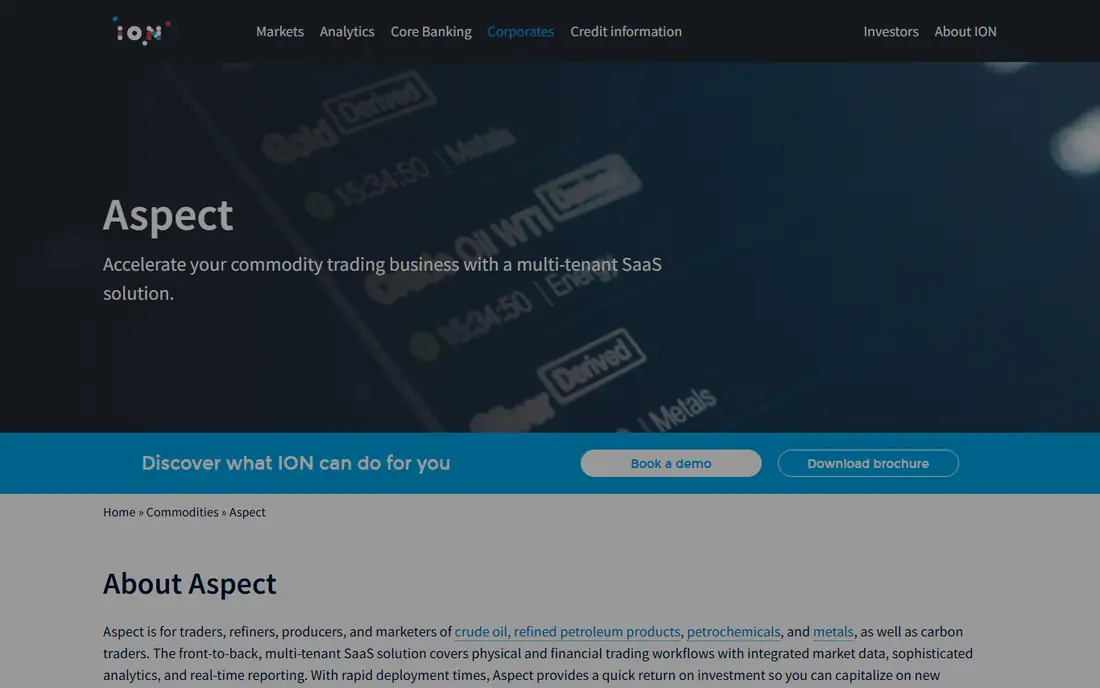
Aspect Enterprise Solutions offers a cloud-native CTRM for energy, metals, and agriculture, covering trade capture through risk and settlement. The cloud design suits desks that want faster updates and remote access without running their own servers. Real-time profit and loss and risk views help traders and risk managers see exposure as markets move.
Niche commodity rules, such as complex physical logistics or assay handling, should be tested against your trade types before buying. Pricing is quoted. For a desk that wants a modern cloud CTRM without a heavy on-premise project, Aspect is a strong shortlist pick.
- Cloud-native design
- End-to-end trade and risk coverage
- Real-time profit and loss views
- Pricing is quote-based
- Some niche commodity logic should be tested
- Enterprise reporting needs care

Eka, now part of a larger commodity software group in public listings, covers trading, risk, logistics, and supply chain work for multi-commodity businesses. It handles trade capture, positions, risk, and settlement, with logistics tracking for physical movements. That breadth suits companies that trade and move physical goods, not only paper positions.
Setup needs care, since supply chain and logistics rules vary by commodity and region. Pricing is quoted, and module costs should be confirmed. For a multi-commodity company that needs trading plus physical supply chain visibility, Eka is a practical enterprise option.
- Multi-commodity trade and supply chain coverage
- Risk and logistics tools
- Cloud and on-premise options
- Pricing is quote-based
- Implementation needs planning
- Some modules cost extra
Brady serves energy and metals trading firms with trade capture, risk, compliance, and accounting tools for physical and financial trades. Its strength in European energy and renewables, noted in public comparisons, suits desks with complex physical contracts and regulatory reporting needs. Accounting links help finance close trades without retyping data.
The design is more traditional than cloud-native rivals, and pricing is quoted. Small desks with simple trades may find it broad. For an energy or metals desk that needs compliance and accounting depth, Brady is a solid enterprise choice.
- Energy and metals focus
- Physical trading, compliance, and accounting tools
- On-premise and cloud options
- Pricing is quote-based
- Interface can feel traditional
- Smaller desks may find it broad
Amphora Symphony supports crude oil, refined products, biofuels, LNG, coal, ores, and other commodity markets on one configurable platform. It covers trade capture, logistics, risk, invoicing, claims, and settlement, with a configuration-driven design that aims to cut custom code. Public listings describe implementations measured in weeks for some clients, which is faster than many enterprise rivals.
Configuration still needs expertise, and desks outside its core markets should test commodity logic carefully. Pricing is quoted. For an oil or refined products desk that wants a configurable system without a long custom build, Symphony is worth a demo.
- Configurable platform for oil and refined products
- Trade to settlement coverage
- Faster implementation claims
- Pricing is quote-based
- Niche focus may limit other commodities
- Configuration still needs expertise
Contigo focuses on the deal lifecycle, with rule-driven workflows that carry contract terms into valuation and exposure outputs. Automated valuation cycles and an auditable history help risk and finance teams trust the numbers and trace how they were produced. That governance focus suits desks where valuation disputes or audit questions are common.
It is a smaller vendor than Openlink or Aspect, so public pricing and commodity breadth are thinner. Buyers should test their exact trade types and valuation rules in a demo. For a team that values automated valuation and clear audit trails, Contigo is a focused option.
- Rule-driven deal lifecycle workflows
- Automated valuation cycles
- Auditable processing history
- Pricing is quote-based
- Smaller vendor with less public detail
- Commodity breadth should be checked
Agiboo offers trade capture, risk management, and accounting for agriculture, energy, and metals, with logic shaped for agricultural contracts. That specialty matters, since agricultural trades often involve grades, delivery windows, and pricing formulas that generic systems handle poorly. Cloud and on-premise deployment options give IT teams a choice.
Enterprise breadth is narrower than the largest suites, so multi-commodity houses with many books should test coverage. Pricing is quoted. For an agricultural trading company that needs commodity-specific logic without an enterprise mega-suite, Agiboo is a strong fit.
- Agriculture-specific trade logic
- Trade, risk, and accounting in one place
- Cloud and on-premise options
- Pricing is quote-based
- Enterprise breadth is narrower than Openlink
- Support coverage should be checked
SAP Commodity Management fits companies that already run SAP enterprise resource planning and want commodity trading inside that system. Trade, pricing, position, and settlement workflows connect with SAP finance, logistics, and reporting, which cuts duplicate data entry. Governance and audit trails follow SAP controls that finance teams already know.
Outside SAP, the value falls sharply, and implementation needs SAP skills. Pricing is quoted and depends on SAP licensing. For an SAP company that trades commodities, keeping trading inside SAP can be simpler than adding a separate CTRM and building integrations.
- SAP-aligned workflow control
- Links to SAP finance and logistics
- Strong governance for SAP users
- Pricing is quote-based
- Value drops sharply outside SAP
- Implementation needs SAP expertise
Allegro Horizon, from Allegro Development, is known for desks that need frequent intraday position changes and up-to-date risk views. It covers energy and commodity trading, risk, and settlement, with tools for traders and risk managers who adjust positions during the day. That intraday focus suits power, gas, and other fast-moving markets.
Setup and interface feel enterprise-grade, and pricing is quoted. Smaller desks with simple daily positions may not need its intraday depth. For a desk where positions move often and risk must be current, Allegro Horizon belongs on the shortlist.
- Intraday position and risk views
- Energy and commodity trade coverage
- Long CTRM history
- Pricing is quote-based
- Interface and setup can feel enterprise-heavy
- Smaller desks may find it broad
How we picked these
We compared official vendor pages and public CTRM comparisons, and kept tools live in October 2026 that handle commodity trade capture, positions, risk, and settlement in a direct way. We left out generic financial trading tools and accounting tools with no commodity trade logic. Where a vendor does not publish a price, we wrote See website rather than guessing.
What to check before you buy
Start with your trade types, not a feature list. List each commodity, physical versus financial trades, delivery terms, and pricing formulas, then test those exact trades in a demo. Check position views, profit and loss, credit limits, and settlement in the same test, since a tool that captures trades well but reports risk poorly will fail in live use.
Also check market data feeds, exchange and broker links, regulatory reporting for your regions, and ERP or accounting integration. Ask for a written implementation plan with timeline, data migration, and training, since enterprise CTRM projects often take months. This article is general information only, not financial, tax, or legal advice, and risk limits, hedging, and reporting duties should be confirmed with qualified advisers.
Frequently asked questions
What does CTRM stand for?
CTRM stands for commodity trading and risk management. The software helps commodity businesses capture trades, track positions and inventory, measure market and credit risk, manage logistics and delivery, and settle and account for trades. It serves physical traders, financial desks, and companies that do both.
Who needs CTRM software?
Energy, metals, agriculture, and other commodity traders need it when trade volume, position complexity, or risk reporting outgrows spreadsheets. Power and gas desks, oil traders, agricultural merchants, and metals traders are typical users. A company with a few simple trades a month may still manage with a ledger and spreadsheets.
How much does CTRM software cost?
Most enterprise CTRM vendors quote prices based on users, commodities, modules, and deployment, so published prices are rare. Public listings for some specialist tools show starting prices near $1,000 per user per month, but that figure does not apply to every vendor. Ask for a quote that includes implementation, market data, and support.
How long does CTRM implementation take?
Timelines vary widely: cloud and specialist tools can go live in weeks to a few months, while large enterprise suites often take six to eighteen months. Data migration, trade type setup, risk limits, and integration with finance systems drive the timeline. Ask for a plan based on your trade types, not a generic estimate.
Can CTRM software handle regulatory reporting?
Many CTRM tools include reporting workflows for rules such as EMIR, Dodd-Frank, REMIT, and MiFID II, but coverage varies by vendor and region. Confirm which reports your business must file, and test those reports with your trade data before buying. A tool helps with reporting, it does not remove legal duties.
Sources
See where you really rank - block by block
ProMapRanker scans Google Maps across a grid of your service area. Simple monthly plans from $19, white-label on every plan.
Start freeKeep reading
 zoro.to alternatives
Best Zoro.to Alternatives in 2026
We compare the best zoro.to alternatives in 2026, listing only legal licensed anime streaming services, from Crunchyroll to free options for fans today.
Read → zip alternatives
Best Zip Alternatives in 2026
We compare the best zip alternatives for buy now, pay later in 2026, covering pay-in-4 plans, fees, spending limits, and credit reporting options today.
Read → yesware alternatives
Best Yesware Alternatives in 2026
Compare the best yesware alternatives for sales email tracking, templates, and sequences, with current pricing and honest tradeoffs for small sales teams.
Read →