 ProMapRanker
Comparing 7 CRM Software for Higher Education Tools in 2026


Small to mid-sized private colleges already running Jenzabar One or SONIS · Pricing starts at: See website (custom quote)
Direct answer
This list puts Jenzabar first for small to mid-sized private colleges already running Jenzabar One or SONIS. Element451 fits Enrollment and marketing teams that want AI doing the outreach work; Encoura (Reach / Connect) fits advancement offices and enrollment teams inheriting the Anthology CRM portfolio. The remaining 4 options are covered below with prices and limits.
Key takeaways
- Top of the list is Jenzabar, which targets small to mid-sized private colleges already running Jenzabar One or SONIS.
- Slate (Technolutions) is the one to check for admissions-led institutions that want one system for the entire funnel.
- A fair warning about Encoura (Reach / Connect): a new owner for the Anthology portfolio means roadmap questions for the next year.
- HubSpot is the only tool of the 7 with a free plan.
- Starting prices begin at $525/user/month with Salesforce Education Cloud.
Quick comparison
| Pick | Great for | Pricing starts at | Free tier | |
|---|---|---|---|---|
| Jenzabar | Small to mid-sized private colleges already running Jenzabar One or SONIS | See website (custom quote) | No | Visit |
 Element451 | Enrollment and marketing teams that want AI doing the outreach work | See website (custom quote) | No | Visit |
 Encoura (Reach / Connect) | Advancement offices and enrollment teams inheriting the Anthology CRM portfolio | See website (custom quote) | No | Visit |
 Ellucian CRM | Banner and Colleague institutions that want CRM inside their Microsoft investment | See website (custom quote) | No | Visit |
 HubSpot | Small colleges and departments that require a working CRM without a quote process | Free CRM; premium Starter from $15/seat/month | Yes | Visit |
 Salesforce Education Cloud | Large universities already running Salesforce elsewhere on campus | $525/user/month (Education Cloud Unlimited Edition, billed annually, per Salesforce's commercial pricing guide) | Free trial | Visit |
 Slate (Technolutions) | Admissions-led institutions that want one system for the entire funnel | See website (custom quote) | No | Visit |
Tool-by-tool breakdown
Choosing CRM software for higher education usually comes down to price, fit and limits. This ProMapRanker guide sets 7 tools side by side on those three points, with the facts kept short and checkable.
Jenzabar
Great for: Small to mid-sized private colleges already running Jenzabar One or SONIS

Jenzabar is built with small to mid-sized private colleges already running Jenzabar One or SONIS in mind. Jenzabar is one of the oldest higher-ed software firms. Its Recruitment product is the CRM piece of a broader product that comes with the Jenzabar One ERP/SIS and SONIS.
Points against: No published pricing.
For everyday use, the recruitment CRM manages inquiry capture, personalized messaging, engagement tracking and a student-facing application portal. It plugs into the Jenzabar SIS so admissions data flows straight into enrollment records. No starting price is listed for Jenzabar here; confirm pricing on the vendor site. Jenzabar has no permanent free option.
- Jenzabar Recruitment is a cloud CRM with modern communication tools and a mobile-first applicant portal
- Its site cites more than 1,400 campuses using Jenzabar options
- Implementation is a vendor-led services engagement
Element451
Great for: Enrollment and marketing teams that want AI doing the outreach work
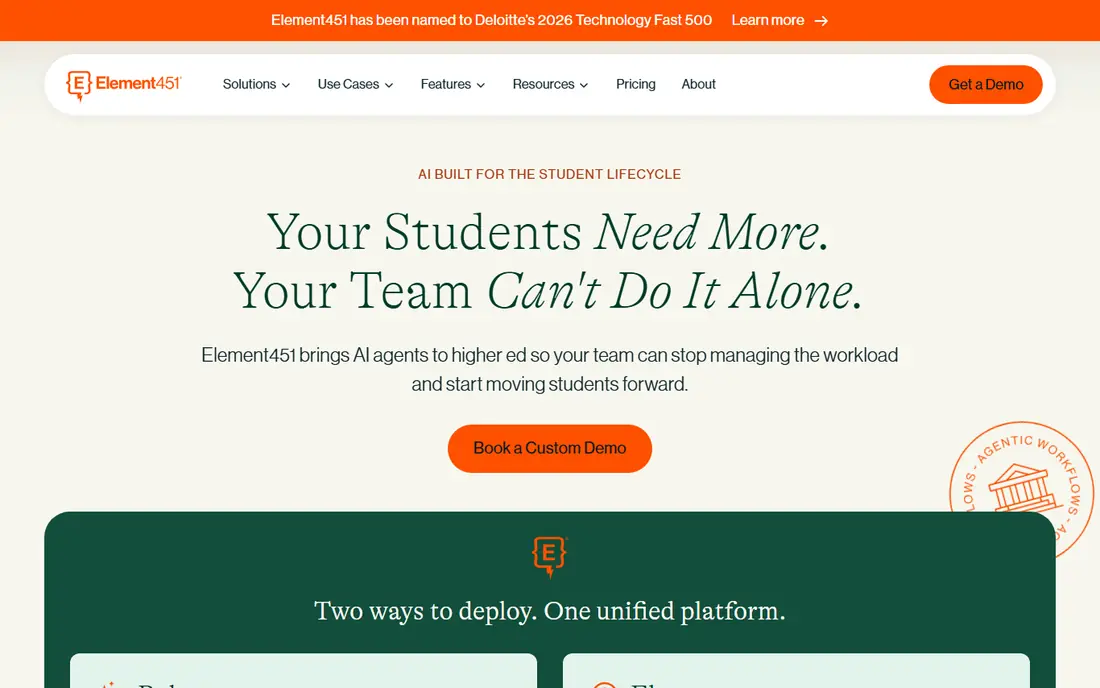
Element451 was built for Enrollment and marketing teams that want AI doing the outreach work. Element451 positions itself as the AI-driven CRM for higher ed, and its homepage leads with agents rather than records. As for the details, the vendor says more than 400 institutions use the product.
Upsides: read applications.
The main drawbacks: No public pricing, so budget planning means a sales conversation.
It raised a $175 million strategic investment from PSG in late 2024 to push further into AI. As for the details, ask for those answers in writing during the demo. Worth adding: the risk is opacity. Pricing is not published, and a CRM that reads applications with AI deserves hard questions about data handling and bias review. Element451 shows no starting price here, so confirm the cost on the vendor site. No free plan comes with Element451.
- Quick to launch, with most institutions up in days
- AI-first by design, with Bolt agents that answer inquiries 24/7
- The AI-heavy approach is the opposite of Slate's control-everything philosophy, which can worry compliance-minded teams
Encoura (Reach / Connect)
Great for: Advancement offices and enrollment teams inheriting the Anthology CRM portfolio
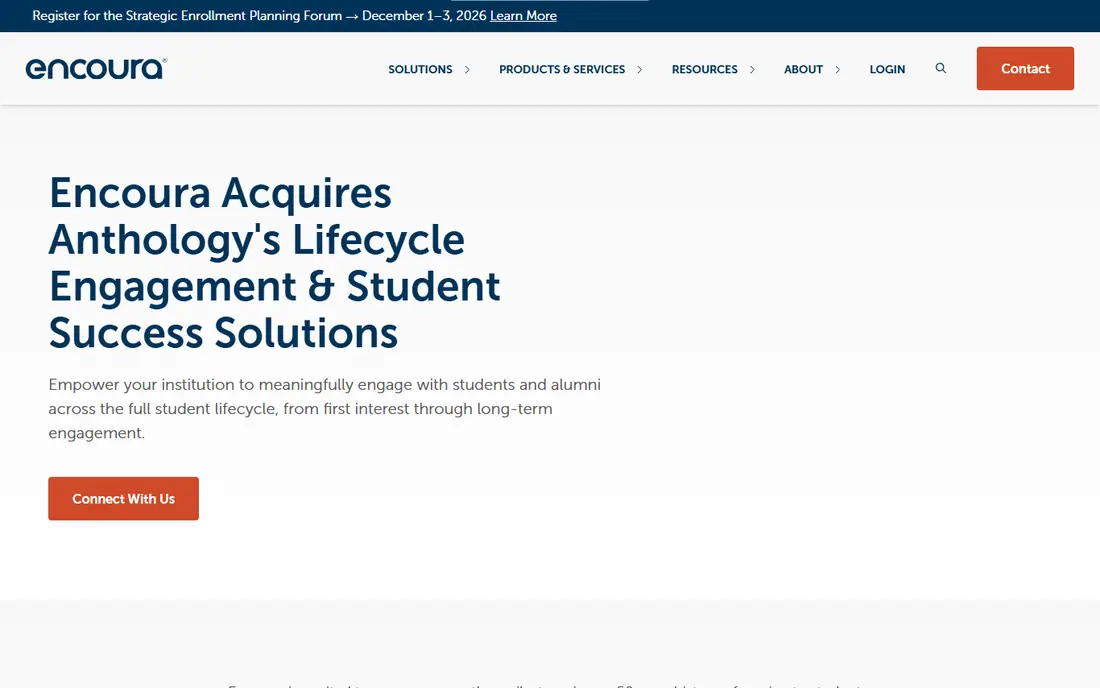
Encoura (Reach / Connect) targets advancement offices and enrollment teams inheriting the Anthology CRM portfolio. In 2026 Anthology completed a Chapter 11 restructuring, rebranded its core teaching-and-learning business as Blackboard, and sold its Lifecycle Engagement and Student Success firms (including the Reach, Engage, Encompass and Advance CRMs) to Encoura, effective February 2026.
Drawbacks to consider: Encoura is a services-and-data company first, so product depth varies by module.
Where it shines: Now owns the former Anthology Reach, Engage.
Encoura now supports those products and has also launched Encoura Connect, a CRM built in partnership with Element451 that merges enrollment data with AI agents. On top of that, treat the first year under new ownership as a watch period: ask for the product roadmap and support SLAs in the contract. This comparison lists no price for Encoura (Reach / Connect); ask the vendor. No free plan comes with Encoura (Reach / Connect).
- 50-year history serving higher ed
- Encompass and Advance products, so existing customers keep their investment
- A new owner for the Anthology portfolio means roadmap questions for the next year
Ellucian CRM
Great for: Banner and Colleague institutions that want CRM inside their Microsoft investment
In short, Ellucian CRM is for banner and Colleague institutions that want CRM inside their Microsoft investment. Note also that Ellucian was the stalking-horse bidder for Anthology's enterprise operations business in 2026, so expect more consolidation news in this corner of the market. The buying logic is ecosystem logic.
Best features of Ellucian CRM: retention and fundraising.
If your SIS is something else, much of the value disappears. You are choosing a Dynamics-based CRM when Salesforce-based choices have the bigger higher-ed partner network. In a 2025 expansion of its Microsoft collaboration, Ellucian moved the CRM suite onto Dynamics 365 and Power Platform, bringing Dynamics AI features into the product. Its CRM line splits the lifecycle three ways: Recruit for enrollment, Advise for retention and advising, and Advance for alumni and donor engagement. Pricing for Ellucian CRM is not stated here, so ask the vendor for current figures. Ellucian CRM has no free tier.
Downsides: Most useful for institutions already in the Ellucian ecosystem.
- Same vendor as the SIS, so data flows without middleware
- Customer Service and Power Platform with embedded AI
- Custom quotes only, with enterprise-scale pricing expectations
HubSpot
Great for: Small colleges and departments that require a working CRM without a quote process
HubSpot works best for small colleges and departments that require a working CRM without a quote process. HubSpot is the odd one out: a general CRM in a list of education specialists. On top of that, admissions workflows, application review and SIS integration are not native; you build them with custom objects and integrations.
Worth adding: the free CRM handles contact management, deal (or applicant) tracking, live chat, entry-level email and reporting, which is enough for a small college, a single graduate program or a department to run real recruitment campaigns this week. At scale the pricing jumps: Professional levels for Marketing Hub run into the high hundreds a month, and expanding contact lists inflate the bill. The limits are category limits. For everyday use, for a university running a 50,000-record funnel, the specialists above fit better. On cost, HubSpot starts like this: Free CRM. A free plan is available with HubSpot.
Points against: Not made for higher ed: no native Common App integration or admissions workflows, so enrollment teams configure around it.
What users get: Capable marketing automation and landing pages that admissions teams actually use.
- A genuinely handy free level with no credit card required
- Rare in this category
- Costs climb quick into Professional levels as contacts and users grow
Salesforce Education Cloud
Great for: Large universities already running Salesforce elsewhere on campus
Salesforce Education Cloud is aimed squarely at large universities already running Salesforce elsewhere on campus. Education Cloud includes the entire constituent relationship from first inquiry to alumni donation.
Trade-offs to know: Implementations are long and almost always need consultants.
The vendor's own commercial pricing guide lists the Unlimited Edition at $525 per user a month billed yearly, with Agentforce 1 editions for recruitment/admissions or student success at $750. Per-user licensing means a 40-person enrollment team pays over $250,000 per year before extras, and integrations with your SIS, email and event systems add consultant fees on top. Salesforce Education Cloud cost at the entry level: $525/user/month. Free options: Free trial.
- The largest partner ecosystem in higher ed
- Full student-lifecycle coverage (recruitment and admissions, student success, advancement, academic operations, student financials) on one system
- Small colleges will find it oversized for what they pay
Slate (Technolutions)
Great for: Admissions-led institutions that want one system for the entire funnel
Slate (Technolutions) targets admissions-led institutions that want one system for the entire funnel. Ask any US admissions office which CRM they envy and Slate is typically the answer.
Check the vendor site for Slate (Technolutions) pricing; none is listed in this comparison. No free plan comes with Slate (Technolutions).
Limits to weigh: Custom-quoted pricing with no public numbers.
Strengths: student success and advancement rather than three tools.
- Deep customizability in forms
- Workflows and communications
- The configurability that makes it solid also means a steep ramp-up time and a serious setup effort
How we chose
Pricing pages, product documentation and feature lists were the main sources, and every entry carries at least one honest drawback. Prices and plan limits come from vendor pages and can change, so confirm them on the vendor site before you buy. The ranking is editorial: typical fit first, then clear pricing, then free access. If your needs are unusual, read the profiles rather than relying on position.
Before you commit
- Confirm the entry price on the vendor page. For Jenzabar, Element451, Encoura (Reach / Connect) and others that means a quote rather than a fixed price.
- Look at the free plan from HubSpot closely: its caps decide whether it is usable for real work.
- Use real work to test the free trial from Salesforce Education Cloud, rather than a demo project.
- Before choosing Jenzabar, weigh its main limit: the CRM is most solid inside the Jenzabar ecosystem and less proven as a standalone against Slate or Element451.
- Ask Slate (Technolutions) whether prices are locked for the first term and what happens at renewal.
- Before rolling out Ellucian CRM, verify the integrations your workflow depends on.
Frequently asked questions
What happened to Anthology's CRM products?
Anthology restructured in 2026 and sold its Lifecycle Engagement and Student Success firms (Reach, Engage, Encompass, Advance) to Encoura. The Blackboard LMS continues under the Blackboard name.
What is the best CRM for higher education?
Jenzabar comes first here and is built for small to mid-sized private colleges already running Jenzabar One or SONIS. Buyers with other needs may prefer Element451 (for Enrollment and marketing teams that want AI doing the outreach work) or Encoura (Reach / Connect) (for advancement offices and enrollment teams inheriting the Anthology CRM portfolio). Compare costs and limits first.
Is Jenzabar the right pick for everyone comparing CRM software for higher education?
No single tool suits every team. Jenzabar comes first because it fits small to mid-size private colleges already running Jenzabar One or SONIS, while Element451 suits Enrollment and marketing teams that want AI doing the outreach work and Encoura (Reach / Connect) suits advancement offices and enrollment teams inheriting the Anthology CRM portfolio. Match the tool to your own size, budget and workflow before deciding.
How are the tools for CRM software for higher education ordered?
The order follows typical fit for CRM software for higher education, with Jenzabar first and Slate (Technolutions) last, then price clarity and free access. It is editorial judgement, not a score, so another team could rank the tools differently.
Can I try these tools before paying?
Often, yes. HubSpot has a free plan and Salesforce Education Cloud offers a free trial. Use your own data and a real task during the test, and check what the free tier or trial limits before you rely on it.
What is the cheapest option for CRM software for higher education in this list?
On published monthly entry prices, Salesforce Education Cloud is the lowest here at $525/user/month. Entry price is only part of the cost, because seats, add-ons and billing terms can change the total.
Sources
See where you really rank - block by block
ProMapRanker scans Google Maps across a grid of your service area. Simple monthly plans from $19, white-label on every plan.
Start freeKeep reading
 zscaler alternatives
Best Zscaler Alternatives in 2026
Looking for zscaler alternatives? We compare 9 SASE and zero trust platforms on architecture, data protection, pricing, and fit for your network and team.
Read → zapier alternatives free
Best Zapier Alternatives Free in 2026
Nine automation tools for zapier alternatives free in 2026, all with genuinely free tiers, plus free plan limits, starting prices and upgrade paths explained.
Read → which platform is best for online reputation
Which Platform Is Best for Online Reputation in 2026
Wondering which platform is best for online reputation? We compare 8 review, listing, and response tools for small and multi-location businesses and agencies.
Read →