 ProMapRanker
Best CRM for Manufacturing Companies in 2026


Large channel manufacturers · Pricing starts at: $275 per user per month
Key takeaways
- Manufacturing CRM choice turns on ERP links first, because order status, inventory and pricing live in the ERP, not in the CRM alone.
- Salesforce Manufacturing Cloud and Dynamics 365 Sales suit larger firms with channel sales and long account cycles, while HubSpot and Zoho suit smaller teams that need a faster start.
- NetSuite CRM makes the most sense when NetSuite is already the ERP, since it shares the same database rather than relying on a connector.
- Budget figures below are starting list prices only, so ask each vendor for the full cost including implementation, add-ons and user counts before signing.
Quick comparison
| Pick | Great for | Pricing starts at | Free tier | |
|---|---|---|---|---|
| Salesforce Manufacturing Cloud | Large channel manufacturers | $275 per user per month | Free trial | Visit |
 Microsoft Dynamics 365 Sales | Microsoft and Dynamics ERP users | $65 per user per month | Free trial | Visit |
 HubSpot | Growing marketing-led teams | $15 per user per month | Yes | Visit |
 Zoho CRM | Budget-conscious smaller teams | $14 per user per month | Yes | Visit |
 Oracle NetSuite CRM | Existing NetSuite ERP users | See website | No | Visit |
 Pipedrive | Small sales-first teams | $14 per user per month | Free trial | Visit |
 Odoo CRM | Firms wanting CRM plus production tools | See website | Yes | Visit |
 Creatio | Complex multi-channel processes | $25 per user per month | Free trial | Visit |
 Insightly | Deals that hand off to projects | $29 per user per month | Free trial | Visit |
The best CRM for manufacturing companies
Manufacturing sales rarely look like a simple online checkout. Deals run through distributors, repeat orders matter, and a promise made by sales has to match what the plant can actually build. We compared official feature pages, pricing pages and public reviews for the systems below, with a focus on ERP connections, forecasting, distributor handling and total setup effort.
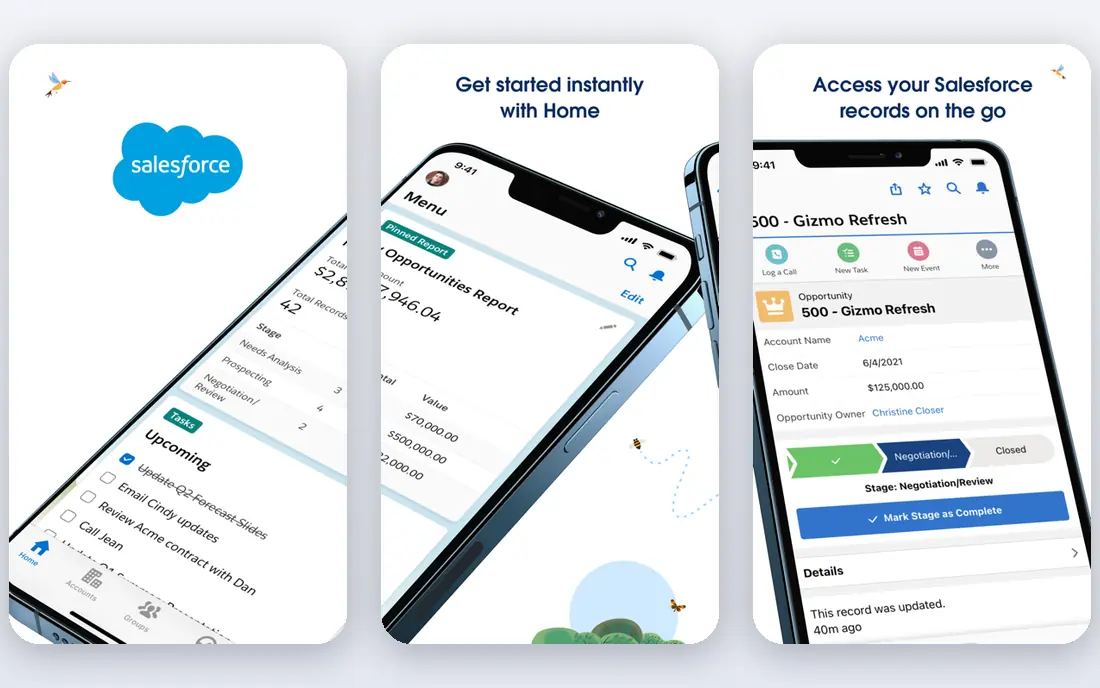
Salesforce Manufacturing Cloud is built for firms that sell through partners and need a clear view of planned versus actual revenue by account. Sales agreements let teams record committed volumes and prices, while account-based forecasting ties those commitments to what is really shipping. That structure helps when a few large accounts drive most of the revenue.
The trade-off is cost and complexity. A small job shop will find much of this depth unnecessary, and a firm without an in-house admin may need a partner for setup. Firms that already run Salesforce elsewhere, or that need partner portals and rebate tracking, get the most value from it.
- Sales agreements and account-based forecasting
- Partner and distributor tools
- Wide connector and app ecosystem
- High starting price
- Implementation often takes months
- Add-ons can raise the total fast
Dynamics 365 Sales is the natural shortlist entry for a manufacturer already running Business Central or Dynamics 365 Finance and Supply Chain Management. Shared data reduces double entry, and sales staff who live in Outlook and Teams face a shorter learning curve. Forecasting, quotes and account hierarchies cover the core needs of most mid-sized manufacturers.
It is less compelling as a standalone pick for a firm with no Microsoft ERP. In that case, the integration advantage fades and the buyer should compare it on price and usability alone. Check which Sales tier includes the forecasting and AI features you want, since not every tier includes them.
- Close fit with Microsoft 365 and Dynamics ERP
- Solid forecasting and pipeline tools
- Familiar interface for Office users
- Full value depends on the Microsoft stack
- Configuration can still need partner help
- Licensing tiers need careful reading
HubSpot suits a manufacturer that is trying to win new accounts with content, email and a clear website pipeline, rather than only managing existing distributors. The free tier lets a small team centralise contacts and deals before paying, and the paid Starter tier keeps the entry cost low. Marketing and service tools on the same record help a firm follow a lead from first enquiry to after-sales support.
The honest catch is depth on the manufacturing side. HubSpot does not ship a native manufacturing ERP, so order status and inventory still come from another system through an integration. Teams should test that link early, and price the Professional tier before building processes that depend on its features.
- Free CRM tier to start
- Marketing, sales and service in one place
- Large integration library
- ERP links usually need apps or middleware
- Higher tiers jump sharply in price
- Onboarding fees apply on some tiers
Zoho CRM gives a smaller manufacturer a capable system without the enterprise price tag. Automation, pipelines and custom fields cover quoting and follow-up well, and the link to Zoho Inventory and Books helps firms that already use those tools. For a team moving off spreadsheets, that combination is a practical step up.
Limits appear when the ERP is SAP, Oracle or a specialist manufacturing system. Those links are possible, but they need more work than a native connection, and support quality can vary by plan. Zoho is best judged on a trial with real deal data, not on the feature list alone.
- Low starting price
- Free tier for up to 3 users
- Native links to Zoho Inventory and Books
- ERP links outside Zoho need APIs or third-party tools
- Interface can feel busy
- Advanced setup takes time
NetSuite CRM is hard to beat when NetSuite is already the system of record. Sales staff see orders, fulfilment status and payment history without waiting for a sync, and finance sees the same customer record. That single-database design removes a whole class of integration problems that other CRM buyers have to solve.
As a standalone purchase it makes little sense. A firm that does not run NetSuite ERP would be buying a large suite for one part of it, and pricing is quoted rather than published. Existing NetSuite customers should ask what CRM functions are already included in their licence before paying for more.
- Same database as NetSuite ERP
- Order, inventory and customer history in one place
- Strong for firms already on NetSuite
- Quote-based pricing
- Weak as a standalone CRM choice
- Implementation and admin effort can be high
Pipedrive wins on speed. A small manufacturer with a direct sales team can set up pipelines, stages and reminders in days, and reps tend to keep it updated because the interface stays simple. That adoption matters more than a long feature list that nobody uses.
The limit is manufacturing depth. There is no built-in sales agreement or plant-aware forecasting of the kind Salesforce offers, and ERP links come through apps or an API. Pipedrive fits firms where the CRM job is mainly to manage deals and follow-ups, with production planning handled elsewhere.
- Clear visual pipeline
- Fast setup
- Easy for reps to adopt
- Weaker native manufacturing depth
- ERP links rely on marketplace apps
- Reporting is simpler than enterprise rivals
Odoo appeals to a manufacturer that wants one platform to grow into, rather than a CRM plus a separate set of tools. CRM sits beside inventory, manufacturing orders and accounting, so a quote can connect to stock and production without a third-party bridge. The modular approach lets a firm start small and add apps as needs grow.
That breadth brings a setup burden. Firms should plan who owns configuration, test the manufacturing module with real bills of material, and confirm pricing for the full app set they need. Odoo rewards a team willing to invest in setup, and it frustrates teams that expect a finished, single-purpose CRM out of the box.
- CRM, inventory, manufacturing and accounting in one platform
- One app free tier
- Modular pricing
- Modules vary in polish
- Setup and customisation need care
- Support depends on partner or plan
Creatio suits manufacturers whose sales process itself is the problem, with approvals, distributor rules and handoffs that differ by channel. Its no-code tools let process owners build those workflows without waiting for developers for every change. That flexibility is valuable when a firm sells direct, through distributors and through OEM partners at the same time.
Flexibility also creates risk. A team without clear process ownership can build workflows that are hard to maintain, and pricing needs a direct quote to confirm the full bundle. Creatio is a strong pick for firms that know their process and want to encode it, not for teams that just need a simple pipeline.
- No-code process design
- Strong workflow automation
- Flexible data model
- Higher learning curve for process design
- Yearly minimums reported on some plans
- Needs clear process ownership
Insightly fits manufacturers that sell custom or project-based work, where winning a deal is only the start. The project tools let teams track delivery tasks, milestones and related contacts from the same record that held the sale. That handoff reduces the dropped-ball moments that happen when sales and delivery use separate tools.
It is not a manufacturing ERP replacement, and firms with heavy distributor or forecasting needs may outgrow it. Insightly works best for smaller teams that value a clean deal-to-project flow and are willing to connect their ERP separately.
- Projects linked to deals
- Straightforward interface
- Useful for custom-order work
- Less manufacturing-specific depth
- Smaller app ecosystem than leaders
- ERP links need connectors
How we picked these
We compared official feature and pricing pages, integration documentation and public reviews, and we favoured systems with a real manufacturing use case rather than a generic sales pitch. ERP connection, distributor and channel support, forecasting, setup effort and published starting price all shaped the list. Where a vendor prices by quote, we wrote See website instead of guessing a figure.
What to check before you buy a manufacturing CRM
Start with the ERP question, then work outward. Ask which system holds order status, inventory and pricing, and how often that data reaches the CRM. A daily batch sync may be fine for monthly account reviews, but it will disappoint a sales rep who needs live availability during a customer call.
Next, map one real deal from enquiry to shipment, including distributor steps, approvals and repeat orders. The CRM that handles that path with the fewest workarounds is usually the right one, even when another system has a longer feature list. Finally, price the whole rollout, including implementation, training, integrations and the tier that holds the features you tested. A low starting price means little when the features you need sit two tiers higher.
Questions to ask in a demo
Ask the vendor to show a distributor order, a sales agreement variance and a forecast change in the same session. Ask who owns the ERP connector when it breaks, and what happens to historical data if you leave. Get implementation time in writing, with the assumptions behind it, before you compare headline prices.
Frequently asked questions
What is the best CRM for a small manufacturing company?
HubSpot and Zoho CRM are the most practical starting points for small teams, because both offer a free tier and a low paid starting price. Pipedrive also works when the main need is a clear sales pipeline. The right choice still depends on the ERP in use, so check that link before deciding on price alone.
Do manufacturing companies need a CRM if they already have an ERP?
An ERP tracks orders, inventory and finance well, but it rarely manages prospecting, distributor relationships and pipeline forecasting as clearly as a CRM. Many firms keep both, with the CRM handling relationships and the ERP handling execution. When the two share data cleanly, sales and operations stop working from different versions of the truth.
How much does a manufacturing CRM cost?
Starting list prices in this guide range from free tiers to $275 per user per month for Salesforce Manufacturing Cloud, with several systems priced by quote. Implementation, integrations and higher tiers can add a large amount to the total. Ask for a full quote at your user count before budgeting from a starting price.
Which CRM integrates best with SAP or Oracle ERP?
Salesforce and Dynamics 365 both offer connectors and partner-built links to SAP and Oracle, while NetSuite CRM suits firms already on NetSuite. No connector should be taken on trust. Ask for a reference customer on the same ERP version and test order status and pricing flows during a trial.
Is HubSpot good for manufacturers?
HubSpot is good for manufacturers that need marketing, lead handling and service in one place and that can connect their ERP through an app or middleware. It is weaker for firms that need deep sales agreement or plant-level forecasting built in. Test the ERP link early if order visibility matters to your sales team.
How long does a manufacturing CRM take to implement?
Small teams can go live on HubSpot, Zoho or Pipedrive in weeks, while enterprise systems such as Salesforce and Dynamics 365 often take months with partner help. The timeline depends on data quality, ERP work and how many processes change at the same time. A phased rollout, starting with pipeline and accounts, usually beats a big-bang launch.
Sources
See where you really rank - block by block
ProMapRanker scans Google Maps across a grid of your service area. Simple monthly plans from $19, white-label on every plan.
Start freeKeep reading
 worlds best local seo company
8 Worlds Best Local SEO Companies for Map Pack Growth in 2026
Compare the worlds best local seo company options for Google Business Profile work, citations, reviews, and multi-location rankings and reporting in 2026.
Read → world's best web hosting company
World's Best Web Hosting Company in 2026
Searching for the world's best web hosting company? We compared 10 hosts on price, renewal rates, speed, and support to help you choose well today in 2026.
Read → who's got the best nanny tax services
Who's Got the Best Nanny Tax Services in 2026
We answer who's got the best nanny tax services, comparing full filing, back taxes, software, and pricing so families can handle nanny taxes correctly.
Read →