 ProMapRanker
Best Courier Apps in 2026: 9 Apps Compared

Key takeaways
- The best courier software depends on volume: small teams need simple routing and proof of delivery, while larger fleets need dispatch control and integrations.
- Routific and Detrack are strong low cost starting points, while Onfleet suits high volume operations that can support its monthly pricing.
- Proof of delivery, live tracking links and driver apps matter more than a long feature list, because they cut failed deliveries and customer messages.
- Check how each vendor charges, per driver, per task or per order, because the same team can pay very different totals on different pricing models.
Quick comparison
| Pick | Great for | Pricing starts at | Free tier | |
|---|---|---|---|---|
 Onfleet | High volume delivery operations | $619 per month | Free trial | Visit |
 Routific | Route optimisation for small teams | $150 per month | Yes | Visit |
 Circuit | Simple team routing and tracking | See website | Free trial | Visit |
 Detrack | Budget dispatch and proof of delivery | $29 per driver per month | Free trial | Visit |
 OptimoRoute | Multi day route planning | See website | Free trial | Visit |
 Zeo Route Planner | Solo drivers and small teams | Free | Yes | Visit |
 Track-POD | Proof of delivery focused teams | See website | Free trial | Visit |
 Shipday | Restaurants and on demand delivery | Free | Yes | Visit |
 Spoke Dispatch | Courier companies with many clients | $125 per month | Free trial | Visit |
The best courier apps
We compared official pricing pages, dispatch features, driver apps and proof of delivery tools, and we focused on software that a courier or delivery business can actually run day to day in October 2026.

Onfleet is built for delivery operations that run hundreds or thousands of tasks each month. Dispatchers get a live map, task assignment tools and customer tracking links, while drivers get a focused app for deliveries, photos and signatures. That combination helps a growing courier firm keep control as order volume rises.
The price is the main barrier. The Launch plan starts at $619 per month for up to 2,500 tasks, which is a serious commitment for a small team. If your volume is lower, start with Routific or Detrack and move to Onfleet when dispatch complexity, not only order count, justifies the cost.
- Strong dispatcher dashboard
- Driver app with live tracking
- Automation and integrations for larger teams
- High starting price for small teams
- Advanced routing sits on higher plans
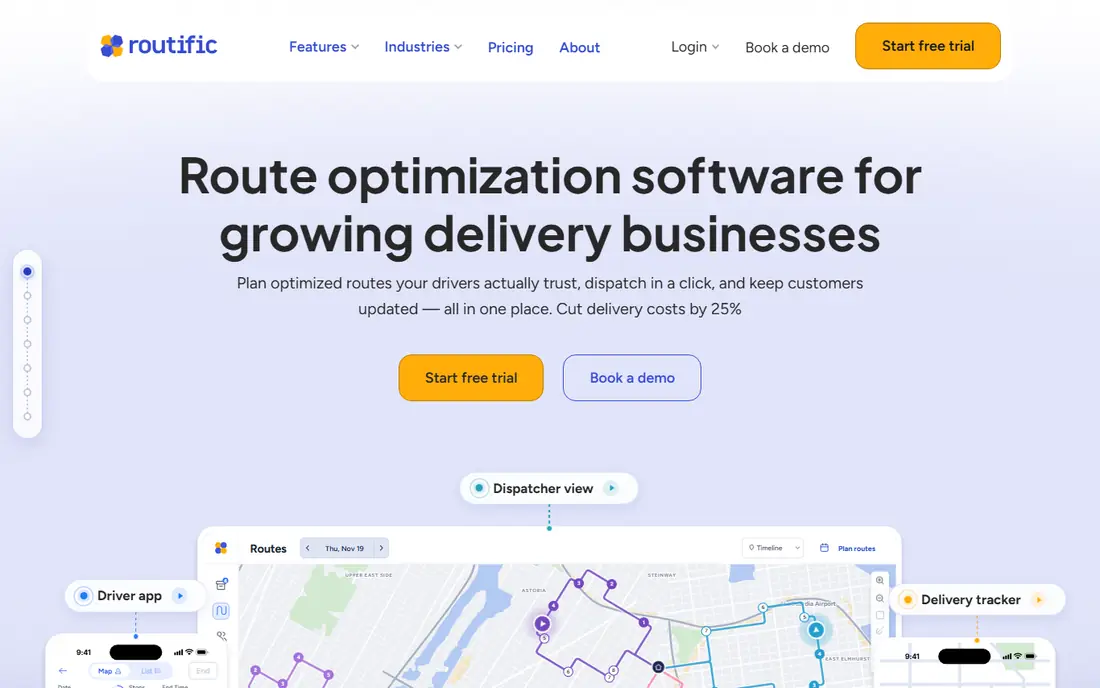
Routific is our pick for small delivery teams that want good routes without paying per driver. You upload stops, it builds balanced routes that respect time windows and capacity, and drivers follow the plan in the app with signature or photo proof. The free tier for up to 100 orders per month makes it easy to test on real routes before paying.
Pricing scales with orders, so a team doing up to 1,000 orders per month pays $150 per month on the published plan. That model suits teams with many part time drivers better than a per driver charge. The limit is that Routific is a route optimiser first, so courier firms that need deep client billing or warehouse workflows may need a second tool.
- Free tier up to 100 orders per month
- Charges by order, not by driver
- Driver app with proof of delivery
- Less suited to complex multi client courier billing
- SMS notifications are a separate cost
Circuit is a good middle ground for delivery teams that want routing, dispatch and tracking without a steep setup. Dispatchers can plan routes, assign drivers and watch progress, while customers get tracking updates that reduce where is my order calls. The interface is approachable for teams that do not have a dedicated logistics manager.
We list pricing as See website because Circuit offers team plans that vary with drivers and features, and the right plan depends on your setup. Ask for a quote based on your driver count and monthly stops, and compare the total with Routific and Detrack before you commit.
- Easy route planning for teams
- Driver app with live progress
- Customer tracking and delivery proof
- Pricing varies by plan and needs a quote for some teams
- Less deep on courier client billing
Detrack is the budget pick that still covers the essentials well. Dispatchers assign jobs, drivers update status in the app, and customers can follow deliveries. Proof of delivery with signatures, photos and timestamps gives you a record when a delivery is disputed, which is valuable for courier work even at low volume.
Routing is functional rather than advanced, so teams with tight time windows and complex capacity rules may pair Detrack with a route optimiser or move to Routific or OptimoRoute. For many small courier firms, though, Detrack's price and simplicity make it the sensible first system.
- Low per driver price
- Clear proof of delivery with photos and signatures
- Live tracking for customers
- Routing is simpler than specialist optimisers
- Larger fleets may want deeper automation
OptimoRoute suits fleets that plan routes across several days, balance workloads, and manage vehicle capacity, service times and driver schedules. It can handle constraints that break a simple planner, such as delivery windows, breaks and pickup and delivery pairs. Analytics then show where routes are wasting time.
Pricing is listed as See website because plans vary by billing term and features, and a trial is the best way to test it on your real stops. If your routes are simple and daily, a lighter tool will be faster to run. If your planning spans days and drivers, OptimoRoute earns its setup time.
- Strong multi day and multi constraint planning
- Driver app and live tracking
- Analytics for route performance
- Pricing depends on plan and billing term
- Setup takes more time than a simple planner
Zeo is the easiest place to start if you are a solo driver or a very small team. The free basic plan covers routes up to 15 stops, which is enough for many local rounds, and you can import addresses from a list rather than typing each one. Paid fleet plans add more stops, team features and tracking.
The free limit is also the reason to check your route size before you rely on it. A driver with 40 stops a day will need a paid plan, and at that point you should compare Zeo with Routific and Detrack on total monthly cost. For short rounds and new couriers, Zeo is hard to beat for simplicity.
- Free basic plan for small routes
- Easy stop import and route building
- Fleet plans for growing teams
- Basic plan limits stops per route
- Advanced dispatch features sit on paid plans
Track-POD is built around the delivery record: what was delivered, when, where, and with what signature or photo. That focus helps courier firms, suppliers and field teams that face regular delivery disputes or need records for clients. Route planning and live tracking sit alongside that record, so dispatchers still see the day as it unfolds.
Pricing varies with fleet size and plan, so we list it as See website and recommend a trial with your own delivery forms. Teams that mainly need simple routing will find lighter tools cheaper, while teams that live by proof of delivery will value Track-POD's detail.
- Detailed proof of delivery templates
- Live tracking and route planning
- Useful for fleets that need delivery records
- Pricing varies by fleet size
- Interface is more business focused than consumer simple
Shipday is a strong pick for restaurants, cafes and local shops that run their own delivery. The free tier covers up to 300 orders per month, which lets a small business test self delivery without a monthly bill. Dispatch is simple, drivers get clear jobs, and customers get tracking links that cut phone calls to the shop.
Larger courier firms with multiple depots, client billing and complex routing will likely need Onfleet, OptimoRoute or Spoke Dispatch instead. For a single location business that wants to move away from marketplace delivery fees, Shipday is a practical first step.
- Free tier up to 300 orders per month
- Easy dispatch for restaurants
- Driver app and customer tracking
- Less suited to complex multi depot courier fleets
- Advanced features sit on paid plans
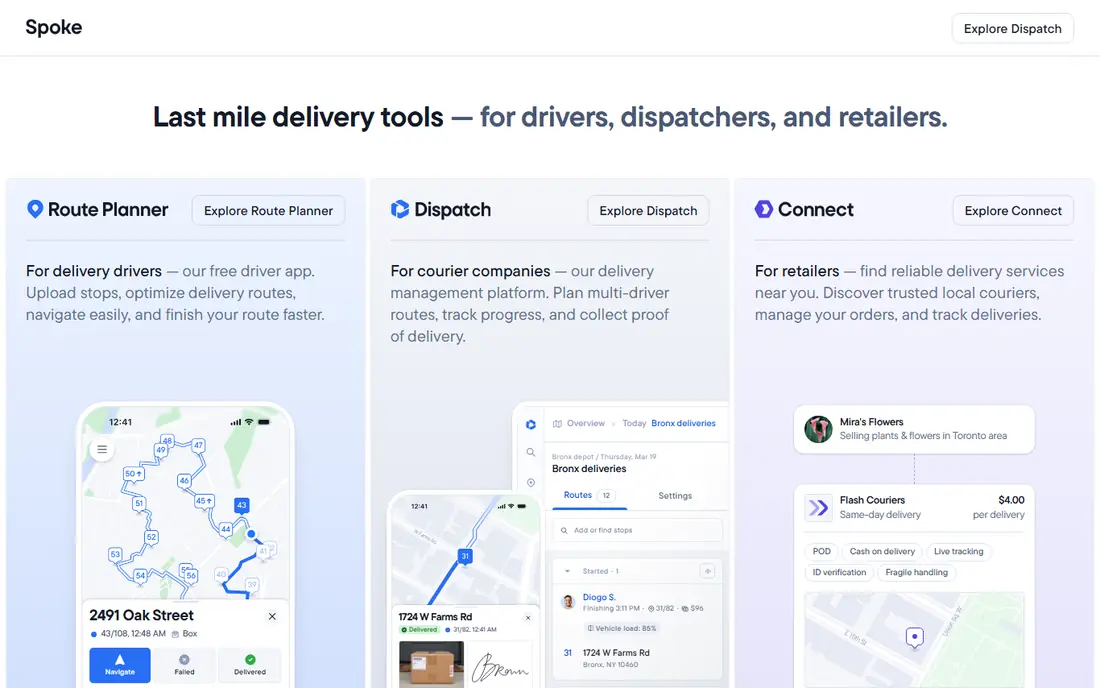
Spoke Dispatch is designed for courier companies rather than for a single shop delivering its own goods. It handles multiple shipper clients, driver assignment and delivery tracking in one system, and its published starting price of $125 per month with unlimited drivers suits firms with many part time drivers. That model is worth comparing carefully with per driver pricing.
The trade off is familiarity and setup. Smaller teams may find Routific or Detrack faster to learn, while courier firms that juggle clients, drivers and billing will appreciate Spoke's focus. Run a trial with a real client and a real driver roster before you switch a live operation to it.
- Built for courier firms with multiple shipper clients
- Unlimited drivers on published plans
- Per stop pricing model
- Less known than larger rivals
- Smaller teams may find simpler tools easier to learn
How we picked these
We compared official pricing pages, dispatch and routing features, driver apps, proof of delivery tools and customer tracking. We kept only software that is live in October 2026 and fits courier or last mile delivery work, and we left out general mapping apps that do not manage drivers or deliveries. We weighted pricing model, proof of delivery, ease of daily use, and how well each tool fits a stated team size.
How to choose courier software
Start by counting your real volume: stops per day, drivers, depots and clients. Then test the pricing model on those numbers, because per driver, per task and per order pricing produce very different bills for the same team. Run a trial on live routes, not demo data, and check proof of delivery, customer tracking and how dispatchers reassign a job when a driver is delayed.
Also check integrations with your ordering or shop system, and confirm how customer notifications are charged, since SMS costs can add up. Pick the simplest tool that handles your busiest day well, and keep a backup plan for days when a driver app or a route fails.
Frequently asked questions
What is the top courier software?
The top choice depends on team size and volume. Onfleet leads for high volume operations, Routific leads for small team route optimisation, and Detrack leads for low cost dispatch with proof of delivery.
What is the best courier software?
The best courier software is the one that matches your pricing model and daily workflow. Compare Routific, Detrack and Zeo for small teams, and Onfleet, OptimoRoute and Spoke Dispatch for larger or multi client operations.
What is the best courier app?
For a driver, the best courier app is one with clear jobs, offline friendly navigation links, and simple photo and signature capture. For a dispatcher, the best app is one with a live map, easy reassignment and customer tracking links.
How much does courier software cost?
Costs range from free for small route plans to $619 per month for Onfleet Launch and higher for larger fleets. Always compare the total for your driver count and monthly stops, not only the headline starting price.
Do I need proof of delivery?
For most courier work, yes. Photos, signatures, timestamps and location records settle disputes, prove completion to clients, and protect drivers when a recipient later says a parcel did not arrive.
Can small courier firms use free courier apps?
Yes, Zeo and Routific both offer free tiers, and Shipday offers a free tier up to 300 orders per month. Free tiers suit testing and low volume work, but check stop limits and paid features before you rely on them for a busy day.
Sources
See where you really rank - block by block
ProMapRanker scans Google Maps across a grid of your service area. Simple monthly plans from $19, white-label on every plan.
Start freeKeep reading
 zscaler alternatives
Best Zscaler Alternatives in 2026
Looking for zscaler alternatives? We compare 9 SASE and zero trust platforms on architecture, data protection, pricing, and fit for your network and team.
Read → zapier alternatives free
Best Zapier Alternatives Free in 2026
Nine automation tools for zapier alternatives free in 2026, all with genuinely free tiers, plus free plan limits, starting prices and upgrade paths explained.
Read → which platform is best for online reputation
Which Platform Is Best for Online Reputation in 2026
Wondering which platform is best for online reputation? We compare 8 review, listing, and response tools for small and multi-location businesses and agencies.
Read →