 ProMapRanker
Best Corporate Travel Booking Platforms in 2026


Mid-size teams wanting travel and expense together · Pricing starts at: See website
Key takeaways
- Navan and TravelPerk suit fast-moving mid-size teams, while SAP Concur and the large travel management companies suit complex global programs.
- The best platform for your company depends on how much policy control, expense integration, and human support your travelers actually need.
- Booking fees, card fees, and expense add-ons can change the total cost, so compare the full package rather than a single monthly figure.
- A short pilot with real travelers will reveal booking friction, support quality, and policy gaps far better than a sales demo alone.
Quick comparison
| Pick | Great for | Pricing starts at | Free tier | |
|---|---|---|---|---|
| Navan | Mid-size teams wanting travel and expense together | See website | Yes | Visit |
 TravelPerk | European and growing mid-market teams | See website | Yes | Visit |
 SAP Concur | Large enterprises on SAP systems | See website | No | Visit |
 Egencia | Mid-market teams on a managed service | See website | No | Visit |
 American Express Global Business Travel | Large global enterprise programs | See website | No | Visit |
 BCD Travel | Complex global travel programs | See website | No | Visit |
 CWT | Global enterprises with meetings needs | See website | No | Visit |
 FCM Travel | Multinational mid-size to large teams | See website | No | Visit |
 Spotnana | Tech-led teams wanting modern infrastructure | See website | No | Visit |
The best corporate travel booking platforms
Corporate travel booking is about more than finding a flight. The right platform enforces policy, tracks spend, supports travelers when plans change, and feeds clean data into expense and finance systems. The nine platforms below cover self-serve software, managed travel services, and modern infrastructure for different company sizes.
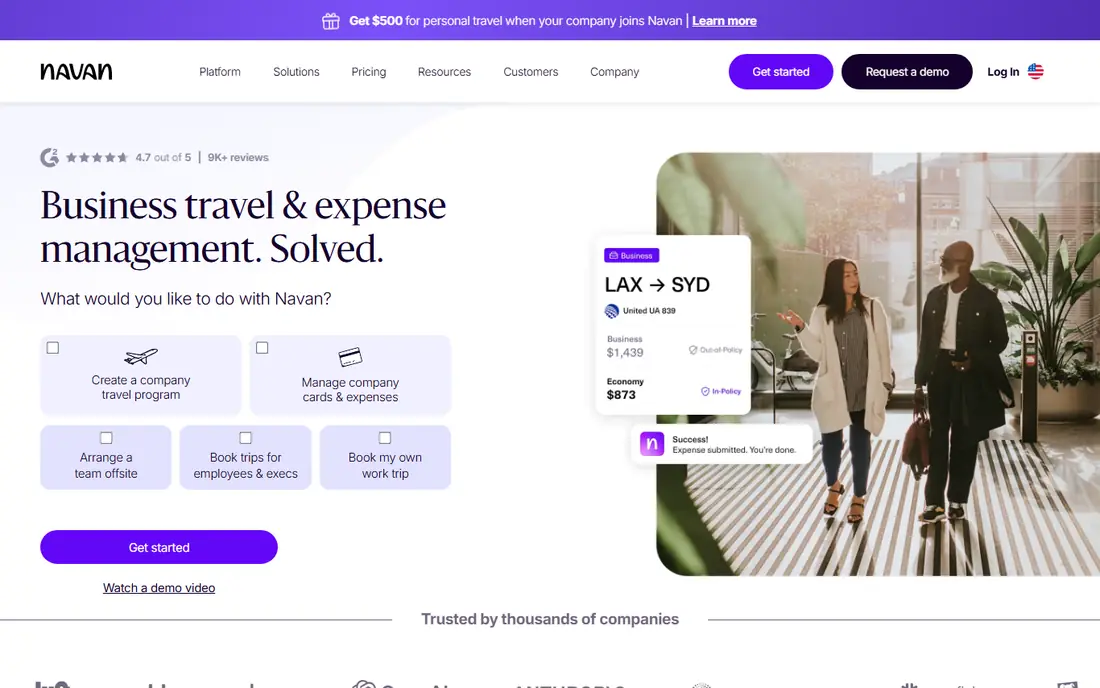
Navan, formerly TripActions, is built for teams that want business travel to feel closer to consumer booking. Employees can book flights, hotels, and cars in one app, while finance sets policy rules, approval flows, and spend limits in the background. Its expense and card products, where used, close the loop between booking and reimbursement, which cuts down on manual expense work.
The catch is that Navan is not one flat price for every company. Free and lower tiers cover core booking for smaller teams, while larger programs pay for added controls, support, and integrations. Run a pilot with your most frequent travelers, and check how policy exceptions, group bookings, and offline support work before you roll it out company-wide.
- Travel, expense, and card in one platform
- Traveler-friendly booking
- Policy controls and reporting
- Advanced enterprise features sit on higher tiers
- Pricing varies by plan and company size
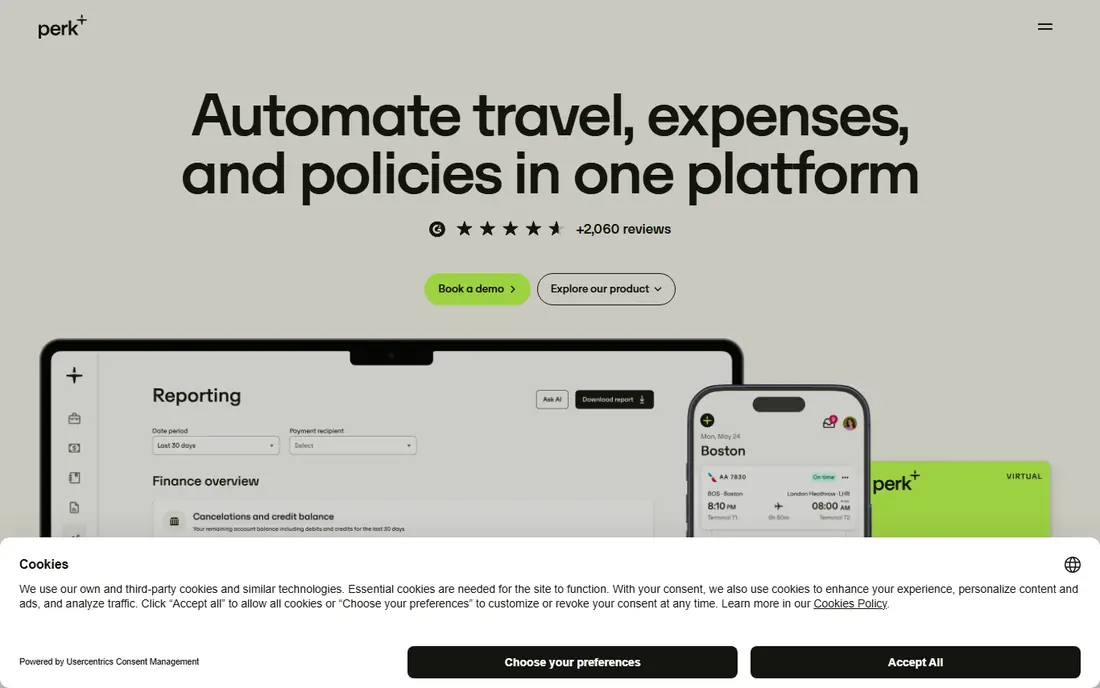
TravelPerk suits mid-market companies, especially those with strong European travel. Its booking tools cover flights, hotels, cars, and rail in many markets, and its flexible cancellation product can refund a large share of a cancelled trip, which helps when plans change often. Policy settings, approvals, and spend reporting give finance a clear view without forcing travelers through a clunky tool.
Pricing depends on plan and booking volume, and the free starter tier has limits that larger teams will outgrow. Check the booking fee structure, the terms of flexible cancellation, and the level of human support on your plan. For teams with heavy US domestic travel, compare its inventory and support hours against a US-focused rival.
- Flexible cancellation options
- Broad flight and hotel inventory
- Clear policy and approval tools
- Some advanced features need paid tiers
- US coverage is growing but less deep than in Europe
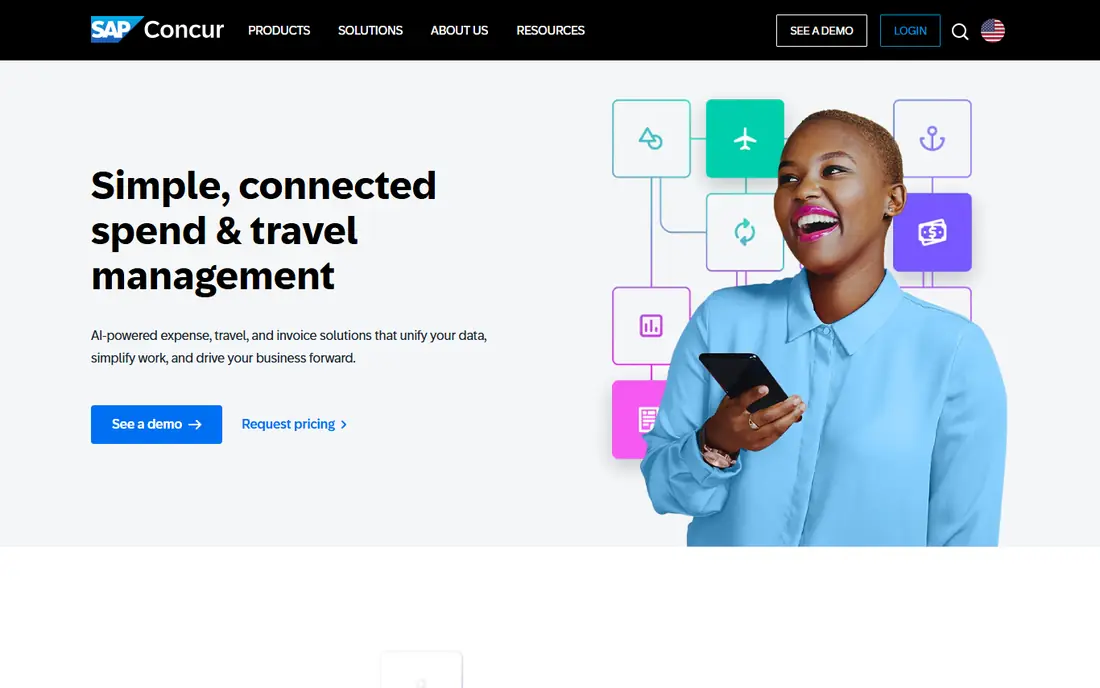
SAP Concur remains the default for many large enterprises, largely because its expense product is already embedded in finance teams. Concur Travel pairs with Concur Expense, giving one flow from booking to receipt to reimbursement, plus policy controls, audit trails, and reporting that large companies need. Its partner travel management companies handle offline servicing where needed.
The trade-off is implementation time and user experience. Rolling out Concur across a large company can take weeks or longer, and travelers sometimes find the booking flow slower than newer tools. If your company already runs SAP, that integration value may outweigh the friction, but test the mobile booking flow with real travelers first.
- Deep SAP and ERP integration
- Strong expense pairing
- Mature policy and compliance controls
- Setup can take weeks
- Booking experience feels less modern than newer rivals
Egencia combines an online booking tool with managed travel services, which suits mid-market companies that want self-serve booking plus human help when trips go wrong. Its inventory draws on Expedia Group supply, and its tools cover policy, approvals, and traveler tracking. Companies that outgrow a pure software tool but do not need a full enterprise travel program often land here.
Since its acquisition by American Express Global Business Travel, Egencia is best judged as part of that larger service rather than a standalone startup. Ask how servicing, pricing, and product updates will work for your account, and compare renewal terms carefully, since some customers report price increases at renewal.
- Online booking plus managed travel support
- Expedia inventory
- Traveler tracking tools
- Now part of American Express Global Business Travel, so its standalone roadmap has changed
- Pricing is custom
American Express Global Business Travel
Great for: Large global enterprise programs
American Express Global Business Travel, often called Amex GBT, is a full-service travel management company for large and global programs. It offers booking tools, traveler support, negotiated rates, duty-of-care tracking, and meetings and events services across a large number of countries. For a multinational with complex travel, visa, and risk needs, that scale is hard to match with software alone.
Smaller companies will find it heavy and expensive. Pricing is custom, usually built from transaction and management fees, and onboarding involves policy design, data setup, and support planning. It is worth the effort only when your travel spend, traveler count, or global complexity justifies a managed program.
- Very large global network
- Strong duty-of-care and crisis support
- Meetings and events services
- Enterprise pricing and minimums can exclude smaller teams
- Implementation is a project, not a quick signup
BCD Travel is another large travel management company, with a focus on global program management for enterprises with complex itineraries. It helps companies set policy, negotiate rates, manage traveler risk, and report on spend and emissions. Its consultants and account teams suit programs where travel touches many countries, suppliers, and internal stakeholders.
Like other managed services, BCD is not a quick self-serve signup. Pricing is custom, and the booking experience depends on the online tool paired with the service. If your team values a modern app above all else, compare BCD's tooling side by side with Navan or TravelPerk before committing to a managed contract.
- Broad global coverage
- Strong program management
- Data and sustainability reporting
- Managed-service pricing is custom
- Self-serve booking feel varies by tool and region
CWT, formerly Carlson Wagonlit Travel, serves large global companies with travel management, meetings and events, and traveler support. Its scale helps with negotiated rates and consistent service across regions, and its risk tools help travel managers locate and assist travelers during disruptions. Companies with heavy meetings travel often value its events capability alongside regular business trips.
For a small or mid-size team, CWT is likely more service than needed, and pricing will reflect that. It fits best when travel spend is large, when meetings are a major cost line, or when duty-of-care requirements demand a managed partner rather than software alone.
- Global reach
- Meetings and events strength
- Traveler support and risk tools
- Enterprise focus and custom pricing
- Smaller teams may find it too heavy
FCM Travel is a global travel management company with particular strength in Asia-Pacific, alongside coverage in the Americas and Europe. It offers a mix of online booking and serviced support, and it can tailor its model to mid-size companies as well as large enterprises. That flexibility makes it a useful option for companies expanding across regions with uneven travel patterns.
As with other managed providers, you will need a sales conversation to get pricing, and the booking tool may differ by country. Ask for references from companies of similar size and travel mix, and check support hours for the regions where your travelers actually fly.
- Strong in Asia-Pacific as well as other regions
- Flexible service models
- Good account management
- Pricing is custom
- Booking tool experience varies by market
Spotnana takes a different approach, providing cloud-based travel infrastructure that other travel companies and large enterprises can build on. Its booking, content, and integration tools aim to fix the legacy systems behind many older booking tools, with open APIs and a modern traveler experience. For technology-led companies, or travel programs that want deep customization, that architecture is a real draw.
It is not the simplest pick for a company that just wants to sign up and book. Evaluate Spotnana alongside your travel management partner, check which servicing and support model applies, and confirm how policy, expense, and duty-of-care features are delivered in your setup.
- Cloud-based travel infrastructure
- Open integrations
- Modern booking experience
- More of a platform layer than a traditional managed service
- Best fit needs technical evaluation
How we picked these
We compared official product pages, pricing models, coverage, and public comparisons of corporate travel tools in October 2026. We included self-serve platforms, managed travel companies, and modern infrastructure, because a startup and a multinational need different kinds of help. Many enterprise prices are custom, so we list those as See website and focus the comparison on fit, policy control, expense integration, and support.
What to check before you choose
Start with your travel pattern: how many travelers, which regions, how much spend, and how often plans change. A team with mostly domestic trips and simple approvals needs a different tool than a global program with meetings, visas, and duty-of-care duties. Map policy rules early, including cabin class, hotel caps, advance booking windows, and approval chains, and test them in a pilot.
Next, check the total cost and the data flow. Add booking fees, card fees, expense add-ons, and support tiers together, and confirm how bookings feed expense, accounting, and HR systems. Test support during a disruption, not just during a demo, and ask about contract length, renewal pricing, and exit terms for your travel data. The platform that wins the pilot with real travelers is usually the right one.
Frequently asked questions
What is the best corporate travel booking tool for a small team?
Navan and TravelPerk are strong starting points for small and mid-size teams, because both offer free or low-cost entry tiers and traveler-friendly booking. Pick Navan if you also want expense and card in one place, and TravelPerk if your travel is heavily European.
What are the best corporate travel booking tools for large enterprises?
SAP Concur, American Express Global Business Travel, BCD Travel, and CWT suit large enterprises with complex policy, global coverage, and duty-of-care needs. The right choice depends on your ERP system, travel regions, and how much managed support you want.
How much do corporate travel booking platforms cost?
Costs range from free entry tiers for small teams to custom enterprise contracts built from transaction and management fees. Always compare booking fees, expense add-ons, and support tiers together, since a low monthly figure can hide per-booking charges.
Do these platforms handle expense reports too?
Navan and SAP Concur pair booking with expense directly, while other platforms integrate with expense tools such as Concur, Expensify, or your finance system. Confirm the integration for your exact expense tool before you buy, since a weak link here creates manual work.
What happens when a business trip is disrupted?
Most platforms offer in-app rebooking and support, while managed companies add phone support and traveler tracking. Check support hours, response times, and duty-of-care features for your main travel regions, and test them during a pilot if you can.
Sources
See where you really rank - block by block
ProMapRanker scans Google Maps across a grid of your service area. Simple monthly plans from $19, white-label on every plan.
Start freeKeep reading
 zscaler alternatives
Best Zscaler Alternatives in 2026
Looking for zscaler alternatives? We compare 9 SASE and zero trust platforms on architecture, data protection, pricing, and fit for your network and team.
Read → zapier alternatives free
Best Zapier Alternatives Free in 2026
Nine automation tools for zapier alternatives free in 2026, all with genuinely free tiers, plus free plan limits, starting prices and upgrade paths explained.
Read → which platform is best for online reputation
Which Platform Is Best for Online Reputation in 2026
Wondering which platform is best for online reputation? We compare 8 review, listing, and response tools for small and multi-location businesses and agencies.
Read →