 ProMapRanker
Best Cookie Consent Management Tools in 2026


Automatic scanning and Consent Mode · Pricing starts at: See website
Key takeaways
- Cookiebot and CookieYes suit small and mid-size sites that want fast setup, automatic scanning, and a free tier to start with.
- OneTrust and TrustArc suit large organisations that need consent alongside wider privacy governance, at enterprise prices.
- Usercentrics, iubenda, and Didomi sit in the middle, with stronger control over regions, languages, and advertising frameworks.
- Software alone does not make an organisation compliant, since consent also depends on how tags are blocked, how records are kept, and how staff handle requests.
- Check Google Consent Mode support, IAB TCF support, and geo-targeting before you buy, since those three features decide whether a banner works for your traffic.
Quick comparison
| Pick | Great for | Pricing starts at | Free tier | |
|---|---|---|---|---|
| Cookiebot | Automatic scanning and Consent Mode | See website | Yes | Visit |
 CookieYes | Small sites and fast setup | See website | Yes | Visit |
 OneTrust | Enterprise privacy governance | See website | No | Visit |
 Usercentrics | Flexible consent for growing sites | See website | Yes | Visit |
 iubenda | Consent plus legal documents | See website | Free trial | Visit |
 Osano | US multi-state privacy coverage | See website | Free trial | Visit |
 Didomi | Publishers and multi-regulation sites | See website | Free trial | Visit |
 Ketch | Consent across apps and systems | See website | Yes | Visit |
 Termly | Simple consent and policies | See website | Yes | Visit |
The best cookie consent management tools
The best cookie consent management tools below cover small sites, publishers, and enterprises, so you can match the tool to your traffic, regions, and advertising setup. Remember that a consent tool is only part of compliance, and your legal team should review how it is configured for your site.
Cookiebot, now part of Usercentrics, scans a site on a schedule, finds tracking technologies, and builds a cookie declaration that visitors can read. That automation saves the manual work of listing every cookie and tag, which is where many small teams fall behind. It also supports Google Consent Mode, which matters for sites that run Google Ads or Analytics.
The pricing model is the catch, since it depends on domain and page count, so a portfolio of small sites can cost more than expected. For a single site, especially one with ads or analytics, Cookiebot remains one of the simplest ways to get a working, well-documented banner live quickly.
- Automatic cookie scanning
- Google-certified CMP
- Detailed cookie declaration for visitors
- Priced per domain and page count
- Larger site portfolios can become costly
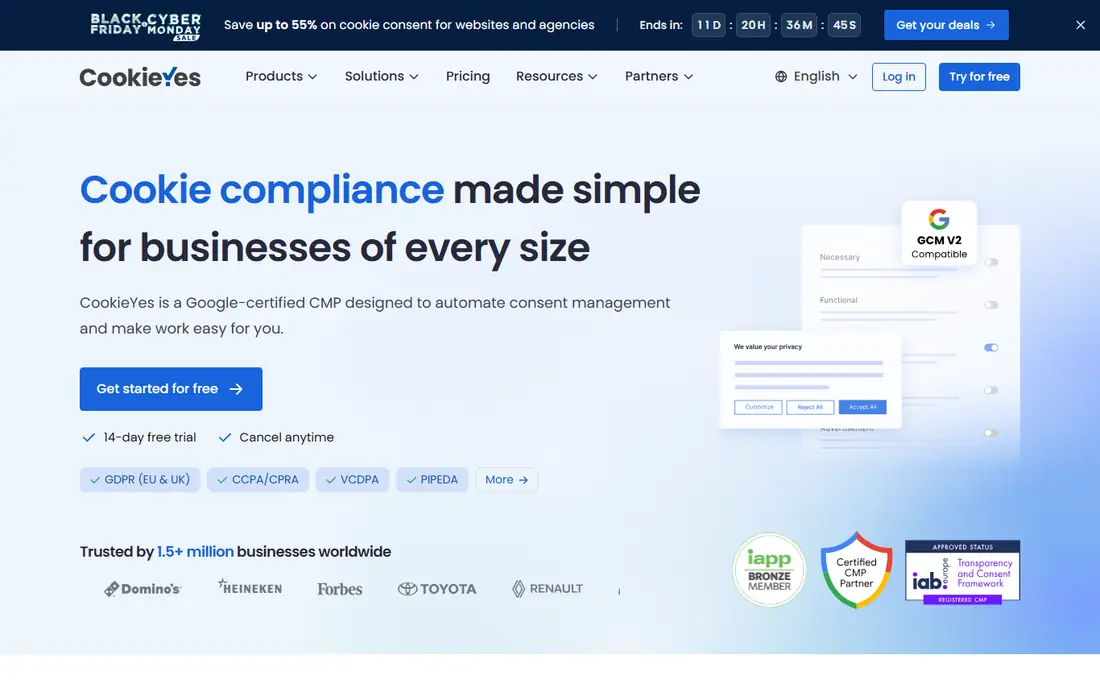
CookieYes is a popular choice for small sites because setup is fast and the free tier covers modest traffic. It offers cookie scanning, banner customisation, and integrations with WordPress, Shopify, and other common platforms. For a small business owner who wants a banner live this week, CookieYes removes most of the friction.
Higher-end advertising features, including full IAB TCF support, sit on paid plans, so a publisher with complex ad setups should check the plan details before choosing. For a straightforward business site, blog, or small store, CookieYes gives a good balance of price, ease, and control.
- Fast setup for WordPress and other platforms
- Free tier for small sites
- Clear banner customisation
- Advanced IAB TCF features sit on higher plans
- Support is lighter than enterprise tools
OneTrust suits large organisations that need consent management as part of a wider privacy program, including data mapping, request handling, and vendor risk. Its consent tools cover many regulations and regions, with reporting and audit trails that suit a compliance team. For a global firm, that breadth can replace several separate tools.
The cost and complexity put it out of reach for most small sites, and setup needs time and staff. A small team that only needs a cookie banner will find Cookiebot or CookieYes simpler and far cheaper. OneTrust earns its price when consent is one part of a larger privacy operation, not when it is the only need.
- Broad privacy suite beyond consent
- Strong reporting and audit trails
- Global regulation coverage
- Enterprise pricing
- Complex setup
- Needs dedicated staff to run well
Usercentrics offers flexible consent banners with geo-targeting, so visitors in different regions see the rules that apply to them. That matters for a site with traffic from both Europe and US states with privacy laws. A/B testing on some plans also helps teams improve consent rates without guessing.
Session-based pricing can be hard to forecast for a site with seasonal traffic, and the most useful features sit on paid tiers. For a growing site that serves several regions and wants more control than a basic banner, Usercentrics is a strong middle option between a small-site tool and an enterprise suite.
- Geo-targeted banners
- A/B testing on some plans
- Wide language and integration support
- Pricing depends on sessions
- Advanced features need higher plans
iubenda pairs a consent banner with generators for privacy policies, cookie policies, and terms, which suits a small team that needs several legal documents at once. Its consent tool supports auto-blocking for common services, so tags should not run before consent, and it offers SDKs for mobile apps as well as websites.
The documents it generates are templates, not legal advice, so a business with unusual data practices should still get a lawyer to review them. Pricing also rises as you add features and sites. iubenda fits a small firm that wants consent and basic legal documents from one provider, with the understanding that templates do not replace legal review.
- Pairs consent with privacy and cookie policies
- Auto-blocking for common services
- Mobile SDKs
- Pricing rises with features
- Policy wording still needs legal review for your business
Osano focuses on privacy compliance across US states as well as Europe, which suits a US business with customers in California, Colorado, Connecticut, and other states with privacy laws. It combines consent management with vendor risk and data mapping views, so a team can see which third parties receive data. The interface is clear for a privacy or marketing team.
The starting price is higher than CookieYes or Cookiebot for a small site, and the fullest features need higher plans. Osano suits a growing US business that needs to handle several state laws at once, rather than a single small blog that only needs a basic banner.
- Strong US state law coverage
- Clear vendor and data mapping features
- Clean interface
- Higher starting price than small-site tools
- Enterprise features need higher plans
Didomi serves publishers and larger sites that must handle several regulations, languages, and advertising frameworks at once. Its IAB TCF support matters for ad-funded sites, and its consent tools extend across web, mobile, and connected TV in some setups. Geo-targeting and analytics help a publisher see consent rates by region and placement.
Pricing is sales-led, which means a small site cannot simply compare a public price list, and setup needs more planning than a plug-in banner. For a publisher or a multi-country site, that extra planning is worth it. For a small business site, a simpler tool will be faster and cheaper.
- Strong IAB TCF support
- Cross-device and app consent
- Geo-targeting for publishers
- Sales-led pricing
- Setup needs more planning than small-site tools
Ketch treats consent as data that should travel with a user across websites, apps, and downstream systems, not as a banner that lives on one page. Its API-led design suits a team that wants consent choices to reach analytics, advertising, and customer data tools in a consistent way. A free tier helps smaller teams start without an enterprise contract.
The full value needs engineering time, since connecting consent to downstream systems is a project, not a plug-in. Teams without developer help may prefer a simpler banner tool. Ketch fits a product or data team that already manages several systems and wants consent to stay consistent across them.
- Consent signals shared across systems
- API-led design
- Free tier for smaller use
- Needs engineering time to get full value
- Enterprise features are sales-priced
Termly suits a small site that wants a consent banner plus basic policy generators without learning a complex platform. Setup is straightforward, the free tier covers a single domain for basic use, and paid plans add more domains and features. For a startup, freelancer site, or small store, Termly keeps the compliance workload manageable.
It lacks the depth of Didomi or OneTrust for complex advertising, multi-region publishing, or enterprise reporting. A site with heavy ad tech or many regions should look higher up this list. For a simple site that needs a working banner and clear policies, Termly is a practical, low-friction choice.
- Simple setup
- Pairs consent with policy generators
- Free tier for one domain
- Less depth for complex ad setups
- Higher plans needed for more domains and features
How we picked these
We compared official pricing pages, feature lists, and public documentation for consent tools that are still active in October 2026, with attention to Google Consent Mode, IAB TCF support, geo-targeting, and free tiers. We included small-site tools, publisher tools, and enterprise suites, and we favoured tools with clear scanning, blocking, and record-keeping features. Where pricing varied by domain, sessions, or contract, we wrote See website rather than a figure that could mislead.
How to choose a cookie consent tool
Start with where your visitors live and how you earn money. A site with European traffic and Google Ads needs Consent Mode and strong blocking, while a US-only site needs state law coverage and Global Privacy Control support. A publisher with ad tech needs IAB TCF support, while a small business site may only need a clear banner, scanning, and a cookie policy.
Then test the banner as a visitor would. Check that non-essential tags do not run before consent, that withdrawing consent works, that the banner is readable on mobile, and that consent records are kept. A tool that looks good in a demo but lets tags run early does not help you. Finally, get a legal review of your configuration, since software alone does not make an organisation compliant, and the same tool can be compliant or not depending on how it is set up.
Frequently asked questions
What are the best tools for cookie consent management for small websites?
CookieYes, Cookiebot, and Termly suit most small websites, since they offer free tiers, fast setup, and automatic scanning. Cookiebot suits a site with ads or analytics that needs Consent Mode, while CookieYes suits a simple business site. The best tools for cookie consent management for a small site are the ones you can configure correctly and keep updated, not the ones with the longest feature list.
What are the best cookie consent management platforms for enterprises?
OneTrust and TrustArc-style enterprise suites suit large firms that need consent alongside data mapping, request handling, and vendor risk. Didomi suits publishers with complex ad setups, while Ketch suits firms that need consent signals across many systems. Enterprise tools cost more and need staff, so they fit only when consent is part of a larger privacy program.
Do I need a cookie consent tool for a US-only website?
US federal law does not require a cookie banner in the same way as European law, but several state privacy laws require honoring opt-out signals and giving users control over personal data sales and sharing. If you run ads or analytics, a light consent tool is still useful insurance as state laws expand. Check the states where your visitors live, not only where your business is based.
What is Google Consent Mode and why does it matter?
Google Consent Mode lets a site send consent signals to Google services, so Analytics and Ads can adjust how they use data based on what a visitor allowed. A Google-certified consent tool handles those signals for you, which helps measurement and ad performance while respecting choices. Without it, a site may lose measurement data or run tags in a way that does not match visitor consent.
Does a consent tool make my site GDPR compliant?
No, a consent tool alone does not make a site compliant. Compliance also depends on blocking tags before consent, keeping consent records, honoring withdrawals, writing clear policies, and handling data requests properly. A tool helps with the technical parts, but your legal team should review the full setup, including which vendors receive data and why.
How much do cookie consent tools cost?
Costs range from free tiers for small sites to enterprise contracts that run into thousands per year. Small-site tools often charge per domain, page count, or sessions, while enterprise tools charge by contract. Compare the total cost for your domains and traffic, and check what happens to pricing if your traffic grows.
Sources
See where you really rank - block by block
ProMapRanker scans Google Maps across a grid of your service area. Simple monthly plans from $19, white-label on every plan.
Start freeKeep reading
 zscaler alternatives
Best Zscaler Alternatives in 2026
Looking for zscaler alternatives? We compare 9 SASE and zero trust platforms on architecture, data protection, pricing, and fit for your network and team.
Read → zapier alternatives free
Best Zapier Alternatives Free in 2026
Nine automation tools for zapier alternatives free in 2026, all with genuinely free tiers, plus free plan limits, starting prices and upgrade paths explained.
Read → which platform is best for online reputation
Which Platform Is Best for Online Reputation in 2026
Wondering which platform is best for online reputation? We compare 8 review, listing, and response tools for small and multi-location businesses and agencies.
Read →