 ProMapRanker
Best Contractor Payment Software in 2026


Transparent global contractor pay · Pricing starts at: $49 per contractor per month
Key takeaways
- Deel and Remote suit global contractor teams that need contracts, compliance checks and payouts in many countries.
- Gusto and Rippling suit US-first teams that want contractor pay close to employee payroll and HR tools.
- Wise Business and Payoneer suit simpler payout needs, where contracts and tax forms are handled elsewhere.
- Pricing is often per contractor per month, so count active contractors carefully before you compare totals.
Quick comparison
| Pick | Great for | Pricing starts at | Free tier | |
|---|---|---|---|---|
| Deel | Transparent global contractor pay | $49 per contractor per month | Free trial | Visit |
 Remote | Compliant global contractor management | $29 per contractor per month | Free trial | Visit |
 Gusto | US small businesses with contractors | See website | Free trial | Visit |
 Rippling | Contractor pay linked to HR and IT | See website | No | Visit |
 Payoneer | Global payouts and workforce payments | See website | No | Visit |
 Papaya Global | Enterprises unifying payroll and contractors | See website | No | Visit |
 RemoFirst | Lower-cost global contractor pay | $25 per contractor per month | Free trial | Visit |
 Playroll | Affordable global contractor and EOR work | $35 per contractor per month | Free trial | Visit |
 Wise Business | Simple, low-markup international payouts | See website | No | Visit |
The best contractor payment software
We focus on platforms that pay independent contractors, handle contracts and tax documents, or both. If you run a construction firm that needs progress billing and retainage, note that these platforms cover workforce payments, not construction pay applications, and you may need a construction billing tool alongside them.
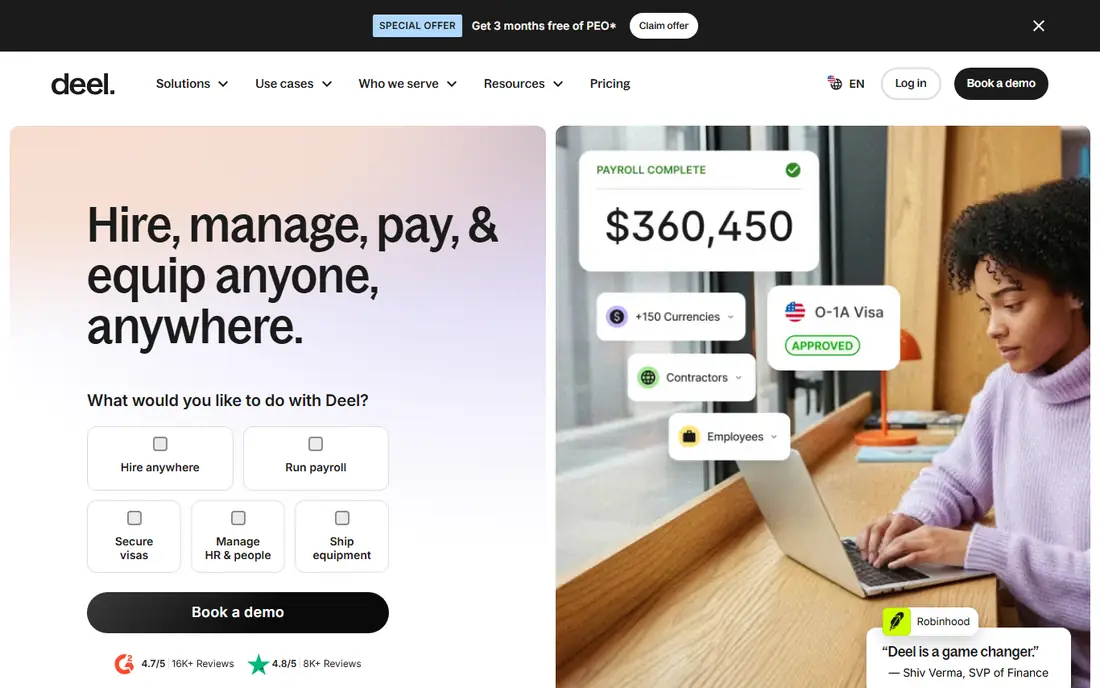
Deel is the clearest pricing story on this list, with $49 per contractor per month published for its contractor product. Onboarding is fast, with localised contracts, compliance checks and integrated payments, which helps a company that hires contractors in many countries and wants one process. For finance teams, the per-worker maths makes budgeting simple, because costs scale directly with active contractors.
The catch is conversion. Moving a contractor to full employment through Deel costs far more per month, so plan that path before you start, especially if several contractors may become employees. Support quality also varies by country, which is common for global platforms. For pure contractor management at scale, Deel's clarity is hard to beat.
- Published per-contractor pricing
- Localised contracts in many countries
- Fast onboarding
- Converting a contractor to full employment costs far more
- Support quality varies by country
Remote suits companies that want compliance handled carefully, not just payments sent. Its contractor product, priced at $29 per contractor per month in published material, includes localised contracts, structured compliance workflows and automated tax forms. That structure helps when you hire in many jurisdictions and want to reduce misclassification risk.
Costs still add up across a large contractor team, and some countries need extra setup or documents. Remote also offers an employee route, which helps if a contractor later becomes a full hire. For a company that values compliance process over the lowest payout fee, Remote is a strong, well-documented choice.
- Localised contracts and compliance workflows
- Automated tax forms
- Employee conversion path
- Contractor pricing still adds up at scale
- Some countries need extra setup

Gusto is the natural pick for a US small business that already uses payroll and wants contractors in the same system. Contractor pay runs are simple, tax handling is automated for US contractors, and the interface is familiar to small business owners and bookkeepers. That closeness to payroll matters, because contractor payments, 1099 forms and employee payroll should not live in separate spreadsheets.
Global coverage is the limit. Gusto can pay contractors in many countries, but its depth there is thinner than Deel or Remote, and pricing depends on the plan you choose. For a US-first team with a few overseas freelancers, Gusto is practical. For a team that is mostly global, start with Deel or Remote instead.
- Simple US contractor pay runs
- Automated tax handling
- Familiar payroll interface
- Global contractor coverage is thinner than Deel or Remote
- Pricing depends on plan
Rippling suits companies that want contractor pay inside a wider HR and IT system, not as a standalone payment tool. Contractors can be onboarded alongside employees, with access provisioning, approvals and workflows in one place, and the platform offers many integrations. That unity helps as a team grows, because contractor data does not sit apart from employee data.
The system is broader than a simple payout tool, and pricing is quote-based, so a small team that only needs payments may find it more than it needs. Implementation also takes more planning than a payout-only platform. For a growing company that already uses HR and IT workflows, Rippling keeps contractor pay in the same system, which is a real advantage.
- Contractors alongside employees in one system
- Onboarding and access provisioning
- Many integrations
- Pricing is quote-based
- Broader system may be more than a small team needs
Payoneer is widely known to freelancers, which helps adoption, because many contractors already have an account. Its workforce management product covers contracts, invoicing and multi-currency payouts, with published contractor pricing in earlier material. That familiarity can shorten onboarding, especially for creative, tech and marketing freelancers.
Contracts and compliance depth vary by product tier, so check what is included before you assume full compliance coverage. Fees also depend on payout method and currency, so model total cost for your actual payout mix. For a company that prioritises payout reach and freelancer familiarity, Payoneer is a practical choice.
- Wide payout coverage and currencies
- Workforce management tools
- Familiar to freelancers
- Contracts and compliance depth varies by product
- Fees depend on payout method
Papaya Global suits larger companies that want global payroll, contractor payments and workforce data in one platform. Its enterprise integrations, including major ERP systems, help finance teams that need payroll data to flow into existing systems without manual work. Compliance support and reporting are geared to that enterprise scale.
Smaller teams should expect heavier setup and quote-based pricing, which may not suit a handful of contractors. Papaya Global earns its place for enterprises that are unifying payroll and contractors, not for a startup that only needs to pay five freelancers. If you are at enterprise scale, ask for a demo focused on your ERP and reporting needs.
- Global payroll and contractor payments in one platform
- Strong enterprise integrations
- Compliance support
- Enterprise focus and quote-based pricing
- Heavier setup than payout-only tools
RemoFirst is worth a look for teams that want global contractor pay at a lower published price, with $25 per contractor per month in published material. It covers automated invoicing and payment processing, with contracts and an employee route for later conversion. That combination makes it a budget-friendly alternative to larger global platforms.
It is a smaller platform than Deel or Remote, so check country coverage, support hours and integration options for the countries where your contractors live. If coverage fits, RemoFirst can save money across a larger contractor team. If you need the widest coverage or the deepest compliance team, a larger platform may still be safer.
- Lower published contractor pricing
- Automated invoicing and payments
- Employee route available
- Smaller platform than Deel or Remote
- Country coverage should be checked
Playroll offers contractor management and employer-of-record services in one platform, with $35 per contractor per month published for its contractor product. It supports payouts in many currencies, with cyclical and ad hoc invoicing, which suits teams that pay contractors on different schedules. Having contractor and EOR work in one place also helps when a contractor later becomes an employee.
Playroll is newer and smaller than Deel or Remote, so check support, country coverage and integration depth for your needs. Payout speed also varies by method and country. For a team that wants a flat, mid-range price and a single platform for contractors and employees, Playroll is a credible option.
- Flat published contractor pricing
- Many payout currencies
- Contractor and EOR in one platform
- Newer and smaller than the largest platforms
- Payout speed varies by method
Wise Business is different from the rest of this list, because it is a payout tool, not a contractor management platform. It offers international transfers at the mid-market rate, with transparent, pay-per-transfer pricing, which can save money on currency conversion compared with banks. Setup is simple, and it suits companies that already handle contracts and tax forms elsewhere.
That simplicity is also its limit. Wise does not provide contractor contracts, classification checks or tax form filing on its own, so you need another process for those tasks. If you already have contracts and compliance covered, and you mainly need low-cost payouts, Wise is excellent. If you need the full contractor workflow, pair it with a management platform or pick Deel, Remote or Rippling instead.
- Mid-market exchange rate with no markup on conversion
- Pay-per-transfer pricing
- Simple setup
- No contractor contracts or tax forms on its own
- You handle compliance separately
How we picked these
We compared official pricing pages, product pages and public reviews for contractor payment platforms active in October 2026. We favoured platforms that pay contractors in multiple countries or in the US, that publish clear pricing or a clear product scope, and that handle contracts, tax forms or payouts in a documented way. We left out platforms that only list freelancers without payment and compliance tools.
We did not claim hands-on testing that did not happen. Our notes are based on published pricing, product pages and documented features, not on private payroll tests. Where pricing was quote-based, we wrote See website, and where published pricing was available, we used that figure and noted that it may change.
What to check before you choose
Start by counting contractors and mapping where they live. A per-contractor monthly fee looks small for five people and large for fifty, so model total cost at your real headcount. Check country coverage next, because a platform that covers most countries may still miss one where a key contractor lives, and that gap can force a second tool.
Then check contracts, classification and tax forms. Ask who provides localised contracts, how classification risk is assessed, and which tax forms are filed, such as 1099 forms for US contractors. Also check payout methods and currencies, since contractors care about speed, fees and local payout options. Finally, test onboarding with one contractor before you migrate a whole team, and check how the platform handles offboarding, final payments and record access.
For construction firms, add one more check. These platforms pay people, but they do not handle progress billing, schedules of values, retainage or lien waivers, which are construction-specific. If you need those, you will need a construction billing tool in addition to a workforce payment platform, and you should budget for both.
Frequently asked questions
What is the best contractor payment software?
Deel and Remote suit global teams that need contracts and compliance, Gusto suits US small businesses, and Rippling suits teams that want contractor pay inside HR and IT. Wise Business suits simple payouts where contracts are handled elsewhere. The best platform depends on contractor locations, headcount and how much compliance work you want handled.
What are the best contractor payment platforms for global teams?
Deel, Remote, Papaya Global, RemoFirst and Playroll all cover global contractor payments, with different pricing and coverage. Deel offers the clearest published pricing, Remote offers strong compliance workflows, and RemoFirst and Playroll offer lower published prices. Check country coverage for your exact contractor locations before you choose.
How much does contractor payment software cost?
Many platforms charge per contractor per month, with published figures on this list ranging from $25 to $49 per contractor per month for contractor products, while others use quote-based pricing. Total cost depends on active contractor count, payout methods and currency conversion. Always model total cost, not just the headline per-person figure.
Does contractor payment software handle taxes?
Many platforms handle tax form collection and filing for contractors, such as 1099 forms for US contractors, and localised contracts for global contractors. Wise Business, as a payout tool alone, does not handle those tasks. Check exactly which forms and filings are included, since coverage varies by country and product tier.
Can contractor payment software pay construction subcontractors?
These platforms pay independent contractors and freelancers, but they do not handle construction progress billing, retainage or lien waivers on their own. A construction firm should use a construction billing tool for pay applications, and use a workforce payment platform for people payments, if both are needed. Check both tools before you commit.
Sources
See where you really rank - block by block
ProMapRanker scans Google Maps across a grid of your service area. Simple monthly plans from $19, white-label on every plan.
Start freeKeep reading
 zscaler alternatives
Best Zscaler Alternatives in 2026
Looking for zscaler alternatives? We compare 9 SASE and zero trust platforms on architecture, data protection, pricing, and fit for your network and team.
Read → zapier alternatives free
Best Zapier Alternatives Free in 2026
Nine automation tools for zapier alternatives free in 2026, all with genuinely free tiers, plus free plan limits, starting prices and upgrade paths explained.
Read → which platform is best for online reputation
Which Platform Is Best for Online Reputation in 2026
Wondering which platform is best for online reputation? We compare 8 review, listing, and response tools for small and multi-location businesses and agencies.
Read →