 ProMapRanker
Best Continuous Delivery Software in 2026

Key takeaways
- Continuous delivery keeps a human approval before release, while continuous deployment releases every passing change automatically.
- Argo CD and Spinnaker suit platform teams with complex release needs, while GitHub Actions and GitLab suit teams that want delivery close to code.
- Rollback, approvals, canary releases, and audit trails matter more than pipeline speed alone.
- Open source tools cost less in licenses but more in operations, while managed platforms cost more and reduce platform work.
- Start with one service, one environment, and a tested rollback, then expand.
Quick comparison
| Pick | Great for | Pricing starts at | Free tier | |
|---|---|---|---|---|
 Argo CD | GitOps for Kubernetes | Free | Yes | Visit |
 Jenkins | Flexible self-hosted pipelines | Free | Yes | Visit |
 GitHub Actions | Delivery inside GitHub | Free | Yes | Visit |
 GitLab CI/CD | All-in-one DevOps platform | Free | Yes | Visit |
 CircleCI | Fast cloud pipelines | Free | Yes | Visit |
 Harness | Enterprise delivery governance | See website | Free trial | Visit |
 Octopus Deploy | Environment promotion and releases | See website | Free trial | Visit |
 Spinnaker | Multi-cloud delivery pipelines | Free | Yes | Visit |
The best continuous delivery software
We compared tools that move tested code to production in a controlled, repeatable way. Our pick for most teams is GitHub Actions if code already lives on GitHub, and GitLab CI/CD if you want source control, pipelines, and security in one place.
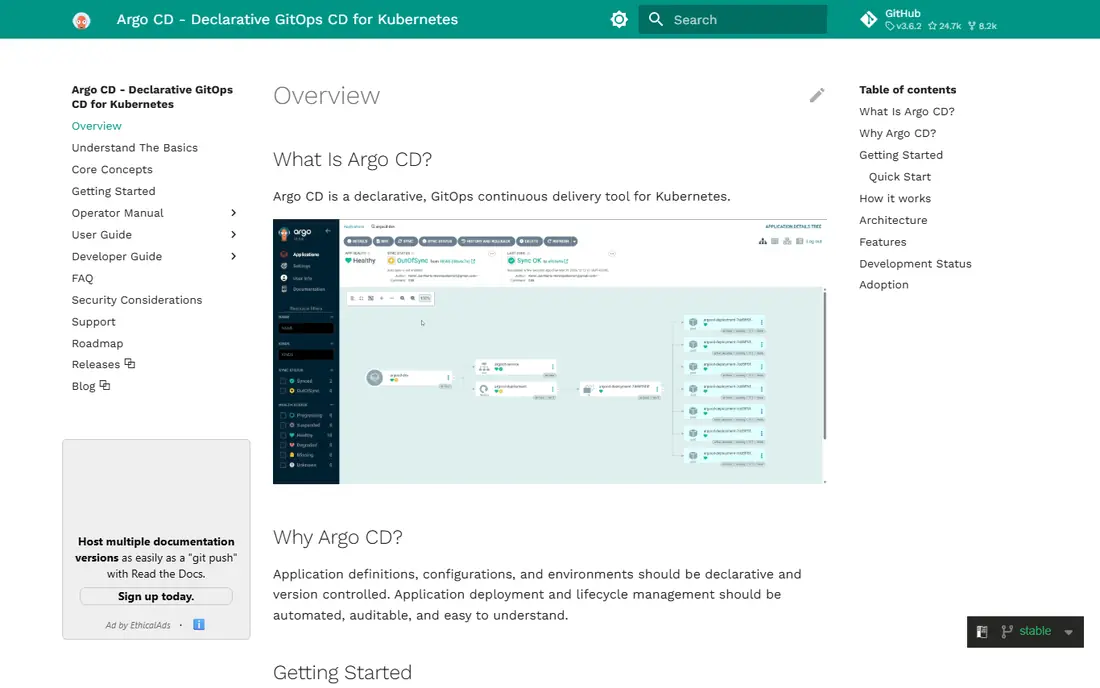
Argo CD treats a Git repository as the desired state for an application running in Kubernetes. When the live cluster drifts from that state, Argo CD shows it clearly and can sync it back. That visibility helps teams spot a manual change that would otherwise linger unnoticed until the next incident.
Argo CD does not build code, run unit tests, or package artifacts on its own. You pair it with a continuous integration tool, which adds a second system to maintain. It also assumes Kubernetes knowledge, so teams without that background may find the learning curve steep. For Kubernetes teams, though, its GitOps model is hard to beat for auditability.
- Git as the source of truth for releases
- Clear sync status and drift detection
- Strong Kubernetes fit
- Kubernetes only
- Needs another tool for building code
- Setup and access control take care

Jenkins remains a strong choice when a team needs full control over unusual build environments, on-premises systems, or legacy workflows. Its plugin library covers almost every tool and cloud, and pipelines can be stored as code alongside the application. If a job needs a special agent, a custom script, or a private network, Jenkins usually allows it.
The cost is operations. Upgrades, backups, agent scaling, and plugin conflicts become your team's job, and a poorly maintained Jenkins server can become a bottleneck. Small teams without platform help may prefer a managed service. Teams with platform skills, though, get a level of control that managed tools rarely match.
- Open source and highly extensible
- Huge plugin library
- Full control over agents and environments
- Maintenance falls on your team
- Plugin sprawl can cause trouble
- Interface feels dated
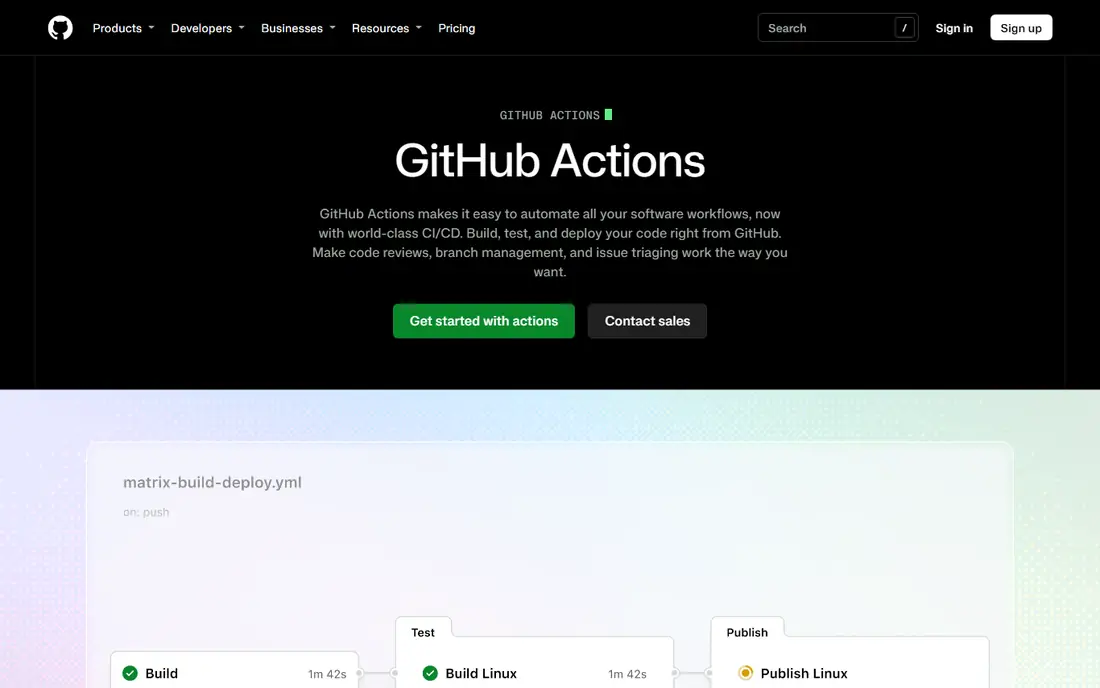
GitHub Actions is the natural pick for teams already on GitHub. Pipelines sit next to code, pull requests can trigger checks and deploys, and the marketplace offers reusable steps for common jobs. Self-hosted runners give larger teams a way to control cost and run jobs on their own hardware or cloud.
The weakness is workflow sprawl. As a project grows, YAML files can become long and hard to review, and a change in one reusable workflow can affect many repos. Hosted minutes are generous for small teams but add up for large builds. Still, for most GitHub teams, starting here avoids buying and learning a separate delivery system.
- Lives where code already lives
- Large marketplace of reusable actions
- Self-hosted runners available
- Workflow files can grow messy
- Hosted runner costs rise with scale
- Tied to GitHub
GitLab CI/CD appeals to teams that want one platform instead of stitching several tools together. Code, issues, pipelines, security scanning, and environments live in the same system, which makes access control and audit trails simpler. Environment promotion, manual approvals, and deployment history are built in rather than bolted on.
The trade-off is breadth. New teams may face more settings than they need, and paid tiers are priced per user, so cost grows with headcount. Runner minutes also need watching on busy projects. If your team already uses GitLab for code, though, its delivery features are a strong reason to stay.
- Repos, pipelines, and security in one place
- Environment controls and approvals
- Self-managed option
- Paid plans charge per user
- Feature depth can overwhelm small teams
- Runner costs add up
CircleCI suits teams that want managed pipelines without running their own servers. Jobs start quickly, Docker layer caching speeds up repeat builds, and parallelism helps large test suites finish sooner. A free tier with monthly credits lets small teams try it on real work before paying.
Credit pricing is the catch. Resource classes consume credits at different rates, so a heavy job can burn credits faster than expected. Teams should monitor usage in the first month and set alerts. For cloud-native teams that value speed and low maintenance, CircleCI remains a solid delivery choice.
- Fast cloud execution
- Credit-based scaling
- Good Docker and caching support
- Credit use can be hard to predict
- MacOS and large jobs cost more
- Less GitOps-native than Argo CD
Harness is built for organizations that need control over many services, environments, and teams. It offers deployment strategies such as canary releases, automated verification, approvals, and audit trails that help platform teams enforce policy without blocking every release by hand. Support for multiple clouds and GitOps workflows makes it flexible for mixed estates.
Harness is not a casual pick for a two-person team. Pricing is quoted, and the platform covers far more than delivery, which can feel heavy if you only need pipelines. Enterprises with compliance needs, many services, or strict change control will get the most from it. Smaller teams should trial it against a narrow use case first.
- Strong governance and approvals
- Canary and verification features
- Multi-cloud delivery support
- Quote-based pricing
- Broad platform can feel heavy
- Best value for larger teams
Octopus Deploy focuses on the release side: promoting a tested build through dev, staging, and production with approvals, variables per environment, and a clear history of what went where. That model suits teams that release the same build to many customers or environments and need to prove it later. It works with many stacks, including .NET shops that have used it for years.
Octopus does not replace a build tool, so you still need CI to produce artifacts. Pricing and licensing also need a direct check, since cloud and server options differ. For teams whose main pain is messy environment promotion rather than building code, Octopus gives that job a proper home.
- Clear environment promotion model
- Release versioning and approvals
- Good for .NET and varied stacks
- Pricing is quoted for many teams
- Needs a CI tool for builds
- Can feel formal for tiny projects
Spinnaker is designed for large fleets of services across multiple clouds. It models pipelines with stages, supports canary analysis and red-black deployments, and gives platform teams a central place to manage releases at scale. Companies with many services and strict release practices have used it for years for exactly that reason.
Running Spinnaker is a serious commitment. It has many components, needs care to operate, and takes time to learn. A team with one or two services will find it far heavier than Argo CD or GitHub Actions. If you run dozens of services across clouds and need consistent release control, that weight starts to make sense.
- Open source multi-cloud pipelines
- Canary and red-black strategies
- Strong for large service fleets
- Heavy to run and operate
- Steep learning curve
- Overkill for a single service
How we picked these
We compared official documentation, pricing pages, and public user reviews for tools that handle delivery, deployment, or GitOps in October 2026. We kept tools that are actively maintained and that cover a distinct delivery pattern, from GitOps to managed pipelines to multi-cloud platforms. We noted where pricing is free and open source, where a free tier exists, and where pricing is quoted.
How to choose the right delivery tool
Start with where your code and infrastructure already live. A GitHub team gains little by adding a separate system before it needs one, while a Kubernetes team gains a lot from a GitOps tool that shows drift. A team on GitLab or Azure may find its built-in pipelines cover delivery well enough, with less integration work.
Next, list your release risks. If you need approvals, audit trails, canary releases, or promotion across many environments, rank those features above raw speed. A fast pipeline that cannot roll back cleanly is a liability. Test rollback on a staging environment before you trust a tool in production, and make sure the team on call knows how to use it at night.
Finally, weigh total cost, not just license cost. Open source tools look free until you count servers, upgrades, and on-call time. Managed tools look costly until you count the platform hours they save. Run a small pilot on one service, measure build time, failure rate, and time to roll back, then decide with real numbers.
Frequently asked questions
What is the best continuous delivery software?
It depends on your stack. GitHub Actions suits GitHub teams, GitLab CI/CD suits all-in-one DevOps teams, Argo CD suits Kubernetes teams, and Harness or Octopus Deploy suit larger organizations with strict release control. Start with the tool closest to your existing code and infrastructure.
What are the best continuous delivery tools for Kubernetes?
Argo CD is the leading GitOps choice, Spinnaker suits multi-cloud fleets, and Harness supports GitOps alongside broader delivery workflows. Pair Argo CD with a CI tool for builds, since Argo CD focuses on deployment rather than building code.
What are the top continuous delivery platforms for enterprises?
Harness, GitLab, Octopus Deploy, and Spinnaker stand out for enterprises because they offer approvals, audit trails, environment promotion, and governance at scale. Enterprises should trial governance features with real teams, not just read feature lists.
Is Jenkins still a good continuous delivery tool?
Yes, for teams that need control and have platform skills. Jenkins is open source, extensible, and proven, but maintenance falls on your team. Teams without platform capacity often do better with a managed service such as GitHub Actions or CircleCI.
What is the difference between continuous delivery and continuous deployment?
Continuous delivery means every change is ready to release, but a human approves the final step to production. Continuous deployment removes that manual step, so every passing change reaches production automatically. Delivery is safer for regulated or high-risk releases.
How much does continuous delivery software cost?
Open source tools such as Jenkins, Argo CD, and Spinnaker cost nothing in licenses but need servers and operations time. Managed tools offer free tiers and then charge by minutes, credits, users, or quoted contracts. Check runner, storage, and support costs before comparing headline prices.
Sources
See where you really rank - block by block
ProMapRanker scans Google Maps across a grid of your service area. Simple monthly plans from $19, white-label on every plan.
Start freeKeep reading
 zscaler alternatives
Best Zscaler Alternatives in 2026
Looking for zscaler alternatives? We compare 9 SASE and zero trust platforms on architecture, data protection, pricing, and fit for your network and team.
Read → zapier alternatives free
Best Zapier Alternatives Free in 2026
Nine automation tools for zapier alternatives free in 2026, all with genuinely free tiers, plus free plan limits, starting prices and upgrade paths explained.
Read → which platform is best for online reputation
Which Platform Is Best for Online Reputation in 2026
Wondering which platform is best for online reputation? We compare 8 review, listing, and response tools for small and multi-location businesses and agencies.
Read →