 ProMapRanker
Best Construction Equipment Management Software in 2026

Key takeaways
- Construction-first tools such as Tenna and Clue track owned and rented machines together, which general fleet tools often handle less cleanly.
- Maintenance scheduling by engine hours matters more than a simple calendar reminder for heavy equipment that sits idle between jobs.
- GPS and telematics help with location and use, but they do not replace inspections, work orders, and parts tracking.
- Published per-user pricing helps small contractors budget, while larger fleets usually need a quote based on fleet size and modules.
Quick comparison
| Pick | Great for | Pricing starts at | Free tier | |
|---|---|---|---|---|
 Tenna | Construction fleets with GPS tracking | See website | No | Visit |
 Clue | Mixed owned and rented heavy fleets | See website | No | Visit |
 Fleetio | Mixed vehicle and equipment fleets | See website | Free trial | Visit |
 MaintainX | Mobile-first work orders | Free | Yes | Visit |
 UpKeep | Maintenance-led equipment tracking | $24 per user per month | Free trial | Visit |
 HCSS Equipment360 | Heavy civil contractors | See website | No | Visit |
 Samsara | Telematics-driven large fleets | See website | No | Visit |
 Limble | Easy setup and preventive maintenance | See website | Free trial | Visit |
 B2W Maintain | Contractors using B2W estimating and tracking | See website | No | Visit |
The best construction equipment management software
We focused on tools that manage real machines on real jobsites, including maintenance, inspections, location, work orders, and costs, rather than generic asset lists.

Tenna is built for construction fleets, not adapted from a general fleet tool. It combines GPS and Bluetooth tracking with preventive maintenance scheduling, inspections, and mixed-fleet management, so a contractor can see owned and rented units in one view. That construction focus shows in details such as jobsite assignments and utilisation reporting.
Pricing is quoted, so a small contractor will need a sales call to budget accurately. The platform also rewards a team that will tag assets, set up maintenance intervals, and keep inspections current. For a mid-size or large contractor losing time to lost equipment and missed service, Tenna is a strong first shortlist pick.
- Construction-specific asset tracking
- GPS and Bluetooth tracking
- Maintenance by hours, miles, or dates
- Quote-only pricing
- Setup effort for a large fleet
- Smaller firms may not need the full platform
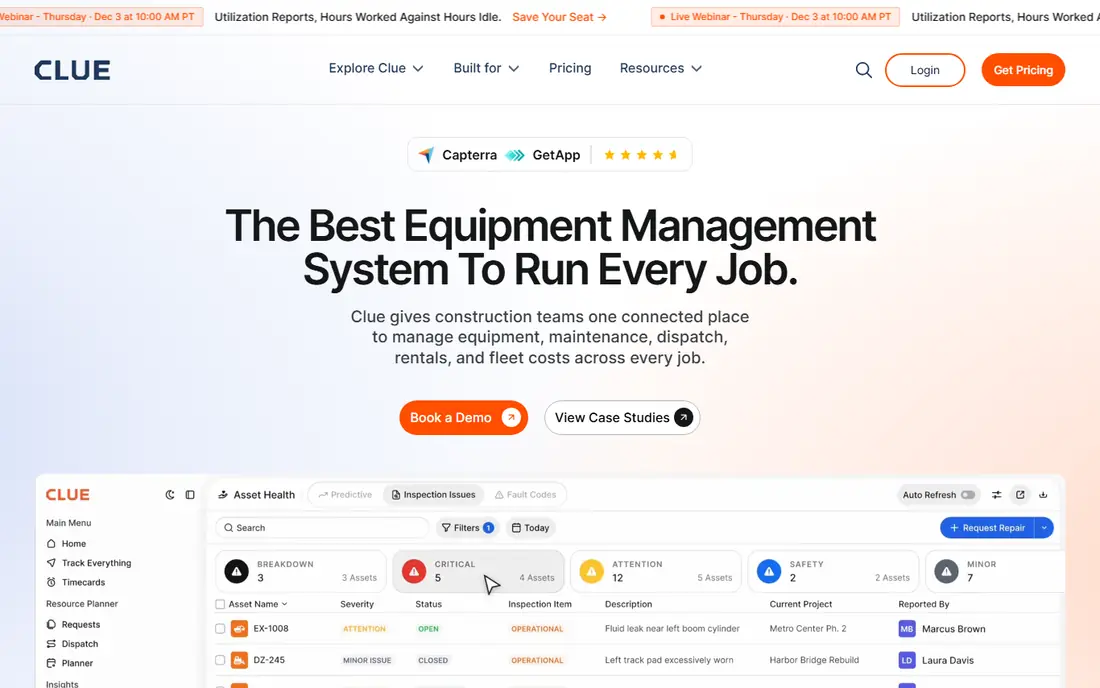
Clue centres on one record per machine, with maintenance plans driven by engine hours, mileage, dates, or custom intervals. Work orders can start from a failed inspection, a fault code, or a due service, and parts are tracked across warehouses, shops, and jobsite trailers. Rented units get the same inspection treatment as owned ones, including on-hire and off-hire checks.
The main drawback is pricing transparency. Plans are quoted by fleet size and modules, so comparison takes a call. Clue is also clearly built for construction and similar field fleets. Within that scope, its coverage of dispatch, rentals, and fleet costs in one platform is a genuine advantage over a maintenance-only tool.
- One record per machine
- PM by hours, mileage, or dates
- Parts tracking across shops and jobsites
- No public pricing
- Review volume is smaller than older rivals
- Construction focus may not suit fixed plant
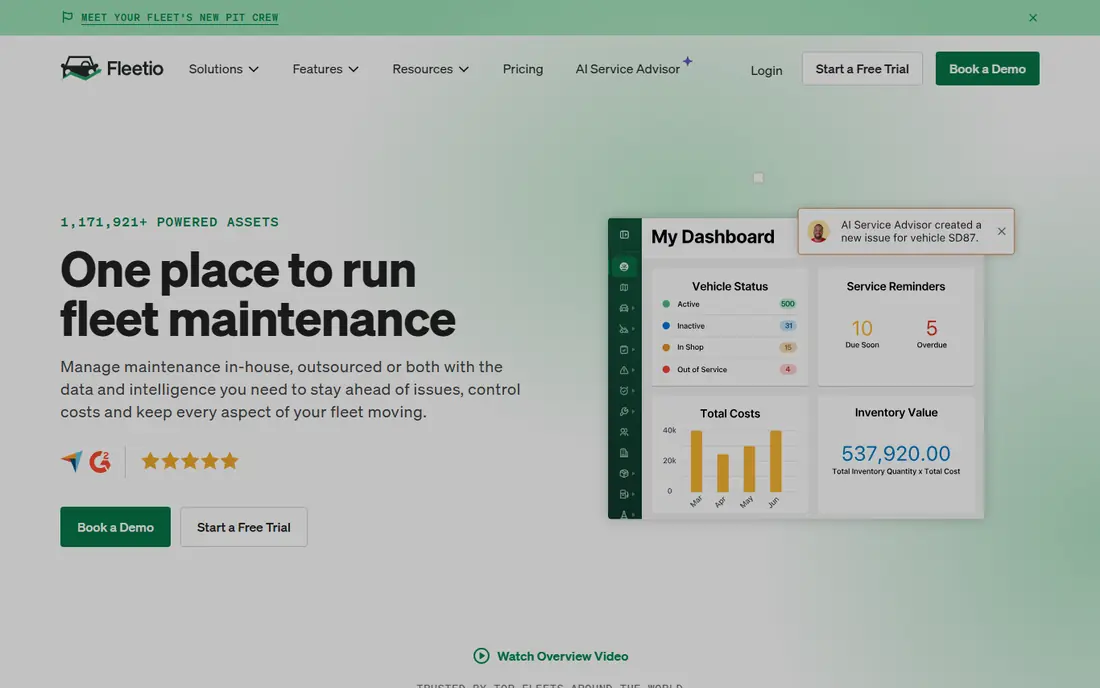
Fleetio suits a contractor whose fleet mixes trucks, vans, and heavy equipment. It covers inspections, work orders, fuel tracking, and cost analytics, with telematics links that bring in engine-hour data from major equipment makers. That breadth helps a fleet manager who currently juggles separate systems for vehicles and machines.
The trade-off is specialisation. A pure heavy-civil contractor may find Tenna or HCSS Equipment360 closer to its daily workflow. Fleetio wins when the fleet is mixed and the manager wants one system for everything on wheels and tracks, with a mobile app that field staff will actually use.
- Strong for vehicles plus equipment
- Inspections and work orders
- Integrations with OEM telematics
- Pricing varies by plan and fleet size
- Construction-specific depth is less than Tenna or Clue
MaintainX starts from the field worker, not the back office. Work orders, checklists, asset records, and messaging live in a mobile app that crews can use on site, which helps when a paper process keeps breaking down. The free plan lets a small team test the core workflow before paying.
Telematics is thinner here than in Tenna or Samsara, and meter-based preventive maintenance requires a paid plan. For a contractor whose main problem is missed work orders and unclear asset history, rather than live GPS, MaintainX is an excellent low-risk starting point, and its published paid tiers make budgeting simple.
- Free starter plan
- Mobile work orders and checklists
- In-app messaging for field teams
- Telematics links are limited
- Meter-based PM sits on paid plans
- Large fleets may need higher tiers
UpKeep approaches equipment from the maintenance side. Work orders, preventive schedules, and technician assignments are the heart of the product, with equipment records attached to that workflow. For a contractor whose biggest cost is breakdowns and deferred service, that focus is exactly right.
Published pricing at $24 per user per month for the Essential plan is welcome, but per-user pricing adds up when a large field crew needs access. Pure inventory or live GPS tracking is also thinner here than in Tenna or Samsara. Pick UpKeep when maintenance discipline, not location tracking, is the problem you need to fix first.
- Maintenance is the core strength
- Clear published pricing
- Technician-friendly mobile app
- Per-user cost grows with a large crew
- GPS tracking is thinner than telematics-first tools
HCSS Equipment360 is made for heavy civil contractors who already run HCSS tools for estimating and job costing. It covers preventive maintenance alerts, mechanic planning, work orders, field requests, and fuel data, with telematics links for location and use. The link to job costing matters, because equipment cost only means something when it lands on the right job.
The catch is ecosystem fit. A contractor outside the HCSS world will get less value and still face quote-only pricing. For a heavy civil firm already on HCSS, Equipment360 is the natural choice, because equipment, labour, and job cost data stay in one family of tools.
- Built for heavy civil work
- Mechanic planning and PM alerts
- Links to HCSS HeavyJob and accounting tools
- Quote-only pricing
- Best value inside the HCSS suite
- IPad-focused field experience in earlier listings
Samsara is a telematics leader, and its construction offering centres on connected hardware. GPS trackers, dash cameras, and equipment gateways report location, use, and engine data in real time, with fault-code alerts and maintenance reminders. For a contractor running a significant fleet of vehicles and heavy equipment, that live visibility is unmatched.
The model is hardware plus software with quote-based pricing, aimed at operations large enough to justify it. Small contractors tracking hand tools should look elsewhere. If your core question is where every machine is and what it is doing right now, Samsara is the strongest answer on this list.
- Strong real-time GPS and equipment gateways
- Safety and compliance features
- Fault-code alerts
- Quote-only pricing
- Hardware plus software model
- Aimed at larger operations
Limble is known for a clean interface and fast setup, which matters when a team has tried a complex system and abandoned it. Work orders, preventive maintenance, asset hierarchy, and QR scanning cover the daily maintenance job well, and custom dashboards help managers spot overdue work without digging through reports.
Telematics comes through integrations rather than built-in hardware, and some ERP links sit on higher tiers. Pricing is handled through a quote calculator rather than a simple published table, so confirm the full cost for your crew size. For a small to mid-size contractor that wants a system staff will actually adopt, Limble is a sound pick.
- Easy to learn
- Work orders and PM by meter on higher plans
- QR scanning for assets
- Pricing is quoted through a calculator
- ERP links may cost extra
- Telematics via integrations only
B2W Maintain, part of the B2W Software suite, gives contractors a maintenance tool that speaks the same language as their estimating and field tracking tools. Preventive maintenance runs natively from AEMP telematics data, so service intervals follow actual machine hours rather than guesswork. Work orders, inspections, and cost tracking sit in a construction workflow, not a generic maintenance template.
As with HCSS, the value is highest inside its own suite, and pricing is quoted. A contractor already using B2W Estimate or Track should shortlist it first. A contractor starting fresh should compare it against Tenna and Clue on tracking depth and total cost before committing.
- Native hours-based PM from AEMP telematics
- Links to B2W Estimate and Track
- Construction-focused workflow
- Quote-only pricing
- Best value inside the B2W suite
- Smaller public profile than Fleetio or Samsara
How we picked these
We compared official product pages, pricing pages, and public reviews for tools that manage construction equipment in October 2026. We favoured construction-specific coverage, maintenance by hours or meters, inspections, work orders, and location tracking, and we wrote See website where a vendor does not publish a starting price.
What to check before you buy
Start with your fleet mix, not a feature list. List owned machines, rented machines, vehicles, and small tools separately, then check how each tool handles rentals and off-hire inspections. A tool that only handles owned assets will leave a gap exactly where rental costs and damage disputes arise.
Run a pilot on one jobsite with real machines and real mechanics. Test an inspection that fails, a work order that needs parts, and a service due by engine hours. Confirm how telematics data arrives, how costs map to jobs, and how the system works offline on site. Those three tests reveal more than a sales demo ever will.
Frequently asked questions
What is the best software for construction equipment management?
For construction-specific tracking, Tenna and Clue are strong picks. For maintenance-led teams, UpKeep and MaintainX are easier starts, while Samsara leads on live telematics for larger fleets.
What is the top construction equipment management software for small contractors?
MaintainX and UpKeep suit small contractors best, because they offer free or low-cost entry points and mobile work orders. Larger, construction-first platforms make more sense once fleet size and rental volume grow.
How much does construction equipment software cost?
It varies widely. MaintainX offers a free plan and UpKeep starts at $24 per user per month, while Tenna, Clue, HCSS, Samsara, and B2W Maintain use quote-based pricing tied to fleet size and modules.
Does equipment software replace GPS tracking hardware?
Not always. Some platforms include GPS hardware, while others rely on integrations or manual entry. Confirm whether trackers, gateways, and installation are included in the quote before you compare prices.
Can one tool manage rented and owned equipment?
Yes, in the better construction tools. Tenna and Clue both track rented units with inspections and costs, which helps with off-hire checks and rental billing disputes.
Sources
See where you really rank - block by block
ProMapRanker scans Google Maps across a grid of your service area. Simple monthly plans from $19, white-label on every plan.
Start freeKeep reading
 zscaler alternatives
Best Zscaler Alternatives in 2026
Looking for zscaler alternatives? We compare 9 SASE and zero trust platforms on architecture, data protection, pricing, and fit for your network and team.
Read → zapier alternatives free
Best Zapier Alternatives Free in 2026
Nine automation tools for zapier alternatives free in 2026, all with genuinely free tiers, plus free plan limits, starting prices and upgrade paths explained.
Read → which platform is best for online reputation
Which Platform Is Best for Online Reputation in 2026
Wondering which platform is best for online reputation? We compare 8 review, listing, and response tools for small and multi-location businesses and agencies.
Read →