 ProMapRanker
Best Consolidation Companies in 2026

Key takeaways
- LightStream, Marcus and Discover offer no-fee personal loans in many cases, which keeps more of the loan amount available for paying creditors.
- SoFi suits larger consolidation amounts, with loans up to $100,000 described in recent guides, while Marcus and Discover cap at $40,000.
- LendingClub, Upgrade and Upstart accept lower credit scores than the no-fee leaders, but origination fees and higher rates can apply.
- Direct pay to creditors can help, because SoFi and others can send funds straight to card issuers instead of to your bank account.
- This article is general information only, not financial advice, and fees, rates and terms vary and must be checked in writing before you borrow.
Quick comparison
| Pick | Great for | Pricing starts at | Free tier | |
|---|---|---|---|---|
 SoFi | Large consolidation loans | See website | No | Visit |
 LightStream | Low-fee strong credit loans | See website | No | Visit |
 Marcus by Goldman Sachs | No-fee mid-size loans | See website | No | Visit |
 Discover Personal Loans | No-fee loans with direct pay | See website | No | Visit |
 LendingClub | Broader credit acceptance | See website | No | Visit |
 Upgrade | Lower credit score access | See website | No | Visit |
 Upstart | Alternative credit assessment | See website | No | Visit |
 PenFed | Credit union consolidation | See website | No | Visit |
The best consolidation companies
We compared lenders that offer personal loans for debt consolidation on fees, loan amounts, terms, credit requirements described in recent guides and direct pay options. Rates quoted here are guide figures from 2026 comparisons, not a guaranteed offer, because your actual rate depends on credit, income and debt-to-income ratio. Check the lender's own page before you apply.
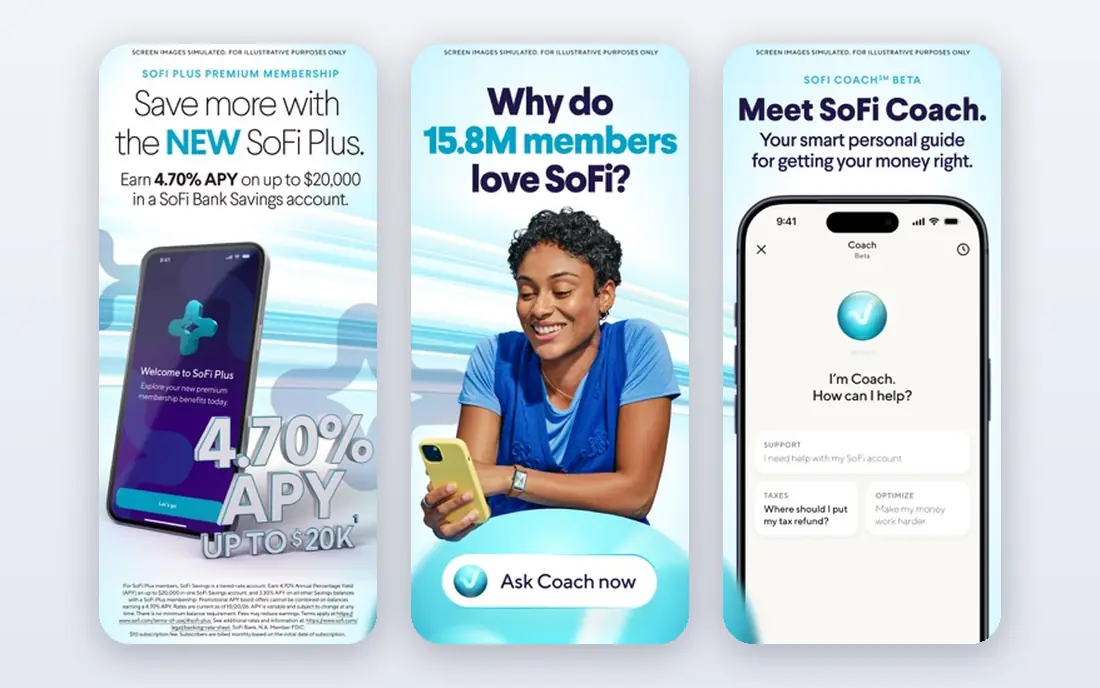
SoFi is a strong pick if your consolidation amount is larger than most lenders allow. Recent guides put its loans at $5,000 to $100,000, with terms of 24 to 84 months and APRs from 8.74 to 35.49 percent, including autopay and direct deposit discounts. Its Direct Pay feature can send proceeds directly to eligible credit card companies, with a 0.25 percent APR discount described when at least half of proceeds go to creditors.
The limit is qualification. Guides put the minimum credit score around 680, and the best rates go to strong profiles. Unemployment protection and career coaching are also described, which can help if your job situation changes. If you need a large, fee-free loan and have good credit, SoFi is a natural first quote to obtain.
- Loans up to $100,000 described
- No origination, late or prepayment fees described
- Direct pay to creditors with rate discount described
- Minimum credit score around 680 in guides
- Large loans need strong income and credit
- Rate ceiling is high for weaker profiles
LightStream, a division of Truist Bank, is often named best overall in 2026 guides because of its no-fee structure and low starting APR. Recent comparisons put APRs from 6.94 to 25.29 percent, loans from $5,000 to $100,000, and terms from 24 to 84 months, with same-day funding described for well-qualified borrowers. For strong-credit borrowers, that combination is hard to beat.
Qualification is the catch. Guides note a minimum around 660, with 700 or higher recommended in practice, so borrowers with fair credit may not receive the headline rate. Direct pay to creditors is also described as disputed in one recent study, so confirm whether LightStream will pay your creditors directly before you rely on that feature. If you qualify, it is a clean, low-fee option.
- No origination, late or prepayment fees described
- Lowest starting APR in several guides
- Same-day funding described
- Strong credit needed in practice
- Direct pay availability is disputed in some guides
- Minimum score guidance varies
Marcus by Goldman Sachs offers personal loans with no origination fees, no late fees and no prepayment penalties in recent guides, which makes the total cost easier to compare. One guide puts APRs at 7.99 to 28.99 percent, loan amounts at $3,500 to $40,000, and terms at 3 to 6 years, with free credit monitoring for borrowers. That simplicity suits borrowers who want a straightforward loan without fee surprises.
The cap is the main limit. At $40,000 maximum, Marcus cannot cover very large card balances on its own, and you may need a second strategy for remaining debts. It also requires a minimum credit score around 660 in guides, so it is not a subprime option. For mid-size consolidation with no fees, Marcus is a solid, transparent choice.
- No fees described
- APR range 7.99 to 28.99 percent in one guide
- Free credit monitoring described
- Loans capped at $40,000
- Terms 3 to 6 years
- Minimum credit around 660 in guides
Discover Personal Loans offers no-fee consolidation loans with a structure similar to Marcus, but with a direct pay option highlighted in recent guides. Comparisons put APRs at 7.99 to 24.99 percent, loans at $2,500 to $40,000, and terms at 36 to 84 months, with funding as fast as the next business day in some cases. Direct pay can help borrowers who want the lender to send funds to creditors, rather than handling each payment themselves.
As with Marcus, the $40,000 cap limits very large consolidations, and the best rates go to stronger profiles. Discover is also described as more accessible than LightStream for borrowers below 700, which makes it a useful second quote if LightStream declines you. Compare the total interest cost, not just the headline APR, before you choose.
- No origination fees described
- Next-business-day funding described
- Direct pay option noted in guides
- Loans capped at $40,000
- Minimum credit around 660 in guides
- Terms and rates vary by profile
LendingClub accepts broader credit profiles than the no-fee leaders, with guides putting the minimum credit score around 600 and loans from $1,000 to $60,000. Terms run 24 to 84 months in recent comparisons, with APRs from 6.53 to 35.99 percent. Funding as fast as 24 hours is described, which can help borrowers who need to act quickly.
Origination fees are the main cost to watch. Guides put fees at 0 to 8 percent, which means a $20,000 loan could arrive as less than $20,000 after fees, leaving a shortfall for creditors. Ask for the exact fee, the amount you will receive, and the total interest cost before you accept. LendingClub suits borrowers who cannot qualify for no-fee lenders but can still afford a clear, fixed payment.
- Minimum credit around 600 in guides
- Loans up to $60,000
- Funding as fast as 24 hours described
- Origination fees from 0 to 8 percent in guides
- APR ceiling up to 35.99 percent
- Fees reduce amount received
Upgrade is a useful option for borrowers with credit scores in the high 500s or low 600s who still want a fixed personal loan. Recent guides put loans at $1,000 to $50,000, terms at 24 to 84 months, and APRs from 7.74 to 35.99 percent. One recent study notes Upgrade for flexible partial direct pay, with no minimum percentage requirement, which can help if you want the lender to pay some creditors directly.
Fees and rates are the trade. Origination fees of 1.85 to 9.99 percent in guides can reduce the amount available to pay creditors, and weaker profiles face higher APRs. Upgrade is best used when the new payment is clearly lower than your current total payments, and when you have a plan to avoid new card debt after consolidation.
- Minimum credit around 580 in guides
- Loans from $1,000
- Direct pay with no minimum percentage described in one study
- Origination fees 1.85 to 9.99 percent in guides
- APR up to 35.99 percent
- Fees and rates rise for weaker profiles
Upstart uses alternative data, including education and employment history, alongside credit scores when assessing borrowers. That approach can help applicants with thin credit files or fair credit who might not qualify on score alone. It is listed in recent guides among options for fair-credit borrowers, with flexible income verification described for freelancers and non-traditional income in some comparisons.
The cost still needs careful checking. Origination fees and a high APR ceiling apply to weaker profiles, so the total cost can be high if the loan runs for several years. Compare Upstart with Upgrade and LendingClub on fee, amount received and total interest, not on approval speed alone. It suits borrowers whose broader profile is stronger than their credit score suggests.
- Considers education and employment as well as credit
- Accepts fair credit profiles
- Fast funding described
- Origination fees apply in many cases
- APR ceiling is high
- Approval model may not suit every borrower
PenFed, the Pentagon Federal Credit Union, offers personal loans that can be used for consolidation, and it is noted in recent guides for flexible verification and for strong-credit borrowers with larger balances. Credit union pricing can be competitive, and membership is open to a broad group, though you must join to borrow. That structure suits borrowers who prefer a credit union over a bank or online lender.
Membership and qualification are the limits. Rates, amounts and terms depend on your profile, and the application process may feel different from a purely online lender. Check membership eligibility, fees and whether PenFed will pay creditors directly before you apply. For eligible members with good credit, PenFed is worth a quote alongside SoFi and LightStream.
- Credit union pricing
- Flexible income verification described in guides
- Large loan amounts for strong profiles in guides
- Membership required
- Qualification and rates vary
- Branch and online experience varies by member
How we picked these
We compared recent 2026 lender guides, including Money, Finanso and other comparison pages, plus lender descriptions of fees and direct pay features. We used guide APR ranges and loan amounts rather than inventing a single rate, because actual offers depend on credit and income. We did not claim guaranteed approval, and we note where direct pay availability is disputed or described differently across guides.
How to choose a consolidation loan without making debt worse
Start with the total picture. List every debt, its balance, APR, minimum payment and due date, then compare that total monthly payment and total interest with the new loan payment. A consolidation loan only helps if the new payment is affordable, the total interest is lower or the term is not stretched so long that you pay more overall. A lower monthly payment over a much longer term can cost more in total.
Next, check fees and amount received. Origination fees reduce the cash available to pay creditors, so ask for the net amount, the APR, the term and the total amount you will repay. If the net amount does not cover all the debts you planned to consolidate, decide in advance which debts remain and how you will handle them. Also ask whether the lender pays creditors directly, and confirm which creditors are eligible.
Finally, make a plan for after consolidation. Close or stop using the cards you paid off, or at least set a strict spending limit, because new card debt on top of a consolidation loan is a common trap. Set up autopay, keep an emergency buffer if you can, and review your budget monthly for the first year. If you cannot afford minimum payments at all, speak to a nonprofit credit counselor before choosing a loan or a settlement program. This article is general information only, not financial advice, and no rate or outcome is promised.
Frequently asked questions
What is the best consolidation company?
The best lender depends on your credit and loan size. LightStream and Discover are strong no-fee options, SoFi suits larger amounts up to $100,000, and Marcus suits mid-size no-fee loans. Borrowers with lower scores may need LendingClub, Upgrade or Upstart, with fees checked carefully.
What is the best loan consolidation company for bad credit?
No lender guarantees approval for bad credit, and rates will be higher. Upgrade, with a guide minimum around 580, and LendingClub, around 600, are among the more accessible options on this list. Compare fees and total cost, and consider nonprofit credit counseling if a loan payment is not affordable.
Does debt consolidation hurt your credit?
Applying can cause a small, temporary score dip from a hard inquiry, and closing old cards can affect credit utilization and history. On-time payments on the new loan can help over time, while missed payments will hurt. The effect depends on your starting score, utilization and payment history.
Should I choose consolidation or debt settlement?
For most borrowers with steady income, a consolidation loan is safer than settlement, because settlement involves stopping payments while balances are negotiated, which can damage credit and create tax liability on forgiven amounts over $600. Settlement is usually a last resort after a credit counselor has reviewed your situation.
How much can I borrow for debt consolidation?
It varies by lender and profile. SoFi and LightStream describe up to $100,000 in guides, LendingClub up to $60,000, and Marcus and Discover up to $40,000. Your income, credit and debt-to-income ratio decide the actual amount offered, so get a personalized quote.
What is direct pay for consolidation loans?
Direct pay means the lender sends loan proceeds directly to your creditors, rather than depositing all funds in your bank account. SoFi, Discover and Upgrade are noted for direct pay options in recent guides, with terms varying by lender. Confirm eligible creditors and any minimum percentage before you rely on it.
Sources
See where you really rank - block by block
ProMapRanker scans Google Maps across a grid of your service area. Simple monthly plans from $19, white-label on every plan.
Start freeKeep reading
 zscaler alternatives
Best Zscaler Alternatives in 2026
Looking for zscaler alternatives? We compare 9 SASE and zero trust platforms on architecture, data protection, pricing, and fit for your network and team.
Read → zapier alternatives free
Best Zapier Alternatives Free in 2026
Nine automation tools for zapier alternatives free in 2026, all with genuinely free tiers, plus free plan limits, starting prices and upgrade paths explained.
Read → which platform is best for online reputation
Which Platform Is Best for Online Reputation in 2026
Wondering which platform is best for online reputation? We compare 8 review, listing, and response tools for small and multi-location businesses and agencies.
Read →