 ProMapRanker
Best Configuration Management Software in 2026

Key takeaways
- Ansible is the best starting point for most teams, because its core engine is free, agentless, and easy to learn.
- Puppet and Chef suit enterprises that need strict enforcement, compliance reporting, and audit trails.
- Terraform provisions cloud resources, while Ansible configures what runs on them, so many teams use both together.
- Salt remains a live open source project for large, event-driven estates, even after changes in its corporate ownership.
- Containers reduce server configuration work, but hosts, networks, and older systems still drift without a configuration tool.
Quick comparison
| Pick | Great for | Pricing starts at | Free tier | |
|---|---|---|---|---|
 Ansible | Agentless configuration for most teams | Free | Yes | Visit |
 Puppet | Enterprise enforcement and compliance | See website | Yes | Visit |
 Chef Infra | Policy-as-code for DevOps teams | See website | Yes | Visit |
 Salt | Large event-driven infrastructures | Free | Yes | Visit |
 Terraform | Multi-cloud infrastructure provisioning | Free | Yes | Visit |
 CFEngine | Lightweight compliance at large scale | Free | Yes | Visit |
 Rudder | Centralized policy with a clear interface | See website | Yes | Visit |
 Pulumi | Infrastructure in real programming languages | See website | Yes | Visit |
 Octopus Deploy | Deployment and configuration for release teams | See website | Free trial | Visit |
The best configuration management software
These nine tools cover the main approaches to keeping infrastructure in its intended state, from agentless scripts to full enterprise platforms.
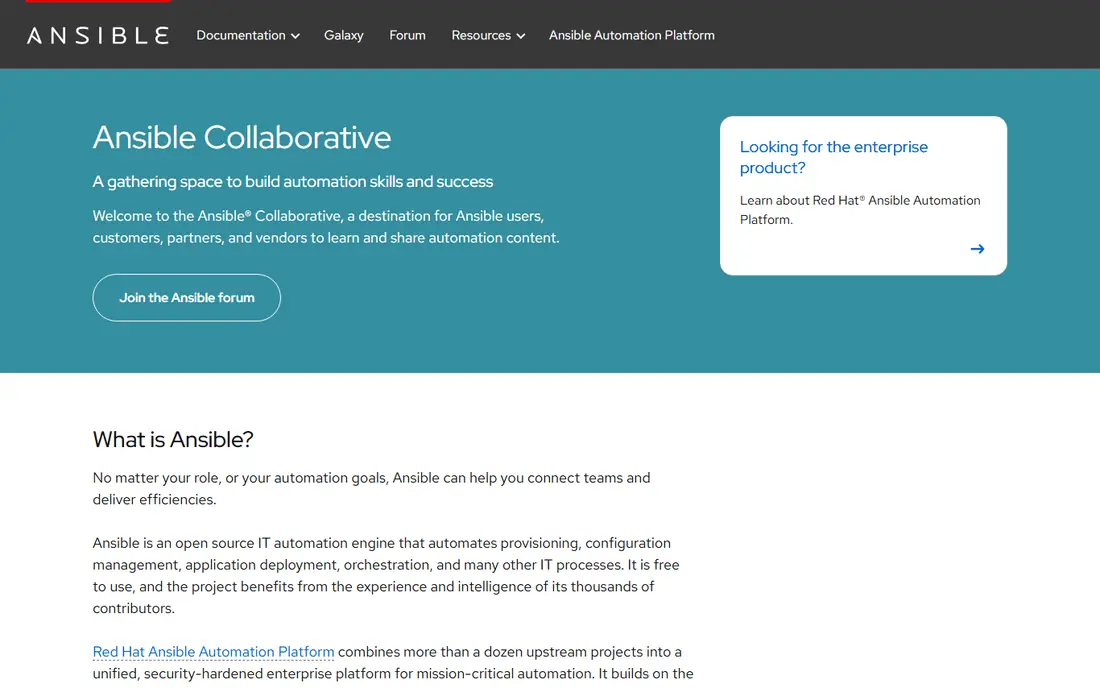
Ansible is our pick for most teams starting with configuration management. It connects over SSH or WinRM, runs tasks described in readable YAML playbooks, and needs no agent installed on each server. That agentless design makes first setup quick, and the module library covers packages, files, services, users, and cloud resources without writing custom code for common tasks.
The limits show at very large scale, where push-based runs and inventory management need care, and where the paid Red Hat Ansible Automation Platform adds the interface, role controls, and event-driven features that large teams want. For small and mid-size teams, though, the free engine plus version-controlled playbooks gives a clean, repeatable way to configure servers. Start here unless a compliance or governance need points elsewhere.
- No agent needed on managed machines
- YAML playbooks are readable
- Large module and community library
- Push-based runs can be slower at very large scale
- Enterprise platform features cost extra
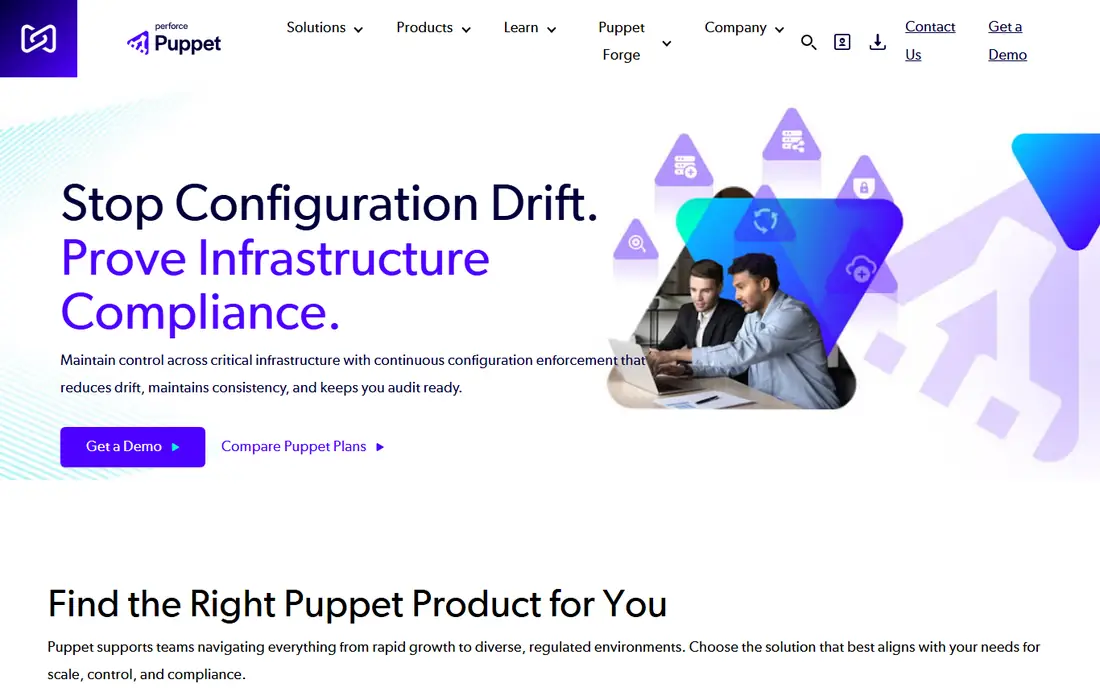
Puppet suits organizations that need machines to stay in a defined state, not just reach it once. Agents check in regularly, apply the declared configuration, and report drift, which gives auditors a clear record of what changed and when. That continuous enforcement is why Puppet remains common in regulated industries and large IT estates with strict compliance needs.
The cost of that strength is learning. Puppet's declarative language and module system take longer to learn than Ansible playbooks, and small teams may find the setup heavy for a handful of servers. Open source Puppet is available, while the enterprise platform with advanced reporting and controls is priced by quote. Choose Puppet when enforcement and proof matter as much as automation itself.
- Continuous enforcement of desired state
- Strong compliance reporting
- Mature enterprise tooling
- Learning its declarative language takes time
- Enterprise pricing is quote-based
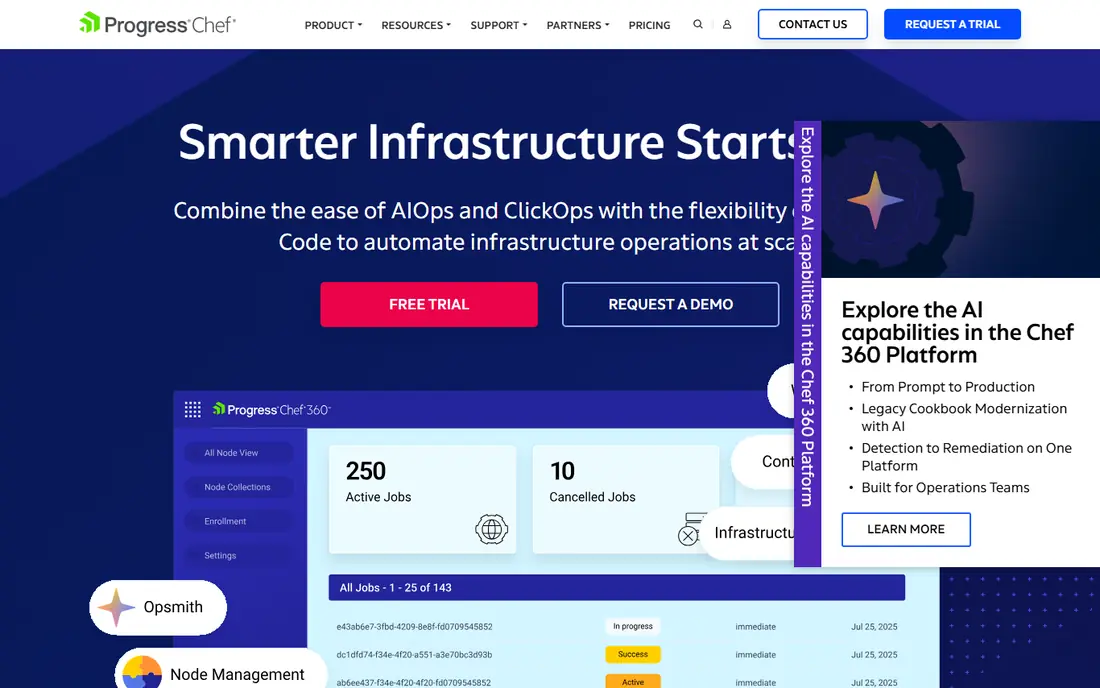
Chef Infra treats infrastructure policy as code, with recipes and cookbooks that describe how a system should be built and kept. That approach suits DevOps teams that already think in code, test changes, and review them like software. Chef also offers testing tools for cookbooks, which helps teams catch configuration mistakes before they reach production servers.
The main barrier is language. Serious Chef work benefits from Ruby knowledge, and teams without it face a steeper start than with Ansible. Pricing for the enterprise platform is also quote-based, so budgeting needs a vendor conversation. For teams that want policy, testing, and code review baked into configuration work, Chef remains a strong, mature choice.
- Policy-as-code with Ruby-based recipes
- Strong for complex workflows
- Mature testing tools for cookbooks
- Ruby knowledge helps for serious use
- Enterprise pricing is quote-based
Salt, also known as SaltStack, is built for speed and scale, with an event system that lets machines react to changes in near real time. That design suits large estates where thousands of machines must receive updates quickly, and where orchestration across many systems matters. The open source Salt Project continues with documentation, releases, and community support, and Broadcom owns VMware, which stewards Salt.
The trade-off is complexity. Salt rewards teams that invest in architecture and tuning, and smaller teams may find Ansible simpler for the same basic jobs. Before adopting Salt, check the current roadmap and support position, since ownership changes can affect long-term plans. For large, fast-moving estates, its event-driven model still stands out.
- Fast, event-driven automation
- Scales to very large estates
- Open source core with active documentation
- Setup and tuning take care at scale
- Corporate ownership history deserves a check before adoption
Terraform is the default tool for provisioning cloud infrastructure, and it belongs on this list because many teams pair it with a configuration tool. It describes servers, networks, and databases in code, shows a plan before applying changes, and works across major clouds through providers. That preview step is valuable, since it lets a team review a change before it creates or destroys real resources.
Terraform is not a full replacement for Ansible or Puppet. It creates resources well, but configuring software inside those resources in depth is better left to a configuration tool. State files also need safe storage and locking, or teams risk conflicts. Used as the provisioning layer with Ansible or Puppet for configuration, Terraform gives a clean division of work.
- One language for many clouds
- Preview of changes before applying
- Large provider ecosystem
- Provisions resources rather than configuring servers in depth
- State files need careful handling
CFEngine is one of the oldest configuration tools still in use, and its strength is efficiency. Its agents are light, its model centers on promised desired state, and it has a long record in large, security-conscious estates. For teams that must prove compliance across many machines without heavy agents, CFEngine remains a credible option.
Its age shows in other ways. The community is smaller than Ansible's, learning material is thinner, and the policy language feels less familiar to teams raised on YAML or Python. CFEngine suits teams that value light weight and compliance proof over a large modern ecosystem. For most new teams, Ansible is easier, but CFEngine still earns a place for large, lean estates.
- Very lightweight agents
- Strong on security and compliance
- Long history at large scale
- Smaller community than Ansible or Puppet
- Policy language feels dated to new users
Rudder gives teams a central interface for managing nodes, applying policies, and checking compliance, without requiring deep code knowledge for every change. Policies are defined once and applied across groups of machines, and reporting shows which nodes match the intended state. That clarity helps IT teams that manage many Linux systems and want audit-friendly reporting.
Rudder's ecosystem is smaller than Ansible, Puppet, or Chef, so ready-made modules for unusual software may be thinner. Its open source core is free, while enterprise features are priced by quote. For teams that want a clear interface and steady enforcement more than a huge marketplace, Rudder is a practical, lesser-known option.
- Central web interface for nodes and policies
- Continuous compliance reporting
- Agent-based enforcement
- Smaller ecosystem than the big three
- Enterprise features priced by quote
Pulumi appeals to teams that prefer real programming languages over a separate configuration language. Infrastructure can be written in Python, TypeScript, Go, C#, or Java, with loops, functions, and tests that developers already know. That approach suits teams that manage complex cloud setups and want to reuse code, libraries, and testing habits from application work.
The cost is skill. Pulumi is less approachable for IT generalists who do not code daily, and team features such as advanced policy controls sit on paid tiers. For configuration management in the strict sense, Pulumi pairs best with Ansible or a similar tool for in-server settings. For cloud provisioning with developer ergonomics, it is a strong alternative to Terraform.
- Use Python, TypeScript, Go, and other languages
- Strong multi-cloud support
- Preview and policy controls
- Code-first approach needs developer skill
- Paid tiers gate team features
Octopus Deploy sits at the release end of configuration work, managing how software and settings move from development through testing to production. Its variable system lets the same release use different settings per environment, which reduces manual edits and mistakes at deploy time. Teams that release often, especially in .NET and cloud environments, find its dashboards and approvals useful.
Octopus is not a direct replacement for Ansible or Puppet for general server configuration, since its strength is deployment rather than continuous server enforcement. It works well alongside a configuration tool, handling releases while the other tool keeps servers in state. For teams whose main pain is safe, repeatable releases, Octopus deserves a trial.
- Clear release and deployment workflows
- Variable management across environments
- Strong for .NET and cloud releases
- Deployment focus rather than pure server configuration
- Pricing needs a vendor check
How we picked these
We compared official documentation, pricing pages, and public feature descriptions, and we kept tools that are live and maintained in October 2026. We favored tools with a clear role in configuration or provisioning, from agentless automation to enterprise enforcement, and we noted where a tool provisions resources rather than configuring servers. Where enterprise pricing is quote-based, we wrote See website instead of repeating an old figure.
How to choose the right configuration tool
Start by naming the job. If servers drift after manual changes, a configuration tool such as Ansible, Puppet, or Chef is the core need. If cloud resources are created by hand, add Terraform or Pulumi for provisioning. If releases cause most incidents, add a deployment tool such as Octopus Deploy. Many mature teams run two tools, one for provisioning and one for configuration, rather than forcing one tool to do both badly.
Next, weigh team skill and scale. A small team with limited time should start with Ansible, since its playbooks are readable and its core is free. A large, regulated team should weigh Puppet or Chef for enforcement and reporting, even at higher cost. Finally, store all configuration in version control, review changes, test them on a small group first, and monitor for drift after rollout. The tool enforces the plan, but discipline keeps the plan worth enforcing.
Frequently asked questions
What is the best configuration management software overall?
Ansible is the best starting point for most teams, because it is free, agentless, and easy to learn. Puppet and Chef lead for enterprise governance and compliance, while Terraform leads for cloud provisioning. The right tool depends on whether you need provisioning, configuration, or both.
What are the best configuration management tools for beginners?
Ansible is the easiest entry point, with readable YAML and no agent to install. Rudder also offers a clear interface for teams that prefer a central console. Beginners should start with one tool, version-controlled playbooks, and a small test group before rolling changes to production.
What are the top software configuration management systems for enterprises?
Puppet, Chef, and Ansible Automation Platform are the top enterprise choices, with strong reporting, role controls, and support. Salt also scales well for large estates. Enterprise pricing is usually quoted, so compare reporting, support, and compliance features alongside the quoted price.
Is Ansible really free?
Yes, the open source Ansible engine is free to use, with a large community and module library. Red Hat Ansible Automation Platform is the paid enterprise tier, adding a web interface, role-based access, event-driven automation, and support. Small teams can run the free engine for years without paying.
What is the difference between Terraform and Ansible?
Terraform provisions infrastructure, creating servers, networks, and cloud resources. Ansible configures them, installing software and settings inside those resources. Teams commonly use both together, with Terraform creating the machines and Ansible setting them up.
Do I still need configuration management if I use containers?
You need less of it, but you still need it. Containers reduce server-level configuration, but hosts, networks, and non-containerized systems still drift. Many teams use Terraform and Kubernetes for new workloads and Ansible or Puppet for what remains.
Sources
See where you really rank - block by block
ProMapRanker scans Google Maps across a grid of your service area. Simple monthly plans from $19, white-label on every plan.
Start freeKeep reading
 zscaler alternatives
Best Zscaler Alternatives in 2026
Looking for zscaler alternatives? We compare 9 SASE and zero trust platforms on architecture, data protection, pricing, and fit for your network and team.
Read → zapier alternatives free
Best Zapier Alternatives Free in 2026
Nine automation tools for zapier alternatives free in 2026, all with genuinely free tiers, plus free plan limits, starting prices and upgrade paths explained.
Read → which platform is best for online reputation
Which Platform Is Best for Online Reputation in 2026
Wondering which platform is best for online reputation? We compare 8 review, listing, and response tools for small and multi-location businesses and agencies.
Read →