 ProMapRanker
Best Composable Commerce Platforms in 2026


Pure composable enterprises · Pricing starts at: See website
Key takeaways
- Composable commerce builds a store from API-first services, so each part can change without replacing the whole stack.
- commercetools is the reference for pure composable builds, while Shopify Plus and BigCommerce offer faster headless routes.
- Open source options such as Medusa and Saleor suit developer-led teams that want to own the stack.
- The license is often the smallest cost. Storefront work, integrations, hosting, and engineering time dominate total cost.
- Composable only pays when you need multiple storefronts, complex B2B rules, or frequent change across channels.
Quick comparison
| Pick | Great for | Pricing starts at | Free tier | |
|---|---|---|---|---|
| commercetools | Pure composable enterprises | See website | No | Visit |
 Elastic Path | Enterprise B2B composable | See website | No | Visit |
 Adobe Commerce | Adobe ecosystem B2B | See website | No | Visit |
 Salesforce Commerce Cloud | Salesforce ecosystem commerce | See website | No | Visit |
 BigCommerce | Headless SaaS without heavy engineering | See website | Free trial | Visit |
 Shopify Plus | Fast scaling direct-to-consumer | See website | No | Visit |
 Spryker | B2B and marketplace builds | See website | No | Visit |
 Medusa | Open source developer-led builds | Free | Yes | Visit |
The best composable commerce platforms
We compared platforms that support API-first, headless, or fully composable builds in 2026, with live products and public architecture material. We favored a mix of SaaS, enterprise, and open source options so different team sizes can compare. Pricing for enterprise platforms is usually quoted, so we use See website where a fixed price does not apply.
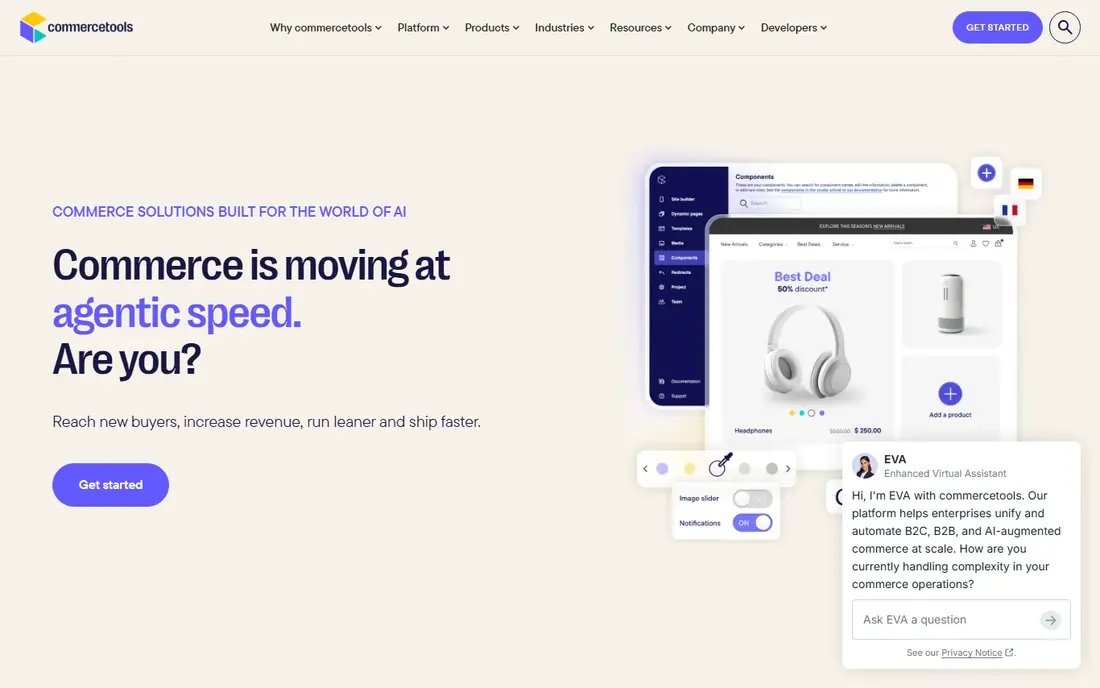
commercetools pioneered composable headless commerce, and it remains the reference for a pure build. Its API-first services for products, carts, orders, and pricing let a team assemble a custom stack from best-of-breed parts, with front ends that deploy independently. Cloud-native scale and a strong partner ecosystem support large, global, multi-brand deployments that monolithic platforms struggle to match.
The honest requirement is engineering. commercetools is a developer platform, not a ready store, so a firm needs engineers for storefront, integrations, payments, search, and ongoing operations. Simple stores should choose a simpler SaaS platform. commercetools fits enterprises building differentiated commerce across channels, with the team and budget to run a composable stack for years.
- API-first microservices for cart, product, order, and pricing
- Cloud-native scale
- Strong MACH ecosystem
- Needs a real engineering team
- Build and integration costs are high
- Not a store-in-a-box
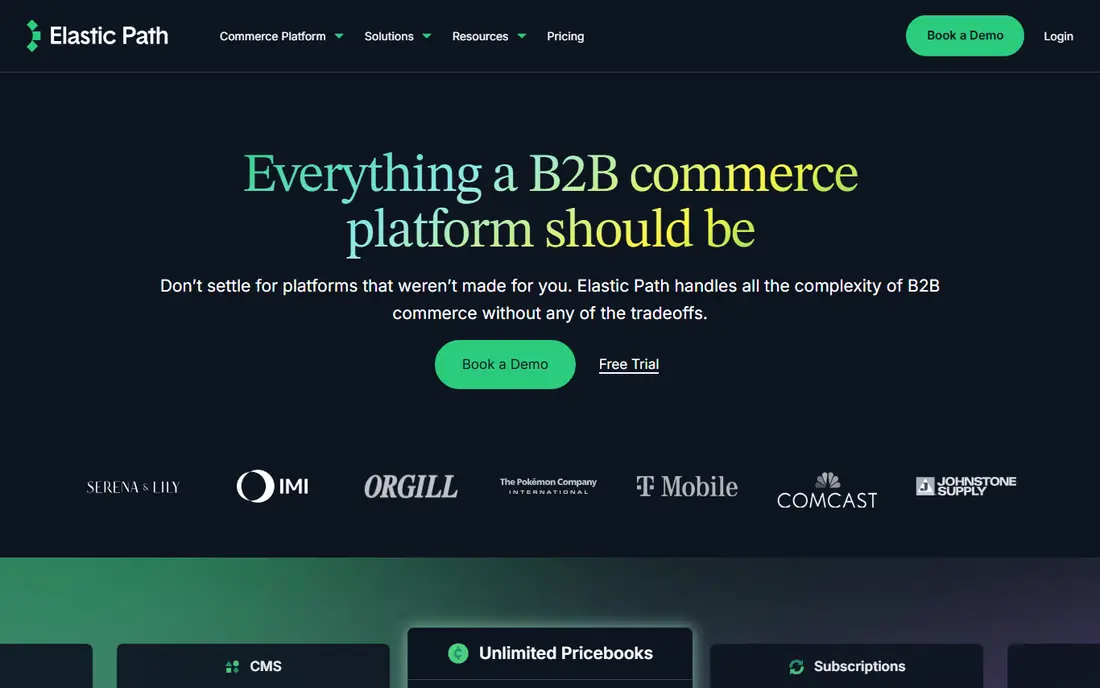
Elastic Path offers commercetools-style composability with more business-user tooling, which helps teams that want flexibility without building every piece from scratch. Its catalog, pricing, and B2B features suit firms with complex catalogs, negotiated pricing, and multiple brands or markets. Subscription and account features add depth for B2B and B2B2C models that simpler platforms handle poorly.
The limit is still enterprise effort. Elastic Path reduces some build work, but a team still needs storefront development, integrations, and operations planning. Pricing is quoted, and total cost depends on catalog complexity and volume. Elastic Path fits large B2B and B2B2C firms that want composable control plus usable business tooling, rather than a pure developer-only platform.
- Composable services with business-user tooling
- Strong B2B and catalog depth
- Subscription support
- Enterprise pricing is quoted
- Still needs integration and storefront work
Adobe Commerce, formerly Magento, suits enterprises already invested in Adobe, with deep B2B requirements, large catalogs, and heavy ERP, PIM, or order system dependencies. Its B2B suite, catalog tools, and extension ecosystem cover complex quoting, account hierarchies, and merchandising needs that lighter platforms lack. For Adobe-centered firms, the wider Adobe Experience Cloud link adds analytics, content, and personalization value.
The drawback is weight. Adobe Commerce implementations are major projects, hosting and performance need planning, and total cost includes licenses, implementation, and ongoing engineering. Adobe Commerce fits Adobe-invested brands with complex B2B or catalog needs and a team to run it. Lighter SaaS options suit firms that do not need that depth.
- Deep B2B features
- Large extension ecosystem
- Strong catalog and merchandising tools
- Heavy implementation
- Adobe ecosystem assumed
- Total cost can be high
Salesforce Commerce Cloud fits enterprises whose sales, service, and marketing already live in Salesforce. Commerce data connects to customer, order, and service records in one system, which helps omnichannel firms coordinate web, store, and service channels. Enterprise scale, B2B features, and AI-assisted merchandising support large, multi-brand deployments inside the Salesforce world.
Outside Salesforce, the value drops. Implementation needs Salesforce expertise, pricing is quoted, and firms without a Salesforce stack will find a more neutral platform simpler. Salesforce Commerce Cloud fits Salesforce enterprises that want commerce as part of one customer platform, not as a standalone store. For neutral composable builds, commercetools or Elastic Path are more direct choices.
- Native Salesforce sales, service, and marketing link
- Omnichannel coordination
- Enterprise scale
- Pricing is quoted
- Salesforce ecosystem assumed
- Customization needs expertise
BigCommerce is the closest SaaS-to-SaaS route to composable for teams that want headless flexibility without staffing a platform team. Its Catalyst storefront framework and APIs let a team build a custom front end on a managed backend, skipping hosting and core operations work. B2B features, multi-storefront support, and a broad app ecosystem cover many mid-market and enterprise needs without a full composable build.
The trade-off is control. BigCommerce trades some API-first freedom for speed and lower total cost, so firms with very unusual catalog, pricing, or order logic may still need a purer platform. BigCommerce fits mid-market and enterprise teams that want headless speed, managed operations, and a lower engineering burden than commercetools or Elastic Path.
- Headless on a managed backend
- Lower complexity than pure composable
- Strong B2B features
- Less control than pure API-first platforms
- Enterprise features vary by plan
Shopify Plus is the speed pick for scaling direct-to-consumer brands. Hydrogen gives teams a custom storefront framework, and Shopify Functions add custom backend logic, without unbundling the whole stack. The app ecosystem, checkout, payments, and hosting are managed, so a brand can ship fast and focus on product and marketing rather than platform operations. For many brands, that middle path beats a full composable build.
The limit is freedom and B2B depth. Shopify Plus is less composable than commercetools, and heavy B2B workflows, complex catalog rules, or multi-system governance may fit Adobe Commerce or Elastic Path better. Shopify Plus fits direct-to-consumer brands that need a custom storefront and fast shipping, not a fully unbundled stack. Teams should test B2B needs carefully before committing.
- Fastest time to market on this list
- Hydrogen storefront framework
- Large app ecosystem
- Less composable freedom than pure platforms
- B2B depth lags specialist B2B platforms
Spryker leads for B2B requirements in many headless comparisons, with native modules for punch-out, quote management, buyer roles, and account hierarchies. Marketplace support adds value for firms running multi-seller models, and its modular architecture suits enterprises that need to compose B2B, B2C, and marketplace experiences from shared services. For catalogs with customer-specific pricing and approval workflows, that native B2B depth matters.
The cost is engineering and project scale. Spryker is not a quick SaaS store, and a firm needs developers, integrators, and operations planning to run it well. Spryker fits B2B, wholesale, and manufacturing firms with complex buying workflows and a team to build them. Simpler B2B needs may be met faster on BigCommerce or Shopify Plus.
- Native B2B suite modules
- Marketplace support
- Strong for complex enterprise models
- Needs a strong engineering team
- Implementation is a major project
Medusa is an open source commerce engine for developer-led teams that want to own the stack. The core is free, the architecture is modular, and APIs cover products, carts, orders, and pricing for custom storefronts. That ownership suits teams that want to avoid license fees, control hosting and data, and extend the platform with their own modules and plugins.
Ownership is also the cost. A Medusa team must host, secure, update, and operate the platform, and the ecosystem is smaller than Shopify or BigCommerce. Medusa fits engineering-led firms with a clear reason to own the stack, such as custom workflows, data control, or a product that embeds commerce. Teams without platform engineering should choose a managed SaaS route instead.
- Open source core with no license cost
- Modular commerce engine
- Developer-friendly APIs
- Team must host and operate the stack
- Ecosystem is smaller than SaaS rivals
How we picked these
We compared composable and headless platforms using vendor architecture pages, partner material, and third-party comparisons in 2026. We kept platforms with a live API-first or headless product and a clear composable path, covering SaaS, enterprise, and open source models. We left out traditional monolithic-only stores with no headless path, and tools with no verifiable commerce product. We did not claim hands-on builds, and we compared architecture, B2B depth, and team needs rather than invented performance figures.
How to decide if composable is worth it
Start with the business model, not the architecture trend. Composable pays when you run multiple storefronts, sell B2B with complex pricing, operate marketplaces, or change channels often. A single web store with a standard catalog rarely needs it, and a traditional or headless SaaS platform will ship faster and cost less to run. Write down the specific cases that a simpler platform cannot handle before you choose composable.
Next, price three years, not one license. Add storefront development, payments, search, CMS, ERP and PIM integrations, hosting, monitoring, and engineering salaries or agency fees. Open source saves license cost and spends more on engineering, while SaaS does the opposite. A three-year total cost view stops a team from choosing on sticker price alone and regretting it in year two.
Finally, check team capacity honestly. Composable needs front-end, back-end, integration, and operations skills for years, not just for launch. If your team cannot staff that work, choose a managed headless platform such as BigCommerce or Shopify Plus, and revisit pure composable when volume and complexity justify it. The best platform is the one your team can ship and run well.
Frequently asked questions
What is the best composable commerce software for enterprises?
commercetools is the reference for pure composable enterprises, while Elastic Path suits B2B firms that want composable control plus business tooling. Adobe Commerce and Salesforce Commerce Cloud suit firms already invested in those ecosystems. Match ecosystem and B2B depth before you choose on architecture alone.
What are the best composable commerce platforms for B2B?
Spryker and Elastic Path lead for B2B depth, with Adobe Commerce strong for large catalogs and ERP-linked B2B. BigCommerce also covers many B2B needs on a managed platform. Check punch-out, quotes, buyer roles, and customer-specific pricing against your actual buying workflows.
Is headless the same as composable commerce?
No. Headless separates the storefront from the commerce engine, while composable goes further and builds the stack from several specialized services connected by APIs. You can be headless without being fully composable, and many brands get the storefront freedom they need from a headless SaaS platform alone.
How much does a composable build cost?
License cost is often the smallest line. Storefront development, integrations, hosting, and ongoing engineering dominate total cost, and open source platforms shift cost from licenses to engineering time. Get a three-year total cost estimate, including team time, before you commit.
Should a small brand choose composable commerce?
Usually not yet. If you sell through a single web store with no B2B, app, or multi-brand plans, a traditional platform is cheaper to run. Composable becomes worth it when your business model outgrows one storefront or needs complex rules that a simpler platform cannot handle.
What is MACH architecture?
MACH stands for microservices, API-first, cloud-native, and headless. It describes the building blocks behind many composable platforms, including commercetools. A MACH approach lets each service scale and change independently, but it also needs a team able to run several services together.
Sources
- https://commercetools.com
- https://www.elasticpath.com
- https://business.adobe.com/products/commerce.html
- https://www.salesforce.com/commerce/
- https://www.bigcommerce.com
- https://www.shopify.com/plus
- https://spryker.com
- https://medusajs.com
- https://www.elasticpath.com/blog/commercetools-alternatives
- https://www.netguru.com/blog/top-headless-commerce-platforms
See where you really rank - block by block
ProMapRanker scans Google Maps across a grid of your service area. Simple monthly plans from $19, white-label on every plan.
Start freeKeep reading
 zscaler alternatives
Best Zscaler Alternatives in 2026
Looking for zscaler alternatives? We compare 9 SASE and zero trust platforms on architecture, data protection, pricing, and fit for your network and team.
Read → zapier alternatives free
Best Zapier Alternatives Free in 2026
Nine automation tools for zapier alternatives free in 2026, all with genuinely free tiers, plus free plan limits, starting prices and upgrade paths explained.
Read → which platform is best for online reputation
Which Platform Is Best for Online Reputation in 2026
Wondering which platform is best for online reputation? We compare 8 review, listing, and response tools for small and multi-location businesses and agencies.
Read →