 ProMapRanker
Best Company to Open a Roth IRA With in 2026

Key takeaways
- Fidelity and Charles Schwab are the easiest starting points for most self-directed savers, with no account minimum and no commission on online stock and ETF trades.
- Vanguard still suits buy-and-hold index investors, though many of its mutual funds carry minimums that ETFs do not.
- Managed options such as Betterment and Wealthfront make sense if you want a portfolio built and rebalanced for you, and you accept an annual advisory fee.
- A contribution match at Robinhood or SoFi can add value, but only if you read the holding rules and transfer fees first.
- This is not financial advice. Investing carries risk, and returns are never promised.
Quick comparison
| Pick | Great for | Pricing starts at | Free tier | |
|---|---|---|---|---|
 Fidelity | Most self-directed savers | Free | Yes | Visit |
 Charles Schwab | Branch support and research | Free | Yes | Visit |
 Vanguard | Low-cost index investing | Free | Yes | Visit |
 SoFi | Simple app-based investing | Free | Yes | Visit |
 Merrill Edge | Bank of America customers | Free | Yes | Visit |
 E*TRADE | Active self-directed investors | Free | Yes | Visit |
 Robinhood | Mobile-first savers chasing a match | Free | Yes | Visit |
 Betterment | Hands-off managed investing | $5 per month | No | Visit |
 Wealthfront | Automated portfolios | 0.25% per year | No | Visit |
The best companies to open a Roth IRA with
A Roth IRA is a retirement account where contributions are made with after-tax money and qualified withdrawals in retirement are generally tax free. The company you choose matters less than saving regularly, but fees, fund choice, and support can change how easy that habit is to keep. We compared official fee pages, account minimums, investment menus, and managed options, and we left out firms that do not offer a clear US retail Roth IRA.
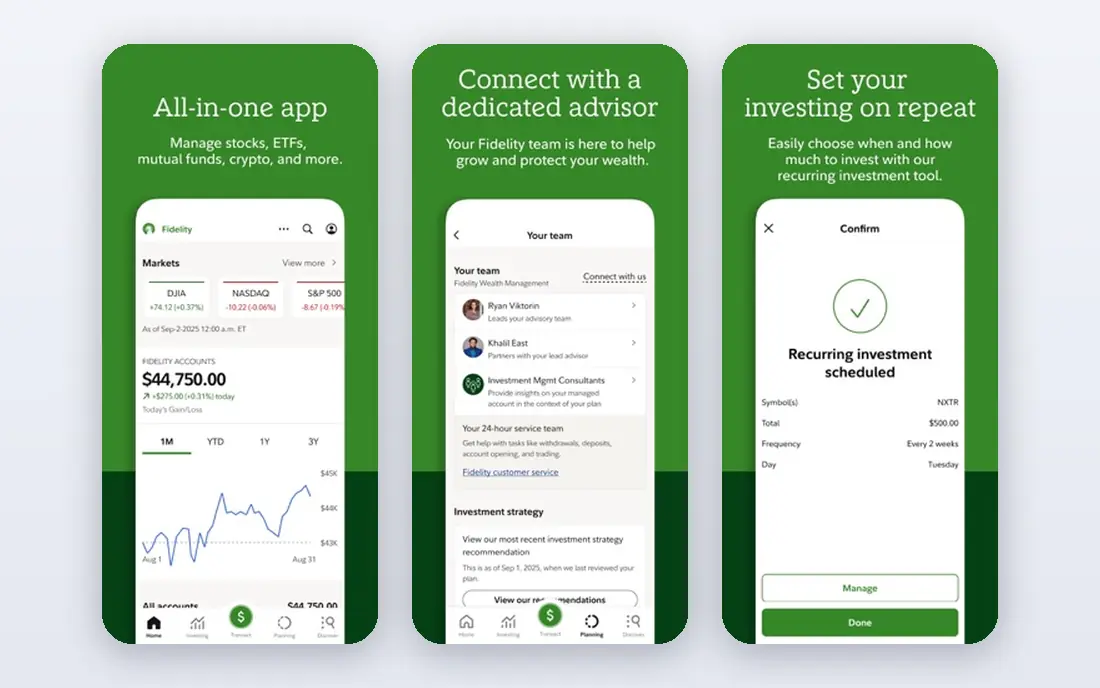
Fidelity is our pick for most people opening a Roth IRA. There is no minimum to open a retail IRA, and no account fee for most accounts, so a small first contribution is not eaten up by charges before it is invested.
If you want a managed version, Fidelity Go has no minimum to open, with advisory fees waived under 25,000 dollars and 0.35 percent per year at or above that level.
- No account minimum
- No commission on online US stock and ETF trades
- Wide fund menu including zero-expense-ratio index funds
- The breadth of tools can feel busy for a first-time investor
- Some advisory services carry separate fees
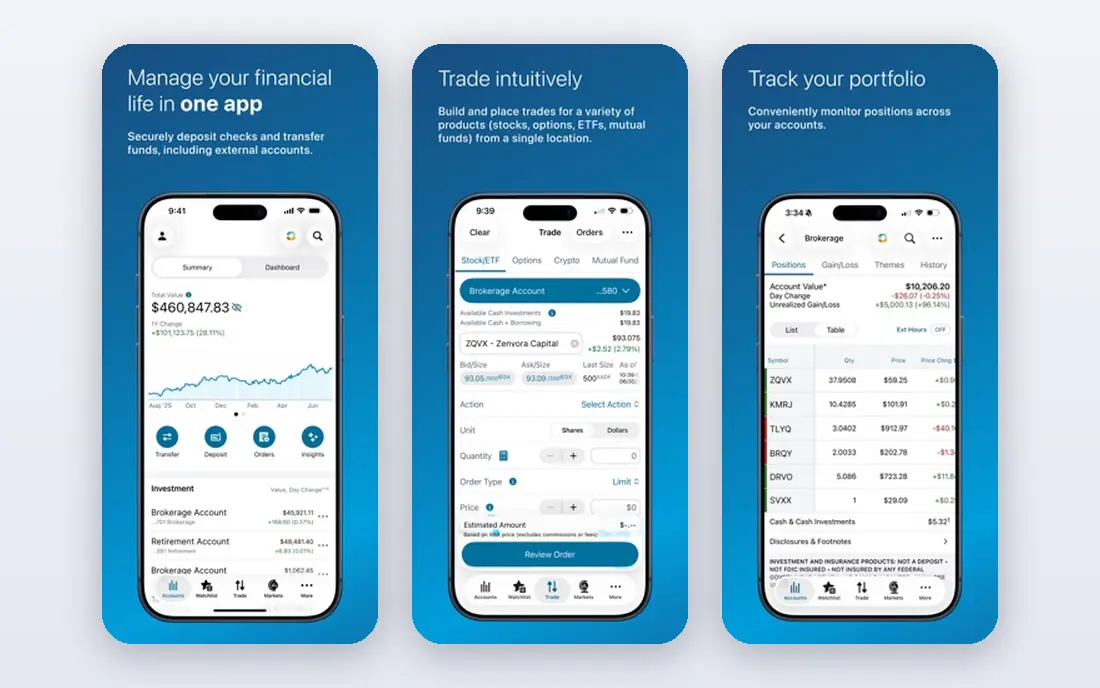
Schwab pairs a full online brokerage with in-person branches, which still matters to savers who want to talk through a rollover or a first contribution face to face. Online stock and ETF trades carry no commission, and Schwab index mutual funds can start at 1 dollar, which keeps small, regular investing practical.
The catch is Schwab Intelligent Portfolios, its managed option. It charges no advisory fee, but it requires 5,000 dollars to start and holds a cash allocation that can drag on returns in strong markets.
- No account minimum
- No commission on online stock and ETF trades
- Large branch network and research library
- Its robo-advisor requires a 5,000 dollar minimum
- Options trades cost 0.65 dollars per contract
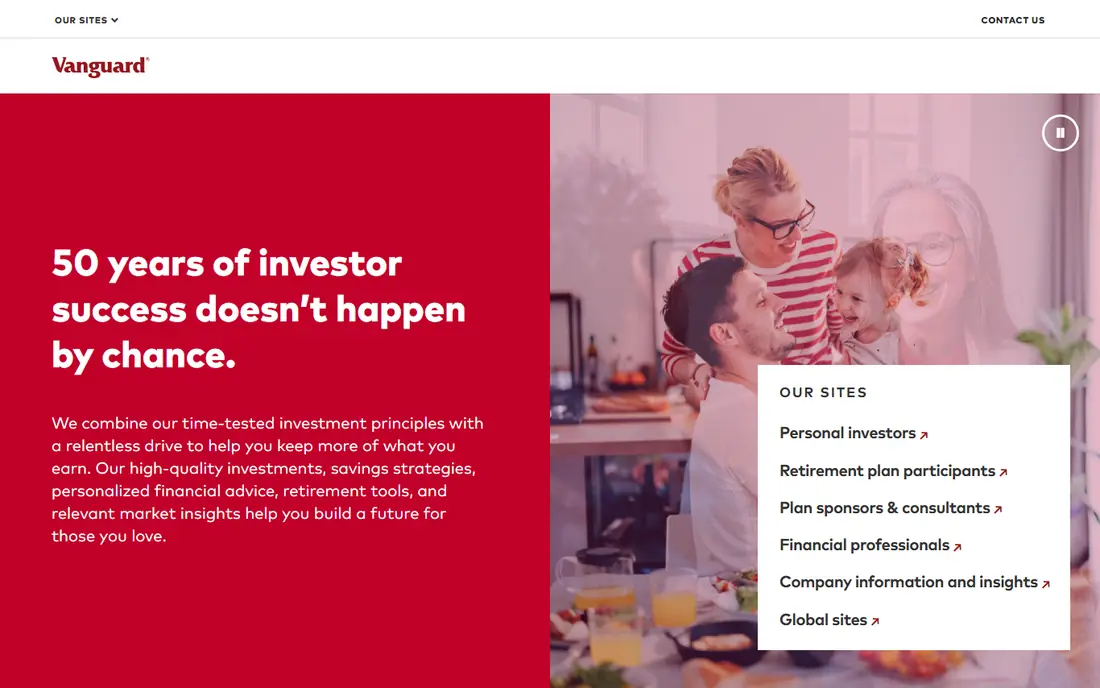
Vanguard built its name on low-cost index investing, and that focus still shows in a Roth IRA. Its ETFs trade commission free online, and its target-date funds give a one-fund answer for savers who do not want to rebalance by hand. If your plan is to buy a broad index fund or a target-date fund and add money on a schedule, Vanguard does that job with very little friction and very low fund costs.
The main drawback is the minimum on many mutual funds, so small savers often start with ETFs instead. The digital experience is also less polished than Fidelity or Schwab. Vanguard suits patient, buy-and-hold investors who care more about fund costs than about a slick app.
- Very low-cost index funds and ETFs
- Strong target-date funds
- Long record of investor-first pricing
- Many mutual funds require 1,000 to 3,000 dollars
- The website and app feel dated next to newer brokers
SoFi is a good fit for savers who want investing, banking, and planning in one app and do not want to sort through a huge fund catalog. Self-directed Roth IRAs carry no annual fee, and you can start investing with 5 dollars through fractional shares. The interface is clean, the educational material is written for beginners, and a 1 percent match on eligible IRA contributions is offered, subject to a holding period, which can add a small boost if you stay put.
SoFi does not offer the same depth of research or fund choice as the large brokerages. SoFi works best for a first Roth IRA that you plan to fund steadily and leave alone, rather than for active trading or complex fund research.
- No annual account fee on self-directed IRAs
- Fractional shares from 5 dollars
- Access to financial planners
- Outgoing transfer fee of 100 dollars
- Robo-advisor option costs 0.25 percent per year
Merrill Edge is the natural choice if you already bank with Bank of America, since accounts, transfers, and rewards can sit in one place. A Roth IRA here carries no account minimum and no commission on online stock and ETF trades, and the fund menu includes a wide range of mutual funds and ETFs. Customers in the Bank of America Preferred Rewards program can also earn extra benefits, such as bonus credit card rewards, based on combined balances.
If you value one login for banking and retirement, and you like the idea of rewards tied to your balance, Merrill is a strong pick.
- No account minimum
- No commission on online stock and ETF trades
- Preferred Rewards can cut costs further
- Research and guidance feel tied to the wider bank relationship
- Options trades cost 0.65 dollars per contract
E*TRADE, now part of Morgan Stanley, is built for investors who like to research and trade for themselves. A Roth IRA carries no account minimum and no commission on online stock and ETF trades, and the platform offers detailed charts, screeners, and options tools that go well beyond a basic fund picker. That depth is useful if you plan to hold individual stocks alongside index funds, or if you want to compare funds on costs, holdings, and performance before buying.
The drawback is that E*TRADE does not offer fractional shares in its core brokerage in the way Fidelity and Schwab do, so small contributions cannot always buy into a high-priced stock or ETF in slices.
- No account minimum
- No commission on online stock and ETF trades
- Strong charting and screening tools
- No fractional share trading in the core platform
- The toolset can overwhelm beginners
Robinhood Retirement stands out for one reason: the match. Self-directed IRA contributions earn a 1 percent match, rising to 3 percent with Robinhood Gold, which costs 5 dollars per month or 50 dollars per year. The app is fast, the account opens with no minimum, and fractional orders from 1 dollar make it easy to invest a small paycheck contribution right away. For a young saver who might otherwise delay opening an account, that simplicity has real value.
The limits are clear and should be weighed before you chase the match. Robinhood does not offer mutual funds, so target-date mutual funds are off the table, and managed Strategies accounts are excluded from the contribution match. Match money generally must stay in place for five years, and moving the account out costs 100 dollars. Robinhood fits mobile-first savers who are happy with stocks and ETFs and who plan to stay put. It is a weaker fit for savers who want mutual funds or a managed portfolio.
- No account minimum
- 1 percent IRA contribution match, or 3 percent with Gold
- Fractional orders from 1 dollar
- No mutual funds
- Outgoing transfer fee of 100 dollars
- Match assets carry a five-year holding condition
Betterment is a managed investing service, not a traditional brokerage, and that difference defines who should use it. You answer questions about your goal and risk tolerance, Betterment builds a diversified ETF portfolio, and it rebalances for you. There is no required minimum balance, and the standard digital plan costs 5 dollars per month when household balances are below 24,000 dollars with small recurring deposits, or 0.25 percent per year otherwise. A premium tier at 0.65 percent per year adds access to certified financial planners from 100,000 dollars.
That convenience has a cost and a trade. You cannot pick individual stocks, and the annual fee, while modest, will exceed the fund-only cost of a self-directed index portfolio over decades. Betterment suits savers who know they will not rebalance on their own, who want a clear goal view, and who would rather pay a small fee than manage holdings. It is not the right home for hands-on investors who want full control of each holding.
- No required minimum balance
- Automatic rebalancing
- Goal-based planning and Roth conversion tools
- Managed fee applies
- No self-directed stock picking
- Outbound transfer costs 75 dollars per account
Wealthfront is another managed option, with an automated portfolio built from low-cost ETFs and rebalanced as markets move. The advisory fee is 0.25 percent per year, and the account minimum is 500 dollars. The onboarding is short, the portfolio explanation is plain, and the dashboard keeps the focus on the goal and the plan rather than on daily market moves. For savers who want to set a contribution schedule and stop thinking about asset allocation, that is the whole appeal.
The honest catch is that the fee buys convenience, not higher returns, and tax-loss harvesting, one of Wealthfront's best-known features, does not apply inside a Roth IRA, where gains are already tax free on qualified withdrawals.
- Automated diversified portfolios
- Automatic rebalancing
- Tax-loss harvesting in taxable accounts
- 500 dollar account minimum
- Advisory fee applies even in a Roth IRA
- Limited self-directed choice
How we picked these
We started with providers that offer a US retail Roth IRA today, are regulated brokerages or registered advisers, and publish clear fee and minimum information. We compared official pricing pages, account menus, and managed options, and we favored firms with no account fee, a broad fund or ETF menu, and a workable path for both beginners and experienced savers. We did not include firms whose Roth IRA is only available through an employer plan, or whose pricing could not be checked on an official page.
What to check before you open an account
Match the account to how you will invest
If you plan to buy one or two index funds and add money each month, a low-cost brokerage with fractional shares will serve you well. If you want a portfolio built for you, compare managed fees over ten years, not just in year one, since a small annual percentage compounds into real money. Write down how often you will contribute, and whether you will ever want individual stocks, mutual funds, or advice from a person.
Read the small fees before you fund
Commissions get the headlines, but transfer-out fees, closing fees, options contract fees, and advisory fees are where surprises hide. Check the outgoing transfer fee, the cost of an options trade if you ever plan to use options, and the minimum for any managed tier. A firm that looks free on day one can still charge 75 to 100 dollars to leave, so factor that into a long-term choice.
Check eligibility and contribution rules
You need earned income at least equal to your contribution, and the IRS sets an annual limit across all your IRAs, which was 7,500 dollars for 2026, with an extra 1,100 dollars at age 50 or older, according to Fidelity's summary of IRS limits. Income limits can also reduce or remove Roth eligibility, so check the current IRS phase-out ranges before you contribute. If you are over the limit, a traditional IRA contribution followed by a conversion is a separate tax decision that deserves professional advice.
Keep the habit simple
Set up automatic contributions, even small ones, and choose a portfolio you can hold through market drops. A Roth IRA rewards time in the market more than clever fund picking, so the best company is often the one whose app, statements, and support make it easiest to keep contributing. Review the account once or twice a year, and resist the urge to trade in and out of positions inside a retirement account.
Frequently asked questions
What is the best company to open a Roth IRA with?
For most self-directed savers, Fidelity or Charles Schwab is the safest starting point, because both offer no account minimum, no commission on online stock and ETF trades, and a wide fund menu. Vanguard is a strong alternative for index-only savers, while Betterment or Wealthfront suit people who want a managed portfolio. The best choice depends on whether you want to pick investments yourself or hand that job to a managed service.
What are the best companies to open a Roth IRA?
The strongest group includes Fidelity, Charles Schwab, Vanguard, SoFi, Merrill Edge, and E*TRADE for self-directed accounts, plus Betterment and Wealthfront for managed accounts. Robinhood adds a contribution match for mobile-first savers. Compare fees, fund minimums, transfer fees, and whether you want mutual funds, since not every firm offers the same menu.
Is there a best company to open a Roth IRA with for beginners?
Fidelity and SoFi are both beginner-friendly, with no account minimum, fractional shares, and plain educational material. Fidelity offers a wider fund menu and more research, while SoFi offers a simpler app and a managed option in the same place. Start with the firm whose interface you understand, and pick a broad index fund or target-date fund rather than a single stock.
What is the best company to open an IRA if I want a managed portfolio?
Betterment and Wealthfront are the clearest managed choices, with automated portfolios, rebalancing, and goal planning for an annual fee. Fidelity Go and Schwab Intelligent Portfolios are also managed, but their minimums and cash policies differ, so read those terms first. A managed account suits savers who will not rebalance on their own and who accept a fee for that service.
How much do I need to open a Roth IRA?
Most firms on this list let you open an account with no minimum, though some funds inside the account still carry minimums. Fidelity and Schwab allow opening with no minimum, and fractional shares let you invest small amounts. Wealthfront requires 500 dollars, and Schwab Intelligent Portfolios requires 5,000 dollars, so check the managed tier separately from the self-directed account.
Can I open a Roth IRA with more than one company?
Yes, you can hold Roth IRAs at more than one firm, but the annual IRS contribution limit applies across all your IRAs combined, not per account. Splitting accounts can complicate tracking, so most savers are better served by one main account and a clear contribution schedule. If you do hold more than one, keep a single record of total contributions for the tax year.
Sources
- https://www.fidelity.com/retirement/retirement-accounts
- https://www.fidelity.com/learning-center/smart-money/ira-contribution-limits
- https://www.schwab.com
- https://www.vanguard.com
- https://www.sofi.com
- https://www.merrilledge.com
- https://www.etrade.com
- https://www.robinhood.com
- https://www.betterment.com
- https://www.wealthfront.com
See where you really rank - block by block
ProMapRanker scans Google Maps across a grid of your service area. Simple monthly plans from $19, white-label on every plan.
Start freeKeep reading
 zscaler alternatives
Best Zscaler Alternatives in 2026
Looking for zscaler alternatives? We compare 9 SASE and zero trust platforms on architecture, data protection, pricing, and fit for your network and team.
Read → zapier alternatives free
Best Zapier Alternatives Free in 2026
Nine automation tools for zapier alternatives free in 2026, all with genuinely free tiers, plus free plan limits, starting prices and upgrade paths explained.
Read → which platform is best for online reputation
Which Platform Is Best for Online Reputation in 2026
Wondering which platform is best for online reputation? We compare 8 review, listing, and response tools for small and multi-location businesses and agencies.
Read →