 ProMapRanker
Best Company Size for a PEO in 2026

Key takeaways
- Most PEOs fit best between 10 and 100 employees, where payroll, benefits, and compliance work is heavy but a full HR team is not yet justified.
- Companies under 10 staff should compare Paychex PEO, DecisionHR, and Justworks carefully, since fees can outweigh benefits at very small size.
- Companies over 100 staff often need ADP TotalSource, Insperity, or TriNet, plus an in house HR lead for strategy and employee relations.
- The best size is not just headcount: multi state payroll, regulated work, and benefits needs can make a PEO worthwhile earlier, or push a larger firm toward an in house team.
- PEO pricing is usually quote based, so get a written per employee per month figure for your exact headcount and benefits scope before signing.
Quick comparison
| Pick | Great for | Pricing starts at | Free tier | |
|---|---|---|---|---|
 Justworks | 10 to 75 employees | See website | No | Visit |
 Rippling | 25 to 300 employees | See website | Free trial | Visit |
 Insperity | 50 to 200 employees | See website | No | Visit |
 ADP TotalSource | 75 to 200 employees | See website | No | Visit |
 TriNet | 50 to 250 employees | See website | No | Visit |
 Paychex PEO | 5 to 500 employees | See website | No | Visit |
 G&A Partners | 50 to 200 employees | See website | No | Visit |
 CoAdvantage | 10 to 250 employees | See website | No | Visit |
 DecisionHR | 1 to 500 employees | See website | No | Visit |
The best company size for a PEO
A PEO, or professional employer organization, shares employer duties with your company under a co employment agreement. It handles payroll tax filing, benefits purchasing, workers compensation, and compliance monitoring, while you keep control of daily work and hiring. The question is not only which PEO to pick, but at what size that deal makes sense. The nine PEOs below are matched to the company sizes where each one tends to fit best.
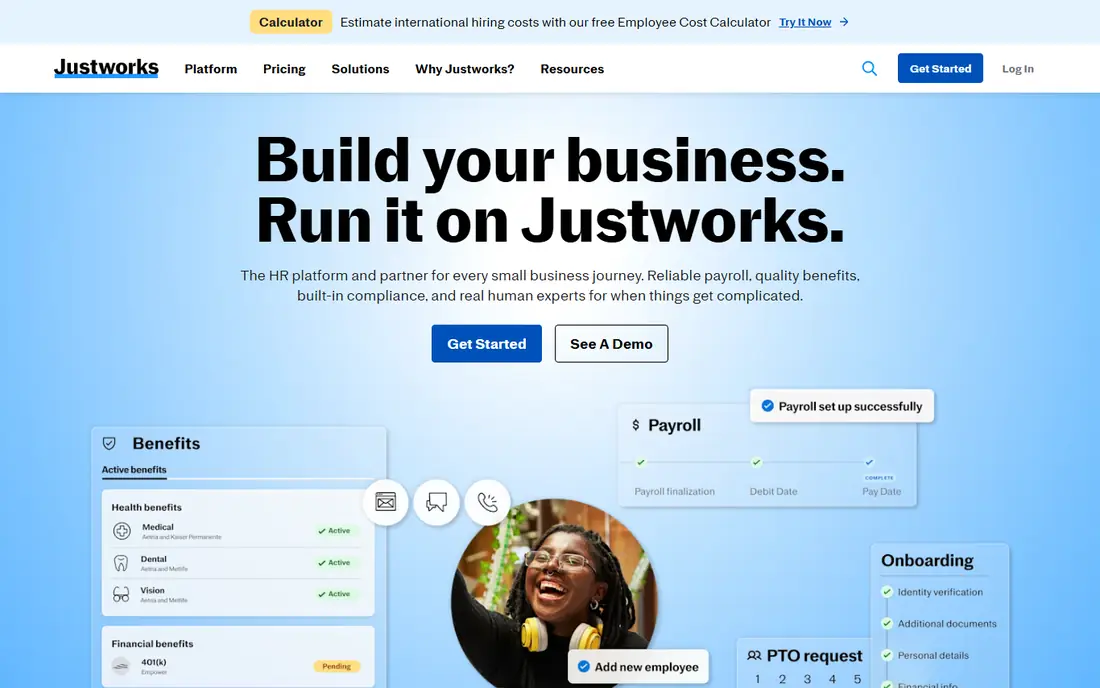
Justworks is the clearest pick for companies in the 10 to 75 range that want transparent pricing. It publishes flat per employee pricing in Basic and Plus tiers, which lets a founder budget without a long sales process. That clarity matters at small size, where an opaque quote can hide fees that only appear after signing.
The limit is service depth. Justworks is efficient and digital first, but it does not offer the named HR partner model that Insperity provides. For a 20 person team that needs clean payroll, benefits, and compliance, that is often enough. For a 150 person firm with complex employee relations needs, look further down this list.
- Published flat pricing tiers on its site
- Simple budgeting
- Good fit for small growing teams
- Less high touch service than some rivals
- Large complex firms may outgrow it
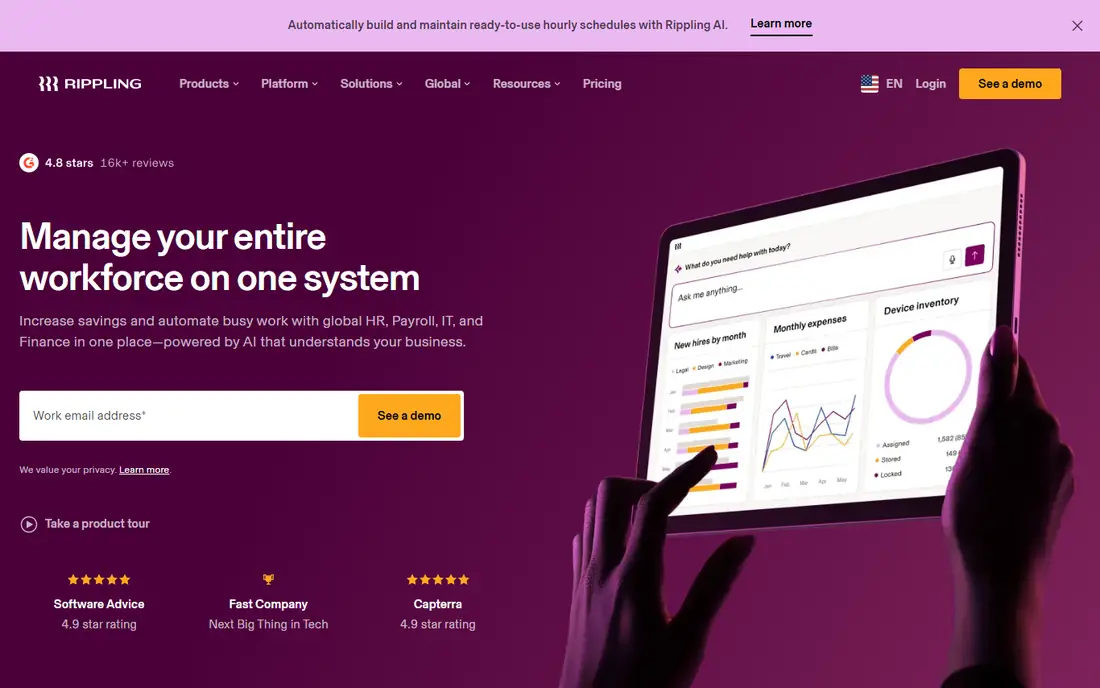
Rippling fits tech first companies in the 25 to 300 range that want HR, payroll, IT, and device provisioning in one platform. Instead of bolting a PEO onto separate tools, Rippling runs the PEO module inside the same system that onboards staff, issues devices, and manages apps. That unity helps distributed teams that hire across states.
Small firms under 25 may find Rippling broader than they need, and pricing for the PEO module requires a quote. Rippling earns its place when a company is growing fast, hires remotely, and wants one system for people and devices, not just payroll.
- HR, payroll, IT, and device management in one system
- Strong for tech first teams
- Scales well
- PEO module pricing is quote based
- Breadth can be more than a small team needs
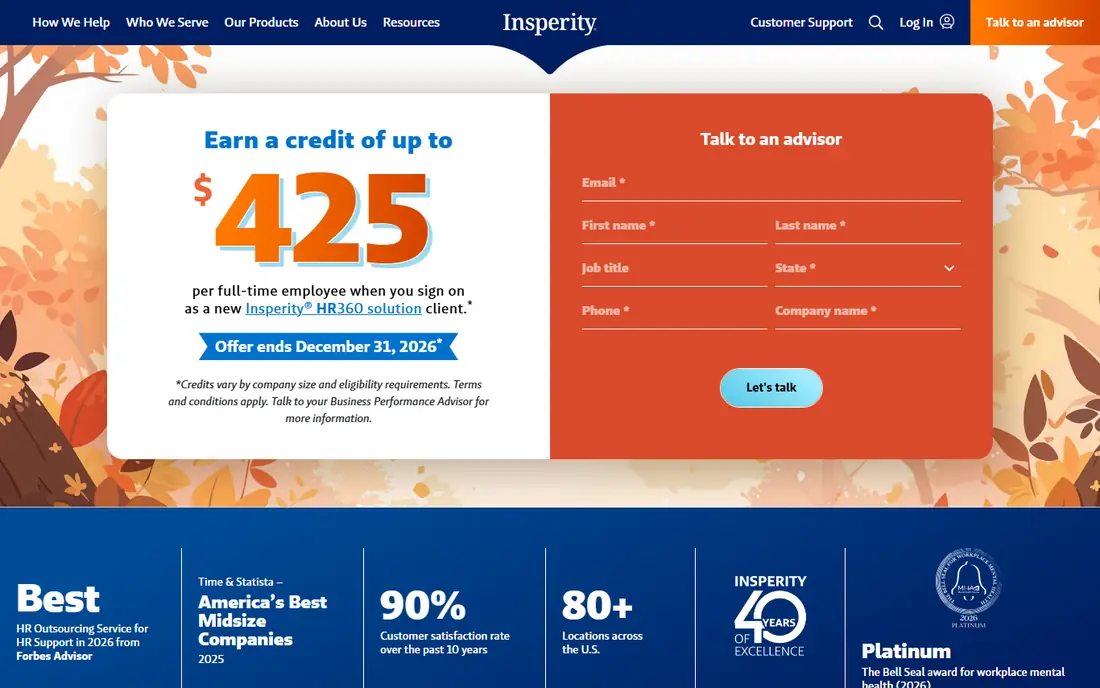
Insperity is built for companies in the 50 to 200 range that want a named HR partner, not a call center queue. With roughly 90 regional offices and dedicated service teams, Insperity gives clients a consistent contact for payroll, benefits, and HR guidance. Its benefits portfolio, including plans from major carriers, helps mid sized firms compete for talent against larger employers.
That service model is not the cheapest path for a ten person startup. Insperity makes sense once headcount, compliance risk, and employee relations work justify a higher touch partner. Below that size, a simpler digital PEO will usually cost less for the same core payroll and benefits job.
- Dedicated HR business partner
- Regional offices
- Strong benefits and training support
- Higher touch model costs more
- Small firms under 25 may find it heavy
ADP TotalSource is the largest PEO in the US by worksite employees, and it fits companies in the 75 to 200 range that want Fortune 500 grade benefits. Pooling employees across many clients gives mid sized firms access to health, dental, vision, and retirement plans that would be costly or unavailable on their own. ADP compliance depth across states is another reason larger firms choose it.
Small companies should be cautious. TotalSource is built for scale, and a 15 person firm may not get the personal service it wants from such a large system. Once a company passes 75 staff and benefits quality becomes a hiring tool, TotalSource becomes a strong contender.
- Largest PEO by worksite employees
- Fortune 500 grade benefit plans
- Deep compliance bench
- Enterprise scale process
- Small firms may feel lost in a large system
TriNet fits companies in the 50 to 250 range in its core verticals: technology, life sciences, and financial services. Its industry pods understand the benefits, compliance, and hiring patterns of those sectors, which can matter more than generic HR support. A life sciences firm with lab staff and a tech firm with remote engineers face different risks, and TriNet staffs for that difference.
Generalist firms outside those verticals may find less advantage here. TriNet still serves a broad range of companies, but its edge is sharpest inside its specialties. If your firm sits in one of those sectors and has passed 50 staff, TriNet deserves a quote alongside Insperity and ADP.
- Deep vertical specialization
- Tech, life sciences, and financial services expertise
- Strong benefits
- Vertical focus may not suit generalist firms
- Pricing is quote based
Paychex PEO is one of the few large PEOs with a band starting at just 5 employees, which makes it a serious option for very small firms that still need multi state compliance. Its payroll heritage gives it depth in tax filing and reporting, which matters for companies hiring across state lines early. The broad 5 to 500 range also means a small firm can grow without switching PEO.
The trade off is scale. Paychex is a large provider, and service can feel less personal than a regional PEO. For a five person firm, compare Paychex against Justworks and DecisionHR on total cost and service model, not on brand size alone.
- Band starts at 5 employees
- Deep multi state tax compliance
- Broad payroll heritage
- Large provider feel
- Service experience varies by team
G&A Partners fits companies in the 50 to 200 range that want personalized service teams rather than call center support. Dedicated account management gives clients a consistent team that knows their business, which helps when HR questions are sensitive or urgent. Its strength in Texas and the Sun Belt is an added reason for firms based there to quote it.
Companies outside its core regions should check service coverage and benefits networks in their states before committing. G&A Partners earns its place on service quality, so test that claim with references from firms of similar size in your state.
- Personalized service teams
- Dedicated account management
- Strong in Texas and the Sun Belt
- Regional strength may suit some states better than others
- Smaller national footprint
CoAdvantage fits small businesses in the 10 to 250 range, with particular strength in Florida and the Southeast. Workers compensation pooling and competitive per employee pricing help small firms control a cost that can be painful in higher risk industries. For a Southeast firm that needs a PEO without enterprise overhead, CoAdvantage is a practical quote.
National firms with staff spread across many states may find a larger PEO simpler. CoAdvantage is best judged on local fit: benefits, workers compensation, and service in the states where your staff actually work.
- Workers compensation pooling
- Competitive small business pricing
- Strong in Florida and the Southeast
- Regional focus
- Less suited to firms outside its core states
DecisionHR is notable because its intake ranges start at a single worksite employee, which makes it one of the few PEOs a one or two person firm can even consider. It is IRS certified, which gives added assurance on tax and compliance handling, and its range runs to 500 plus employees, so a tiny firm can grow without switching providers.
Very small firms should still run the math. A PEO fee on one or two employees can outweigh the benefits saving, and a simple payroll tool plus a broker may cost less until headcount grows. DecisionHR belongs on the list for micro firms that need co employment, compliance, and workers compensation from day one, not as a default for every solo founder.
- Intake from a single worksite employee
- IRS certified
- Broad size range
- Smaller brand than ADP or Insperity
- Check benefits networks in your state
How we picked these
We compared PEO size guides, vendor pages, and small business PEO comparisons from 2026. We favored PEOs with a stated size band, a live official homepage, and a clear service model, and we matched each PEO to the size range where published comparisons place its sweet spot. Prices are marked See website because PEO fees are quote based and depend on headcount, benefits, and risk.
How to decide if your size fits a PEO
Use headcount as a starting point, not as a final answer. A 15 person firm with staff in five states, regulated work, and no HR help may benefit from a PEO sooner than a 40 person firm in one state with simple payroll. Conversely, a 120 person firm with a strong in house HR lead may keep benefits in house and use a PEO only for payroll and compliance, or move to an administrative services model instead.
Run the total cost, not just the per employee fee. Add the PEO administration fee, benefits pass through costs, workers compensation, and any setup or termination fees, then compare that total against hiring an HR manager, which can cost 85,000 to 120,000 dollars fully loaded for a mid level role. Many scaling firms land on both: a PEO for infrastructure, plus one HR professional for strategy, added between 75 and 150 employees. That hybrid often beats either choice alone.
Frequently asked questions
What size company benefits most from a PEO?
Most guides point to roughly 10 to 100 employees, where payroll, benefits, and compliance work is heavy but a full HR team is not yet justified. Some PEOs serve firms from 5 employees, and larger firms to 500, so the range is wide and depends on complexity, not headcount alone.
Is a PEO worth it for a company with fewer than 10 employees?
Sometimes, but fees can outweigh benefits at very small size. Compare a PEO quote against a payroll tool plus a benefits broker, and check whether the PEO benefits saving covers its administration fee. Firms with multi state staff, regulated work, or workers compensation needs have a stronger case at small size.
At what size should a company leave a PEO and hire in house HR?
Many firms add an in house HR lead between 75 and 150 employees, while keeping a PEO for infrastructure, then reassess full in house HR above 200 staff. The trigger is usually strategy work, such as org design, culture, and sensitive employee relations, that a shared PEO team cannot own.
Does a PEO replace the employer?
No. A PEO uses co employment: the PEO handles administrative employer duties such as payroll tax, benefits, and workers compensation, while your company keeps control of daily work, hiring, and management. Read the service agreement to confirm exactly which duties transfer.
How is PEO pricing calculated?
Most PEOs charge a per employee per month fee, or a percentage of payroll, plus pass through costs for benefits and workers compensation. Get a written figure for your exact headcount and benefits scope, and ask about setup, minimum, and termination fees before signing.
Can a company use a PEO if it already has HR staff?
Yes. Many companies use a PEO to handle administrative work while an in house HR lead focuses on strategy, culture, and employee relations. That hybrid is common for firms between 75 and 200 employees.
Sources
See where you really rank - block by block
ProMapRanker scans Google Maps across a grid of your service area. Simple monthly plans from $19, white-label on every plan.
Start freeKeep reading
 zscaler alternatives
Best Zscaler Alternatives in 2026
Looking for zscaler alternatives? We compare 9 SASE and zero trust platforms on architecture, data protection, pricing, and fit for your network and team.
Read → zapier alternatives free
Best Zapier Alternatives Free in 2026
Nine automation tools for zapier alternatives free in 2026, all with genuinely free tiers, plus free plan limits, starting prices and upgrade paths explained.
Read → which platform is best for online reputation
Which Platform Is Best for Online Reputation in 2026
Wondering which platform is best for online reputation? We compare 8 review, listing, and response tools for small and multi-location businesses and agencies.
Read →