 ProMapRanker
The best companies for mba graduates in 2026


Strategy consulting for MBAs · Pricing starts at: See website
Key takeaways
- McKinsey, BCG, and Bain remain the largest consulting recruiters of MBAs, with structured associate roles and global staffing.
- Amazon, Google, and Microsoft hire large MBA cohorts into product, program, and strategy roles, with tech pay and internal mobility.
- Goldman Sachs and JPMorgan Chase lead finance hiring for MBAs, with investment banking and corporate strategy paths.
- Deloitte offers a broader mix of consulting, strategy, and industry roles, which suits MBAs who want variety without pure strategy work.
- The best employer depends on function, location, and work style, not just salary, so compare role type, travel, and promotion pace.
Quick comparison
| Pick | Great for | Pricing starts at | Free tier | |
|---|---|---|---|---|
| McKinsey and Company | Strategy consulting for MBAs | See website | No | Visit |
 Boston Consulting Group | Consulting with global staffing | See website | No | Visit |
 Bain and Company | Consulting with team-focused culture | See website | No | Visit |
 Deloitte | Broad consulting and strategy roles | See website | No | Visit |
 Amazon | Product and operations roles at scale | See website | No | Visit |
 Google | Product and strategy roles in tech | See website | No | Visit |
 Microsoft | Program and product roles in tech | See website | No | Visit |
 Goldman Sachs | Investment banking for MBAs | See website | No | Visit |
 JPMorgan Chase | Finance and strategy roles at scale | See website | No | Visit |
The best companies for mba graduates
We compared school employment reports, official careers pages, and public hiring data to find employers that hire MBAs in large numbers and across functions in 2026. Each employer below is framed as an employer for MBA graduates, not as a software product, and each hires MBAs into distinct roles with different pay, travel, and career paths.
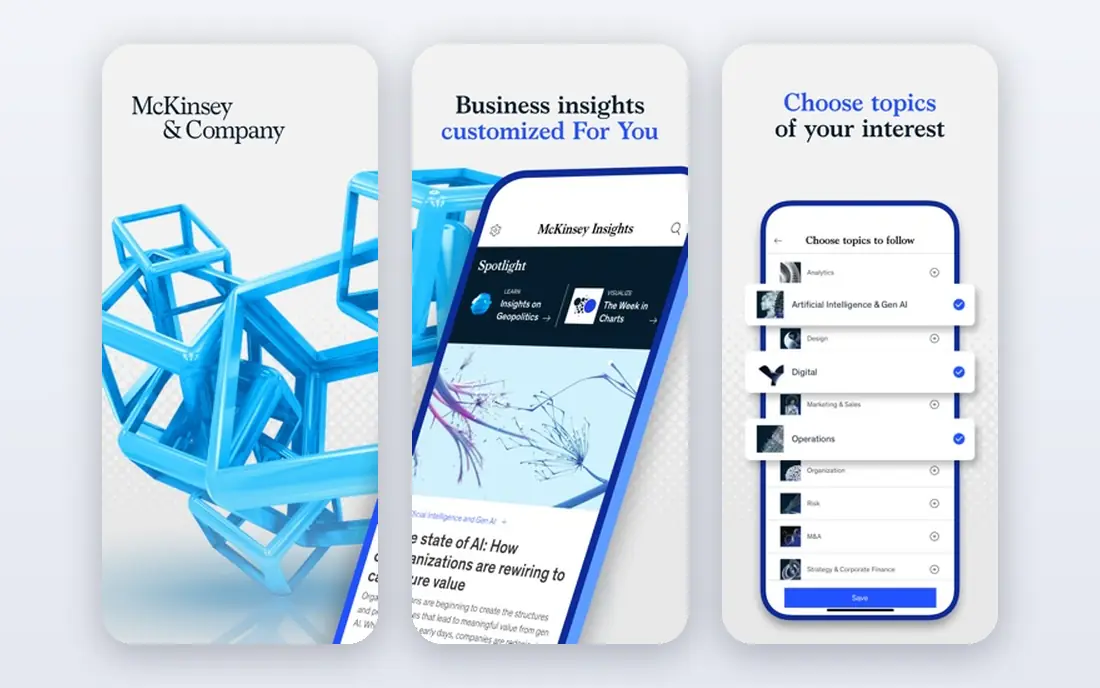
McKinsey hires MBAs as associates into strategy consulting, working on problems across industries such as healthcare, energy, finance, and technology. Associates join teams that analyze data, interview clients, build recommendations, and present to senior leaders, with training, mentorship, and global staffing that lets them work across offices. For MBAs who want fast skill growth, broad industry exposure, and a strong alumni network, McKinsey remains the benchmark consulting employer. The trade-offs are well known. Hours can be long, travel can be heavy, and the case interview process is demanding, with multiple rounds and strict selection. Promotion is structured but competitive, and many associates leave after a few years for industry roles. McKinsey suits MBAs who want consulting intensity, global exposure, and a launchpad for later leadership roles.
- Largest MBA consulting recruiter
- Structured associate path
- Global offices and clients
- Long hours and heavy travel on many projects
- Highly selective hiring
Boston Consulting Group, known as BCG, hires MBAs as consultants and associates into case teams that solve strategy, operations, and transformation problems for clients worldwide. Its model pairs junior consultants with experienced managers and partners, with training in analysis, client communication, and problem solving. BCG offices span many countries, and MBAs can often request staffing preferences, though project needs decide final assignments. BCG hiring is selective, with case interviews that test structured thinking and quantitative skills. Project intensity varies, and travel and hours can be high during busy periods. For MBAs who want a top consulting brand, strong mentorship, and global project variety, BCG is a leading choice alongside McKinsey and Bain.
- Large MBA hiring
- Case-team model with mentorship
- Strong global office network
- Demanding case interviews
- Work-life balance varies by project

Bain hires MBAs as associate consultants, working in small teams on strategy, private equity diligence, and operational improvement projects. Its culture stresses teamwork, mentorship, and results, and its private equity practice gives MBAs exposure to investment work that many other firms do not offer at the same scale. Bain offices are global, and its alumni network is strong in consulting, private equity, and corporate leadership. As with other top consulting firms, Bain interviews are rigorous and case-based, and project work can involve long hours and travel. The firm suits MBAs who want a collaborative team culture, private equity exposure, and a consulting career with clear promotion steps from associate consultant upward.
- Associate consultant path for MBAs
- Team culture focus
- Strong private equity links
- Selective hiring
- Hours and travel can be intense
Deloitte hires MBAs across consulting, strategy, risk, technology, and industry practices, with roles that range from strategy consulting to operational and digital work. That breadth is useful for MBAs who are not sure they want pure strategy consulting, since Deloitte offers paths into healthcare, financial services, technology, and public sector work under one employer. Its global scale also means many office locations and internal transfer options. Breadth has a cost. Experience can vary a lot by practice and team, and large-firm staffing and promotion processes can feel slower than boutique consulting. MBAs should target a specific practice and team, not just the Deloitte brand, and check project types before accepting. Deloitte suits MBAs who want consulting variety, scale, and many industry options.
- Large MBA hiring across practices
- Strategy plus industry roles
- Global scale
- Role quality varies by practice
- Large-firm processes can slow moves
Amazon is one of the largest MBA employers in technology, hiring graduates into product management, program management, operations, and path leadership roles across retail, cloud, devices, and logistics. Its scale means MBAs can move between businesses, from Amazon Web Services to consumer products, and build skills in data, pricing, and operations at a level few firms match. Amazon also hires MBAs through structured programs and internships that often convert to full-time roles. Amazon pace is fast, expectations are high, and team culture can vary widely, so the hiring manager and team matter as much as the company name. Some roles involve operations shifts or on-call duties that other tech firms do not. Amazon suits MBAs who want scale, ownership, and operational depth, and who thrive in a data-driven, fast-moving environment.
- Very large MBA hiring
- Product, program, and operations paths
- Internal mobility
- Fast pace and high bar culture
- Role experience varies by team
Google hires MBAs into product management, strategy and operations, partnerships, and program roles across search, cloud, advertising, and hardware. Its appeal for MBAs is the mix of product ownership, data-driven decision making, and strong benefits, plus the chance to work on products used by billions of people. Internal mobility lets MBAs move between teams and product areas over time, which helps long-term career growth. Google hiring is highly selective, and MBA-specific openings are fewer than engineering roles, so competition is strong. Interview processes can be long, with several rounds focused on product sense, analysis, and leadership. Google suits MBAs who want product leadership in tech, with strong analytical skills and a preference for large-scale consumer and cloud products.
- Product and strategy roles for MBAs
- Strong pay and benefits
- Internal mobility
- Highly selective
- MBA roles are fewer than engineering roles
Microsoft hires MBAs into product management, program management, strategy, and business roles across cloud, AI, productivity software, and gaming. Its cloud and AI growth gives MBAs exposure to enterprise customers and large-scale platforms, while its size offers many teams, locations, and internal moves. Microsoft benefits and work-life balance are often cited as strengths compared with faster-paced tech peers. Large-company work can feel slower than startup or consulting pace, and role scope varies by team, so MBAs should check team goals and manager style. Hiring is selective, though less narrowly focused on case interviews than consulting. Microsoft suits MBAs who want tech product careers with stability, enterprise scale, and long-term growth paths.
- Product and program roles for MBAs
- Cloud and AI growth
- Stable large-tech employer
- Large-company pace
- Role scope varies by team
Goldman Sachs hires MBAs as investment banking associates, working on mergers, acquisitions, financing, and advisory work for corporate clients. Associates build financial models, prepare client materials, and support deal execution, with training and mentorship from senior bankers. For MBAs who want finance careers, Goldman offers deal exposure, a strong brand, and exit options into private equity, corporate development, and investing roles. Investment banking hours are famously long, especially during live deals, and the work can be intense for years. Hiring is highly competitive, with a focus on finance skills, deal interest, and prior experience. Goldman suits MBAs who want investment banking as a career or as a launchpad, and who accept the hours in exchange for deal experience and pay.
- Leading MBA investment banking recruiter
- Associate path
- Strong deal exposure
- Very long hours in banking
- Highly selective and competitive
JPMorgan Chase hires MBAs across investment banking, corporate strategy, commercial banking, asset management, and operations, making it one of the broadest finance employers for graduates. That range suits MBAs who want finance careers but are not fixed on investment banking alone, since internal moves and varied divisions offer different paces and focuses. Its global scale also provides many office locations and client types. As a very large bank, JPMorgan Chase processes can feel formal, and experience varies by division and team. Investment banking roles still carry long hours, while corporate and strategy roles tend to be steadier. MBAs should target a division and team, and check hours and promotion paths for that specific path. JPMorgan Chase suits MBAs who want finance scale, variety, and a strong brand across banking.
- Large MBA hiring across banking
- Corporate strategy and investment banking paths
- Global scale
- Large-bank processes
- Role experience varies by division
How we picked these
We compared school employment reports, official careers pages, and public hiring data, and we kept employers that hire MBAs in significant numbers across consulting, technology, and finance in 2026. We looked for structured MBA roles, internship-to-offer paths, and repeat hiring from top MBA programs, rather than firms with only occasional MBA hires. We left out firms with no clear MBA hiring track and firms whose MBA claims could not be checked against employment reports or official pages. Pay varies by role, location, and year, so check current offers and school reports for your target program before deciding.
How to choose among MBA employers
Pick the function first, then the firm
Consulting, product management, and investment banking lead to different daily work, hours, and exit options. Decide which function fits your skills and life, then compare firms inside that function on team, manager, and project types.
Compare total pay and promotion pace
Base salary is only part of the offer. Compare signing bonuses, annual bonuses, stock, benefits, and promotion timelines, and ask alumni about real hours and attrition. A higher headline salary with slow promotion may be worth less over five years than a steadier path.
Use internships and alumni as a test
Summer internships, coffee chats, and alumni conversations reveal team culture better than brand rankings. Ask about manager style, staffing, travel, and internal moves, and treat a strong internship team as a signal for full-time fit.
Frequently asked questions
Which companies hire the most MBA graduates?
McKinsey, Amazon, Deloitte, BCG, and Bain consistently rank among the largest MBA employers by headcount, with Google, Microsoft, Goldman Sachs, and JPMorgan Chase also hiring large cohorts each year.
Do I need prior consulting or finance experience for these firms?
It helps, but it is not always required. Consulting firms test structured thinking through case interviews, tech firms test product sense, and banks test finance skills, so preparation should match the function you target.
What is the best company for an MBA who wants work-life balance?
Balance varies more by team and function than by firm alone. Corporate strategy and some tech program roles tend to be steadier than investment banking or strategy consulting, so check team hours before accepting.
How much do MBA graduates earn at these companies?
Total pay varies by role, location, and firm, with top consulting and banking roles often reaching high six figures in total compensation in the US. Check current school employment reports for median pay by industry.
Should I choose consulting or tech after an MBA?
Consulting gives broad exposure and fast skill growth with heavy travel, while tech product roles give ownership of a product with steadier hours. Your interest in breadth versus depth, and your tolerance for travel, should guide the choice.
Can MBAs move between these firms later?
Yes. Consulting alumni often move into tech product and corporate strategy roles, bankers move into private equity and corporate development, and tech managers move across firms. Early function choice shapes, but does not lock, later moves.
Sources
See where you really rank - block by block
ProMapRanker scans Google Maps across a grid of your service area. Simple monthly plans from $19, white-label on every plan.
Start freeKeep reading
 worlds best local seo company
8 Worlds Best Local SEO Companies for Map Pack Growth in 2026
Compare the worlds best local seo company options for Google Business Profile work, citations, reviews, and multi-location rankings and reporting in 2026.
Read → world's best web hosting company
World's Best Web Hosting Company in 2026
Searching for the world's best web hosting company? We compared 10 hosts on price, renewal rates, speed, and support to help you choose well today in 2026.
Read → who's got the best nanny tax services
Who's Got the Best Nanny Tax Services in 2026
We answer who's got the best nanny tax services, comparing full filing, back taxes, software, and pricing so families can handle nanny taxes correctly.
Read →