 ProMapRanker
Best Companies for Investing in 2026

Key takeaways
- Fidelity, Schwab, Vanguard, E*TRADE, Robinhood, Webull, SoFi, and Interactive Brokers all offer $0 commissions on US stock and ETF trades.
- Fidelity stands out for research, education, and zero-expense index funds, while Schwab stands out for thinkorswim and branch support.
- Vanguard suits committed buy-and-hold index investors, while Interactive Brokers suits global and advanced traders.
- Robinhood and Webull suit mobile-first traders, while SoFi suits readers who want investing alongside banking and loans.
- This is not financial advice, and investing carries risk, including loss of principal.
Quick comparison
| Pick | Great for | Pricing starts at | Free tier | |
|---|---|---|---|---|
 Fidelity | Best overall for most investors | Free | Yes | Visit |
 Charles Schwab | Active traders and branch support | Free | Yes | Visit |
 Vanguard | Buy-and-hold index investing | Free | Yes | Visit |
 Robinhood | Mobile-first beginners | Free | Yes | Visit |
 Interactive Brokers | Global and advanced trading | Free | Yes | Visit |
 E*TRADE | Education and intermediate traders | Free | Yes | Visit |
 Webull | Active mobile traders | Free | Yes | Visit |
 SoFi Invest | Investing plus banking | Free | Yes | Visit |
The best companies for investing
This is not financial advice, and investing carries risk. We compared official pricing pages, account features, and current 2026 brokerage roundups, and we kept only companies that are live in the United States in October 2026, offer brokerage accounts to retail investors, and publish $0 stock and ETF commission terms. We compared companies on publicly reported factors such as commissions, account minimums, fund choice, tools, and support, and we did not invent scores, returns, or rankings beyond those factors.
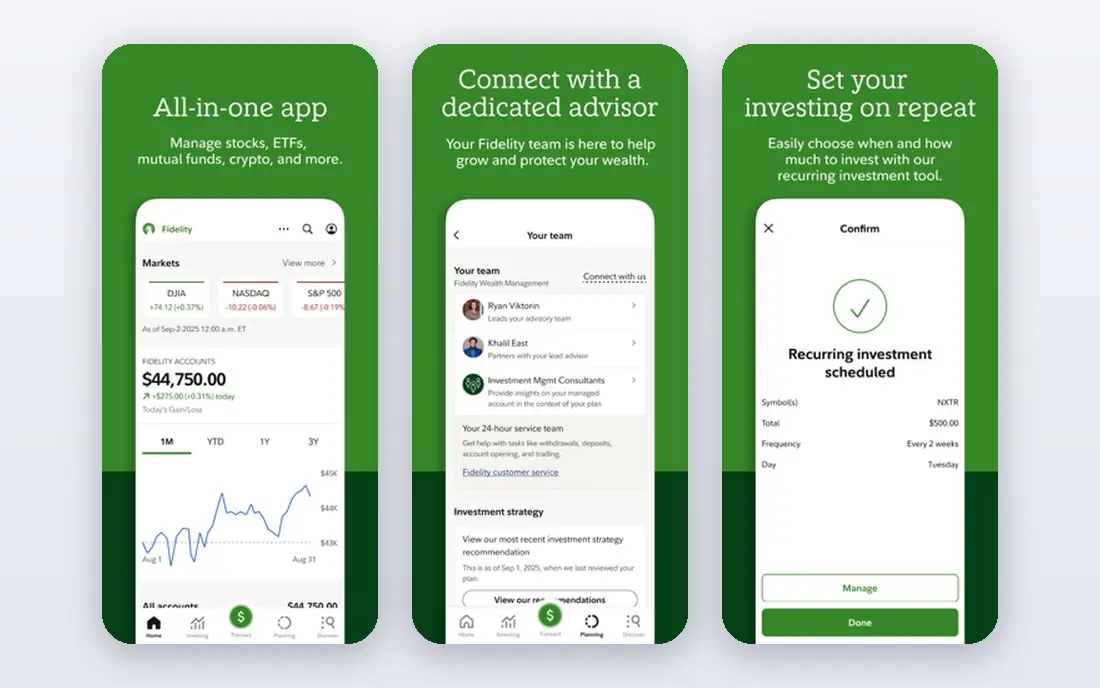
Fidelity is our pick for most investors because it covers the widest range of needs at low cost. It offers $0 commissions on US stock and ETF trades, no account minimum, fractional shares from $1, and zero-expense index funds that are exclusive to Fidelity accounts. Its research library, education content, and retirement tools suit both new investors and long-term savers.
The main drawback is breadth itself. New investors may find the platform busy at first, with many tools, account types, and fund choices. Start with a simple index fund or ETF portfolio, use the education hub for basics, and add advanced tools only when you need them.
- $0 stock and ETF commissions
- No account minimum
- Zero-expense index funds
- Strong research and education
- Options cost $0.65 per contract
- Interface can feel busy for absolute beginners
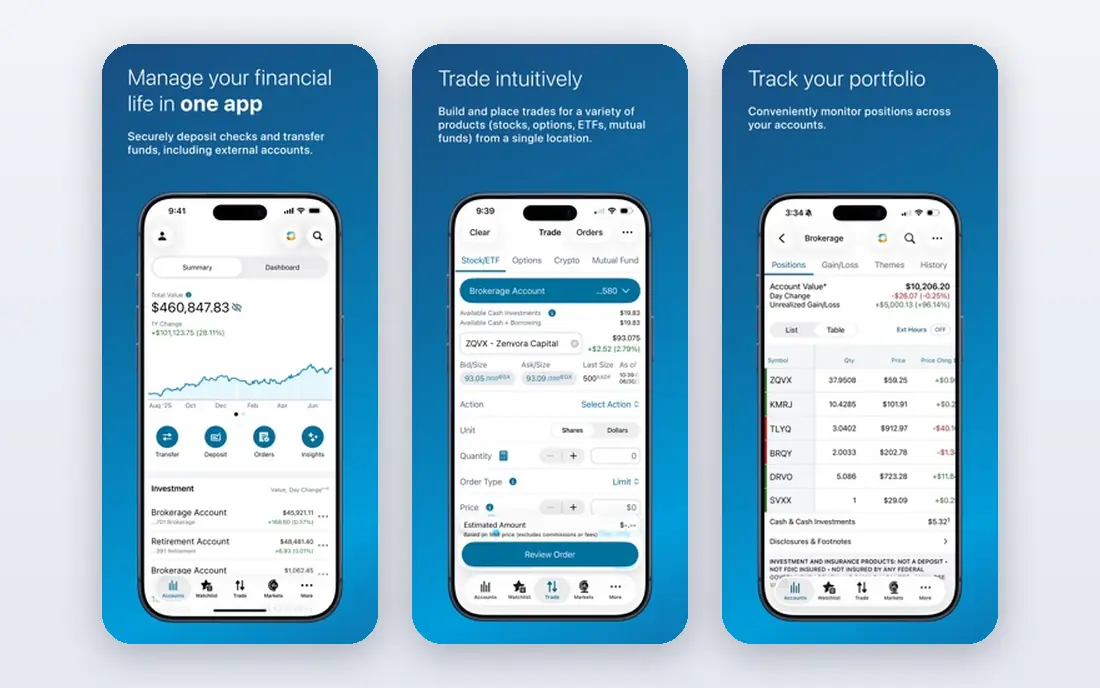
Schwab suits investors who want a full-service broker at DIY prices. Its thinkorswim platform, inherited from TD Ameritrade, gives active traders advanced charting, paper trading, and options tools, while its branch network gives investors a place to meet a consultant in person. Customer service is available around the clock in published listings.
The catch is idle cash. Schwab's default cash sweep often yields far less than a money market fund, so investors who hold large cash balances should check sweep options and choose a higher-yield fund where offered. For most stock and ETF investors, that detail matters less than platform quality and support.
- $0 stock and ETF commissions
- Thinkorswim platform
- 400 plus US branches
- Strong customer service
- Options cost $0.65 per contract
- Default cash sweep yields are often low unless you choose another fund
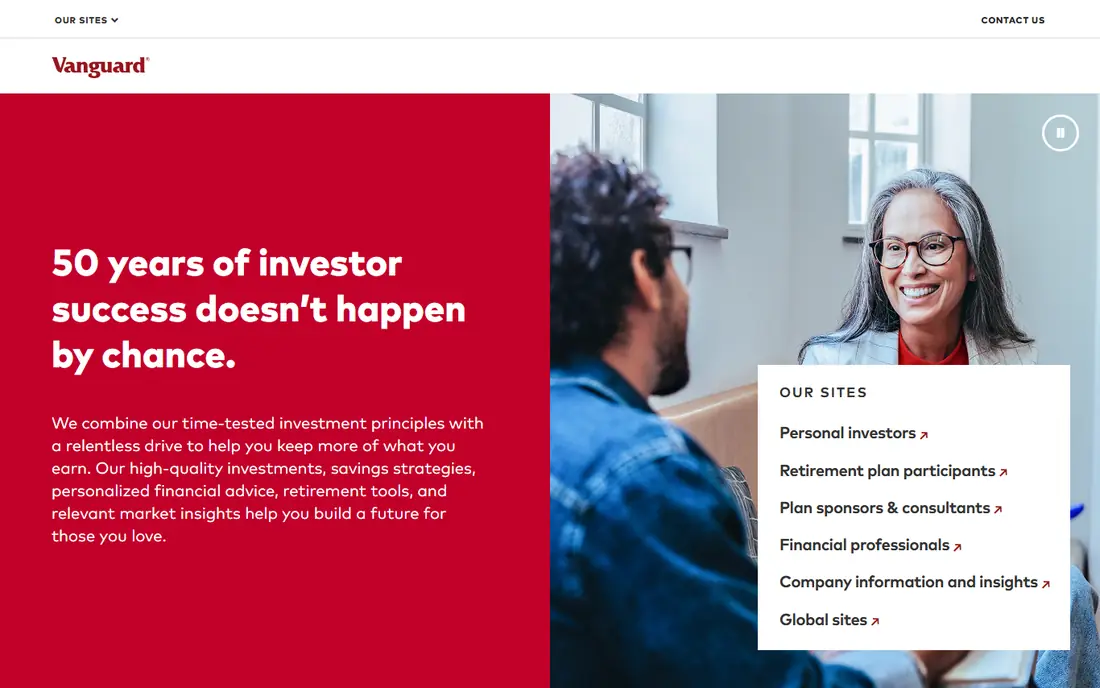
Vanguard is the natural pick for committed buy-and-hold investors. It invented index fund investing for retail investors, and its low-cost funds and ETFs, such as broad-market index funds, remain a benchmark for cost. Its retirement accounts and automatic investing tools suit savers who want to set a plan and leave it alone.
The trade-off is user experience. Vanguard's app and website are simpler and less polished than Fidelity or Schwab, and its options pricing is higher at $1.00 per contract. If you trade rarely and hold index funds for years, those limits rarely matter. If you trade often, a more active platform will feel better.
- $0 stock and ETF commissions
- Low-cost index funds and ETFs
- Strong retirement focus
- Options cost $1.00 per contract
- App and website feel simpler than Fidelity or Schwab
Robinhood suits beginners who want a clean mobile app and no friction to start. It offers $0 commissions on stock, ETF, and options trades, fractional shares from $1, and crypto trading in the same app in supported regions. Robinhood Gold at $5 per month adds a 3 percent IRA contribution match in published listings and higher cash yields.
Research is the weak point. Robinhood's tools and education are thinner than Fidelity, Schwab, or E*TRADE, so investors who want deep research will need outside sources. Customer support is also more app-based than branch-based, which suits mobile users but not investors who want in-person help.
- $0 stock, ETF, and options commissions
- Simple mobile app
- Fractional shares from $1
- IRA match with Gold
- Research and education are thinner than Fidelity or Schwab
- Gold costs $5 per month
Interactive Brokers suits advanced and international traders who need more than US markets. Its Lite plan offers $0 commissions on US stock and ETF trades, while its Pro plan adds volume-based pricing and access to a very wide range of global markets, currencies, and asset types. Margin rates are among the lowest published by major brokers.
Complexity is the price of that breadth. The platform has many order types, settings, and tools, and beginners can feel lost. If you trade only US stocks and ETFs, a simpler broker will serve you better. If you trade globally or need advanced order control, Interactive Brokers is hard to match.
- IBKR Lite offers $0 US stock commissions
- Access to many global markets
- Low margin rates
- Advanced tools
- Platform complexity can overwhelm beginners
- Support is thinner than full-service rivals
ETRADE, now part of Morgan Stanley, suits intermediate traders who want education alongside trading tools. It offers $0 commissions on stock and ETF trades, a strong library of webinars and articles, paper trading for practice, and the Power ETRADE platform for active traders. Its no-fee mutual fund list is also broad in published comparisons.
The drawback is that it sits between two stronger poles. It is less simple than Robinhood for beginners and less powerful than thinkorswim for the most active traders. For investors in the middle, who want to learn while they trade, that balance is exactly the point.
- $0 stock and ETF commissions
- Strong education and webinars
- Paper trading
- Power E*TRADE platform
- Options cost $0.65 per contract, with a lower rate for active traders
- No branch network like Schwab
Webull suits active traders who want professional-level mobile data without paying commissions. It offers $0 commissions on stock, ETF, and options trades, detailed mobile charts, real-time quotes, and paper trading. Fractional shares from $1 help small accounts diversify, and a Premium tier at $3.99 per month or $40 per year adds extra features in published listings.
The limits are product range and support. Webull does not offer mutual funds, so investors who want a broad mutual fund portfolio will need another broker. Support is app-based rather than branch-based, and transfer-out fees apply if you later move your account, so check those terms before you fund a large balance.
- $0 stock, ETF, and options commissions
- Strong mobile charts and data
- Paper trading
- Fractional shares
- No mutual funds
- Customer support is app-based
- Transfer-out fees apply
SoFi Invest suits readers who want investing alongside banking, loans, and financial planning in one app. Active investing offers $0 commissions on stock and ETF trades from $5, while automated investing from $50 builds a diversified portfolio for a 0.25 percent annual advisory fee. That all-in-one model appeals to younger investors who already bank with SoFi.
Research depth is the trade-off. SoFi's tools are simpler than Fidelity, Schwab, or E*TRADE, and its fund and account range is narrower. If you want one app for money management and simple investing, SoFi is a strong fit. If you want deep research or advanced trading tools, a full-service broker will serve you better.
- $0 stock and ETF commissions
- Active investing from $5
- Automated investing from $50
- Banking and loans in one app
- Research tools are thinner than Fidelity or Schwab
- Automated investing carries a 0.25 percent annual advisory fee
How we picked these
We compared official pricing pages, account features, and current 2026 brokerage roundups, and we kept only companies that are live in the United States, offer retail brokerage accounts, and publish $0 stock and ETF commission terms. We compared companies on publicly reported factors such as commissions, minimums, fund choice, tools, and support, and we did not invent returns, scores, or performance claims. We did not open or trade in an account for this article.
How to choose a company for investing
Start with how you invest, not with a brand name. If you buy index funds monthly and rarely trade, Vanguard or Fidelity will serve you well at low cost. If you trade actively, Schwab with thinkorswim, E*TRADE, or Webull will feel better. If you want global markets, Interactive Brokers is the clearest pick. Matching the platform to your style matters more than small differences in $0 commission terms, since those terms are now common across major brokers.
Next, check the costs that are not $0. Options contracts, margin rates, cash sweep yields, transfer-out fees, and advisory fees vary widely and can matter more than stock commissions over time. Read the fee schedule for the account type you actually plan to use, not just the headline commission.
Accounts, taxes, and support
Check whether the broker offers the account types you need, such as Roth IRA, traditional IRA, taxable brokerage, and solo 401(k) for self-employed readers. Check tax tools, such as cost basis tracking and tax-loss harvesting where offered, and check support hours and channels. A broker with 24/7 phone support and branches suits investors who want help in person, while a mobile-only broker suits readers who prefer app support.
Start small and test the platform
Open an account with a small amount, place a test trade, try the mobile app, and check how deposits, withdrawals, and statements work. A platform that feels clear in week one will be easier to stick with for years. If the app frustrates you early, switch before your balance grows, since moving a large account later can involve transfer fees and paperwork.
Frequently asked questions
What is the best company for investing for beginners?
Fidelity is a strong beginner pick, with $0 commissions, no account minimum, fractional shares from $1, and strong education. Robinhood is simpler on mobile, while Schwab adds branch support and thinkorswim for later growth. Start with a simple index fund or ETF plan, and add complexity only when you understand it.
Is Fidelity better than Schwab?
For most investors, Fidelity edges ahead on research, education, and zero-expense index funds, while Schwab edges ahead on active trading tools with thinkorswim and on branch support. Both offer $0 stock and ETF commissions and no account minimum. Choose Fidelity for research and low-cost funds, and Schwab for active trading and in-person help.
What is the best company for investing in index funds?
Vanguard and Fidelity are the leading choices for index funds. Vanguard offers a long history of low-cost index funds and ETFs, while Fidelity offers zero-expense index funds that are exclusive to Fidelity accounts. Both suit buy-and-hold investors, and the best choice often depends on whether you value portability or the lowest possible expense ratio.
Do I need a minimum to start investing?
Most major brokers in this list have no account minimum, and fractional shares let you start from $1 at Fidelity, Robinhood, and Webull, or from $5 at SoFi Active Invest. Check the specific account type, since some mutual funds still have minimums, even when the brokerage account itself has none.
Is investing with Robinhood safe?
Robinhood accounts are covered by SIPC protection up to legal limits for missing securities, like other major brokers, but SIPC does not protect against market losses. Investing always carries risk, including loss of principal. Use strong passwords, two-factor authentication, and position sizes you can afford to hold through market falls.
What is the difference between a brokerage and a robo-advisor?
A brokerage lets you choose your own stocks, ETFs, and funds, while a robo-advisor builds and manages a diversified portfolio for you for a fee, such as SoFi Automated Investing at 0.25 percent per year. Brokerages suit investors who want control, while robo-advisors suit investors who want a hands-off plan. Some companies, such as Fidelity and Schwab, offer both.
Sources
See where you really rank - block by block
ProMapRanker scans Google Maps across a grid of your service area. Simple monthly plans from $19, white-label on every plan.
Start freeKeep reading
 zscaler alternatives
Best Zscaler Alternatives in 2026
Looking for zscaler alternatives? We compare 9 SASE and zero trust platforms on architecture, data protection, pricing, and fit for your network and team.
Read → zapier alternatives free
Best Zapier Alternatives Free in 2026
Nine automation tools for zapier alternatives free in 2026, all with genuinely free tiers, plus free plan limits, starting prices and upgrade paths explained.
Read → which platform is best for online reputation
Which Platform Is Best for Online Reputation in 2026
Wondering which platform is best for online reputation? We compare 8 review, listing, and response tools for small and multi-location businesses and agencies.
Read →