 ProMapRanker
Best Companies for AI Search Optimization in 2026

Key takeaways
- Profound is the deepest enterprise option for tracking how AI answers cite a brand, while Otterly is the cheapest credible start.
- Scrunch stands out for serving optimised content to AI crawlers, and AthenaHQ stands out for turning gaps into on-page fixes.
- Most of these tools monitor and recommend rather than publish content for you, so budget for an execution step.
- Prices are starting figures only: prompt volume, engine coverage and seats change the real annual cost fast.
Quick comparison
| Pick | Great for | Pricing starts at | Free tier | |
|---|---|---|---|---|
 Profound | Enterprise AI search programs | $99 per month | Free trial | Visit |
 Scrunch AI | AI crawler and agent readiness | $250 per month | Free trial (7 days) | Visit |
 Peec AI | Clean multi-brand monitoring | $95 per month | Free trial | Visit |
 Otterly.AI | Small teams on a budget | $29 per month | Free trial | Visit |
 AthenaHQ | Turning citation gaps into fixes | $295 per month | Yes | Visit |
 Goodie AI | End-to-end answer engine programs | $399 per month | No | Visit |
 Semrush AI Visibility Toolkit | Existing Semrush users | $99 per month | Free trial | Visit |
 Ahrefs Brand Radar | SEO-led citation research | See website | No | Visit |
 Conductor | Enterprise SEO plus AI search | See website | Free trial | Visit |
The best companies for ai search optimization
AI search optimisation, often called GEO or answer engine optimisation, means making a brand visible and correctly cited when chatbots and AI overviews answer questions. We compared official feature and pricing pages and recent independent comparisons. Our pick for most teams starting out is Otterly for price and clarity, with Profound as the enterprise step up.
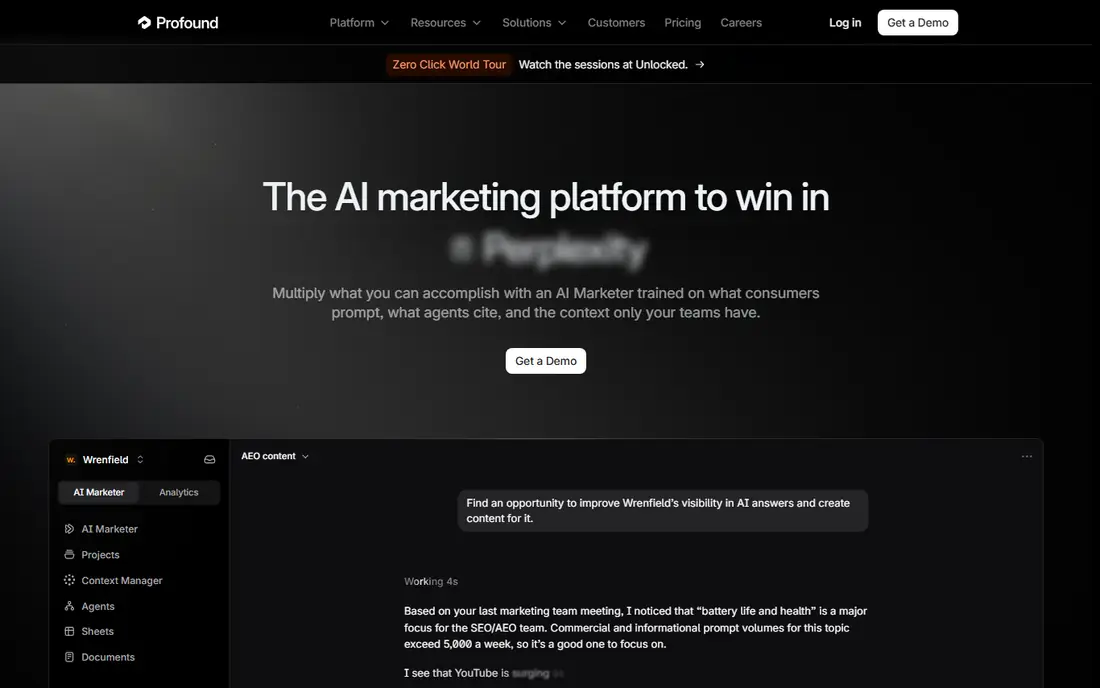
Profound is the most complete platform on this list for a dedicated AI search program. It tracks prompts across major engines, shows which sources get cited, and adds agent tools that connect content work to results. Its use of real-user conversation data for prompt research is a genuine difference from tools that rely only on configured prompt lists. For a large brand or agency running AI search as a program, that depth matters.
Smaller teams may find it heavy. Dashboards are analyst-oriented, and the starting price is only the entry point for a multi-engine, multi-brand setup. If your need is a weekly visibility check rather than a full program, a cheaper tool will serve you better. For an enterprise team, Profound is the benchmark others are judged against.
- Broad engine coverage
- Real-user prompt data
- Agent tools that link content to attribution
- Overkill for a team that only wants a simple visibility score
- Enterprise costs rise with scale
Scrunch takes a different angle: it does not just watch AI answers, it helps AI crawlers read your site well. Its Agent Experience Platform serves optimised content to crawlers and agents without changing the human-facing site. That technical approach suits engineering-led teams and brands that worry about being misread, blocked or summarised badly by AI systems.
The trade-off is scope. Scrunch is stronger on monitoring and crawler readiness than on writing content, so a content team still needs its own production step. At $250 a month to start, it is a mid-market buy rather than a casual trial. For brands with crawler or agent traffic problems, it is the most distinctive option here.
- Agent Experience Platform serves AI-ready content to crawlers
- Strong audits
- Agency workflows
- Content generation is limited
- Monitored prompts are configured rather than sourced from real conversations
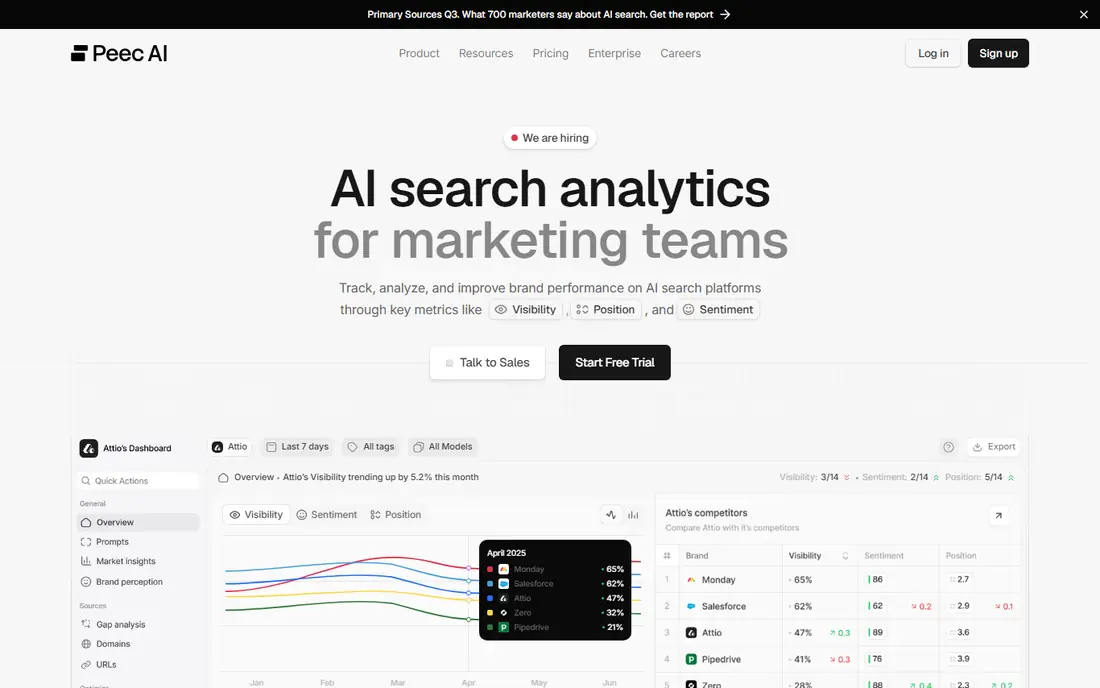
Peec AI is the monitoring tool we would hand to an agency managing several brands. Its dashboard is clear, daily tracking is easy to read, and screenshot trails make reports easy to trust in client meetings. Prompts and models can be allocated across different brand projects, which avoids paying for a separate account per client.
Peec does not create content, so teams must turn its findings into articles, FAQ pages and schema work themselves. Volume data is also estimated from clickstream sources rather than real AI conversations. For a team that wants reliable monitoring at a mid-market price, those limits are acceptable. For a team that wants the tool to do the fixing, look at AthenaHQ.
- Clean dashboard
- Daily tracking
- Screenshot audit trails
- Flexible prompt allocation across brands
- No content creation in platform
- Volume data is clickstream-based rather than real conversation data
Otterly is the sensible first step into AI search optimisation. Setup is fast, the interface is clear, and it produces recommendations and content briefs that a small team can act on without hiring an analyst. At $29 a month it is priced for a small business testing whether AI search matters for its traffic.
The limits are honest ones. Prompt prioritisation leans on the prompts you configure rather than measured demand, and there is no content generation inside the platform. Larger teams will outgrow its prompt volume and reporting depth. As a low-cost way to learn your AI visibility and build a first action list, Otterly is hard to beat.
- Lowest starting price here
- Fast setup
- Clear recommendations and content briefs
- No real prompt-volume data
- No in-platform content generation
- Fixed prompt sets
AthenaHQ tries to close the gap between seeing a citation problem and fixing it. It tracks across many models, applies automated schema and entity tagging at scale, and turns visibility data into an Action Center of next steps. That automation suits teams managing many pages that need consistent structured data and entity signals.
The Starter price of $295 a month puts it out of reach for small teams, and its prompt volume figures rely on an estimation model rather than direct conversation data. Recommendations also need real editing before they go live. For a mid-market team that wants fixes, not just reports, AthenaHQ is a strong contender.
- Broad model coverage
- Automated schema and entity tagging
- Action Center with prescriptive next steps
- Starter price is high for small teams
- Prompt volume relies on an estimation model
- Recommendations need editing
Goodie AI positions itself as an end-to-end answer engine program rather than a single dashboard. It combines research, monitoring, optimisation work and attribution, which appeals to brands that want one partner for the whole AI search effort. That breadth can simplify vendor management for a team that otherwise juggles three tools.
At $399 a month to start, it is an enterprise or serious mid-market buy, and a small team will not use enough of it to justify the cost. It also needs a clear internal owner, since an end-to-end program without one becomes an expensive report. For a brand ready to fund AI search properly, Goodie is worth a demo.
- Research, monitoring, optimisation and attribution in one program
- Suited to dedicated AEO teams
- High starting price
- Best suited to teams with a real AEO budget and owner
Semrush adds AI visibility to a tool SEO teams already know. The toolkit tracks AI overviews, ChatGPT and Perplexity alongside keyword and site data, so a team can see AI and classic search in one workflow. Per-domain pricing keeps the cost clear for a single site, and the learning curve is low for existing users.
The catch is that it is an add-on, so the total cost is the Semrush subscription plus the toolkit fee. Engine coverage is also narrower than a dedicated platform such as Profound. For a team already paying for Semrush, it is the obvious first AI search step. For a team buying from scratch, a dedicated tool may give more depth for similar money.
- AI visibility beside classic SEO data
- Per-domain pricing
- Familiar workflow for SEO teams
- Add-on cost on top of a Semrush plan
- Narrower engine set than dedicated GEO platforms
Ahrefs Brand Radar brings AI visibility into one of the largest SEO data sets available. Teams can find where AI answers cite a brand, then use the same suite to check backlinks, content gaps and competing pages. That combination suits SEO-led teams that want AI search as part of a wider research workflow rather than a standalone program.
We list pricing as See website because Brand Radar pricing sits inside Ahrefs plan tiers that change, and quoting one figure would mislead. Teams that do not already use Ahrefs may find a dedicated GEO tool cheaper for AI search alone. Teams that live in Ahrefs will get the most from this option.
- Large prompt database
- Citation discovery inside a major SEO suite
- Strong backlink and content data beside it
- AI visibility is an add-on layer
- Pricing is tied to the wider Ahrefs plan
Conductor suits enterprise SEO teams that want AI search reporting inside their system of record. It connects AI response performance with crawler activity and technical site insights, so a team can trace a citation change back to a site change. Content workflows and enterprise permissions sit in the same platform, which helps large organisations govern the work.
Pricing is custom and usage-based, so we list it as See website, and the buying process is sales-led. Small teams will find it heavy and costly. For an enterprise team already running SEO through Conductor, adding AI search there is more coherent than buying a separate point tool.
- Connects AI response performance to site monitoring
- Enterprise workflows
- Content tools in the same platform
- Custom usage-based pricing
- Heavyweight for small teams
- Sales-led buying process
How we picked these
We compared official feature and pricing pages, engine coverage, prompt methods and recent independent comparisons of GEO tools. We kept only companies with a live AI search product in October 2026 and a clear monitoring, optimisation or crawler product. We left out general SEO tools without a named AI visibility feature, and we treated vendor accuracy and volume claims as claims, not verified measurements, since methods differ widely across vendors.
What to check before you buy
Start with the engines your customers actually use. A tool that tracks nine engines is no help if it misses the one driving your traffic, so ask for a sample report on your own brand before paying. Check whether prompts are sourced from real conversations, estimated from clickstream data, or simply configured by you, since that choice shapes how much you can trust prioritisation.
Next, price the full program. Prompt volume, number of brands, seats and update frequency all change the bill, and the starting price rarely covers a serious program. Ask for a written quote at your expected prompt and brand count. Finally, decide who does the fixing. If the tool only monitors, you need content and technical time booked to act on its findings, or the subscription becomes an expensive dashboard.
Frequently asked questions
What is the best AI search optimization company for a small business?
Otterly is our first suggestion for a small business because it starts at $29 a month, sets up quickly and gives clear briefs. Peec AI is the next step up if you manage several brands. A small team should not start with an enterprise platform until AI search drives measurable traffic.
What is the best AI search optimization company for an enterprise?
Profound is the strongest enterprise pick on this list for depth of engine coverage and real-user prompt data. Conductor is the better pick if your enterprise SEO already runs through Conductor, and Scrunch is the better pick if crawler readiness is the main problem.
Do AI search optimization tools guarantee rankings in ChatGPT or AI Overviews?
No tool can guarantee a citation or ranking in an AI answer, since answer engines choose sources by their own models and data. These tools help you track visibility, find gaps and improve the content and technical signals that make citation more likely. Treat any guarantee of placement as a warning sign.
How is AI search optimization different from classic SEO?
Classic SEO targets ranked links on a results page, while AI search optimisation targets being cited or summarised inside an answer. That shift rewards clear facts, structured data, entity clarity and pages that answer a question directly. Classic SEO still matters, since many AI answers draw on pages that also rank well.
How long does AI search optimization take to show results?
Expect weeks to months rather than days, since AI models and indexes update on their own cycles and content changes need time to be picked up. Track prompt-level citation share weekly, but judge a program over a quarter. A tool that promises overnight AI visibility is overselling what it controls.
Sources
- https://www.tryprofound.com
- https://www.scrunch.ai
- https://www.peec.ai
- https://www.otterly.ai
- https://www.athenahq.ai
- https://www.goodie.ai
- https://www.semrush.com
- https://www.ahrefs.com
- https://www.conductor.com
- https://www.semrush.com/blog/best-generative-engine-optimization-tools/
- https://www.tooljunction.io/blog/ai-search-visibility-geo-platforms
See where you really rank - block by block
ProMapRanker scans Google Maps across a grid of your service area. Simple monthly plans from $19, white-label on every plan.
Start freeKeep reading
 zscaler alternatives
Best Zscaler Alternatives in 2026
Looking for zscaler alternatives? We compare 9 SASE and zero trust platforms on architecture, data protection, pricing, and fit for your network and team.
Read → zapier alternatives free
Best Zapier Alternatives Free in 2026
Nine automation tools for zapier alternatives free in 2026, all with genuinely free tiers, plus free plan limits, starting prices and upgrade paths explained.
Read → which platform is best for online reputation
Which Platform Is Best for Online Reputation in 2026
Wondering which platform is best for online reputation? We compare 8 review, listing, and response tools for small and multi-location businesses and agencies.
Read →