 ProMapRanker
Best CNAPP Platforms in 2026

Key takeaways
- Wiz leads for agentless multicloud visibility and attack path analysis, while Orca suits teams that want agentless coverage across many clouds.
- Palo Alto Networks Cortex Cloud suits large enterprises already invested in Palo Alto tooling, with code to cloud coverage and runtime defense.
- Microsoft Defender for Cloud offers the best value for Azure first teams, with a free foundational posture tier and metered advanced features.
- CrowdStrike, Sysdig, and Aqua suit teams that already use those vendors for endpoint, runtime, or container security.
- Most CNAPP pricing is quote based, so run a proof of concept on your real cloud accounts before comparing totals.
Quick comparison
| Pick | Great for | Pricing starts at | Free tier | |
|---|---|---|---|---|
 Wiz | Multicloud attack paths | See website | No | Visit |
 Palo Alto Networks Cortex Cloud | Palo Alto estates | See website | No | Visit |
 Orca Security | Agentless coverage | See website | No | Visit |
 Microsoft Defender for Cloud | Azure first teams | See website | Yes | Visit |
 CrowdStrike Falcon Cloud Security | Falcon customers | See website | No | Visit |
 Sysdig Secure | Kubernetes runtime | See website | No | Visit |
 Aqua Security | Container pipelines | See website | No | Visit |
 Upwind | Runtime first teams | See website | No | Visit |
The best CNAPP platforms
We compared cloud native application protection platforms on coverage across clouds, runtime protection, risk prioritization, code to cloud features, and fit for different team sizes.
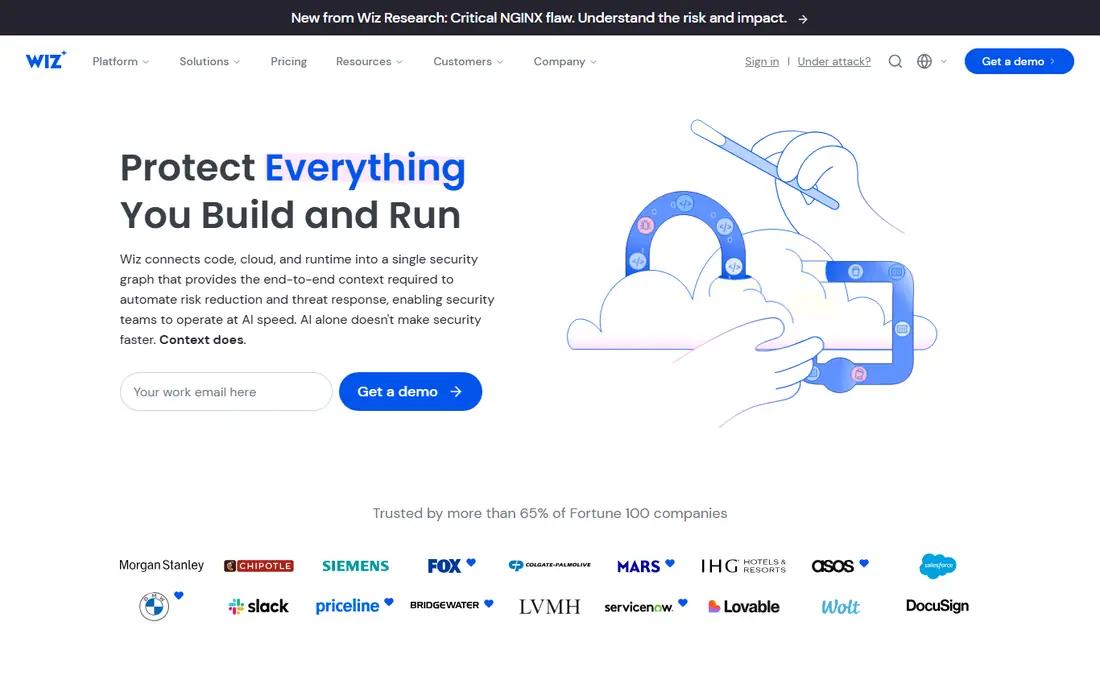
Wiz is the most frequently cited leader for multicloud CNAPP in 2026, thanks to agentless scanning that connects through cloud APIs and builds a security graph across AWS, Azure, Google Cloud, and Oracle Cloud. That graph links misconfigurations, vulnerabilities, exposed identities, and sensitive data into attack paths, so teams can fix the combinations that actually lead to a breach, rather than working through thousands of isolated findings. Shift left features for code and pipelines extend that view from production back into development.
The catch is price and scope. Wiz pricing is tiered and annual, based on monitored cloud workload units, and it is quote based for most enterprises, so small teams should expect an enterprise conversation. Wiz also works best when a team can act on its findings, with cloud, identity, and development owners ready to remediate. If you have that ownership in place, Wiz gives the clearest prioritization on this list.
- Agentless scanning across major clouds
- Graph based toxic combination analysis
- Fast time to value
- Enterprise pricing is quote based
- Tuning and remediation still need security staff time

Palo Alto Networks Cortex Cloud, formerly Prisma Cloud, covers the full code to cloud lifecycle, from infrastructure as code scanning through Bridgecrew heritage to cloud posture, workload protection, and runtime defense. Inline container firewalls and runtime controls suit enterprises that need active blocking, not just visibility, and the platform supports a broad set of compliance frameworks. For organizations already using Palo Alto firewalls, endpoint, or network security, Cortex Cloud fits into an existing console and workflow.
Complexity is the honest limit. Policy tuning, credit allocation across posture, workload, identity, and code modules, and integration with existing Palo Alto tooling all need engineering time. Teams that buy Cortex Cloud for breadth alone, without staff to tune it, may find the initial noise high. Budget for that tuning time, and run the proof of concept on production like accounts, not only on a clean demo environment.
- Code to cloud coverage
- Inline container runtime defense
- Broad compliance frameworks
- Complexity in policy tuning
- Credit based pricing needs careful planning
Orca Security uses agentless side scanning to inspect cloud workloads from outside the workload itself, giving deep visibility without installing agents on every virtual machine or container. That approach scores highly for agentless coverage and time to value, and it covers AWS, Azure, Google Cloud, and other clouds in one view. Orca also maps attack paths and prioritizes risks by exploitability and exposure, which helps small security teams focus on the findings that matter.
The trade-off is runtime depth. Agentless scanning excels at posture and vulnerability visibility, but teams that need deep in workload runtime detection may prefer Sysdig or CrowdStrike alongside or instead of Orca. Pricing is also enterprise and quote based, so Orca suits mid to large organizations with multicloud estates. For a fast, broad first view of cloud risk, Orca is one of the strongest starting points.
- Agentless side scanning
- Deep coverage across clouds
- Fast deployment
- Runtime protection is less agent based than rivals
- Enterprise pricing is quote based
Microsoft Defender for Cloud is the natural pick for Azure first teams, with native integration into Azure, plus coverage for AWS and Google Cloud. A free foundational cloud security posture tier gives basic visibility at no extra cost, while metered workload protection, DevOps security, and advanced features add cost as you enable them. Correlation with Microsoft Sentinel and Defender XDR helps teams that already use Microsoft security tooling to triage cloud findings alongside endpoint and identity alerts.
The limit is multicloud parity. Defender is strongest on Azure, and teams with large AWS or Google Cloud estates should test its coverage and attack path analysis against Wiz or Orca before standardizing on it. Metered pricing also needs monitoring, since enabling many advanced plans across many subscriptions can raise the bill faster than expected. For Microsoft centric shops, though, the value and integration are hard to beat.
- Native Azure integration
- Free foundational posture tier
- Sentinel and XDR correlation
- Multicloud depth varies
- Advanced features are metered and can add up
CrowdStrike Falcon Cloud Security extends the Falcon platform into cloud posture, workload protection, and runtime detection, with agent based depth that suits teams already running Falcon on endpoints and cloud workloads. Runtime protection scores highly in 2026 comparisons, and correlation with endpoint telemetry helps analysts trace an attack from a cloud workload back to related activity. For Falcon customers, adding cloud security to an existing agent and console reduces tool sprawl.
Outside the Falcon ecosystem, the case is less clear. CrowdStrike pricing is quote based, and the full value depends on using Falcon agents and workflows. Teams without Falcon should compare its cloud coverage and posture features directly against Wiz and Orca, rather than assuming endpoint strength alone covers cloud risk. For Falcon shops, it is a strong consolidation pick.
- Strong runtime protection
- Falcon endpoint correlation
- Agent based depth
- Best value inside the Falcon ecosystem
- Pricing is quote based
Sysdig Secure is built for Kubernetes and container runtime security, with deep detection of runtime threats, system calls, and anomalous container behavior. Its in use filtering helps teams ignore vulnerabilities in packages that are loaded but never executed, which cuts noise sharply for container heavy teams. Sysdig roots in open source Falco also give it credibility with platform engineers who live in Kubernetes daily.
The trade-off is deployment and breadth. Sysdig uses agents for runtime depth, so rollout across clusters needs platform team time, and its cloud posture coverage is narrower than a full CNAPP leader such as Wiz. That makes Sysdig best as a runtime specialist, either standalone for Kubernetes first teams or paired with a posture led CNAPP. If runtime is your main gap, Sysdig deserves a proof of concept on your busiest clusters.
- Deep Kubernetes runtime detection
- In use vulnerability filtering
- Open source roots
- Agent based approach needs deployment effort
- Posture breadth is narrower than Wiz
Aqua Security covers the container lifecycle from pipeline and registry scanning through runtime protection, with Trivy as its widely used open source scanner. That pipeline focus suits teams that build and ship many container images, and Aqua supports disconnected and regulated estates where cloud only tools fit less well. Vulnerability, malware, and compliance checks in the pipeline help teams block risky images before they reach production.
As a full CNAPP, Aqua is less unified than Wiz or Cortex Cloud for multicloud posture, identity, and data security in one graph. Teams that need a single CNAPP console for all cloud risk may find Aqua better as a container security layer within a broader platform. For container first organizations, though, its pipeline depth and Trivy ecosystem are real strengths.
- Strong container pipeline and registry scanning
- Trivy open source scanner
- Disconnected estate support
- CNAPP breadth is less unified than leaders
- Pricing is quote based
Upwind takes a runtime first approach to cloud security, using eBPF based sensors to observe workload behavior in real time and to prioritize risks based on what is actually running and exposed. That runtime context helps teams cut through posture noise and focus on live threats, and its cloud onboarding is designed to be fast for AWS, Azure, and Google Cloud. For teams frustrated by posture only tools that flag many issues with no runtime context, Upwind offers a different lens.
As a newer vendor than Wiz, Palo Alto, and Microsoft, Upwind needs a careful proof of concept for breadth, compliance coverage, and long term roadmap. Check its posture, identity, code scanning, and data security features against your requirements, not just its runtime story. For runtime led teams willing to evaluate a newer platform, Upwind is a credible alternative to the established leaders.
- Runtime first cloud security
- EBPF based workload insight
- Fast cloud onboarding
- Newer vendor than leaders
- Enterprise proof of concept still needed for breadth
How we picked these
We compared 2026 CNAPP evaluations, vendor product and documentation pages, and published comparison matrices that weighted agentless coverage, runtime depth, risk prioritization, code to cloud features, and AI workload security. We favored platforms with a current, supported CNAPP offer across major clouds, and we included both agentless and agent based approaches so readers can compare deployment models. We did not invent scores or prices, since most enterprise CNAPP pricing is quote based and depends on workload counts and modules.
How to choose a CNAPP without buying the wrong one
Start with your cloud mix and workload type
A single cloud Azure shop, a multicloud estate, and a Kubernetes heavy team need different strengths. List your clouds, your workload types (virtual machines, containers, serverless, databases), and your identity providers before you shortlist. A platform that excels on one cloud may lag on another.
Test prioritization on your real accounts
Every vendor demo looks clean. Run a proof of concept on real, production like accounts with real misconfigurations, and count how many findings your team can actually fix in a week. The best CNAPP is the one whose top 20 findings are both accurate and actionable for your owners.
Decide how much runtime blocking you need
Posture and visibility suit teams that remediate through pipelines and tickets. Runtime blocking suits teams that need to stop live container and workload attacks. That choice separates agentless leaders from agent based runtime specialists, and it affects deployment effort and cost.
Check code, identity, and data coverage together
A CNAPP should cover posture, workload, identity entitlements, code and pipeline scanning, and data exposure in a connected way. Ask each vendor to show an attack path that crosses those areas in your proof of concept, rather than accepting separate module demos. Gaps here often appear only after purchase.
Frequently asked questions
What is a CNAPP?
A Cloud Native Application Protection Platform combines cloud security posture management, cloud workload protection, cloud identity entitlement management, data security posture, and runtime protection into one platform. It aims to replace separate posture, workload, and code tools with a unified view of cloud risk and attack paths.
Do I need agents for CNAPP?
Not always. Agentless platforms such as Wiz and Orca scan through cloud APIs and side scanning, which gives fast coverage without per workload agents. Agent based platforms such as Sysdig and CrowdStrike give deeper runtime insight but need agent deployment. Many teams use agentless posture plus agents on high risk workloads.
How is CNAPP different from CSPM?
Cloud security posture management covers misconfigurations and compliance for cloud resources. CNAPP adds workload protection, runtime detection, identity analysis, code scanning, and data security, and links them into attack paths. CSPM is one part of a CNAPP, not a replacement for it.
How much does a CNAPP cost?
Most enterprise CNAPP pricing is quote based and depends on monitored workloads, clouds, and modules. Microsoft Defender for Cloud offers a free foundational tier with metered advanced plans, while other leaders use tiered annual subscriptions or credit models. Get a quote based on your actual workload counts, and include proof of concept time in the comparison.
Can a small team use a CNAPP?
Yes, especially with agentless platforms that deploy quickly and prioritize findings automatically. Small teams should start with posture and attack path features, fix the top findings first, and add runtime and code modules as capacity grows. A CNAPP that produces thousands of unactionable findings will not help a small team, whatever its feature list.
Sources
See where you really rank - block by block
ProMapRanker scans Google Maps across a grid of your service area. Simple monthly plans from $19, white-label on every plan.
Start freeKeep reading
 zoro.to alternatives
Best Zoro.to Alternatives in 2026
We compare the best zoro.to alternatives in 2026, listing only legal licensed anime streaming services, from Crunchyroll to free options for fans today.
Read → zip alternatives
Best Zip Alternatives in 2026
We compare the best zip alternatives for buy now, pay later in 2026, covering pay-in-4 plans, fees, spending limits, and credit reporting options today.
Read → yesware alternatives
Best Yesware Alternatives in 2026
Compare the best yesware alternatives for sales email tracking, templates, and sequences, with current pricing and honest tradeoffs for small sales teams.
Read →