 ProMapRanker
Cloud Monitoring Software

AWS-centric teams that want native integration with zero setup · Pricing starts at: Pay as you go (free tier included)
Direct answer
Our first pick is AWS CloudWatch, best for AWS-centric teams that want native integration with zero setup. Alternatives: Grafana Cloud for teams invested in open-source observability standards, and Datadog for expanding engineering teams that want one product for metrics, traces, and logs. Prices, free plans and limits for all 8 tools follow.
Key takeaways
- AWS CloudWatch takes the first slot, best suited to AWS-centric teams that want native integration with zero setup.
- A fair warning about Datadog: costs stack up quick across modules.
- For teams that need streaming, live analytics and already buy Cisco, Splunk Observability Cloud is worth a look.
- For the cheapest start, look at Site24x7: $9/month.
- 3 of 8 tools offer a free plan: AWS CloudWatch, Grafana Cloud, New Relic.
Quick comparison
| Pick | Great for | Pricing starts at | Free tier | |
|---|---|---|---|---|
| AWS CloudWatch | AWS-centric teams that want native integration with zero setup | Pay as you go (free tier included) | Yes | Visit |
 Grafana Cloud | Teams invested in open-source observability standards | $19/month platform fee plus usage | Yes | Visit |
 Datadog | Expanding engineering teams that want one system for metrics, traces, and logs | $15/host/month (Infrastructure Pro, billed yearly) | Free trial | Visit |
 LogicMonitor | IT teams managing mixed on-prem and cloud infrastructure | $16/hybrid unit/month (Essentials) | Free trial (15 days) | Visit |
 New Relic | Teams that want predictable, user-based pricing with a real free level | Free $0; Standard from $10/user/month | Yes | Visit |
 SolarWinds Observability | Network-centric teams that want SaaS or self-hosted choices | $15.75/node/month (Network and Infrastructure, SaaS) | Free trial | Visit |
 Site24x7 | Small IT teams that require wide coverage on a tight budget | $9/month | Free trial (30 days) | Visit |
 Splunk Observability Cloud | Teams that require streaming, live analytics and already buy Cisco | $15/host/month (Infrastructure, billed yearly) | Free trial | Visit |
8 options for cloud monitoring software in detail
Short on time? The summary and table above give the quick view of 8 tools for cloud monitoring software, and the profiles that follow give the detail behind each entry.
AWS CloudWatch
Great for: AWS-centric teams that want native integration with zero setup
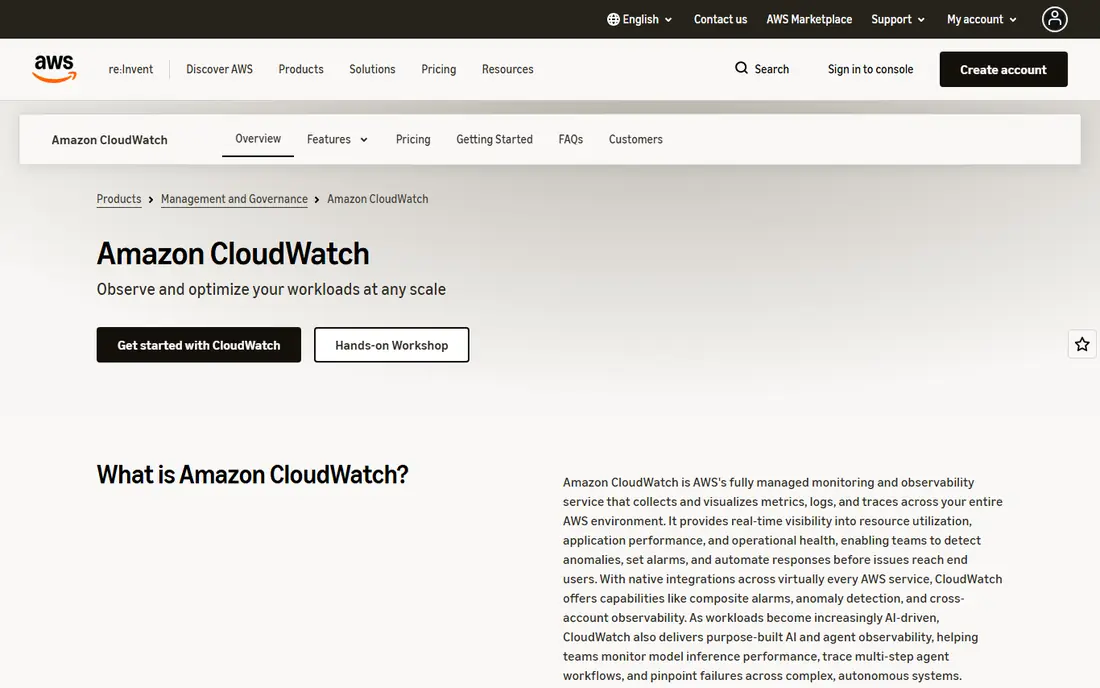
AWS CloudWatch serves AWS-centric teams that want native integration with zero setup. It collects metrics, logs, and traces across nearly every AWS service with no agent to install.
The free level spans a solid baseline. Pricing is pure pay-as-you-go: metrics, log ingestion, and alarms each have their own meter. Entry price for AWS CloudWatch: Pay as you go. AWS CloudWatch includes a free tier.
Honest limits: Costs get murky with heavy custom metrics and logs.
- Native to every AWS service
- Ample free level
- Weaker outside AWS
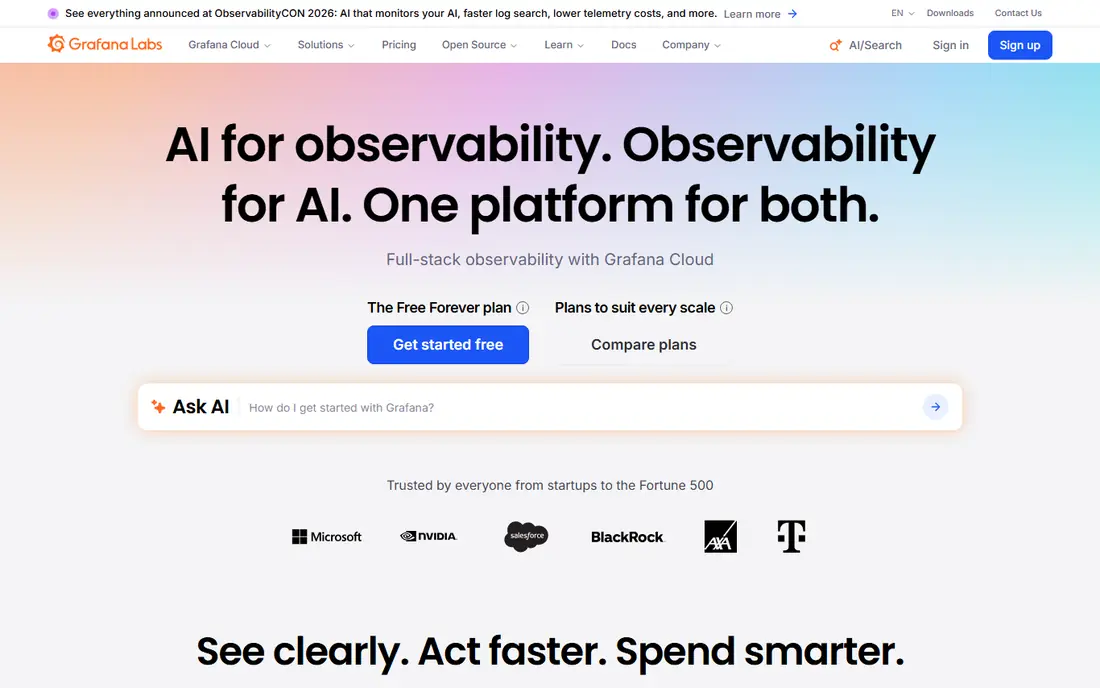
Grafana Cloud works best for teams invested in open-source observability standards. Premium plans start with a $19 monthly system fee plus usage.
Where it falls short: Less hand-holding than Datadog.
The free level includes 10k active series, 50 GB of logs, and 50 GB of traces per month, which is enough to run a small production setup without paying. Worth adding: since it is built on open standards, you can leave for self-hosted Grafana later without re-instrumenting everything. Price to start with Grafana Cloud: $19/month platform fee plus usage. Grafana Cloud includes a free tier.
- Simple path to self-hosting
- Vendor-neutral data
- You assemble more of the experience yourself
Datadog
Great for: Expanding engineering teams that want one system for metrics, traces, and logs
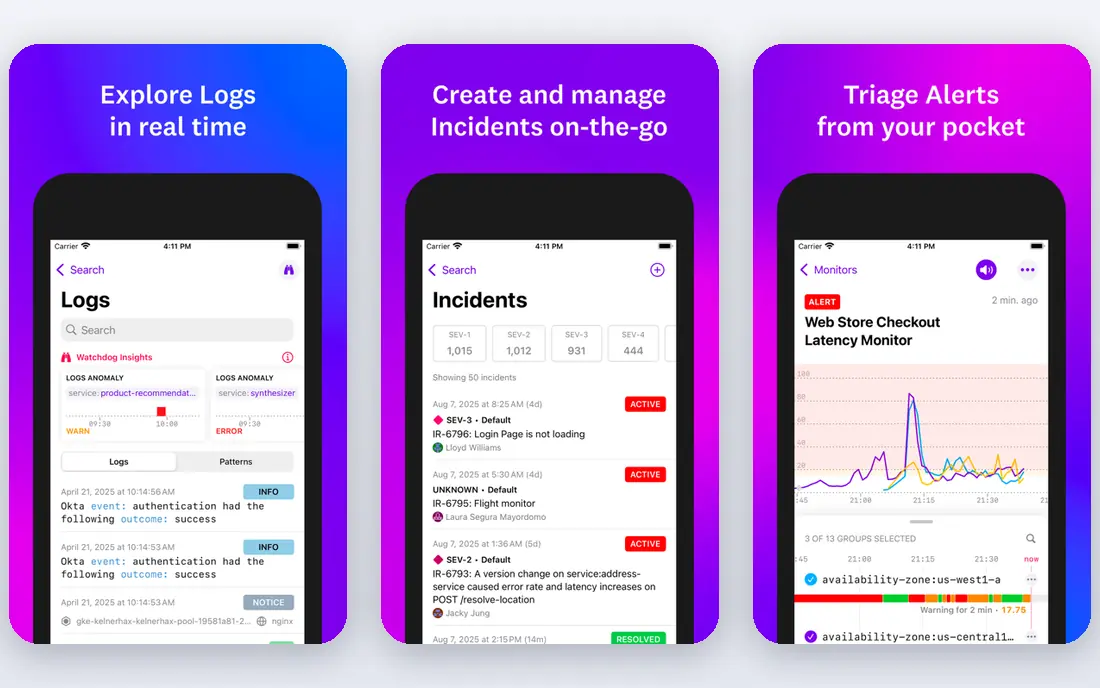
Pick Datadog if this describes you: expanding engineering teams that want one product for metrics, traces, and logs. Datadog is the system most cloud teams end up on.
The reason is boring: it includes infrastructure, APM, logs, synthetics, and RUM in one place with more than a thousand integrations. Once your team is larger than a handful of engineers, that consolidation starts to matter more than any single feature. Starting cost for Datadog: $15/host/month. Trial and free access: Free trial.
Trade-offs to know: You need someone watching the meter.
- Dashboards your team will actually use
- Strong Kubernetes support
- Costs stack up quick across modules
LogicMonitor
Great for: IT teams managing mixed on-prem and cloud infrastructure
LogicMonitor makes the most sense for IT teams managing mixed on-prem and cloud infrastructure. LogicMonitor built its name on hybrid infrastructure monitoring: on-prem servers, network gear, and cloud resources in one pane with genuinely decent auto-discovery.
The hybrid unit normalizes different resource types into one meter, which makes budgeting sane. LogicMonitor cost at the entry level: $16/hybrid unit/month. Free options: Free trial (15 days).
- Very good auto-discovery
- 3,000+ integrations
- APM depth is thinner than the observability-first leaders
New Relic
Great for: Teams that want predictable, user-based pricing with a real free level
New Relic was built for teams that want predictable, user-based pricing with a real free level. The free level is genuinely handy: one full system user, unlimited entry-level users, and 100 GB of ingest per month with no card required.
In daily use, premium Standard starts small, and Pro scales up with unlimited users. On cost, New Relic starts like this: Free $0. Free access exists with New Relic.
- 100 GB monthly ingest free
- 800+ integrations
- Data overages at $0.40/GB add up if your logging is chatty
SolarWinds Observability
Great for: Network-centric teams that want SaaS or self-hosted choices
Think of SolarWinds Observability for network-centric teams that want SaaS or self-hosted choices. The SaaS pricing is modular: network and infrastructure observability from $15.75 per node a month, logs from $5 per GB, and APM from $27.50 per service.
What users get: Modular pricing.
As for the details, pricing needs multi-year annual contracts, so negotiate before you sign. As for the details, network teams that grew up on SolarWinds will find the mental model familiar. SolarWinds Observability starts at: $15.75/node/month. Free plan details: Free trial. Downsides: Multi-year contracts.
- Self-hosted choice
- Solid network monitoring roots
- The SaaS UI is still catching up to cloud-native rivals
Choose Site24x7 for small IT teams that require wide coverage on a tight budget. It is part of the ManageEngine family, so it fits naturally in shops that already use their IT tools.
The interface is not as slick as the leaders, and the advanced analytics are thinner, but for small IT teams the coverage per dollar is hard to beat. Site24x7 starts at: $9/month. Trial and free access: Free trial (30 days).
- 130+ monitoring locations
- All-in-one packs from $9/month
- Depth in APM and analytics lags the premium products
Splunk Observability Cloud
Great for: Teams that require streaming, live analytics and already buy Cisco
For teams that require streaming, live analytics and already buy Cisco, Splunk Observability Cloud is a natural candidate. Infrastructure monitoring opens at $15 per host a month billed yearly, with bundled App and Infra at $60 and end-to-end at $75.
As part of Cisco, it now sits next to AppDynamics and ThousandEyes, which is convenient if your company already standardizes on Cisco. The starting price for Splunk Observability Cloud: $15/host/month. Free access: Free trial.
- Capable Kubernetes support
- True streaming architecture
- The broader Splunk system pricing (ingest-based) can confuse buyers
How the list was put together
Each tool was reviewed on what its vendor publishes: price, plan limits, core features and stated drawbacks. We did not run hands-on tests. Prices and plan limits come from vendor pages and can change, so confirm them on the vendor site before you buy. The sequence is a judgement call: typical use case first, then pricing transparency, then free access. Use the profiles to check fit.
Questions to settle before buying
- Prices are a starting point; Site24x7 shows $9/month to start, so verify what your seat count would cost.
- Read the fine print on the free plans from AWS CloudWatch, Grafana Cloud and New Relic; seat, project and feature caps differ.
- Run a trial of Datadog, LogicMonitor, SolarWinds Observability and others with real work before paying for a year; your own workflow is the best test.
- Read the limits listed for AWS CloudWatch first: weaker outside AWS.
- The entry price of New Relic is only the starting point; model the full cost with seats and extras.
- Let daily users try Site24x7 on real work; their feedback beats any feature checklist.
Frequently asked questions
Do I need APM, or is infrastructure monitoring enough?
Infrastructure monitoring tells you a server is sick. If you run custom applications, you need APM.
Which options for cloud monitoring software have a free plan?
On this list, AWS CloudWatch, Grafana Cloud and New Relic include a free plan. Caps on seats, usage or features are common, so test the free plan against your real workload. Several others offer a trial instead.
Do these tools publish their prices?
Yes. Every tool from AWS CloudWatch to Splunk Observability Cloud shows a starting price, though seats, add-ons and billing terms still change the final cost.
Can I try these options before paying?
Often, yes. AWS CloudWatch, Grafana Cloud and New Relic have a free plan and Datadog, LogicMonitor, SolarWinds Observability and others offer a free trial. Use your own data and a real task during the test, and check what the free tier or trial limits before you rely on it.
How are the tools for cloud monitoring software ordered?
The order follows typical fit for cloud monitoring software, with AWS CloudWatch first and Splunk Observability Cloud last, then price clarity and free access. It is editorial judgement, not a score, so another team could rank the tools differently.
Sources
See where you really rank - block by block
ProMapRanker scans Google Maps across a grid of your service area. Simple monthly plans from $19, white-label on every plan.
Start freeKeep reading
 zoho inventory alternatives
6 Alternatives to Zoho Inventory, Compared on Price and Fit
Zoho Inventory alternatives: 6 tools compared on price, free plans and fit. Katana leads the list for manufacturers. Fit and flaws are laid out for each entry.
Read → zoho crm alternatives
Best Zoho CRM Alternatives (2026)
Need Zoho CRM alternatives? We compare 7 tools on cost, free access and who each suits. Every pick gets a straight assessment. Built for quick decisions.
Read → zelle alternatives
Best Zelle Alternatives in 2026
Compare the best Zelle alternatives for sending money to friends, paying sellers and moving funds abroad, with honest notes on fees, speed and safety in 2026.
Read →