 ProMapRanker
Best Cloud Management Platforms in 2026

Key takeaways
- Cloud management covers different jobs: provisioning, cost control, governance, and performance tuning, so match the tool to your main problem.
- Most enterprise platforms are priced by quote, so budget time for demos and a proof of concept before you commit.
- Cost tools alone do not fix waste; you also need rightsizing, tagging, and ownership of cloud accounts.
- A free tier or free trial helps for small estates, but large hybrid estates usually need a paid enterprise plan.
- Start with one cloud and one cost problem, then expand to multi-cloud governance once tagging and reporting are stable.
Quick comparison
| Pick | Great for | Pricing starts at | Free tier | |
|---|---|---|---|---|
 HPE Morpheus | Hybrid cloud self-service | See website | No | Visit |
 CloudBolt | Hybrid cloud governance and FinOps | See website | Free trial | Visit |
 Flexera One | Cloud cost and license visibility | See website | Free trial | Visit |
 VMware CloudHealth | Multi-cloud cost governance | See website | Free trial | Visit |
 IBM Turbonomic | Automated resource optimization | See website | Free trial | Visit |
 Apptio Cloudability | Cloud cost management | See website | Free trial | Visit |
 Spot by NetApp | Cloud cost optimization | See website | Free trial | Visit |
 Terraform Cloud | Infrastructure provisioning control | Free | Yes | Visit |
The best cloud management platforms
A cloud management platform should give you one view of what you run, what it costs, and who can change it. The eight tools below cover that job from different angles: some focus on provisioning and self-service, others on cost and governance, and one on automated performance tuning. Choose by your main pain, not by feature count.
HPE Morpheus, formerly Morpheus Data and now part of HPE, suits enterprise IT teams that run VMware, public cloud, and Kubernetes side by side. It lets teams request resources through a self-service catalog, applies policies and approvals, and tracks usage across environments. That control matters when many teams share one cloud estate.
The drawback is scope and sales process. Pricing is by quote, based on sockets and workload entitlements in recent listings, and a large deployment needs planning and onboarding. For a single-cloud team, a lighter cost tool may fit better. For a hybrid estate, Morpheus is worth a proof of concept.
- Self-service provisioning across clouds and on-premises systems
- Automation and governance for VMs, Kubernetes, and public cloud
- Enterprise multi-tenancy support
- Quote-based subscription pricing
- Implementation is an enterprise project for large estates
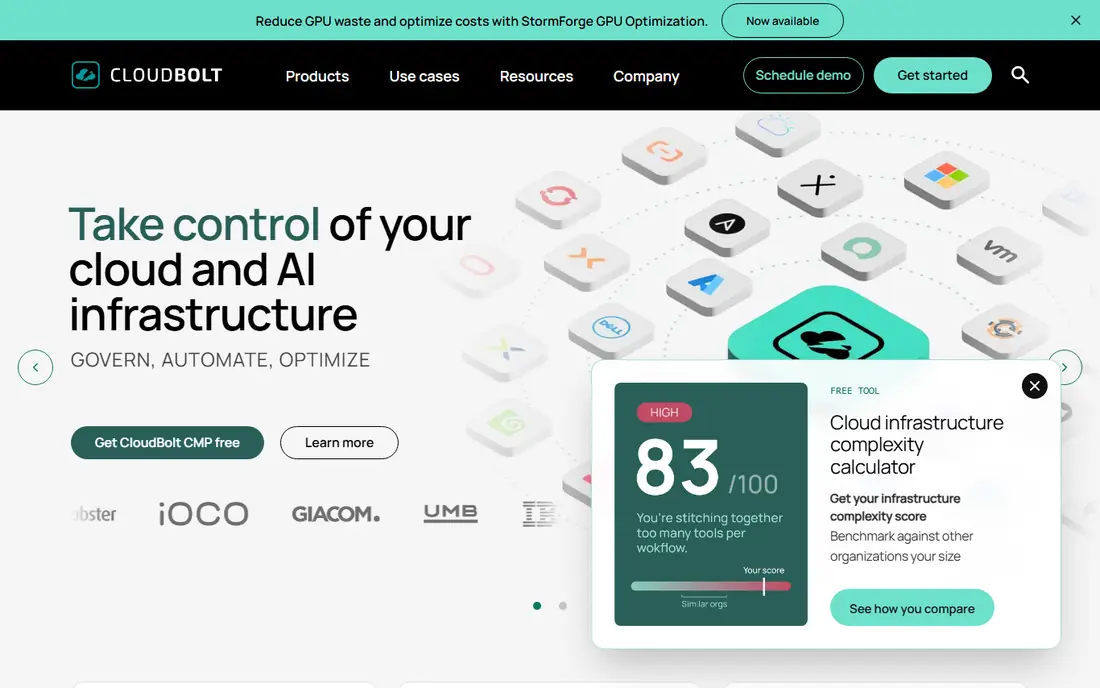
CloudBolt suits enterprises with VMware plus public cloud that need both self-service and cost control. Developers and platform teams can provision approved resources, while finance and operations teams get cost views, budgets, and policy enforcement. That pairing is why CloudBolt appears in multi-cloud comparisons.
The free allowance for up to 100 managed resources helps small teams test the product, but large estates will need a paid plan priced by quote. Test the governance workflow, not just the dashboard, because approval and tagging rules decide whether the tool actually controls spend.
- Self-service provisioning with governance controls
- Cost visibility and FinOps reporting
- Free use for up to 100 managed resources in recent listings
- Enterprise pricing is by quote
- Depth can be more than a small team needs

Flexera One, which includes the former RightScale cloud management capability, suits organizations that need to see cloud cost, licenses, and assets together. Finance teams get forecasting, chargeback, and showback reporting, while IT teams get policy-driven provisioning and compliance tagging. That breadth suits large, complex estates.
The catch is price transparency. Flexera does not publish a simple rate card, and third-party listings suggest enterprise quotes vary widely by features and environments. If you need license visibility as well as cloud cost control, request a scoped quote. If you only need cloud cost reports, a narrower tool may cost less.
- Cost mapping across clouds, regions, and business units
- License and asset visibility alongside cloud spend
- Forecasting and chargeback reporting
- Pricing is gated and enterprise-scale
- Trials typically need sales engagement
VMware CloudHealth, now under Broadcom, is a long-standing enterprise governance tool for AWS, Azure, Google Cloud, and VMware costs. Its grouping feature lets one organization run finance, engineering, and security views from the same data, and its policies enforce tagging, rightsizing, and budget controls across accounts. Managed service providers also use its multi-tenancy features.
The limit is commercial. Pricing is by enterprise contract, scaled by cloud spend and account count, with no public rate card. For a Fortune-scale estate with policy-heavy procurement, that model fits. For a mid-sized team, ask for a clear total before you commit, and compare it with Apptio Cloudability and CloudBolt.
- Policy-based governance across many accounts
- Flexible groupings for finance, engineering, and security views
- Rightsizing and budget controls at scale
- Enterprise contracts only in recent listings
- No simple public price for large estates
IBM Turbonomic takes a different approach: instead of starting with the bill, it maps application dependencies and works out what each workload needs, then resizes resources automatically within your policies. That suits large hybrid estates where waste comes from overprovisioning and manual resizing cannot keep up.
The trade-off is focus. Turbonomic is strong on performance-safe automation, but most teams pair it with a FinOps tool for detailed financial reporting. Pricing is by quote, with a free trial and sandbox available in recent listings. Run a trial on a non-critical workload first, and check that automated actions match your change controls.
- Automated resizing of VMs, pods, and storage within policies
- Full-stack dependency mapping to protect performance
- Auditable actions for regulated teams
- Pricing is by quote
- Financial reporting is thinner than in dedicated FinOps tools
Apptio Cloudability, part of IBM, is a dedicated cloud cost management tool for AWS, Azure, and Google Cloud. It helps finance and engineering teams allocate costs to business units, track budgets, and find savings from rightsizing and commitment purchases. For teams whose main problem is the monthly bill, it is a focused choice.
The catch is data quality. Cost allocation only works well when tagging and account structure are consistent, so expect cleanup work during onboarding. Pricing is by quote, with a free trial in recent listings. If your tagging is messy, budget time for that cleanup before you judge the reports.
- Detailed cloud cost reporting and allocation
- Rightsizing and savings recommendations
- Budgeting and forecasting for finance teams
- Enterprise pricing by quote
- Best value comes when tagging and account structure are already clean
Spot by NetApp focuses on lowering compute cost by automating the use of spare capacity, managing commitments, and optimizing container and VM workloads. That suits teams with flexible workloads, batch jobs, or container estates where cost per workload is a clear metric.
The limit is fit. Workloads that cannot tolerate interruption or that need fixed capacity will save less, so test Spot on a suitable workload first. Pricing is by quote in recent listings, with a free trial available. Compare the net saving after fees, not just the headline discount rate.
- Automated use of spare capacity and commitment planning
- Cost optimization for compute and containers
- Works across major public clouds
- Savings depend on workload type and tolerance for spare capacity
- Pricing and terms need a direct quote
Terraform Cloud, from HashiCorp, is included because many cloud management efforts start with provisioning control. Teams define infrastructure as code, run it through managed workflows, and apply policies before changes go live. The free tier, listed for up to 500 managed resources, suits small teams and trials.
The honest limit is scope. Terraform Cloud controls how infrastructure is created, but it is not a full cost management or performance tuning platform on its own. Pair it with a cost tool such as Cloudability or CloudHealth when you need detailed financial reporting, and use it as the provisioning layer in a larger cloud management setup.
- Declarative infrastructure provisioning across clouds
- Free tier for up to 500 managed resources in recent listings
- Policy and workflow controls on paid plans
- Provisioning focus means cost and governance features are narrower than in a full CMP
- Teams need infrastructure-as-code skills
How we picked these
We compared official product pages, pricing pages, and recent multi-cloud comparisons, and we kept only platforms that are live in October 2026 and that cover provisioning, cost, governance, or optimization across clouds. We excluded Flowise, which reached end of life on 31 August 2026 with its repository archived, because it is not a live product for this list. We did not claim hands-on testing, and where pricing is by quote we wrote See website rather than inventing a figure.
What to check before you buy a cloud management platform
Start with one problem: uncontrolled provisioning, unclear costs, or wasted capacity. A tool that solves that problem well is better than a broad platform that solves none of them deeply. Check which clouds and account types it supports, how it handles tagging, and whether it enforces policies or only reports on them.
Trials, tagging, and ownership
Run a trial on a real account, not a demo account, and test the workflow your team will use daily: request, approval, provisioning, cost report, and rightsizing action. Clean up tagging before you judge cost reports, because bad tags produce bad allocations in any tool. Assign an owner for cloud accounts, budgets, and policies, and agree on who approves automated changes, especially for Turbonomic-style automation.
Frequently asked questions
What is the best cloud management platform?
There is no single best platform, because provisioning, cost control, governance, and performance tuning are different jobs. Morpheus and CloudBolt suit hybrid self-service and governance, CloudHealth and Cloudability suit cost governance, Turbonomic suits automated optimization, and Terraform Cloud suits provisioning control.
How much does a cloud management platform cost?
Most enterprise platforms are priced by quote, based on accounts, resources, cloud spend, or sockets, so a single figure would mislead. Free tiers exist for small use, such as Terraform Cloud for up to 500 managed resources and CloudBolt for up to 100 managed resources in recent listings, but large estates need a scoped quote.
Do I need a cloud management platform for one cloud?
Not always. A single-cloud team can often use native cost tools plus Terraform Cloud for provisioning. A multi-cloud or hybrid team, or a team with many accounts and strict governance needs, gains more from a dedicated platform.
What is the difference between a CMP and a FinOps tool?
A cloud management platform covers provisioning, governance, and operations across clouds, while a FinOps tool focuses mainly on cost visibility, allocation, and savings. Many teams use both: a CMP for control and a FinOps tool for detailed financial reporting.
Can cloud management tools save money on their own?
No. Tools surface waste and can automate some fixes, but savings still need tagging, ownership, and decisions about rightsizing, commitments, and workload design. A tool without those practices will report waste without reducing it.
Is Flowise a current cloud management option?
No. Flowise reached end of life on 31 August 2026, with its repository archived, so we do not list it as a live product. If you used Flowise for AI workflows, look for a currently supported orchestration or automation tool instead, and check its support status before you build on it.
Sources
See where you really rank - block by block
ProMapRanker scans Google Maps across a grid of your service area. Simple monthly plans from $19, white-label on every plan.
Start freeKeep reading
 zoho inventory alternatives
6 Alternatives to Zoho Inventory, Compared on Price and Fit
Zoho Inventory alternatives: 6 tools compared on price, free plans and fit. Katana leads the list for manufacturers. Fit and flaws are laid out for each entry.
Read → zoho crm alternatives
Best Zoho CRM Alternatives (2026)
Need Zoho CRM alternatives? We compare 7 tools on cost, free access and who each suits. Every pick gets a straight assessment. Built for quick decisions.
Read → zelle alternatives
Best Zelle Alternatives in 2026
Compare the best Zelle alternatives for sending money to friends, paying sellers and moving funds abroad, with honest notes on fees, speed and safety in 2026.
Read →