 ProMapRanker
Best Clinical Trial Software in 2026

Large multi-site trial operations · Pricing starts at: See website
Key takeaways
- Medidata Rave, Veeva Vault, and Oracle Clinical One suit large sponsors and CROs running complex, multi-site trials.
- OpenClinica, Castor, Medrio, and Viedoc suit academic teams and smaller sponsors that need faster study builds and clearer pricing.
- SimpleTrials suits sites and small sponsors that want a subscription CTMS with trial master file tools.
- Most enterprise trial software is priced on request, so a shortlist should start with study phase, sites, and data needs.
- This article is general information only. Software alone does not make a trial compliant, and regulatory requirements must be checked with qualified experts.
Quick comparison
| Pick | Great for | Pricing starts at | Free tier | |
|---|---|---|---|---|
| Medidata Rave | Large multi-site trial operations | See website | No | Visit |
 Veeva Vault CTMS | Sponsors using the Veeva suite | See website | No | Visit |
 Oracle Clinical One | Unified data capture and randomization | See website | No | Visit |
 OpenClinica | Academic and grant-funded studies | See website | No | Visit |
 Castor | Faster study builds for midsize teams | See website | No | Visit |
 Medrio | Cost-conscious electronic data capture | See website | No | Visit |
 SimpleTrials | Subscription CTMS for sites and sponsors | $849 per month | No | Visit |
 Viedoc | Flexible data capture for varied phases | See website | No | Visit |
 Clinion | Integrated data capture and randomization | See website | No | Visit |
The best clinical trial platforms
We compared clinical trial software on study management, electronic data capture, randomization, compliance support, and fit for different team sizes. General information only: software features do not replace protocol review, ethics approval, or regulatory advice, and teams must confirm current rules for their trial type and region.
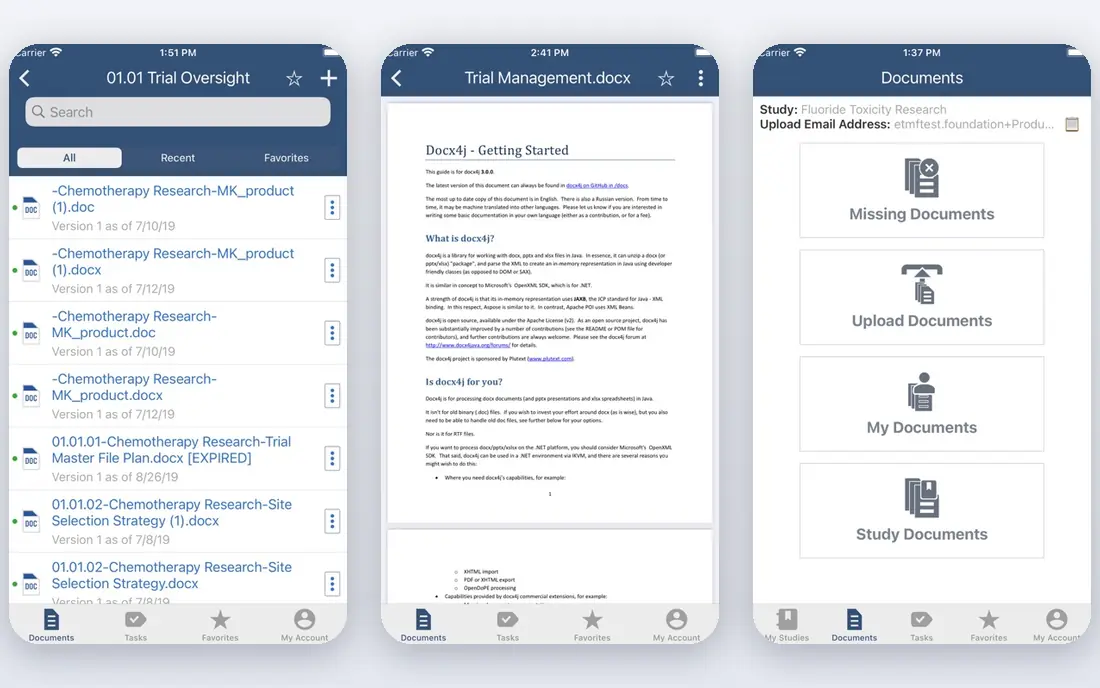
Medidata Rave is one of the most widely used platforms for clinical trial data capture and study management, with tools for study planning, site tracking, real-time data capture, and regulatory document handling. Large sponsors and contract research organizations use it for complex, multi-country trials where consistency across sites matters more than speed of a single small study build.
The trade-off is scale and cost. Pricing is quoted, implementation and validation take planning, and smaller teams may find the system heavier than needed. For a sponsor running large Phase II or Phase III trials across many sites, Rave offers depth that smaller tools cannot match. For a single-site academic study, a lighter platform will usually be faster and cheaper.
- Deep trial operations toolset
- Strong data capture and study tracking
- Broad integrations
- Enterprise pricing
- Complex for teams new to large trial systems
Veeva Vault CTMS manages trial operations inside the wider Veeva Vault clinical suite, which covers trial master files, study documents, and site information in connected applications. That shared data model helps sponsors avoid re-entering site and study details across separate systems, and it supports audit trails and access controls expected in regulated work.
Pricing is quoted, and teams that do not use other Veeva products get less benefit from the suite connection. Implementation also needs process work, because the system rewards teams with defined workflows. For sponsors already using Veeva for documents or data, Vault CTMS is a natural operations layer. For teams outside that ecosystem, a standalone CTMS may be simpler.
- Ties into Veeva Vault clinical suite
- Strong document and site management
- Enterprise controls
- Pricing on request
- Best value inside the Veeva ecosystem
Oracle Clinical One brings electronic data capture together with randomization and trial supply management in one platform, so site users can handle randomization and drug allotment without moving between separate systems. Oracle has also added electronic health record interoperability and adverse event reporting connections, which help teams that need data to flow between clinical and trial systems.
The platform is enterprise-priced and quoted, and setup needs validation and integration planning. Smaller teams may find the scope larger than a single study requires. For sponsors that want one governed platform for capture, randomization, and supply across a portfolio, Clinical One is a strong enterprise option.
- Unified data capture, randomization, and supply tools
- Strong enterprise backing
- EHR connections
- Pricing on request
- Enterprise implementation effort
OpenClinica has served academic centers and midsize sponsors since the mid-2000s, growing out of the open-source clinical trial software movement. The commercial offering lets teams build studies themselves with templates or have experts build a validated study, and pricing is described by the vendor as built for grant budgets. That focus matters when research funding must cover science as well as software.
The community edition is still available for self-hosting, but it requires internal technical work and validation responsibility. Enterprise features also trail the largest platforms. For investigator-initiated studies, university teams, and midsize sponsors, OpenClinica offers a practical balance of control, cost, and clinical research focus.
- Long academic track record
- Flexible study builds
- Open-source community edition
- Smaller vendor than enterprise names
- Community edition needs self-hosting
Castor is a modern electronic data capture and trial platform aimed at teams that want to build studies quickly without a long vendor project. Self-service study design, reusable forms, and real-time data views help midsize sponsors, academic groups, and medical device teams move from protocol to live study faster than on a legacy enterprise system.
Pricing is quoted per study or portfolio, so teams need a conversation for a firm figure. Castor also suits teams comfortable with a cloud platform and standard validation processes rather than deep custom development. For a team that values speed and usability over the full enterprise suite, it is a strong shortlist option.
- Fast self-service study builds
- Modern data capture
- Good for decentralized elements
- Pricing on request
- Enterprise depth trails the largest suites
Medrio positions itself as a lower-cost electronic data capture option, marketing itself as costing less than leading enterprise competitors. The platform focuses on study builds, data capture, and reporting without the full weight of a large CTMS suite, which suits smaller sponsors, CROs, and device studies that need clean data capture first.
Pricing is quoted, so the cost advantage must be confirmed for a specific study design and site count. Teams that need deep trial operations, randomization, and supply management in one system may need to pair Medrio with other tools. For data capture-led studies with a tight budget, it deserves a place on the shortlist.
- Lower-cost data capture positioning
- Fast study builds
- Straightforward interface
- Pricing on request
- Smaller feature set than enterprise suites
SimpleTrials is an on-demand, subscription-based clinical trial management system for sponsors, CROs, and investigative sites. It covers study planning, site startup, subject tracking, document management with an integrated electronic trial master file, study analytics, monitoring, and visit reporting. Support for 21 CFR Part 11 is stated by the vendor, which matters for teams that need compliant electronic records.
Starting price is listed at $849 per month, which gives smaller teams a clearer budget figure than quote-only enterprise tools. The trade-off is that a monthly subscription can still be a large line item for a single small site, and the vendor is less widely known than Medidata or Veeva. For sites and sponsors that want CTMS structure without an enterprise project, SimpleTrials is a practical middle path.
- Subscription pricing
- Integrated trial master file
- Site and subject tracking
- Monthly cost adds up for small sites
- Less known than enterprise CTMS names
Viedoc offers electronic data capture designed to adapt to different study protocols and phases, with a modern interface for sites and study teams. Flexibility is the main appeal: teams can configure forms and workflows for early-phase, observational, or later-phase work without rebuilding from scratch each time. That adaptability helps CROs that run varied portfolios.
Pricing is quoted, and teams should confirm validation support, integrations, and site training for their specific trial. Viedoc is less widely recognized than the largest enterprise names, which can matter for sponsors with strict vendor approval lists. For teams that value configurable capture and a clean site experience, it is worth evaluating.
- Flexible study design
- Modern interface
- Suits varied trial phases
- Pricing on request
- Brand recognition trails the largest vendors
Clinion offers an integrated electronic data capture and randomization platform, so site users can perform randomization and drug allotment, including returns and re-allotment, without logging into two systems. That integration reduces reconciliation work between capture and supply data, which is a common source of errors in trial operations. The vendor describes an affordable and predictable pricing model aimed at lowering total randomization system ownership cost.
Pricing still requires a vendor discussion for a firm figure, and Clinion is a smaller vendor than the enterprise leaders. For sponsors and CROs that need capture plus randomization in one place, especially on midsize studies, the integrated approach is a clear practical benefit.
- Integrated data capture and randomization
- Supply management in one login
- Predictable pricing model
- Pricing details need a quote
- Smaller vendor than enterprise leaders
How we picked these
We compared vendor feature pages, pricing information, and public reviews for clinical trial management and data capture platforms in active use in October 2026. We kept a mix of enterprise suites, academic-friendly tools, and midsize platforms, and we marked pricing as See website where vendors quote per study or portfolio rather than publishing a standard price.
How to choose clinical trial software
Start with the trial itself, not the software demo. Note the phase, number of sites and countries, data capture needs, randomization and supply needs, and whether patient-reported or decentralized elements are planned. A platform that excels at data capture may still need a separate CTMS, and a full CTMS may be too much for a single-site study.
Next, check compliance and validation support in plain terms. Ask how audit trails, electronic signatures, access controls, and data exports work, and who is responsible for validation at each step. Confirm data hosting, backup, and privacy handling for patient data, and involve quality and regulatory staff early. Software alone does not make a trial compliant, and a vendor claim should never replace qualified review.
Finally, run a pilot build on a real protocol section with site staff, not just study managers. Check form building speed, site workflow, query handling, and reporting. Ask for total cost across the study, including implementation, training, validation support, and per-site or per-study fees. The best platform is the one site teams can use accurately under real trial pressure.
Frequently asked questions
What is the best clinical trial software for small sponsors?
OpenClinica, Castor, and Medrio suit smaller sponsors and academic teams, because study builds are faster and pricing is aimed at tighter budgets. SimpleTrials suits sites that need a subscription CTMS with trial master file tools. Enterprise suites suit larger portfolios better than single small studies.
What are the best clinical trials platforms for large multi-site trials?
Medidata Rave, Veeva Vault CTMS, and Oracle Clinical One lead for large multi-site work, because they combine data capture, study operations, and governance at scale. They need more implementation effort and quoted pricing, but they handle complex, multi-country trials more completely.
How much does clinical trial software cost?
SimpleTrials lists a starting price of $849 per month, while most enterprise platforms in this list are priced on request. Total cost depends on study count, sites, users, validation support, and implementation, so a shortlist should request a full study-based quote.
Does clinical trial software make a trial compliant?
No. Software can support audit trails, access controls, and document handling, but compliance depends on the protocol, ethics approval, staff training, validation, and current regulatory requirements. Teams should confirm requirements with qualified regulatory and quality experts.
What is the difference between a CTMS and EDC software?
A CTMS manages trial operations such as sites, subjects, documents, milestones, and monitoring, while EDC software captures and manages study data from case report forms. Some platforms combine both, while others focus on one area and integrate with a partner tool.
Sources
See where you really rank - block by block
ProMapRanker scans Google Maps across a grid of your service area. Simple monthly plans from $19, white-label on every plan.
Start freeKeep reading
 zscaler alternatives
Best Zscaler Alternatives in 2026
Looking for zscaler alternatives? We compare 9 SASE and zero trust platforms on architecture, data protection, pricing, and fit for your network and team.
Read → zapier alternatives free
Best Zapier Alternatives Free in 2026
Nine automation tools for zapier alternatives free in 2026, all with genuinely free tiers, plus free plan limits, starting prices and upgrade paths explained.
Read → which platform is best for online reputation
Which Platform Is Best for Online Reputation in 2026
Wondering which platform is best for online reputation? We compare 8 review, listing, and response tools for small and multi-location businesses and agencies.
Read →