 ProMapRanker
Top 6 Citizen Engagement Software Options for 2026, Compared

Direct answer
Zencity is the first pick on this list for AI analysis of community feedback. Polco is better for scientific civic surveys and benchmarking, and MetroQuest is better for visual surveys for plans and projects. Details, prices and limits for the rest of the 6 tools are below.
Key takeaways
- Number one here is Zencity, a fit for AI analysis of community feedback.
- For community projects and ideation, GoVocal is worth a look.
- None of the 6 tools, from Zencity to GoVocal, has a free plan, so budget for a subscription or use a trial.
- Zencity, GoVocal and the 4 others all sell by quote; expect sales conversations before you see a price.
Quick comparison
| Pick | Great for | Pricing starts at | Free tier | |
|---|---|---|---|---|
 Zencity | AI analysis of community feedback | See website | No | Visit |
 Polco | Scientific civic surveys and benchmarking | See website | No | Visit |
 MetroQuest | Visual surveys for plans and projects | See website | No | Visit |
 Granicus | Full government digital services suite | See website | No | Visit |
 Citizen Space | Formal public consultations | See website | No | Visit |
 GoVocal | Community projects and ideation | See website | No | Visit |
Citizen Engagement Software, one by one
If you are comparing Citizen engagement software, this page covers 6 tools in one place: what each is best for, what it costs to start, whether it has a free plan, and the main limit to know about.
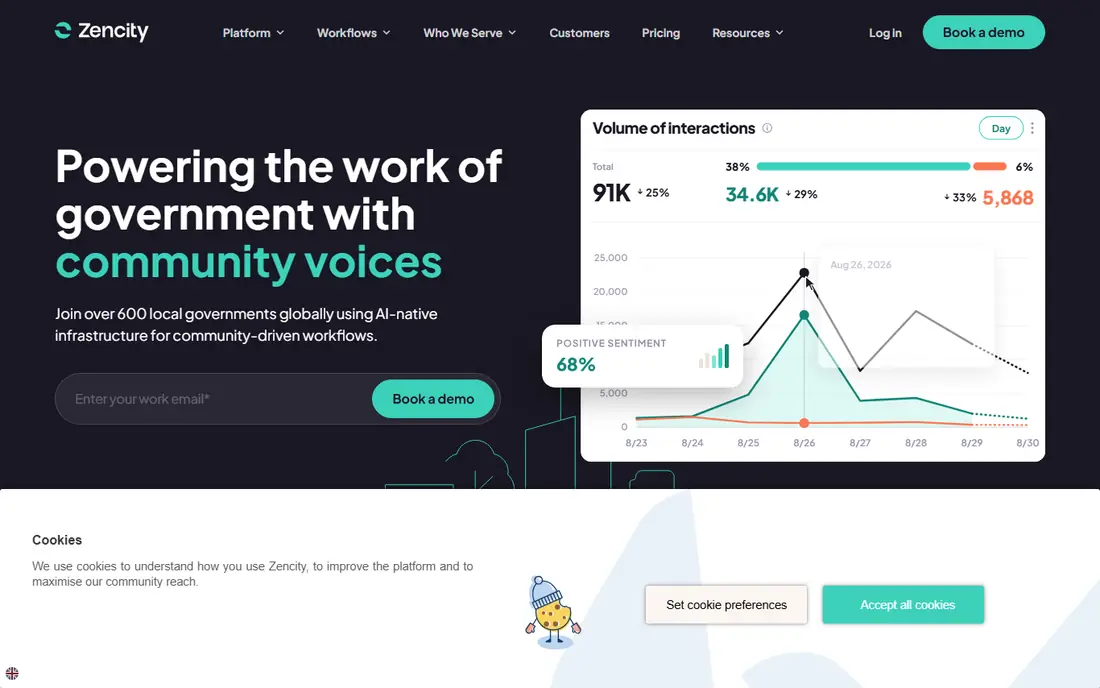
Pick Zencity if this describes you: AI analysis of community feedback. Zencity begins from a different premise: residents are already telling you what they think, in 311 requests, social media, and survey responses. Its AI reads all of it and turns the noise into trends a city manager can act on.
What Zencity does well: Benchmarks sentiment against similar cities; Quick setup.
For everyday use, for agencies drowning in unstructured feedback and short on analysts, Zencity converts a pile of comments into priorities. In practice, setup is quicker than the big suites, since much of the data already exists. Worth adding: the company also provides survey tools, but the analytics engine is the core. Check the vendor site for Zencity pricing; none is listed in this comparison. Zencity has no permanent free option.
What to check first: Dependent on data quality.
- Purpose-built for local government
- AI reads surveys
- Quote-based pricing
For scientific civic surveys and benchmarking, Polco is a natural candidate. If your city manager needs defensible data for strategic planning, or your council wants to know whether satisfaction is actually slipping, Polco is the most rigorous choice here. It is slower and less flashy than idea-collection tools, since decent survey research cannot be rushed.
Where Polco stands out: Benchmark data from hundreds of communities.
Trade-offs to know: Surveys take time to field properly.
From a buyer's view, the product has added engagement features over time, but surveys remain the heart. Its National Community Survey and related instruments are built to produce results a council can trust and a critic cannot easily dismiss. This comparison lists no price for Polco; ask the vendor. There is no free plan with Polco.
- Trusted by city managers
- Survey methodology you can defend
- Less visual than newer systems, Pricing by quote

MetroQuest was built for visual surveys for plans and projects. The results side is equally refined: reports and presentations that communicate findings to councils and the public without a data-science degree.
Where it shines: Decent mobile experience.
Rather than long forms, participants react to images, rank priorities visually, and explore scenarios, all in a mobile-friendly flow built for planning and transportation projects. MetroQuest does not show a starting price in this comparison, so check the vendor site for current pricing. There is no free plan with MetroQuest.
- Highly visual
- Engaging survey design
- Niche focus on planning use cases, Pricing by quote, Smaller company
In short, Granicus is for full government digital services suite. Granicus is the company most local governments already know, normally through govDelivery, its digital communications product that sends the email and text updates residents actually read. More specifically, Granicus sells through a consultative process, pricing is quoted, and rolling it out across departments takes real project management.
But the payoff is a resident experience that links: someone gets a text about a road project, clicks through to an engagement page, submits input, and later receives the decision notice. Few vendors can close that loop end to end. Beyond that, around that core, Granicus built an engagement layer for surveys, public input, and virtual meetings, plus permitting, licensing, and records products. Granicus does not show a starting price in this comparison, so check the vendor site for current pricing. Granicus has no free plan.
Reasons to shortlist it: Trusted by thousands of public agencies.
Trade-offs to know: Quote-based pricing.
- Merges communications with engagement
- Broadest product range in govtech
- Can be more product than small towns need, Implementation takes planning
Citizen Space was built for formal public consultations. When a consultation carries legal weight and the process must be defensible, this is the tool made for that job. For everyday use, for agencies where the consultation itself must stand up to scrutiny, Citizen Space has the deepest pedigree here.
Limits to weigh: Less visual than newer rivals, Pricing by quote.
It structures the process properly: background information, structured questions, document libraries, and response analysis that produces the reports decision-makers need. The analysis side is the strength. It is less about continuing community dialogue and more about running consultations correctly, with accessibility and data handling suited to the public sector. No starting price is listed for Citizen Space here; confirm pricing on the vendor site. Citizen Space has no free tier. Main advantages: Designed for official consultations.
- Decent accessibility compliance
- Widely used across UK government
- Consultation-focused instead of continuing dialogue
GoVocal makes the most sense for community projects and ideation. Multilingual support is a genuine strength, important for diverse communities where English-only engagement quietly excludes people. In practice, for cities that want engagement to feel inviting instead of bureaucratic, GoVocal is a capable pick.
Downsides: Smaller US footprint than competitors.
Worth adding: the company ships updates often and listens to its government users. Beyond that, the downsides are the usual ones for the category: no public pricing, and analytics depth varies by level. More specifically, you produce a project page, choose participation methods like ideas, surveys, voting, or budgeting, and residents engage through an interface that feels closer to a modern web app than a government form. Pricing for GoVocal is not stated here, so ask the vendor for current figures. GoVocal has no free tier.
- Active product development
- Modern participation interface
- Advanced analytics cost additional
Notes on Citizen engagement software
That crowd skewed older, louder, and whiter than the community it claimed to represent. For everyday use, digital engagement is now the default channel for public input in most US local governments. On top of that, the right one relies on what you are asking residents about, how numerous of them you have to reach, and whether you need the full digital-services suite or a focused engagement tool.
How we built this list
Selection started from tools commonly considered for Citizen engagement software, then narrowed to 6 that have clear pricing information or a clear quote process. Where a price is missing, the vendor does not list one publicly or ties it to a quote. Always confirm before budgeting. Tools are placed by general fit for Citizen engagement software, with price clarity and free access as tie-breakers. A different team can reasonably rank them differently.
What to confirm before you sign up
- Ask each vendor, from Zencity to GoVocal, for a written quote; none of them publishes a starting price.
- Before choosing Zencity, weigh its main limit: quote-based pricing, Dependent on data quality, Less of a participation front-end.
- Check whether Zencity bills monthly or annually, and what cancelling early costs.
- Before rolling out Polco, verify the integrations your workflow depends on.
- Total up the real monthly cost of Granicus, including add-ons, extra users and usage-based fees.
Frequently asked questions
What is citizen engagement software?
It is software that helps governments consult the public online: publishing projects, collecting surveys and ideas, hosting virtual meetings, and reporting results.
Does any tool for Citizen engagement software here have a free plan?
No tool in this list, Zencity and GoVocal included, has a permanent free plan. Trials and quotes are the usual route, so plan a short evaluation period.
Can online engagement replace public hearings?
It supplements them but seldom replaces them legally. The best practice is hybrid: digital input for breadth, in-person or virtual hearings for the formal record.
How are the tools for Citizen engagement software ordered?
Zencity sits first and GoVocal last because the order follows typical fit for Citizen engagement software, then price clarity and free access. It is a judgement call, so read each profile for fit and limits.
Is Zencity the right pick for everyone comparing Citizen engagement software?
No single tool suits every team. Zencity comes first because it fits AI analysis of community feedback, while Polco suits scientific civic surveys and benchmarking and MetroQuest suits visual surveys for plans and projects. Match the tool to your own size, budget and workflow before deciding.
Can I try these options before paying?
Not by default. None of the tools, from Zencity to GoVocal, lists a free plan or a free trial here, so ask each vendor for a demo before committing.
Sources
See where you really rank - block by block
ProMapRanker scans Google Maps across a grid of your service area. Simple monthly plans from $19, white-label on every plan.
Start freeKeep reading
 zscaler alternatives
Best Zscaler Alternatives in 2026
Looking for zscaler alternatives? We compare 9 SASE and zero trust platforms on architecture, data protection, pricing, and fit for your network and team.
Read → zapier alternatives free
Best Zapier Alternatives Free in 2026
Nine automation tools for zapier alternatives free in 2026, all with genuinely free tiers, plus free plan limits, starting prices and upgrade paths explained.
Read → which platform is best for online reputation
Which Platform Is Best for Online Reputation in 2026
Wondering which platform is best for online reputation? We compare 8 review, listing, and response tools for small and multi-location businesses and agencies.
Read →