 ProMapRanker
Best Church Administration Software in 2026


Modular apps around a free people database · Pricing starts at: Free
Key takeaways
- Most churches should choose between a modular system that charges per app and a flat rate system that includes everything at one price.
- Planning Center People is free with no cap on people, which makes it a low risk starting point even if you add paid apps later.
- Giving fees are separate from software fees, so compare card and ACH rates alongside the monthly subscription.
- Check data export, check-in speed on a busy Sunday, and volunteer scheduling before signing, because those three tasks cause the most weekly friction.
Quick comparison
| Pick | Great for | Pricing starts at | Free tier | |
|---|---|---|---|---|
| Planning Center | Modular apps around a free people database | Free | Yes | Visit |
 Breeze | Simple flat rate church management | $72 per month | Free trial | Visit |
 ChurchTrac | Budget all in one management | $29 per month | Free trial | Visit |
 Tithe.ly | Giving plus church management in one account | $72 per month | Yes | Visit |
 Pushpay | Growing churches focused on giving | See website | No | Visit |
 FellowshipOne | Large and multisite churches | See website | No | Visit |
 Realm | Churches wanting a connected community platform | See website | No | Visit |
 Rock RMS | Churches with technical help and a tight budget | Free | Yes | Visit |
The best church administration software
We compared vendor pricing pages, feature pages and public reviews for church administration tools live in October 2026. We focused on the weekly work: keeping people records accurate, running check-in, scheduling volunteers, tracking giving, and communicating with groups, rather than on website builders alone.
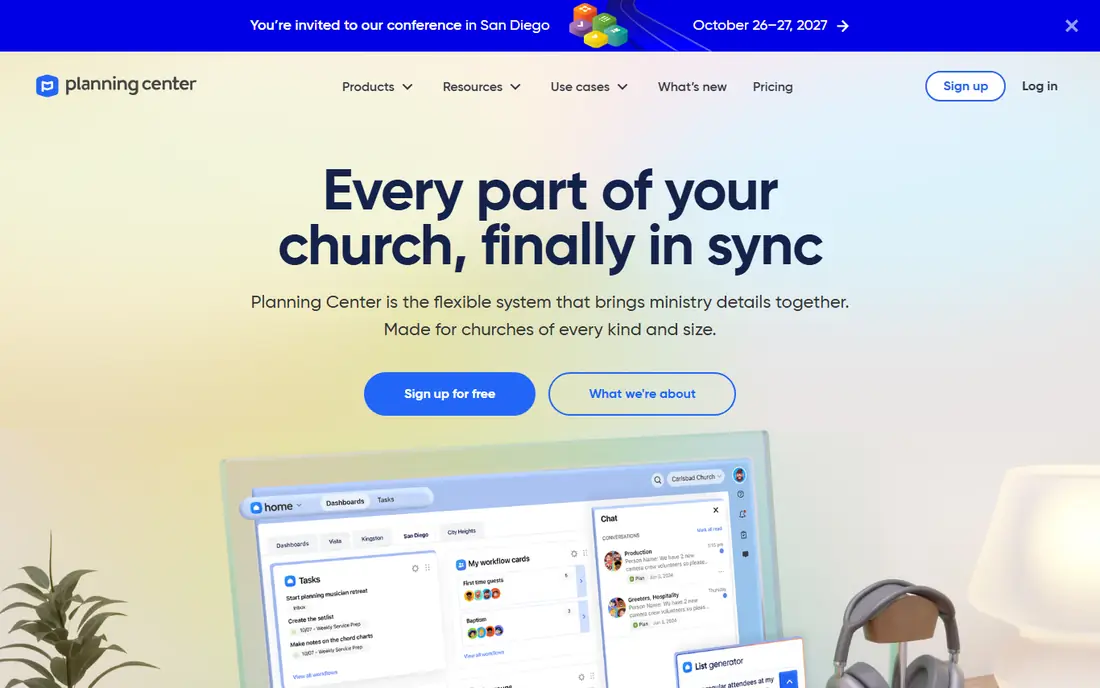
Planning Center is built around People, a free database that holds your congregation records without a cap on the number of people. Around it sit separate apps for giving, groups, check-in, services, registrations and more, each with its own free cap and paid tier. That structure suits a church that knows exactly which jobs it needs, because you pay for the apps you use and skip the rest.
The risk is module creep. A church that adds giving, check-in, groups and services can end up with a bill well above a flat rate rival, so price the full set you expect to use in two years, not just the first app. Volunteer scheduling and service planning are genuine strengths, and the shared People database means a volunteer change flows through every app. For churches that value best in class modules over one flat bill, Planning Center is our first recommendation.
- People database is free with no cap
- Each app can be added separately
- Strong volunteer scheduling and worship planning
- Costs climb as you add modules
- Giving fees apply on top
- Learning the module system takes time

Breeze, now part of Tithe.ly and sold as Tithe.ly Church Management, keeps one promise: one flat monthly price for unlimited people, unlimited users and all core features. There are no tiers to decode and no per person price jumps as the congregation grows, which makes budgeting simple for a finance team. Volunteers usually learn it the same day, because the interface avoids the layered menus that slow larger systems.
That simplicity has edges. Breeze is lighter on fund accounting and layered reporting than a full accounting led system, and churches that need a website or a custom app will pay separately through Tithe.ly. For a church that mainly needs contacts, tags, giving records, groups and events, and wants a predictable bill, Breeze is the easiest choice on this list.
- One flat price with unlimited people and users
- Very easy to learn
- All core features included
- No permanent free plan
- Lighter on accounting and deep reporting
- Website and app features sit with its parent company
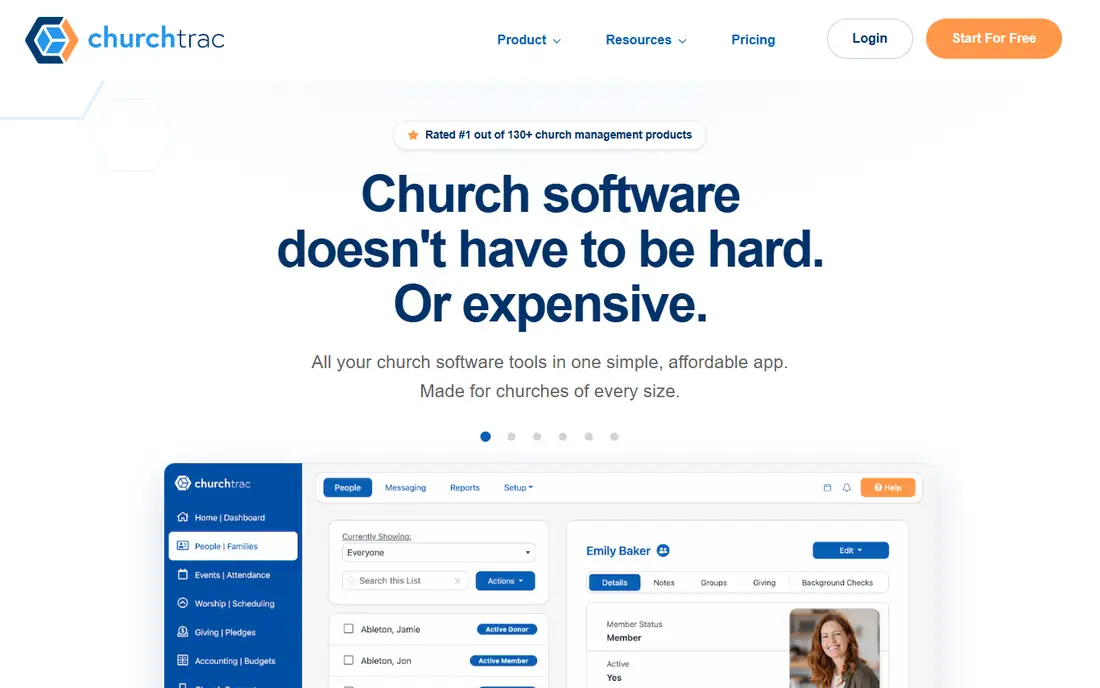
ChurchTrac has served small and mid sized churches since 2002, and its pitch has not changed: a lot of capability for a low monthly price. The base plan covers people records, giving, check-in, groups, volunteer scheduling and a basic website and app, with pricing that scales by database size. Accounting and enhanced messaging are paid add ons, so a church that wants both should price the bundle, not just the entry figure.
ChurchTrac will not win a design contest against newer tools, and its reporting is less deep than enterprise systems. For a small church watching every dollar, though, the value is real: one login, one low bill, and human support included. Start with a trial on real Sunday data, and check whether the add ons you need still keep it cheaper than Breeze.
- Low entry price for small churches
- People, giving, check-in and groups in one login
- Accounting and messaging add ons available
- Interface feels older than rivals
- Accounting and messaging cost extra
- Larger churches may outgrow its reporting
Tithe.ly is best understood as a giving platform that grew into a full church platform. Online giving can start free apart from transaction processing fees, and churches can add church management, a website, a custom app and worship tools, with an All Access bundle covering the set. A cover the fees option lets donors absorb processing costs, which many churches report helps offset giving expenses.
The distinction to keep clear is that free giving is not free church management: the management module carries its own monthly price. A church that only needs giving should not pay for the bundle, while a church that wants one vendor for giving, management, website and app will value the single account. Price the bundle against buying best in class tools separately before committing.
- Free online giving to start
- Church management, website and app can bundle together
- Donor covers fees option
- Church management itself is paid
- Transaction fees apply to giving
- Bundle can include tools a small church does not need
Pushpay targets growing and larger churches that want giving, engagement and management in one platform, with a church app at the centre. Donors can give, join groups and follow church life from the app, while staff manage people, giving and communication behind it. That integrated approach suits a church that already has momentum and wants to deepen digital engagement rather than just record attendance.
Pushpay is quote based, which makes early comparison harder, and its annual plans suit churches ready to commit. A small church will usually find a cheaper fit in ChurchTrac or Planning Center. A larger church that measures success by giving participation and app engagement should put Pushpay on the shortlist and ask for total annual cost in writing.
- Strong giving and engagement tools
- Church management for larger teams
- App and communication features
- Quote based pricing
- Annual commitment typical
- More than a small church usually needs
FellowshipOne is designed for the complexity that appears when a church runs multiple campuses, many ministries and large volunteer teams. It handles people, groups, ministry involvement and giving at a scale where spreadsheets and simple tools break, and its reporting helps central teams see trends across campuses. Staff who run a multisite operation will recognise the problems it solves.
That depth comes with a longer rollout and a quote based price, so a single campus church should not buy it for future growth alone. It also needs a team willing to learn a fuller system. For a large or multisite church that needs central control with campus level flexibility, FellowshipOne remains a serious enterprise option.
- Built for multisite and large church complexity
- Ministry and group management depth
- Reporting for large teams
- Quote based pricing
- Implementation and training take longer
- Overkill for a single small congregation
Realm, from ACS Technologies, aims to connect the whole church community in one place: members can give, join groups, message and follow church life, while staff manage records and communication from the same system. Its heritage in church accounting gives it an edge for churches that want giving and fund records handled with care, rather than bolted onto a simple database.
Realm is quote based, and churches should confirm exactly which accounting and communication features sit in the quoted package. A small church may find the system heavier than it needs, while a mid sized to large church that wants community engagement plus solid records will appreciate the breadth. Trial it with a real group and a real giving report, not just a demo database.
- People, giving, groups and communication in one community system
- Strong ACS heritage for church accounting
- Mobile access for members
- Quote based pricing
- Some features require the wider ACS ecosystem
- Smaller churches may find it heavy
Rock RMS is free open source church management software, which changes the cost question entirely: the software itself costs nothing, but hosting, setup, maintenance and support become the budget. Churches with a developer or a skilled volunteer can customise Rock deeply, from check-in workflows to giving and group tools, and the community plugin ecosystem extends it further.
Without technical help, Rock can stall. Updates, backups, security and troubleshooting fall on the church, and paid support or hosting partners add cost that should be quoted up front. For a church with technical capacity and a tight software budget, Rock offers freedom no commercial tool matches. For a church without that help, a hosted tool such as Breeze or ChurchTrac is the safer choice.
- Free open source software
- Highly customisable
- Large community and plugin ecosystem
- You host and maintain it
- Hosting and support are the real costs
- Needs technical skill to run well
How we picked these
We compared vendor pricing pages, feature documentation and public reviews for church administration tools live in October 2026. We required people records, groups, giving records and check-in or volunteer tools, and we favoured tools with clear pricing or a clear free tier where published. Where a vendor quotes price only, we marked it as See website rather than repeating a third party estimate as a vendor price.
What to check before you choose church software
Run your busiest Sunday through the trial, not a quiet weekday test. Time check-in with a real queue, schedule volunteers for two services, record giving from two channels, and export a people list, because those four tasks reveal speed, accuracy and data freedom. Ask how giving fees work, who can see sensitive pastoral notes, and how data moves if you leave, including whether giving history exports cleanly.
Price the church you expect in two years, not the church you have today. A per person or per module price that looks cheap at 100 people can jump at 400, while a flat rate tool can become the bargain at scale. Finally, ask who answers support questions on a Sunday morning and how fast, since a check-in failure at 9 a.m. is not a Monday ticket. The right tool is the one your volunteers will actually open every week.
Frequently asked questions
What is church administration software?
It is software that holds people records, groups, volunteer schedules, check-in, giving records and communication in one system, so staff and volunteers stop juggling spreadsheets and separate apps. Some tools focus on management alone, while others bundle giving, a website and a church app. The core job is the same: keep people, groups and giving accurate and easy to find.
Is there free church administration software?
Yes, within limits. Planning Center People is free with no cap on people, and Rock RMS is free open source software, though hosting and support cost money. Several tools offer free tiers capped by people or donations, and most paid tools offer a trial. A full free system with giving, check-in and accounting at scale is rare, so check caps carefully.
How much does church administration software cost?
Published entry prices in this list run from free to $72 per month for flat rate tools, with modular tools charging per app and enterprise tools quoting on request. Giving transaction fees sit on top of subscription prices. Price the full set of apps and add ons you will use, plus giving fees, for a fair comparison.
Does church software handle accounting?
Some tools do, and some do not. ChurchTrac offers an accounting add on, Realm draws on ACS accounting heritage, and FellowshipOne covers larger church finance needs, while Breeze stays lighter on accounting by design. If fund accounting and budgets matter, confirm that feature by name before buying, and do not assume a people database includes it.
Can we switch church software later?
Usually yes, but the effort varies. Ask each vendor how people, giving history, groups and notes export, and whether exports include the fields you rely on. Test an export during the trial, and keep a local backup of giving records. A tool that exports cleanly is worth a higher price, because switching costs fall sharply when your data is portable.
Sources
See where you really rank - block by block
ProMapRanker scans Google Maps across a grid of your service area. Simple monthly plans from $19, white-label on every plan.
Start freeKeep reading
 what’s the best risk software for enterprises
What Is the Best Risk Software for Enterprises in 2026
We compared what’s the best risk software for enterprises on risk registers, controls, third-party risk, and reporting, with pricing notes for large teams.
Read → what's the best pam software for enterprises
What is the Best PAM Software for Enterprises in 2026
Find what's the best pam software for enterprises, with vaulting, session recording, just in time access and pricing compared for large enterprise IT teams.
Read → what’s the best grc software
What Is the Best GRC Software in 2026
We compared what’s the best grc software on risk, compliance, audit and vendor risk, so teams can pick a platform that fits their frameworks and budget.
Read →