 ProMapRanker
Best Certificate of Insurance Tracking Software in 2026

Key takeaways
- Certificial leads for teams that want live policy data instead of static certificate PDFs.
- Jones fits construction and real estate teams that need deep policy review.
- TrustLayer and BCS offer free starting tiers for smaller vendor lists.
- Evident, CertFocus, and Avetta suit large enterprises with broader verification needs.
- illumend and Ebix cover AI-assisted review and established enterprise workflows.
- A certificate on file is not proof of current coverage; check cancellations and limit changes.
Quick comparison
| Pick | Great for | Pricing starts at | Free tier | |
|---|---|---|---|---|
 Certificial | Live policy monitoring | See website | No | Visit |
 Jones | Construction and real estate | See website | No | Visit |
 TrustLayer | Small teams starting free | Free | Yes | Visit |
 Evident | Enterprise verification breadth | See website | No | Visit |
 CertFocus | Expert-led compliance chasing | See website | No | Visit |
 BCS | Published per-vendor pricing | Free | Yes | Visit |
 illumend | AI-assisted compliance decisions | See website | Free trial | Visit |
 Avetta | Large contractor networks | See website | No | Visit |
 Ebix | Established enterprise tracking | See website | No | Visit |
The best certificate of insurance tracking software
This is general information only. Coverage varies by policy and state, and a tracking tool does not replace legal or insurance advice on contract requirements. We compared these tools on certificate intake, compliance rules, renewal alerts, fraud checks, and reporting.
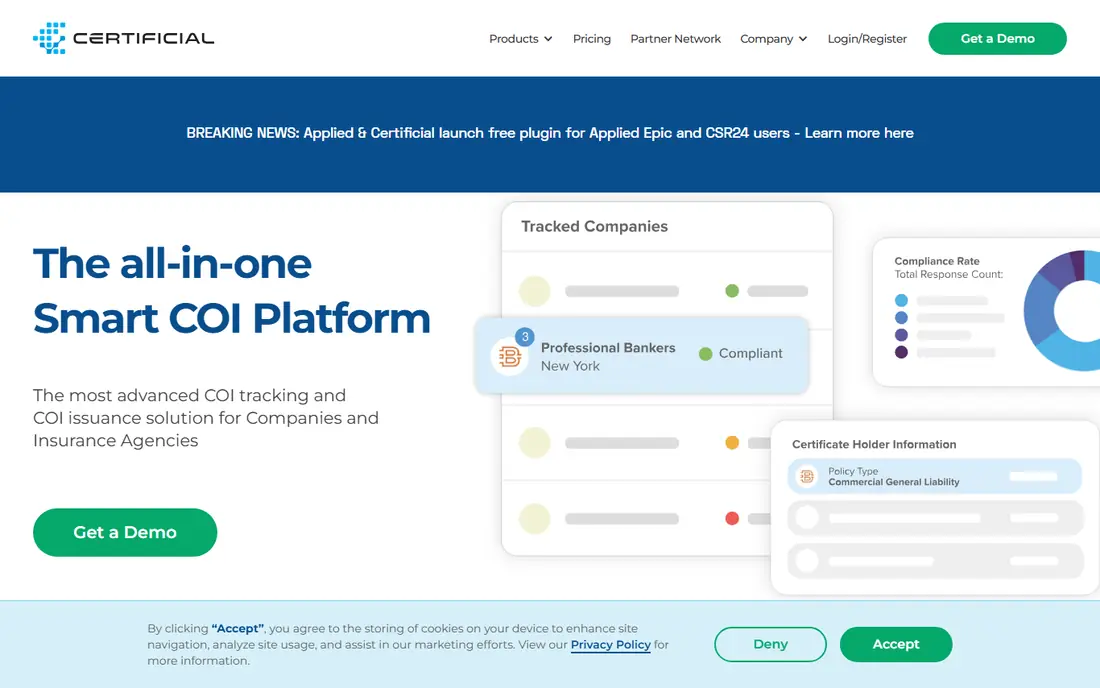
Certificial stands out because it connects directly to agency systems to monitor policy status, rather than relying only on a PDF that can go stale. That live link helps teams spot mid-term cancellations, limit reductions, and schedule changes that a static certificate would miss. It also supports schedule-level tracking for vehicles and locations.
Pricing is quote-based and sold through demos and annual contracts, so budget procurement time. Smaller teams may find the platform more than they need. For firms with high-turnover vendors or transport exposure, live monitoring is a meaningful risk reduction.
- Direct agency connections for live policy data
- Schedule-level detail
- Fraud checks
- Quote-based pricing
- Implementation needs planning
Jones serves commercial real estate and construction teams that need careful review of tenant and subcontractor insurance. It checks certificates against contract requirements, flags deficiencies, and tracks renewals, with a vendor portal for submissions. Pricing is quoted per tenant or vendor record per property and billed annually in recent listings.
Smaller firms with a short vendor list may find it more formal than needed. For property managers and general contractors with many tenants or subcontractors, Jones offers depth that generic trackers lack. Ask how endorsement review is handled, since that detail often decides compliance quality.
- Deep policy review for property and construction
- Vendor portal
- Deficiency tracking
- Quote-based pricing, billed per record
- Enterprise focus
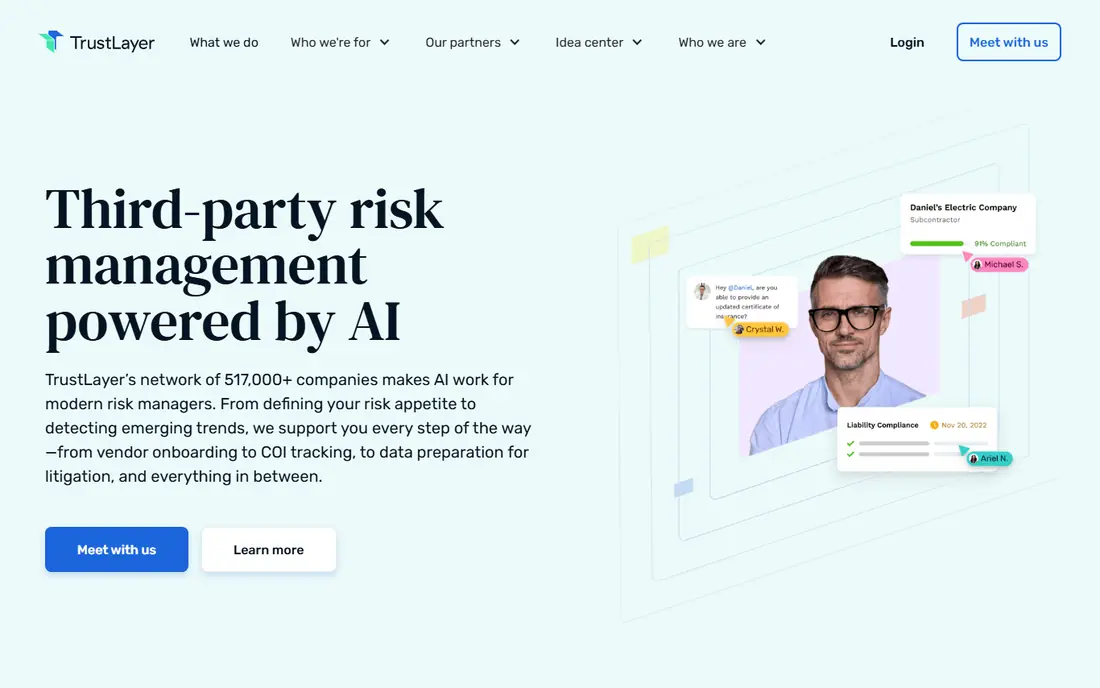
TrustLayer is an accessible start for small teams, with a free Starter plan for up to 50 vendors and $10 per additional vendor per month in recent listings. It automates certificate extraction, tracks expirations, and sends renewal alerts, with a vendor submission portal. The interface is straightforward for teams moving off spreadsheets.
Its main limit is method: it processes documents rather than monitoring live policy data, so a mid-term cancellation may not surface until the next document arrives. Teams with higher risk exposure should weigh that gap. For a small team getting organised, TrustLayer is a practical first step.
- Free Starter tier for up to 50 vendors
- Automated extraction
- Expiration alerts
- Relies on document processing rather than live policy feeds
- Paid tiers for scale
Evident, also called Evident ID, verifies insurance alongside licences, identity, and background checks for large enterprises. That breadth suits firms that onboard many third parties and need one verification record per vendor. Audit trails and reporting support compliance reviews and internal audits.
Pricing is quote-based, and pure COI teams may find the broader platform more than they need. If your onboarding already covers licences and background checks, combining those verifications in one system can save duplicate work. Confirm which insurance checks are automated and which need manual review.
- Verifies insurance plus licences, identity, and background
- Enterprise scale
- Audit trails
- Quote-based pricing
- Broader scope than pure COI tracking
CertFocus suits enterprises that want insurance experts doing the chasing, not just software flagging documents. Its team reviews certificates, follows up with vendors and agents, and maintains compliance records, which helps firms with limited internal risk staff. The service model is a key differentiator from self-serve tools.
Pricing is quote-based, and teams that want full self-serve control may find the managed model slower for simple changes. For firms that prefer to outsource the follow-up work, CertFocus offers expertise that software alone cannot provide. Ask how escalations and audit exports work before signing.
- Credentialed insurance experts review and chase certificates
- Enterprise scale
- Audit support
- Quote-based pricing
- Less self-serve than newer tools
BCS, from the getbcs.com team, offers unusually transparent pricing: free for up to 25 vendors, then $0.95 per vendor per month for self-serve use in recent listings. Vendors get real-time, colour-coded feedback at upload, which helps them correct errors before a compliance team reviews the file. Human review supports the automated checks.
It is smaller than enterprise rivals, and its Procore integration is partial rather than full in some comparisons. Teams with very large or complex programs should test reporting and integrations. For small to mid-size construction teams that want clear pricing, BCS is strong value.
- Free for up to 25 vendors
- $0.95 per vendor per month self-serve
- Real-time feedback at upload
- Smaller vendor than enterprise rivals
- Procore integration is partial
illumend, formerly myCOI, uses AI to read contracts, extract requirements, and explain compliance gaps, including endorsement-level detail. It offers a native Procore integration and no-login vendor submission through magic links, which helps subcontractors submit without account friction. A free trial is advertised by the vendor.
Pricing is quote-based, and as a newer brand, long-term track record questions are fair to ask in a demo. For mid-market to enterprise teams that want the system to make a compliance decision, not just flag a document, illumend is a leading modern option.
- AI reads contracts and endorsements
- Native Procore link
- No-login vendor submission
- Quote-based pricing
- Newer brand from the myCOI team
Avetta manages supplier safety, compliance, and insurance verification for large contractor networks across industries. It combines document collection, requirement rules, and audit trails with broader supply chain risk tools. Firms with thousands of suppliers value its network effects and reporting.
Pricing is quoted, and smaller firms will find the platform broad for pure COI work. If your program already covers safety prequalification and insurance together, Avetta can unify those workflows. Confirm how certificate requirements are configured for your contracts before committing.
- Large supplier network
- Safety and compliance workflows
- Audit trails
- Quote-based pricing
- Broad platform beyond COI tracking
Ebix offers enterprise risk and compliance tools including certificate tracking, through its RCS and related products. It suits large firms that need established workflows, reporting, and integration with broader risk systems. Longevity in the market gives procurement teams a familiar vendor to evaluate.
Pricing is quoted, and setup reflects enterprise expectations rather than self-serve speed. Smaller teams will likely prefer a free-tier tool such as TrustLayer or BCS. For a large firm standardising on an established platform, Ebix remains a credible option.
- Long-running enterprise risk and compliance platform
- Certificate tracking
- Reporting
- Quote-based pricing
- Interface and setup feel enterprise-grade
How we picked these
We reviewed vendor sites and recent COI tracking comparisons, keeping tools that are actively sold for certificate intake, compliance checking, and renewal tracking. We favoured a mix of live-monitoring, AI-assisted, expert-led, and free-tier tools, since risk teams differ in size and risk appetite. Prices are shown only where recent listings support them; otherwise we used a quote-based starting point.
What to check before you buy
Start with your contract requirements, not the feature list. Write down the coverages, limits, endorsements, and additional insured wording you actually require, then ask each vendor to show how those rules are configured and how deficiencies are explained to vendors. A tool that only checks dates will miss wording gaps that matter in a claim.
Next, test vendor submission from the vendor side. A confusing portal creates chasing work for your team, no matter how good the back end looks. Check renewal alerts, audit exports, and integration with your procurement or construction system. Finally, confirm who reviews flagged items and how quickly cancellations surface, since that timing is the real risk control.
Frequently asked questions
What is a certificate of insurance?
It is a document summarising a vendor's insurance coverages, limits, and policy dates. It is evidence of coverage at a point in time, not a guarantee that coverage stays in force or matches your contract wording.
Does COI tracking software prove a vendor is covered?
No. It tracks documents and flags gaps, but coverage can change mid-term through cancellation or endorsement changes. Live monitoring tools reduce that gap, but they do not replace reading the policy or getting insurance advice.
How do renewals and expirations work?
Most tools send alerts before policy or certificate expiry and chase vendors for renewals. Set alert timing to match your risk: high-risk vendors need earlier warnings than low-risk suppliers.
Should vendors pay to use the system?
Most tools here do not charge vendors, which helps submission rates. Confirm this in your agreement, since vendor fees can slow compliance and create friction with subcontractors.
How much does COI tracking cost?
It ranges from free tiers for small vendor lists to quote-based enterprise contracts. Per-vendor pricing, such as BCS at $0.95 per vendor per month, helps small teams budget, while larger programs need a full quote.
Sources
See where you really rank - block by block
ProMapRanker scans Google Maps across a grid of your service area. Simple monthly plans from $19, white-label on every plan.
Start freeKeep reading
 worlds best local seo company
8 Worlds Best Local SEO Companies for Map Pack Growth in 2026
Compare the worlds best local seo company options for Google Business Profile work, citations, reviews, and multi-location rankings and reporting in 2026.
Read → world's best web hosting company
World's Best Web Hosting Company in 2026
Searching for the world's best web hosting company? We compared 10 hosts on price, renewal rates, speed, and support to help you choose well today in 2026.
Read → who's got the best nanny tax services
Who's Got the Best Nanny Tax Services in 2026
We answer who's got the best nanny tax services, comparing full filing, back taxes, software, and pricing so families can handle nanny taxes correctly.
Read →