 ProMapRanker
Best Cell Phone Service in 2026

Key takeaways
- The best cell phone service depends more on coverage at your home, workplace, and commute than on national advertising.
- Visible and US Mobile offer strong value on Verizon and multi-network plans, while Mint Mobile rewards people willing to prepay.
- Verizon, AT&T, and T-Mobile still lead for priority data, in-store support, and family plans with perks.
- Prepaid and smaller carriers often use the same towers, but data may slow first during congestion.
- Check taxes, autopay rules, hotspot limits, and trial options before switching, since the headline price is rarely the full bill.
Quick comparison
| Pick | Great for | Pricing starts at | Free tier | |
|---|---|---|---|---|
 Verizon | Widest reliable coverage | $65 per month | No | Visit |
 T-Mobile | Fast 5G and perks | $25 per month | No | Visit |
 AT&T | Balanced major carrier coverage | $50 per month | No | Visit |
 Visible | Simple Verizon unlimited | $25 per month | No | Visit |
 Mint Mobile | Low prepaid unlimited | $30 per month | No | Visit |
 US Mobile | Choosing your network | $25 per month | No | Visit |
 Google Fi | Flexible and international use | See website | No | Visit |
 Cricket Wireless | AT&T coverage with stores | $35 per month | No | Visit |
 Metro by T-Mobile | In-store T-Mobile value | See website | No | Visit |
 Consumer Cellular | Simple plans and support | $20 per month | No | Visit |
The best cell phone service
Cell phone service is a local question dressed up as a national ranking. A carrier that shines in one city can struggle in another, and the cheapest plan is a poor deal if calls drop at home. We compared official plan pages, coverage claims, pricing terms, and public reviews, focusing on single-line starting prices, data priority, and everyday usability.
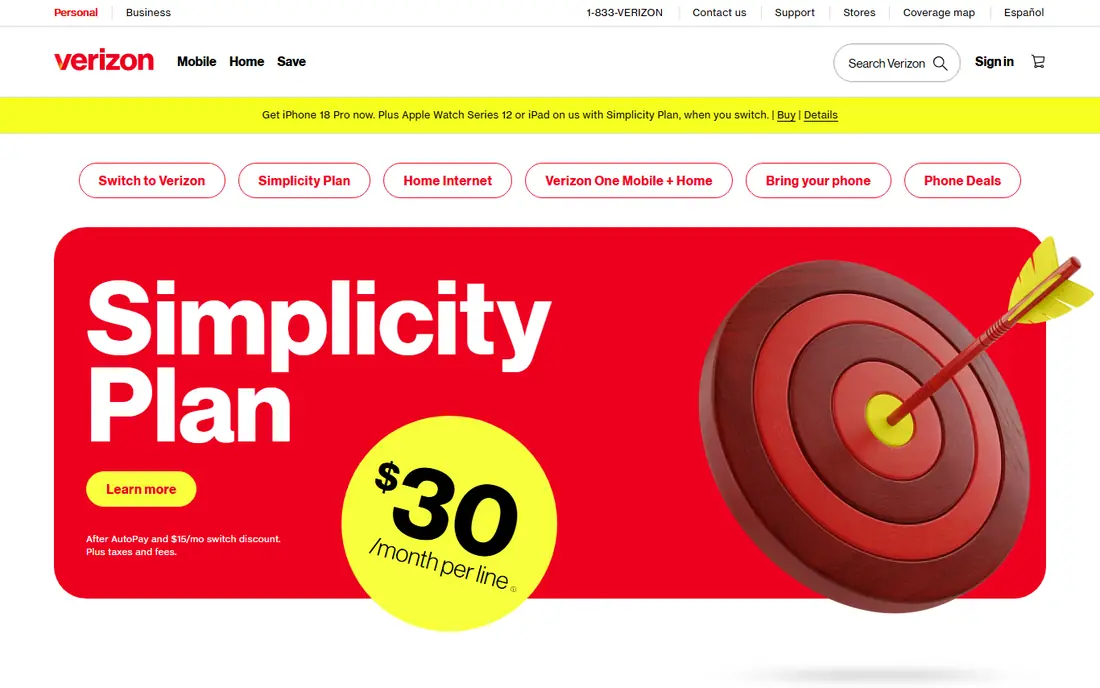
Verizon earns its place for people who need a connection in more places, not just in cities. Its Unlimited Welcome plan is the entry point for unlimited data, and higher tiers add hotspot data, faster 5G access, and perks. For travelers, rural workers, and families who cannot afford dead zones, that coverage is the main selling point.
The cost is the honest catch. Verizon postpaid plans start higher than Visible, Mint, or US Mobile, and the advertised price often excludes taxes and fees. If your area already has strong T-Mobile or AT&T service, you may pay extra for coverage you do not use. Check a coverage map and ask neighbors before paying the premium.
- Broad nationwide coverage, including many rural areas
- Strong network priority on postpaid plans
- Wide store and support network
- Higher starting price than prepaid rivals
- Taxes and fees are added to many plans
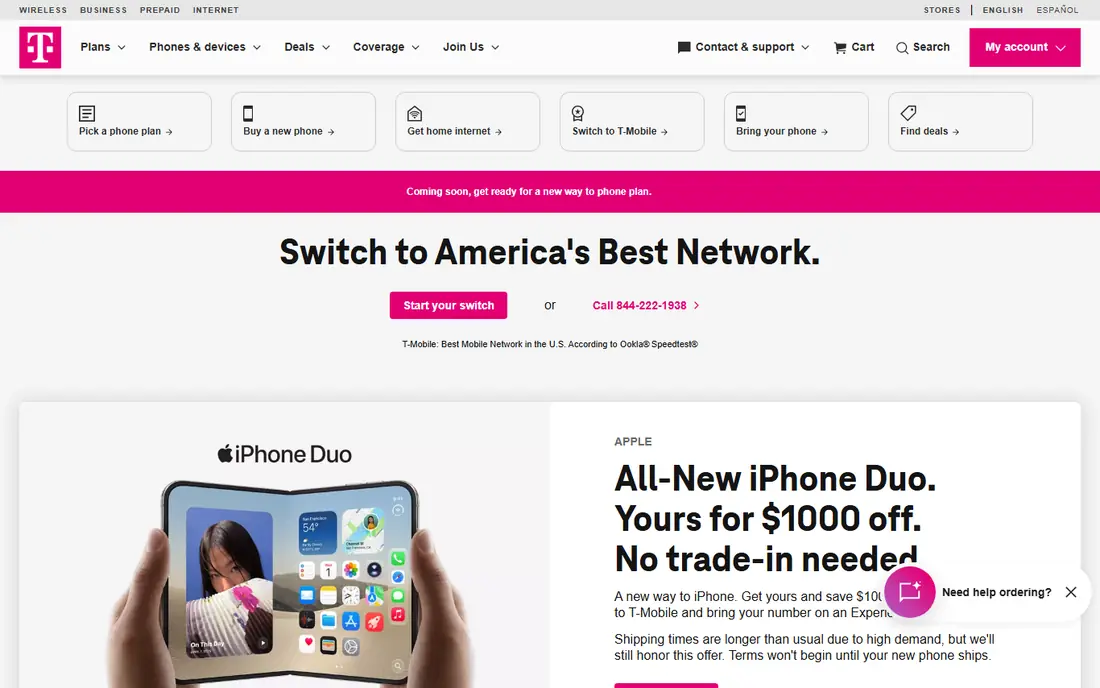
T-Mobile has built its case on speed and value. Its entry plans suit light to moderate users, while higher tiers add large hotspot allowances, international features, and streaming perks. In cities with strong T-Mobile 5G, speeds and responsiveness are often excellent.
Rural coverage is the variable to check. T-Mobile has improved outside cities, but gaps remain in some regions, and building coverage still matters. T-Mobile also offers trial options in some cases, which can help you test service at home before porting a number. Compare the full plan, not just the entry price, since perks sit on higher tiers.
- Fast 5G in many cities
- Perks such as streaming bundles on higher plans
- Competitive entry pricing
- Rural coverage varies by area
- Higher tiers cost much more than the entry plan
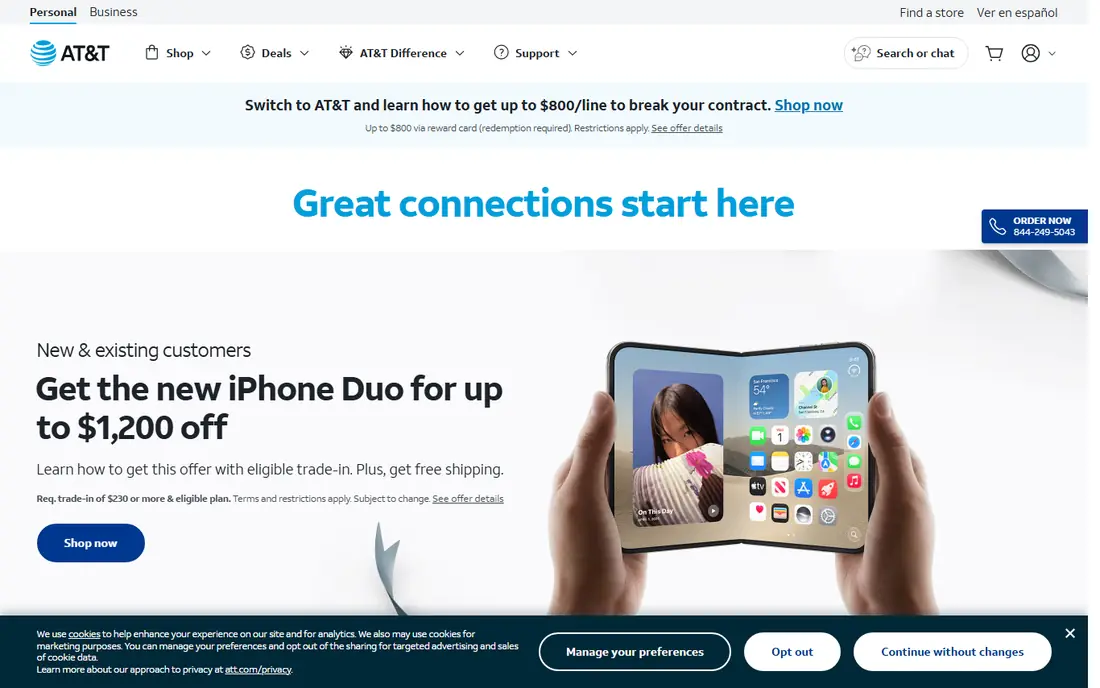
AT&T sits between Verizon coverage and T-Mobile value for many buyers. Its network handles cities, suburbs, and many rural routes well, and its stores and support network suit people who prefer in-person help. Family plans and device deals can narrow the price gap with prepaid carriers.
For a single line, though, AT&T is rarely the cheapest path to unlimited data. Its Value plans offer a lower-cost entry point with limited high-speed data, while full unlimited tiers cost more. AT&T makes most sense when you value a major carrier, want in-store support, or bundle wireless with other AT&T services.
- Strong nationwide network
- Solid family plan options
- Broad device and store support
- Entry unlimited value lags cheaper prepaid options
- Taxes and fees add to the bill
Visible is the simplest way to get Verizon network coverage without a Verizon postpaid bill. The base plan offers unlimited data with taxes included, which makes the monthly cost easy to predict. Hotspot use is included, though speeds are limited on the base plan.
Support is online only, which suits confident buyers but frustrates people who want a store visit. The higher Visible plan adds faster 5G access, more hotspot data, and international features. If Verizon works well at your address, Visible is often the best cell phone service for value, provided you accept online support and possible congestion slowdowns.
- Unlimited data on the Verizon network
- Taxes and fees included
- Simple online signup
- Online-only support
- Data may slow during congestion on the base plan
Mint Mobile rewards commitment. Its unlimited plan costs less when you prepay for a longer term, with the lowest monthly equivalent on a 12-month plan. It runs on the T-Mobile network, so coverage and speeds track T-Mobile in your area.
Prepayment is the catch. Paying months ahead only makes sense if you are confident about the network and your usage. Shorter terms cost more per month, and taxes are added to the advertised price. Mint suits people who know T-Mobile works for them and want to lock in a lower rate without a postpaid contract.
- Low unlimited price on the T-Mobile network
- Simple prepaid structure
- Easy online activation
- Best price requires prepaying for 12 months
- Taxes and fees are added
US Mobile stands out because it lets you pick the network that works at your address, rather than forcing one carrier. Its Unlimited Starter plan is competitively priced with taxes included, and higher tiers add large hotspot allowances and premium data. Light users can also choose smaller shared plans.
That flexibility adds complexity. Plan features can vary by network, and switching networks has rules and limits. Read the current plan page for your chosen network before signing up. For households with mixed coverage needs, US Mobile offers a practical way to match each line to the strongest local network.
- Choice of Verizon, T-Mobile, or AT&T networks
- Taxes included
- Flexible shared and unlimited plans
- Network switching rules and plan details take care to understand
- Online-first support
Google Fi suits people whose usage varies month to month. The Flexible plan starts with a base charge for talk and text, plus a per-gigabyte data charge, which can save money for light users. Unlimited plans add more data and international features, including roaming in many countries.
Phone compatibility matters. Fi works best on Pixel phones and other fully compatible models, though many phones from other carriers can join with limits. If you travel abroad often or want a plan that adapts to light months, Fi is worth a close look. Heavy data users in the United States will usually find cheaper unlimited options elsewhere.
- Flexible plan that charges for data used
- Strong international roaming features
- Works well with Pixel phones
- Best experience often requires a Pixel or compatible phone
- Unlimited pricing is higher than budget rivals
Cricket gives AT&T network access with simpler pricing and store support. Taxes are included in the advertised price, which makes budgeting easier than with postpaid AT&T plans. Its unlimited tiers suit families and moderate to heavy users who want a store nearby.
Speed caps and priority are the trade-offs. Some Cricket plans limit speeds or place data behind AT&T postpaid customers during congestion. For most everyday use, including video and maps, the service still performs well. Cricket is a strong pick for people who want AT&T coverage, a physical store, and a predictable bill.
- AT&T network coverage
- Taxes included
- Retail stores for in-person help
- Data speeds may be capped on some plans
- Premium features cost more
Metro by T-Mobile combines T-Mobile network access with store support and prepaid simplicity. Its unlimited plans include taxes on many options, and in-store staff can help with activation, device setup, and troubleshooting. That support matters for buyers who do not want to manage everything online.
Priority is the limit. Metro customers may see slower data than T-Mobile postpaid customers when a tower is busy. Hotspot allowances also vary by tier, so heavy hotspot users should check the plan details. For city and suburban users with strong T-Mobile coverage, Metro offers good value with human help nearby.
- T-Mobile network access
- Retail stores
- Taxes included on many plans
- Data priority is lower than T-Mobile postpaid
- Higher tiers needed for large hotspot allowances
Consumer Cellular focuses on simplicity and support rather than the lowest unlimited price. Its plans start with a small data tier and scale up, which suits light users, older adults, and anyone who wants clear billing and patient help. The company uses AT&T and T-Mobile networks, depending on the plan and device.
Heavy data users should compare carefully. Unlimited plans exist, but budget carriers often beat Consumer Cellular on unlimited pricing. The value here is service quality and simplicity, not raw data per dollar. If you use modest data and want a carrier that explains plans clearly, Consumer Cellular is a strong contender.
- Simple plan structure
- US-based support reputation
- Flexible data tiers
- Unlimited pricing is higher than budget rivals
- Data allowances on cheaper plans are limited
How we picked these
We compared official plan pages, pricing terms, coverage information, app store listings, privacy policies, and public reviews for carriers that operate nationwide in the United States. We favored carriers with clear starting prices, current plans, and a track record of service in October 2026. We did not claim hands-on testing, and we noted where taxes, autopay discounts, or prepayment change the real monthly cost. Prices vary by lines, autopay, and promotions, so confirm the current plan page before switching.
Choosing the right plan without overpaying
Start with coverage, then data, then price. A cheap plan on a weak network is expensive in missed calls and frustration. Ask people in your area, check carrier coverage maps, and use a trial or prepaid month when possible.
Count your real data use
Look at past bills for actual data use, not guesses. Light users under 5 GB a month often save with smaller prepaid plans, while heavy users need true unlimited with a clear hotspot allowance. Video streaming, hotspot use, and travel quickly change the math.
Read the fine print on price
Autopay discounts, multi-line pricing, taxes, and prepayment terms can move a plan by 10 dollars or more per month. A price that includes taxes is easier to compare than one that adds fees later. Also check whether the plan price changes after a promotional period ends.
Plan the switch carefully
Keep your old service active until the new SIM or eSIM works, and confirm your phone is free to move carriers and compatible. Porting a number usually takes minutes to hours, but it can take longer if account details do not match. Back up contacts and messages before you start.
Frequently asked questions
What is the best cell phone service overall?
There is no single winner for every address, because coverage varies by location. Verizon often leads for broad coverage, T-Mobile leads for fast 5G in many cities, and Visible or US Mobile often lead for value. The best cell phone service for you is the one with strong coverage at your home and workplace at a price you can sustain.
What is the best cell phone service for families?
Major carriers offer the strongest family value when you add multiple lines, since per-line prices drop and perks such as streaming bundles and hotspot data improve. Prepaid carriers such as Visible, US Mobile, and Cricket also offer family savings, often with taxes included. Compare the total family bill, not just the single-line price.
Which carrier has the best cell phone service reviews?
Reviews tend to favor value carriers for price and major carriers for coverage and priority data. Visible, Mint Mobile, and US Mobile often score well on value, while Verizon and T-Mobile score well on network performance. Read recent reviews for your city, since local coverage shapes satisfaction more than national averages.
Is prepaid service as good as postpaid?
Prepaid service uses the same towers, so calls and basic coverage usually match. The difference appears during congestion, when postpaid customers often get data priority first. Prepaid plans also tend to offer fewer perks and less in-store support, though carriers such as Cricket and Metro provide stores.
What is the best phone service for home use?
For home use, the best option is the carrier with the strongest signal inside your house, plus enough hotspot data if home internet is unreliable. Test service indoors before committing, since outdoor coverage maps do not guarantee indoor performance. A carrier with Wi-Fi calling can also help in homes with weak signal.
Should I switch carriers to save money?
Switching can save 20 dollars or more per month per line, especially when moving from postpaid to prepaid. The savings only hold if the new network works well where you live and work. Use a trial, check the return window, and confirm that your phone is free to move carriers before porting your number.
Sources
See where you really rank - block by block
ProMapRanker scans Google Maps across a grid of your service area. Simple monthly plans from $19, white-label on every plan.
Start freeKeep reading
 youtube alternatives
Best YouTube Alternatives in 2026
Looking for youtube alternatives in 2026? We compare Vimeo, Dailymotion, Twitch, Rumble, and more on price, audience, monetization, control and privacy.
Read → what's the best ai tool for photo editing
What Is the Best AI Tool for Photo Editing in 2026
What is the best AI tool for photo editing? We compare ten tools for 2026, from Photoshop and Lightroom to Luminar, Topaz, Canva and mobile editors today.
Read → twitter alternatives
Best Twitter Alternatives in 2026
Compare the best twitter alternatives for 2026, from Bluesky, Threads, and Mastodon to Reddit, Tumblr, and Micro.blog, with free plans and audience notes.
Read →