 ProMapRanker
Best Cash Flow Software in 2026

Key takeaways
- The best cash flow software for a small business is the one that connects to your accounting system and stays current without manual entry.
- Float is our pick for most small businesses on Xero or QuickBooks Online, thanks to clear rolling forecasts and scenario planning.
- Pulse suits owners who want a simple, visual forecast without finance training, while Dryrun suits advisors and CFOs who want hands-on control.
- Fathom and Jirav suit firms that want forecasting alongside reporting and budgeting in one system.
- This guide is general information about software, not financial advice, and forecasts are estimates, not guarantees.
Quick comparison
| Pick | Great for | Pricing starts at | Free tier | |
|---|---|---|---|---|
 Float | Xero and QuickBooks rolling forecasts | See website | Free trial | Visit |
 Pulse | Simple visual forecasting for owners | $29 per month | Free trial | Visit |
 Dryrun | Hands-on scenario control for advisors | See website | Free trial | Visit |
 Clockwork | AI-assisted forecasting and modeling | $599 per month | Free trial | Visit |
 Fathom | Reporting plus forecasting for firms | See website | Free trial | Visit |
 Agicap | Daily cash management across banks | See website | Free trial | Visit |
 CashFlow Frog | Long-range forecasts with easy setup | See website | Free trial | Visit |
 Jirav | Budgeting, forecasting, and reporting | $50 per month | Free trial | Visit |
 LivePlan | Forecasting through a business plan | $20 per month | No | Visit |
The best cash flow software
Cash flow forecasting answers one question: will the business have enough cash, in each future week and month, to pay its bills and fund its plans. The tools below connect to accounting data, project future cash in and out, and let you test what happens if a big customer pays late or a hire starts early. We compared official feature pages, pricing pages, and small business reviews, and we favored tools with clear accounting integrations and honest pricing notes where prices are not published.

Float connects to Xero, QuickBooks Online, and FreeAgent, pulls actual cash data, and builds a rolling forecast you can adjust with scenarios. Owners and finance teams can see the cash low point in the months ahead, test a delayed payment or a new hire, and share a clear chart with a bank or investor. The interface keeps the focus on cash, not on a full financial model, which helps small teams act fast.
Pricing has varied across plans and regions in recent listings, so check the current price on the Float site before budgeting, and use the 14-day free trial to test the integration with your own books. Float is less suited to businesses outside Xero or QuickBooks, since the integration is the core value. For small businesses on those systems, Float is our pick for cash flow forecasting software.
- Clear rolling cash flow forecasts
- Scenario planning for what-if choices
- Strong Xero and QuickBooks integration
- Published prices have varied by plan and region
- Best for businesses already on Xero or QuickBooks

Pulse is built for small business owners who want to understand cash without finance training. You enter income and expenses, or import data, and Pulse draws a clear cash flow chart with future balances, so you can see at a glance when cash dips. Project modeling helps service businesses forecast cash by project, which is useful when income arrives in lumps rather than evenly.
Pulse plans start at $29 per month, with a 30-day free trial, though higher plans cost more for larger teams and features. The integration range is narrower than Float, and some users will enter data manually, which needs discipline to stay current. For an owner who wants a simple, visual forecast they will actually check weekly, Pulse is an excellent fit.
- Simple visual cash flow charts
- Easy scenario and project modeling
- No finance training needed
- Fewer accounting integrations than Float
- Manual entry suits some setups better than others
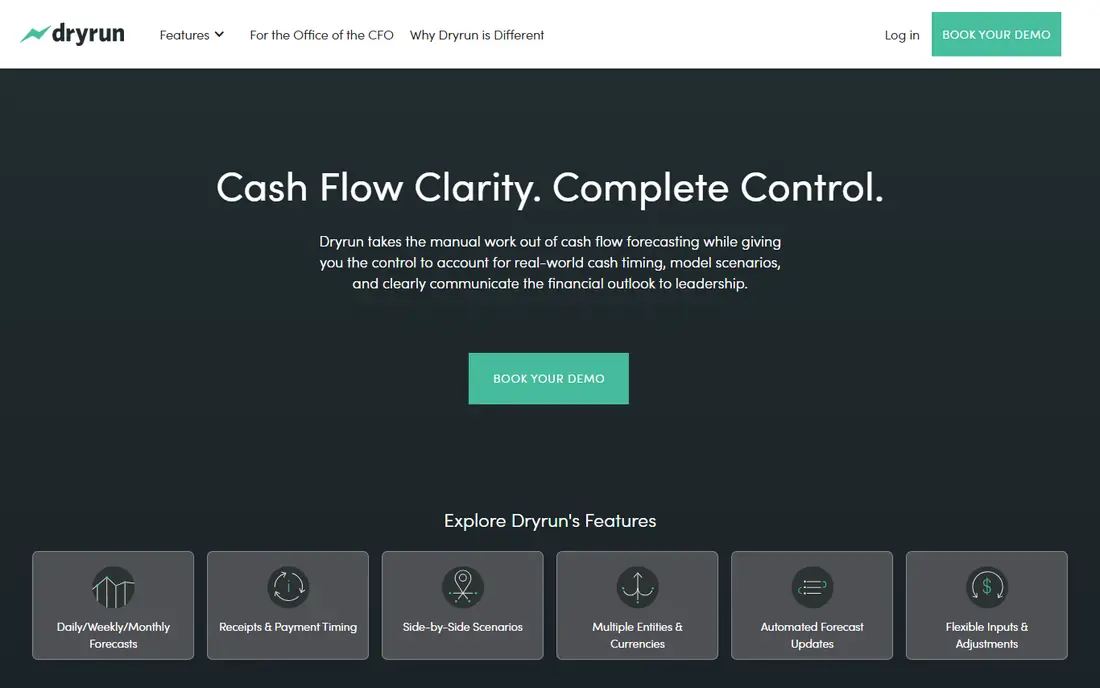
Dryrun gives finance professionals detailed control over a forecast, with daily, 13-week, and monthly views and scenario tools that let you test many what-if choices. Advisors use it with clients to model cash, plan hiring, and prepare for slow periods, and the visual forecast makes the conversation concrete. Integrations cover QuickBooks Online, Xero, and other accounting systems, plus CSV import.
Pricing is not published, so firms need a quote, and the hands-on style takes more setup than a simple owner tool. Dryrun suits CFOs, advisors, and finance-led businesses that want to control every assumption. Owners who want a forecast with minimal setup should start with Pulse or Float instead.
- Detailed control over forecast assumptions
- Daily, 13-week, and monthly views
- Good for advisors and CFOs
- Pricing is not published
- Hands-on style needs more setup time
Clockwork combines cash flow forecasting with a fuller financial model and an AI analyst that highlights trends, risks, and next steps. Growing companies can move from a simple cash forecast to budgeting, headcount planning, and board reporting in one system, without rebuilding the model in spreadsheets. QuickBooks and Xero integrations keep actuals current.
The starting price, from $599 per month on annual billing for the Predict plan, puts Clockwork beyond most very small businesses. It suits companies that have outgrown a simple forecast and need a model their finance team can run daily. Smaller firms should confirm the value against a cheaper tool before committing.
- AI analyst plus full financial model
- Strong QuickBooks and Xero integration
- Good for growing companies
- High starting price for small firms
- More model than a simple cash tool
Fathom combines management reporting, KPI tracking, and three-statement forecasting, which suits accounting firms and multi-entity businesses that want one system for client reporting and planning. Advisors can build forecast models, compare actuals against budget, and share clear reports with clients, all from the same data. The platform supports many companies under one firm account, which helps practices at scale.
Pricing is per company and varies by plan, so firms should request a quote based on company count. Fathom is broader than a pure cash flow tool, and a small owner who only needs a cash forecast may find it more than needed. For firms that report and forecast together, it is a strong choice.
- Reporting, KPIs, and forecasting together
- Multi-entity support
- Good for accounting firms
- Pricing is per company and varies
- Forecasting is one part of a wider platform
Agicap focuses on daily cash management: it pulls bank balances from hundreds of banks, shows the cash position today, and forecasts forward across entities and currencies. Mid-market finance teams use it to manage liquidity, plan payments, and spot shortfalls before they happen. The daily view is the difference from tools that update only monthly.
Pricing is not published, and some plans carry a minimum term, so check terms carefully during a demo. Agicap suits companies with several bank accounts, entities, or currencies, where a single-account forecast is not enough. Smaller single-entity firms will find Float or Pulse simpler and cheaper.
- Daily cash position across many banks
- Multi-entity and multi-currency support
- Good for mid-market finance teams
- Pricing is not published
- Minimum term applies on some plans
CashFlow Frog builds rolling cash flow forecasts up to 36 months, with integrations for QuickBooks Online, QuickBooks Desktop, Xero, Sage Intacct, and other accounting systems, plus bank feeds and Excel import. The setup is straightforward for a growing business, and the long horizon helps owners plan beyond the next quarter, such as for a loan, a lease, or a major hire.
Published prices have varied across listings, so confirm the current plan price on the CashFlow Frog site and use the free trial to test your integration. The tool is less of a full planning suite than Jirav or Fathom, and more of a focused cash forecast. For a growing business that wants a long, clear forecast with easy setup, it is a solid pick.
- Rolling forecasts up to 36 months
- Wide accounting integrations
- Straightforward setup
- Published prices have varied in listings
- Check current pricing on the vendor site
Jirav is a financial planning system that covers budgeting, forecasting, and reporting, with driver-based models that link headcount, revenue, and costs to cash. Companies that need more than a cash chart, such as a full budget with department plans, will find Jirav a step up from a pure forecast tool. The Controller Essentials plan starts at $50 per month, which is accessible for a growing company.
The trade is scope and setup. Building a good driver model takes time, and a very small business may not need that depth. For a company moving from spreadsheets to a real planning system, with cash flow as one part of the plan, Jirav offers strong value at its starting price.
- Budgeting, forecasting, and reporting in one system
- Driver-based planning
- Good for growing companies
- More system than a simple cash tool
- Setup takes time to model well
LivePlan helps business owners write a business plan and build a forecast inside it, then track actual performance against that plan. That structure suits owners seeking a loan or investment, or owners who want a plan they revisit monthly rather than a forecast they check once. The Standard plan starts at $20 per month on monthly billing, or $15 per month on annual billing, which is the lowest starting price on this list.
LivePlan does not offer a free trial, though it provides a 35-day money-back guarantee, so test it promptly if you buy. The forecasting depth is lighter than Float, Dryrun, or Jirav, and the tool is best for owners who want planning and forecasting together. For a new or small business building its first plan, LivePlan is an affordable start.
- Business plan plus forecast in one tool
- Tracks actuals against the plan
- Affordable starting price
- No free trial, though a money-back guarantee applies
- Less deep than specialist forecast tools
How we picked these
We compared official feature pages, pricing pages, and small business reviews for tools that are live, connect to common accounting systems, and focus on cash flow forecasting rather than general accounting. We weighted integration quality, forecast horizon, scenario tools, ease of use for owners, and pricing transparency, and we noted where pricing is not published or has varied, rather than presenting an uncertain figure as fact. We left out tools that had shut down or that only report past cash without forecasting.
What to check before you choose
Start with your accounting system. If you run Xero or QuickBooks Online, shortlist Float, Dryrun, and Clockwork first, because a live connection keeps the forecast current. If you run another system, check the integration list and test the import with your own data before you pay. A forecast built on stale data will mislead you at the worst moment.
Check the forecast horizon, scenario tools, and how the tool handles late payments, seasonal income, and one-off costs. Ask about the total price, including users and plan limits, and use the free trial to build a real forecast, not just to browse the demo. Finally, set a weekly habit of reviewing the forecast and updating assumptions, because even the best cash flow app only helps if someone looks at it.
Frequently asked questions
What is the best cash flow forecasting software for small business?
Float is the best choice for most small businesses on Xero or QuickBooks Online, thanks to clear rolling forecasts and scenario planning. Pulse suits owners who want a simpler visual forecast, and LivePlan suits owners building a business plan with a forecast inside it. Match the tool to your accounting system first, then to your comfort with finance.
What is the best cash flow app for a small business owner?
Pulse is the simplest cash flow app for an owner who wants a visual forecast without finance training, starting at $29 per month. Float is the better choice for owners on Xero or QuickBooks who want automatic data and scenario tools. Both offer free trials, so test each with your own numbers before choosing.
How much does cash flow software cost?
Prices range from $20 per month for LivePlan and $29 per month for Pulse to $50 per month for Jirav and $599 per month for Clockwork, with Float, Dryrun, Fathom, Agicap, and CashFlow Frog pricing by plan or quote. Always confirm the current price on the vendor site, since prices in this category change often. Budget for the plan that covers your users and forecast horizon, not just the entry tier.
Can cash flow software replace an accountant?
No. Cash flow software improves visibility and helps owners plan, but it does not replace professional advice on tax, compliance, or complex financial decisions. Share your forecast with your accountant or advisor, especially before a loan, a major hire, or a pricing change. Forecasts are estimates based on assumptions, and assumptions need regular review.
How often should I update a cash flow forecast?
Review the forecast weekly for a small business, and update assumptions whenever a major payment, hire, or sales change occurs. A monthly review is the minimum for a stable business, while a business in a tight cash period should check daily. The habit matters more than the tool: a forecast updated weekly beats a perfect model updated once a quarter.
Sources
See where you really rank - block by block
ProMapRanker scans Google Maps across a grid of your service area. Simple monthly plans from $19, white-label on every plan.
Start freeKeep reading
 zscaler alternatives
Best Zscaler Alternatives in 2026
Looking for zscaler alternatives? We compare 9 SASE and zero trust platforms on architecture, data protection, pricing, and fit for your network and team.
Read → zapier alternatives free
Best Zapier Alternatives Free in 2026
Nine automation tools for zapier alternatives free in 2026, all with genuinely free tiers, plus free plan limits, starting prices and upgrade paths explained.
Read → which platform is best for online reputation
Which Platform Is Best for Online Reputation in 2026
Wondering which platform is best for online reputation? We compare 8 review, listing, and response tools for small and multi-location businesses and agencies.
Read →