 ProMapRanker
Best Case Management Software for Law Firms in 2026


Firms wanting the largest integration ecosystem · Pricing starts at: $39 per user per month
Key takeaways
- Clio, MyCase, and PracticePanther cover most small and mid-size firms, while Filevine and Smokeball suit litigation and document-heavy practices.
- Entry prices cluster around $39 to $49 per user per month, but add-ons for intake, payments, and AI can raise the real monthly bill.
- Trust accounting, deadline rules, and client portals matter more than raw feature counts for most firms.
- This article is general information only and is not legal advice, so confirm bar rules and trust requirements for your jurisdiction before buying.
- Trial a tool with real matters, not demo data, and check migration, billing, and calendar behavior before signing.
Quick comparison
| Pick | Great for | Pricing starts at | Free tier | |
|---|---|---|---|---|
| Clio | Firms wanting the largest integration ecosystem | $39 per user per month | Free trial (7 days) | Visit |
 MyCase | Solo and small firms wanting one predictable bill | $39 per user per month | Free trial | Visit |
 PracticePanther | Growing firms wanting code-free automation | $49 per user per month | Free trial (7 days) | Visit |
 Smokeball | Document-heavy firms focused on billable time | See website | Free trial (7 days) | Visit |
 Filevine | Litigation, personal injury, and mass tort work | See website | Free trial | Visit |
 CosmoLex | Firms where accounting and trust compliance lead | $49 per user per month | Free trial (10 days) | Visit |
 Rocket Matter | Firms wanting practice management without a steep learning curve | $39 per user per month | Free trial (10 days) | Visit |
 LEAP | Firms wanting legal forms and content built in | $129 per user per month | Free trial (14 days) | Visit |
The best case management software for law firms
These eight tools organize matters, contacts, calendars, documents, billing, and client communication for law firms. We compared published pricing, trust features, and fit by practice type.

Clio Manage is the default shortlist pick for many firms because it covers matters, calendars, documents, time tracking, billing, and payments in one cloud system. Its integration library connects with accounting tools, document systems, email, and court-related apps, which reduces workarounds for firms with an existing stack. The scale also means training resources and support options are easy to find.
The honest catch is price growth. The entry tier starts at $39 per user per month on annual billing in recent listings, but workflow automation, advanced reporting, intake, and AI tools sit in higher tiers or separate products. Solo firms should price the full setup they need, not just the entry tier. Larger firms that use the ecosystem fully will get the best value.
- Wide integration library
- Matter, billing, and client tools in one system
- Strong name recognition with accountants
- Higher tiers and add-ons raise total cost
- Setup can feel large for solo firms
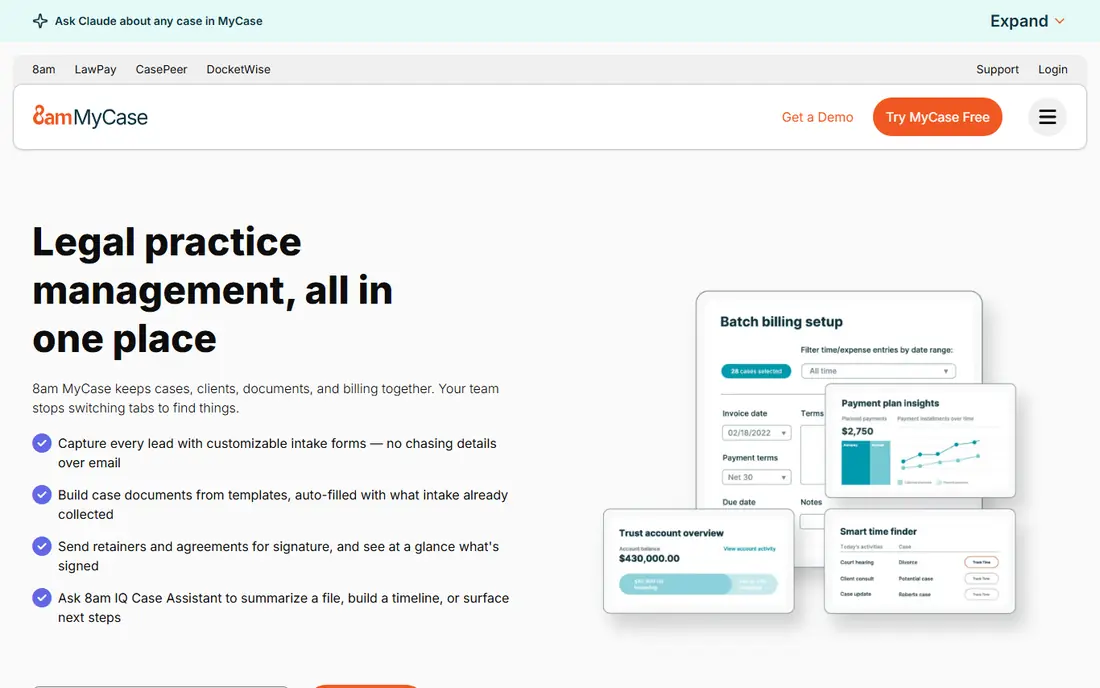
MyCase suits solo attorneys and small firms that want clients to check case status, share documents, and pay online without a tangle of separate tools. The client portal is a genuine strength, since it cuts status-update calls and keeps communication in the matter record. Billing, time tracking, and document handling cover the daily work of a small practice well.
The limit shows up as firms grow more complex. Workflow customization and reporting are less deep than specialist litigation tools, and accounting add-ons can add cost. For a firm of one to five attorneys that values clarity over endless options, that trade is reasonable. Test the portal from a client view during the trial, since that is where the value shows.
- Clean client portal and communication tools
- Case, billing, and payments in one place
- Easy to learn
- Advanced customization is thinner than Filevine
- Some features need higher tiers or add-ons
PracticePanther aims at firms that want routine work to happen on its own: intake forms, task creation, reminders, and payment follow-up without manual steps each time. Its automation tools are usable without technical staff, which helps growing firms that lack an IT team. Two-way texting and e-signatures also keep client communication inside the matter record.
Pricing needs care. The entry tier starts at $49 per user per month in recent listings, but the fuller automation and trust features sit higher. Firms should map which automations they actually need before choosing a tier. For a growing firm that repeats the same intake and billing steps weekly, the automation payoff is clear.
- Workflow automation without code
- Two-way texting
- Trust accounting and e-signatures
- Higher tiers needed for full automation
- Integration depth varies by tool
Smokeball stands out for automatic time capture. Its AutoTime feature records time spent in Word and Outlook, which helps firms recover billable minutes that never make it onto a timesheet. For document-heavy practices, that single feature can change monthly revenue more than any dashboard. Document automation and matter workflows add further value for repeat practice types.
The drawback is pricing opacity. Smokeball now uses quote-based pricing across its tiers, so buyers must request a quote and clarify what is included. Firms that do little document work may not gain enough from AutoTime to justify the cost. Firms that live in documents should trial it with real files and compare captured time against their current method.
- Automatic time capture from documents and email
- Strong document automation
- Fixed-fee billing options
- Quote-based pricing
- Desktop integration focus may suit Windows shops best
Filevine is built for firms that run complex, phase-based cases, especially personal injury and mass tort work. Its workflows, task automation, and reporting let managers see where cases stall and which stages need attention. Demand letters, document handling, and deadline tracking fit litigation work better than generic practice tools.
That power comes with setup cost. Filevine pricing is custom, and configuring phases, tasks, and reports takes time and staff buy-in. Small general practices may find it heavier than needed. Litigation firms that need consistent case handling across many matters will find the structure worth the effort.
- Deep workflow customization for litigation
- Phase-based matter tracking
- Strong reporting and analytics
- Custom pricing
- Setup and configuration take real effort
CosmoLex puts accounting first, which matters for any firm holding client funds. Its built-in legal accounting handles trust deposits, disbursements, and three-way reconciliation without a separate accounting subscription. That single-system approach reduces the risk of billing and trust records drifting apart across tools.
The trade-off is breadth. CosmoLex does not match Clio for third-party integrations, and some users find the interface less polished. Firms that prioritize clean trust accounting over a large app ecosystem will still prefer it. Check that it covers your jurisdiction's trust rules and test reconciliation with your own chart of accounts during the trial.
- Built-in legal accounting and trust reconciliation
- Matter and billing in one system
- No separate accounting add-on at core tiers
- Interface feels dated to some users
- Fewer third-party links than Clio
Rocket Matter
Great for: Firms wanting practice management without a steep learning curve
Rocket Matter suits firms that want to start fast and avoid a long implementation. Matters, calendars, tasks, documents, time, and billing sit in a clear layout that new staff can learn quickly. That simplicity helps small firms where every attorney also handles admin work and cannot spare weeks for setup.
The limit is depth at scale. Native accounting, budgets, and advanced reporting sit in higher tiers, so growing firms should price those tiers early. Rocket Matter also has fewer integrations than the largest rivals. For a small firm that values speed and clarity, it is a strong and affordable pick.
- Easy to learn
- Matter, billing, and calendar tools in one place
- Good for small firms
- Advanced accounting features need higher tiers
- Smaller integration library than Clio
LEAP combines practice management with a library of legal forms and matter content, which can save time for firms that draft similar documents often. Document assembly, accounting, and matter workflows sit in one system, so staff spend less time hunting for templates across drives. The guided trial helps firms test forms for their own practice areas.
The price is the clear barrier. At $129 per user per month in recent listings, LEAP costs far more than entry tiers from Clio, MyCase, or Rocket Matter. Firms outside its strongest practice areas may not use the form library enough to justify it. Check form coverage for your jurisdiction before committing, and price the full team, not just one seat.
- Built-in legal forms and matter content
- Strong document assembly
- Accounting included
- Highest starting price here
- Forms value depends on your practice areas and jurisdiction
How we picked these
We compared official feature and pricing pages and recent published comparisons for law firm case management tools active in October 2026. We favored tools with matter tracking, calendaring, document handling, billing, and client communication, plus trust accounting where relevant. We kept a mix of general practice tools and litigation specialists, since a personal injury firm and a solo estate practice need different strengths. Where pricing was quote-based, we wrote See website rather than repeating an estimate as a published price.
How to choose for your firm
Start with your practice type and trust needs. A firm that holds client money should shortlist tools with proven trust accounting and reconciliation first. A litigation firm should test deadline rules, phase workflows, and reporting with real case types. A solo practice should favor ease of use and a predictable bill.
Trial questions that matter
Bring real matters, contacts, and documents to the trial, and run billing from time entry through invoice and payment. Test calendar rules for your jurisdiction, including how deadlines recalculate when a date changes. Check data export and migration support, since switching later is costly. Ask about support hours, training, and whether intake, payments, and AI features are included or sold separately.
Cost traps to watch
Per-user pricing turns a small tier gap into thousands of dollars a year as headcount grows. Payment processing fees, e-signature limits, texting charges, and AI add-ons can add more than the subscription itself. Get the full quote in writing, including implementation fees and annual contract terms. This article is general information only and is not legal advice, so confirm compliance duties with your own advisors.
Frequently asked questions
What is the best law firm case management software?
Clio suits firms that want the largest ecosystem, MyCase suits solo and small firms that want simplicity, and Filevine suits litigation and personal injury work. The best pick depends on practice area, firm size, and trust accounting needs. Trial two finalists with real matters before deciding.
What is the best attorney case management software for solo attorneys?
MyCase and Rocket Matter are strong solo picks because they are easy to learn and cover matters, billing, and client communication in one bill. PracticePanther also works well for solos who want automation. Compare the entry tier against the tier that includes the billing and portal features you will actually use.
What is the best litigation management software?
Filevine is a strong litigation pick for phase-based case tracking, workflow customization, and reporting. Smokeball suits document-heavy litigation where automatic time capture matters. Check deadline rules, document handling, and reporting for your case types during a trial.
How much does case management software for law firms cost?
Entry prices in this group run from $39 to $129 per user per month, with Smokeball and Filevine priced by quote. Add-ons for intake, payments, e-signatures, and AI can raise the total well above the entry price. Ask for a full written quote for your team size and required modules.
Does case management software handle trust accounting?
Some tools, such as CosmoLex and PracticePanther at higher tiers, include trust accounting and reconciliation. Others rely on integrations or add-ons. If your firm holds client funds, confirm trust features, three-way reconciliation, and jurisdiction rules during the demo, and do not assume every tier includes them.
Sources
See where you really rank - block by block
ProMapRanker scans Google Maps across a grid of your service area. Simple monthly plans from $19, white-label on every plan.
Start freeKeep reading
 zoho inventory alternatives
6 Alternatives to Zoho Inventory, Compared on Price and Fit
Zoho Inventory alternatives: 6 tools compared on price, free plans and fit. Katana leads the list for manufacturers. Fit and flaws are laid out for each entry.
Read → zoho crm alternatives
Best Zoho CRM Alternatives (2026)
Need Zoho CRM alternatives? We compare 7 tools on cost, free access and who each suits. Every pick gets a straight assessment. Built for quick decisions.
Read → zelle alternatives
Best Zelle Alternatives in 2026
Compare the best Zelle alternatives for sending money to friends, paying sellers and moving funds abroad, with honest notes on fees, speed and safety in 2026.
Read →