 ProMapRanker
Best Card Value Scanner Apps in 2026

Key takeaways
- CollX is our pick for most collectors because it pairs camera scanning with a large card database and a built-in marketplace.
- Ludex is worth a closer look for modern parallels and variations, where a plain scan often picks the wrong version of a card.
- A scanner value is an estimate, so check recent sold prices on eBay or 130 Point before buying, selling or paying to grade a card.
- Condition and grade move real prices far more than a scan can show, so treat any single number as a starting point, not a sale price.
Quick comparison
| Pick | Great for | Pricing starts at | Free tier | |
|---|---|---|---|---|
 CollX | All round scanning and trading | Free | Yes | Visit |
 Ludex | Modern parallels and variations | See website | Yes | Visit |
 Card Ladder | Collection value tracking | See website | Yes | Visit |
 130 Point | Checking real sold prices | Free | Yes | Visit |
 eBay | Sold listings and listing cards | Free | Yes | Visit |
 TCGplayer | Trading card game prices | Free | Yes | Visit |
 PriceCharting | Price history across hobbies | Free | Yes | Visit |
 Beckett | Graded and vintage price guides | See website | No | Visit |
The best card value scanner apps
We compared official feature pages, pricing pages, app store listings and public reviews, with a focus on how each tool identifies a card and where its price comes from.
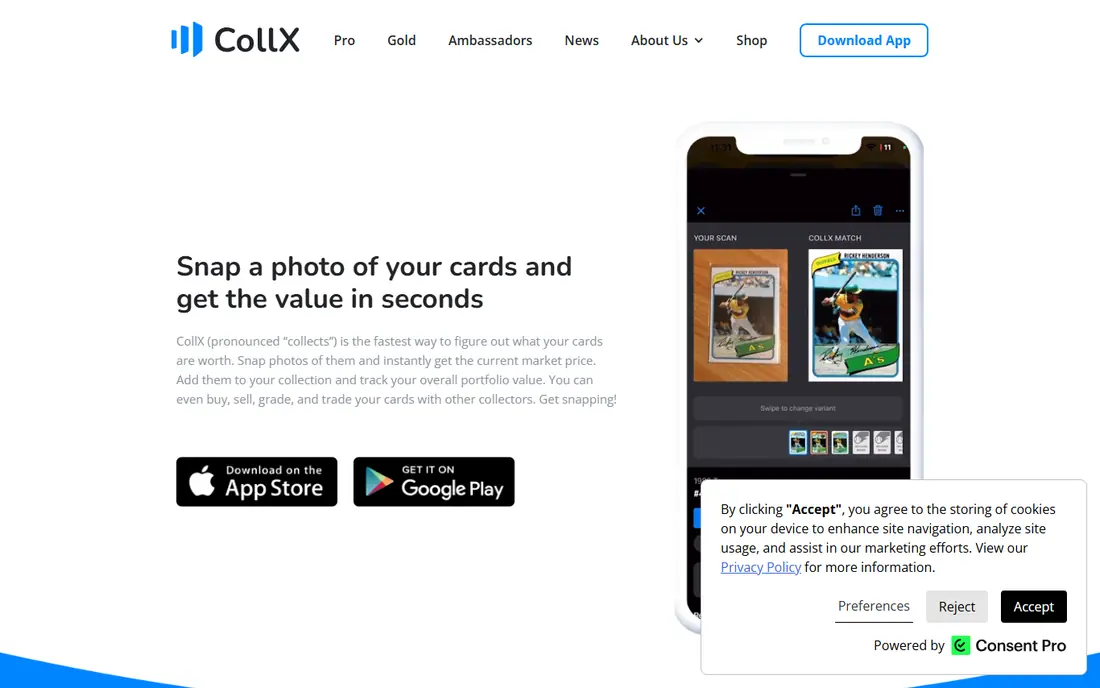
CollX is the easiest place to start because it covers the full loop in one app. You scan a card, add it to a collection, watch a portfolio total move, and list a card for sale or trade without moving to another tool. The database covers millions of cards, and the marketplace gives a quick sense of what other collectors are asking for similar items.
The weakness is the price itself. CollX values are based on historical auction data and averages, and public reviews note that those estimates can sit well below or above a recent sold price. Pro is $9.99 per month, or $99.99 per year, and adds unlimited scans, ad removal, price charts and CSV export. Use the free tier to identify cards, then confirm any important value elsewhere before you act on it.
- Camera scanning across sports and some trading card games
- Built-in marketplace and trading
- Portfolio value tracking
- Values are estimates, not sold prices
- Free tier shows ads and limits some features
- Accuracy drops on older or unusual cards
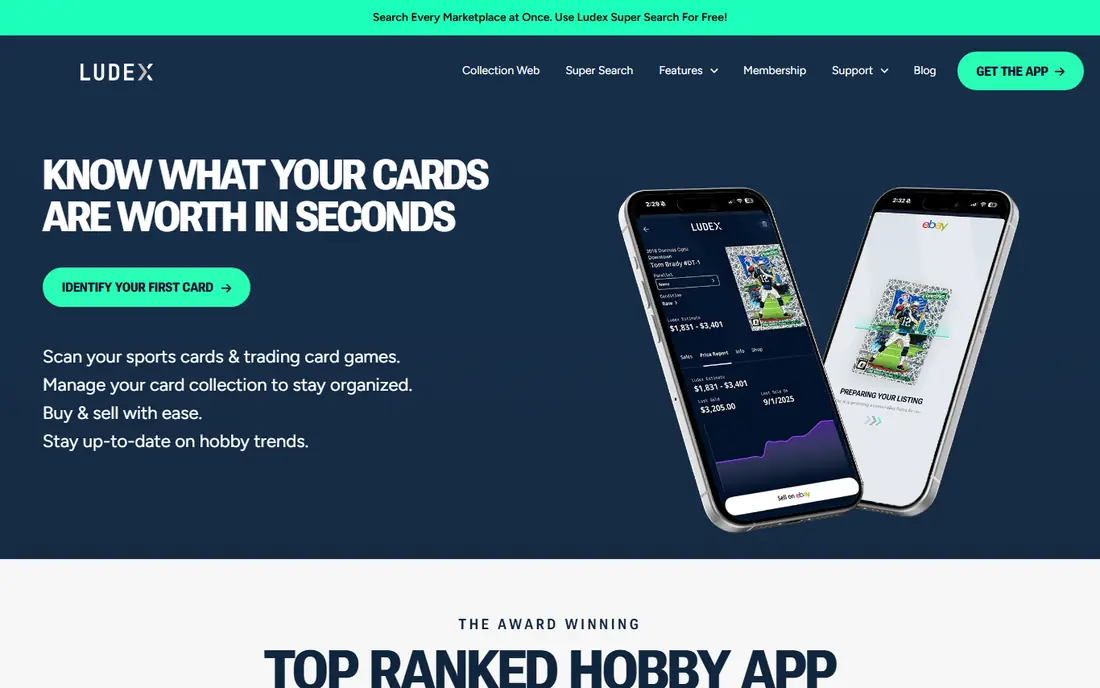
Ludex earns its place for collectors who keep pulling parallels, refractors and numbered variations that look almost identical. Its scanner is built to separate those versions, and its pricing draws on completed marketplace sales rather than a single asking price. That difference matters when two versions of the same card differ in value by a wide margin.
The free membership includes unlimited scans but limits collection size and monthly eBay listings, so a large collection will push you toward a paid plan. Check current plan prices on the Ludex site before upgrading, since tiers and limits have changed over time. Even with Ludex, confirm a high value card against sold listings, since condition still sits outside what a photo can prove.
- Strong handling of parallels and variations
- Market values tied to completed sales
- Collection and set tracking tools
- Best features sit behind a paid plan
- Sports focus is stronger than some trading card games
- Scan results still need a manual check
Card Ladder is less of a quick scanner and more of a portfolio tool. Once cards are logged, it tracks value over time using eBay sale data, which gives a clearer picture than a single estimate on the day you scan. That makes it useful for collectors who want to know whether a holding has risen or fallen, or whether a grade is worth pursuing.
The trade is scope. Card Ladder shines with graded cards and well documented sets, and it is less helpful for a box of low value raw commons. Check its current pricing on its own site, since the free tier and paid features differ by plan. Pair it with a scanner app for identification, and use Card Ladder for the longer tracking job.
- Portfolio tracking based on eBay sales data
- Sales history and population context
- Useful for graded cards
- Strongest for graded and higher value cards
- Casual raw collections get less value from it
- Full features need a paid plan
130 Point is the reality check in this list. It is not a scanner, but it answers the question a scanner cannot: what did this exact card actually sell for, and in what grade. You can filter sold listings, compare raw and graded results, and spot whether an asking price is optimistic. For any card worth real money, this step should come before a purchase or a grading submission.
The work is manual. You need the set, year, player or character, and variation details, which is why it pairs so well with a scanner that identifies the card first. There is no app magic here, just sales evidence, and that is the point. Use it to set a price range, then decide your own asking price from the lower and upper sold results.
- Shows actual eBay sold listings
- Filters by grade and date
- Free to search without an account for basic use
- Not a camera scanner
- Search needs the exact card details
- Data is only as complete as eBay listings
eBay belongs here for two reasons. Its sold listings filter is the most widely used price check in the hobby, and its own app scanner can identify a card when you start a listing. That combination means you can move from identification to a market test in the same place, which is useful when you are clearing a collection.
Do not treat an eBay scanner result as a valuation. It tells you what the card is and what similar cards are listed for, not what your copy is worth in its current condition. Filter sold items by graded or raw, by recent dates, and by variation, and ignore active listings that have not sold. Fees and shipping also cut into any sale, so factor those in before you judge a profit.
- Largest pool of sold card data
- Built-in scanner for listing
- Direct route to sell a scanned card
- Scanner gives no condition assessment
- Sold prices need filtering by grade and condition
- Seller fees apply
TCGplayer is the natural pick for trading card game collectors. Its market price reflects sales through its marketplace, and its app and site let you scan or search a card, check set and rarity details, and compare listings. For Pokemon, Magic: The Gathering and Yu-Gi-Oh, that depth beats a general sports scanner.
Sports collectors should look elsewhere, since TCGplayer does not try to cover that side of the hobby in the same depth. Also remember that a market average can hide a spread: a near mint copy and a played copy of the same card can sit far apart. Check condition notes on listings, and use recent sales rather than the headline average for a high value card.
- Deep coverage of Pokemon, Magic and Yu-Gi-Oh
- Market price based on sales
- Marketplace for buying and selling
- Sports card coverage is not its strength
- Market price is an average, not a single sold result
- Shipping and fees affect small orders
PriceCharting suits collectors who like to see a trend rather than a single snapshot. Its price history pages show how a card has moved over time, with separate views for graded and ungraded copies where data exists. That context helps when you are deciding whether to sell now, hold, or grade a card that has moved sharply.
It is not a like for like replacement for a camera scanner. You will usually search by name, set and number, which is slower than a photo scan but more precise for older or obscure issues. Check the current plan details on its site, since some tools sit behind a subscription. Use it as a second opinion alongside a scanner and sold listings.
- Price history for cards, games and other collectibles
- Graded and ungraded price views
- Useful for spotting trends
- Not a camera scanner for every card type
- Data depth varies by set
- Some advanced tools need a paid plan
Beckett has been part of the hobby far longer than the app scanners, and that history shows in its vintage and graded coverage. Its price guides and grading service context help collectors understand why a graded copy can be worth many times a raw copy, and its set information is useful for older issues that newer scanners handle poorly.
The catch is access and speed. The full online price guide is a paid product, so check current subscription prices on the Beckett site before subscribing. Guide prices can also lag a fast market, so pair Beckett with recent sold listings for any card you plan to sell soon. It works best as a reference for grading and vintage research, not as a quick scan and go tool.
- Long running price guide and grading context
- Strong vintage and graded coverage
- News and hobby content
- Full price guide access needs a paid plan
- Guide prices can lag fast moving markets
- App experience is thinner than newer scanners
How we picked these
We compared official feature pages, pricing pages, app store listings and public reviews for tools live in October 2026. We favoured tools that identify a card, give a price with a stated source, or track a collection over time, and we kept sold price sources in the list because a scan alone is not a valuation. We did not claim hands-on testing, and we treated every in-app value as an estimate to be checked against sold data.
How to use a card scanner without overpaying
Start with the scan, then verify the variation. Parallels, refractors, numbered cards and error versions can look alike in a photo, and picking the wrong one can change the value by a large amount. Read the back of the card, check the set number, and compare the scan result with the physical card before you trust the number.
Next, check sold prices in the same grade and condition. A raw card, a PSA 9 and a PSA 10 are three different markets, and a scanner that does not ask about condition cannot price them all correctly. Look at recent sales, not old listings, and ignore asking prices that never closed. If the sold range is wide, price conservatively.
Finally, decide what the card is for. A collection tracker, a quick sale and a grading decision need different tools. Use a scanner for identification, a sold price source for value, and a portfolio tool for tracking. Keeping those jobs separate is the simplest way to avoid paying too much for a card or selling a good one too cheaply.
Frequently asked questions
What is the best card value scanner app for beginners?
CollX is our pick for beginners because scanning, collection tracking and a marketplace sit in one free app. Start there to learn the workflow, then use 130 Point or eBay sold listings to check any value that matters. That two step habit prevents most early mistakes.
Are card scanner values accurate?
Scanner values are estimates based on averages or historical sales, so they are useful as a guide but not exact. Condition, centering, corners, edges and surface wear can move a real sale price a long way from the estimate. Always check recent sold prices for the same card, variation and grade.
Can a scanner tell me if my card is worth grading?
A scanner can suggest a range, but it cannot grade a card from a photo with certainty. It can flag a card whose graded value is much higher than its raw value, which is a reason to research grading further. For a high value card, get an in-person opinion or submit through a recognised grading service.
Do I need to pay for a card scanner app?
No, for basic scanning. CollX, Ludex and several other tools offer free scanning with limits or ads, and sold price checks on 130 Point and eBay are free. Paid plans mainly add unlimited scans, charts, export and ad removal, so pay only when a limit actually blocks your collecting.
Which app is best for Pokemon cards?
TCGplayer is the strongest choice for Pokemon pricing and selling, since its market price comes from trading card game sales. CollX also covers some trading card games, so use CollX for a quick scan and TCGplayer for price and marketplace depth. Check condition carefully, since played cards sell for less than near mint copies.
Sources
See where you really rank - block by block
ProMapRanker scans Google Maps across a grid of your service area. Simple monthly plans from $19, white-label on every plan.
Start freeKeep reading
 worlds best local seo company
8 Worlds Best Local SEO Companies for Map Pack Growth in 2026
Compare the worlds best local seo company options for Google Business Profile work, citations, reviews, and multi-location rankings and reporting in 2026.
Read → world's best web hosting company
World's Best Web Hosting Company in 2026
Searching for the world's best web hosting company? We compared 10 hosts on price, renewal rates, speed, and support to help you choose well today in 2026.
Read → who's got the best nanny tax services
Who's Got the Best Nanny Tax Services in 2026
We answer who's got the best nanny tax services, comparing full filing, back taxes, software, and pricing so families can handle nanny taxes correctly.
Read →