 ProMapRanker
Best Car Buying and Selling Apps in 2026

Key takeaways
- CarGurus and Edmunds are the strongest starting points for price checks, because deal ratings and market values help you spot an asking price that is far from the local norm.
- Carvana and CarMax suit buyers who want a fixed price, home delivery and a short return window, while private marketplaces often offer lower prices with more paperwork and risk.
- Sellers should get offers from at least two instant buyers and one marketplace listing, since the best cash offer and the best private sale price are rarely the same.
- Always check the title, accident history and a pre-purchase inspection, even when an app makes the listing look polished and complete.
Quick comparison
| Pick | Great for | Pricing starts at | Free tier | |
|---|---|---|---|---|
 Carvana | Fixed-price online buying and delivery | Free | Yes | Visit |
 CarGurus | Deal ratings and price comparison | Free | Yes | Visit |
 Cars.com | Broad dealer and private inventory | Free | Yes | Visit |
 Autotrader | Detailed search filters | Free | Yes | Visit |
 CarMax | No-haggle buying with store support | Free | Yes | Visit |
 Edmunds | Research and True Market Value pricing | Free | Yes | Visit |
 Kelley Blue Book | Valuation and private seller exchange | Free | Yes | Visit |
 TrueCar | Upfront dealer pricing | Free | Yes | Visit |
 Facebook Marketplace | Local private sales | Free | Yes | Visit |
 OfferUp | Local mobile buying and selling | Free | Yes | Visit |
The best car buying and selling apps
We compared these apps on inventory, price transparency, seller options, return terms and how much of the deal can be finished on a phone. The list mixes large dealer marketplaces, instant buyers and local private sale apps, because a good buying app is not always a good selling app. Read the return terms and fees for your state before you commit, and treat any single valuation as a starting point rather than a final price.
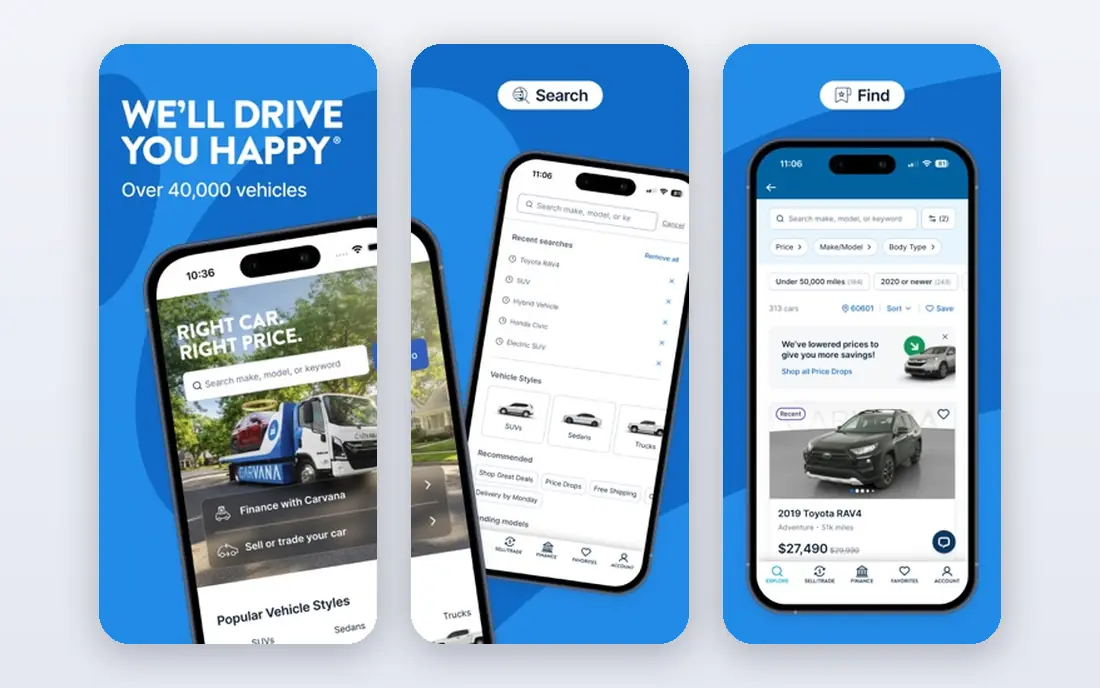
Carvana suits a buyer who wants to skip dealer negotiation and finish most of the purchase online. You search its own inventory, see a fixed price, arrange financing and schedule delivery or pickup through the app. That clarity is useful when you have a firm budget and a specific body style in mind, and you do not want to spend a weekend visiting lots.
The honest catch is that convenience has a price in choice and inspection. You are limited to Carvana inventory, and the return window is short, so a prompt independent inspection still matters.
- No-haggle pricing
- Home delivery in many areas
- 7-day, 400-mile return window on qualifying purchases
- Vehicle price is separate from the free browsing
- Delivery fees and availability vary by location
- Trade-in values can differ from private sale prices
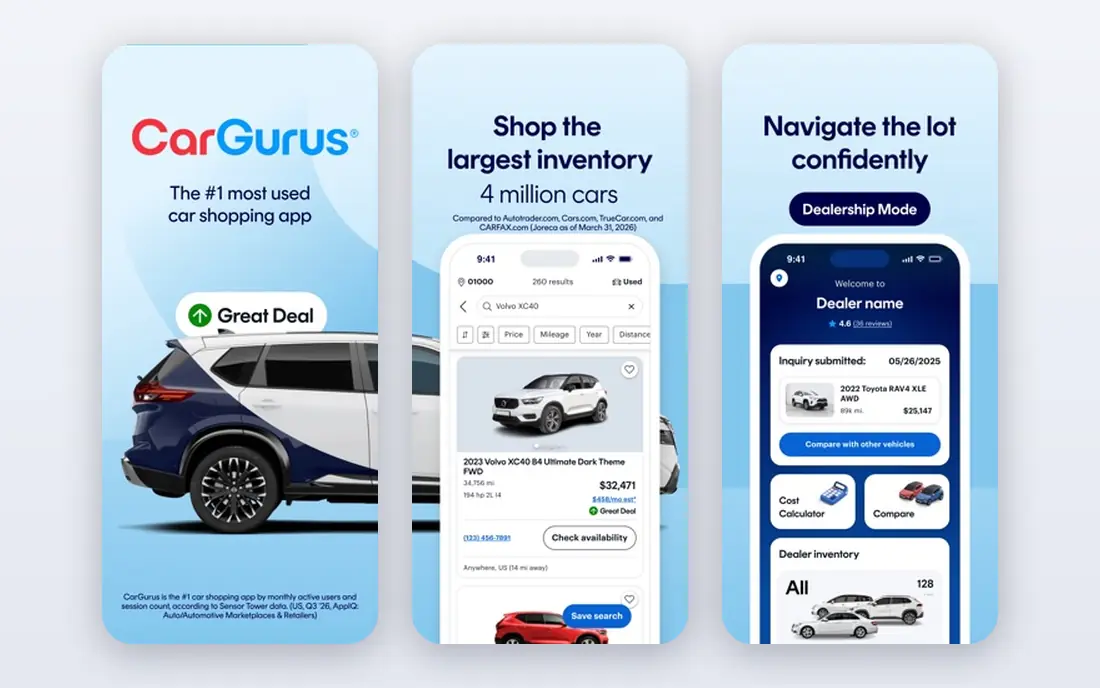
CarGurus is our pick for most shoppers who want to compare prices before they contact anyone. Its deal rating gives a quick read on whether a car is priced below, near or above similar listings, and filters make it easy to narrow by price, mileage, trim and distance. That makes it a strong first stop for both new and used searches.
The limit is that CarGurus does not sell most cars itself, so the buying experience varies by seller. Read the full listing, ask for the out-the-door price and check the vehicle history before you travel to see a car.
- Deal ratings flag overpriced listings
- Large mix of dealer and private listings
- Price history tools on many listings
- The final sale still depends on the dealer or seller
- Deal ratings are estimates, not guarantees
- Some listings lead to dealer fees not shown upfront
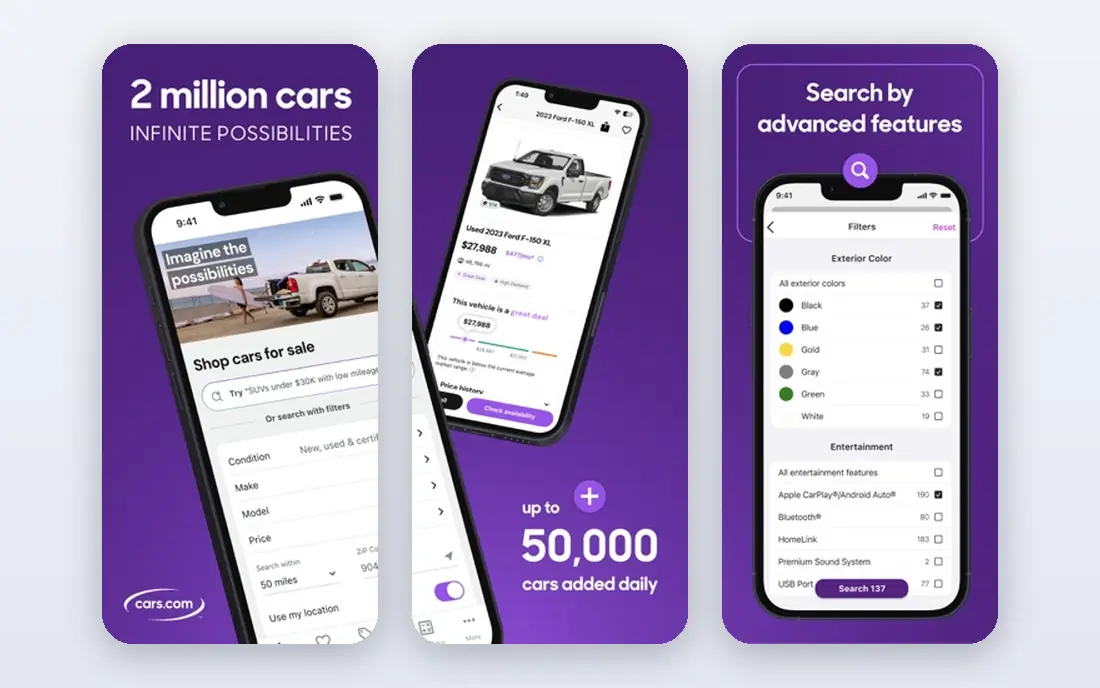
Cars.com works well when you are still narrowing down models and want dealer inventory near you in one place. The search tools cover new and used cars, and the research pages explain trims, safety features and running costs in plain language. Saved searches and alerts help when a popular model sells quickly in your area.
For sellers, the audience is a clear strength, but a listing still needs good photos, honest condition notes and a realistic price. Buyers should confirm availability before visiting, because popular cars can sell between the time a listing is posted and the time you arrive.
- Very broad inventory
- Helpful reviews and research articles
- Price alerts and saved searches
- Most sales still go through dealers
- Private listings vary in detail
- Financing terms depend on the lender and dealer
Autotrader is a good fit for a buyer with a specific specification in mind, such as a certain engine, trim or option package. Its filters are more detailed than many rivals, which saves time when you are comparing nearly identical cars. Dealer and private listings sit side by side, so you can see the price gap between a dealer car and a comparable private car.
The trade-off is that Autotrader is a marketplace, not the seller, so protections and return terms differ by listing. Ask direct questions about title status, accidents, service records and why the car is being sold.
- Precise filters for trim, options and mileage
- Long-running marketplace with dealer and private sellers
- Vehicle history links on many listings
- Private seller listing fees vary
- Final terms depend on the seller
- Some dealer listings include added fees
CarMax suits buyers who like the idea of online shopping but still want a physical store to visit. Prices are fixed, financing can be arranged through CarMax, and the return window is longer than many online rivals. That combination reduces the pressure of a single test drive decision, which matters for a first-time buyer or a family purchase.
Sellers can also get an instant offer and sell without listing the car themselves, which is useful when time matters more than squeezing out the last dollar. Compare that offer with Carvana and a private listing, because the fastest offer is not always the highest.
- Fixed pricing across a large inventory
- 10-day, 1,500-mile return window on qualifying purchases
- Stores for in-person pickup and questions
- Prices can be higher than private sales
- Delivery fees may apply
- Inventory is limited to CarMax stock
Edmunds is best used before you shop, and again before you sign. Its reviews explain how a car drives, how much space it offers and which trim gives the best value, while True Market Value gives a grounded range for what similar cars are selling for. That helps you walk into a negotiation with a number that is based on recent market data, not just the asking price.
The site also lists cars for sale, but its main strength remains research. Use it to shortlist two or three models, then cross-check live listings on CarGurus or Cars.com.
- Detailed reviews and True Market Value estimates
- Clear explanations of trims and features
- Inventory search alongside research
- Edmunds does not sell most cars directly
- Values are estimates for your area
- Final dealer fees still need checking
Kelley Blue Book, often called KBB, is the valuation tool many buyers and sellers quote first. Enter the year, model, mileage and condition, and you get a range for trade-in, private party and dealer retail values. That range is useful for setting a fair asking price or for checking whether a dealer offer is reasonable.
KBB also supports private seller listings, which helps owners reach buyers who already trust the valuation. The catch is condition: a car graded as excellent when it has worn tyres and overdue service will disappoint a buyer at inspection.
- Widely used valuation ranges
- Private seller listings with pricing guidance
- Instant cash offer option in many areas
- Values are ranges, not a guaranteed sale price
- Condition grading affects the result
- Private sale paperwork stays with buyer and seller
TrueCar suits a buyer who wants a dealer price without a long back-and-forth negotiation. You configure a car, see market pricing and connect with participating dealers who offer upfront prices. That can shorten the dealer visit to a test drive, a trade-in check and paperwork, rather than a full day of haggling.
The limit is coverage: not every dealer in your area may take part, and the upfront price may not include every fee. Ask for the full out-the-door total in writing before you travel. For used cars, compare TrueCar prices with CarGurus and Cars.com, since a smaller used inventory can mean fewer close matches in some regions.
- Shows what others paid for similar cars
- Upfront pricing from participating dealers
- Simple price comparison for new and used cars
- Coverage depends on participating dealers
- Final fees can still vary
- Used inventory is smaller than the largest marketplaces
Facebook Marketplace is often where the lowest local private prices appear, because owners list cars they want gone quickly. You can filter by distance, price and model, message the seller directly and arrange a local viewing. Seeing a seller profile and past listings can add useful context, though it is not a substitute for checks.
Risk management is on you here. Meet in a safe public place, verify the title matches the seller identity, check the vehicle identification number and arrange an independent inspection for any car you plan to keep. Never pay in advance for a car you have not seen, and be wary of prices that sit far below market value, since those listings often hide title, accident or payment problems.
- Very large local audience
- Free listings for most private sellers
- Seller profiles and message history add context
- Little buyer protection for private sales
- Scams and misleading listings occur
- No standard return policy
OfferUp works best as a mobile-first local marketplace, especially for budget cars and quick local sales. Listing from a phone takes minutes, offers and messages stay in the app, and local search helps you find cars you can view the same day. For a seller with an older car, that speed can matter more than the wider reach of a national marketplace.
The same openness that makes OfferUp easy also means listing quality varies. Ask for clear photos of the title, odometer, tyres and any damage, and insist on an in-person inspection. As with Facebook Marketplace, treat payment, title transfer and state paperwork as separate steps, and do not rush them to secure a deal that feels too good to last.
- Mobile-first local listings
- Simple messaging and offers
- Useful for lower-priced and older cars
- Listing quality varies widely
- Limited protection for private vehicle sales
- Dealer listings can sit beside private listings
How we picked these
We compared official feature pages, pricing and listing pages, app store listings and public help pages for each service, and we kept only services that are live and active for US buyers and sellers in October 2026. We favoured apps with broad inventory or a clear price advantage, transparent valuations, and a defined buying or selling path, rather than sites that only aggregate headlines. Where a price or fee could not be verified on the vendor site, we used Free for browsing access and left vehicle prices and seller fees to the listing, since those vary by car and location.
What to check before you buy or sell
Start with price, then condition, then paperwork, in that order. Get a valuation from KBB and Edmunds, a deal rating from CarGurus and, if you are selling, instant offers from Carvana and CarMax. That set of numbers shows whether a private listing, a dealer price or an instant offer makes most sense for your car and timeline. A gap of a few hundred dollars may be worth closing for convenience, while a gap of several thousand dollars usually deserves a private listing attempt.
For condition, ask for the vehicle identification number, a history report and service records, and budget for an independent inspection on any car above a modest price. Check tyres, brakes, fluids and warning lights yourself, and test every major feature during a drive, including heating, cooling and driver assistance systems. For paperwork, confirm the title is clear and in the seller name, check for liens, and learn your state transfer, tax and registration steps before you hand over payment. A bill of sale, a signed title and a record of payment protect both sides long after the app messages end.
Frequently asked questions
Is it cheaper to buy from a private seller or a dealer app?
Private sellers often ask less, because they do not carry dealer overhead, reconditioning and warranty costs. Dealer and instant-buyer cars can still be better value when they include a return window, inspection, financing and a cleaner title process. Compare the full out-the-door cost, not just the headline price, and factor in an inspection for any private car.
Do I need to pay to browse these car apps?
Browsing and searching are free on the apps in this list, and most let you save searches and set alerts without paying. Vehicle prices, taxes, delivery fees and any private seller listing upgrades are separate, so check the listing or checkout page for the total before you commit. Seller fees vary by platform and package.
Should I get a pre-purchase inspection for a car bought online?
Yes, for most used cars above a low budget, an independent inspection is money well spent. It can reveal accident repairs, worn brakes, leaks and electrical faults that photos miss, and it gives you a written basis to renegotiate or walk away. Even with a return window, an inspection before delivery or early in the window is safer than discovering a fault later.
How do instant offers from Carvana and CarMax work?
You enter the car details, mileage and condition, and the service gives an offer that is usually valid for a short period. If you accept, you arrange pickup or drop-off and complete title and payment steps through the service. Offers are convenient, but they are based on wholesale-style pricing, so compare them with a private listing value before accepting.
What paperwork do I need for a private car sale?
In most states you need a signed title, a bill of sale, an odometer statement where required, and a record of payment, plus prompt title transfer and registration by the buyer. Check your state motor vehicle agency for exact forms, lien release rules and deadlines, because requirements differ. Keep copies of everything you sign.
Sources
See where you really rank - block by block
ProMapRanker scans Google Maps across a grid of your service area. Simple monthly plans from $19, white-label on every plan.
Start freeKeep reading
 zoro.to alternatives
Best Zoro.to Alternatives in 2026
We compare the best zoro.to alternatives in 2026, listing only legal licensed anime streaming services, from Crunchyroll to free options for fans today.
Read → zip alternatives
Best Zip Alternatives in 2026
We compare the best zip alternatives for buy now, pay later in 2026, covering pay-in-4 plans, fees, spending limits, and credit reporting options today.
Read → yesware alternatives
Best Yesware Alternatives in 2026
Compare the best yesware alternatives for sales email tracking, templates, and sequences, with current pricing and honest tradeoffs for small sales teams.
Read →