 ProMapRanker
Best Cap Table Management Software for Startups in 2026

Key takeaways
- This article is general information only, not legal or financial advice, and startups should check equity decisions with a qualified lawyer or accountant.
- A good cap table tool tracks shares, options, SAFEs, and convertible notes, and shows fully diluted ownership as rounds close.
- Carta suits later-stage firms with broad needs, while Pulley and Eqvista suit early-stage firms that want clearer pricing.
- Free launch plans help pre-seed firms, but check stakeholder limits and what happens when you pass them.
Quick comparison
| Pick | Great for | Pricing starts at | Free tier | |
|---|---|---|---|---|
 Carta | Broad equity and fundraising needs | Free | Yes | Visit |
 Pulley | Seed-stage modelling and clarity | $1,200 per year | No | Visit |
 Eqvista | Value and valuation bundles | Free | Yes | Visit |
 Cake Equity | Early-stage affordability | Free | Yes | Visit |
 Ledgy | European and global equity | Free | Yes | Visit |
 Shareworks by Morgan Stanley | Mature and public-company equity | See website | No | Visit |
 Astrella | Private-company equity admin | See website | Free trial | Visit |
 Vestd | UK startups and share schemes | See website | No | Visit |
The best cap table management software for startups
We compared tools on cap table accuracy, share class handling, option and SAFE tracking, valuations, and pricing clarity. The best software for startup cap table management depends on stage, location, and how complex your equity already is.
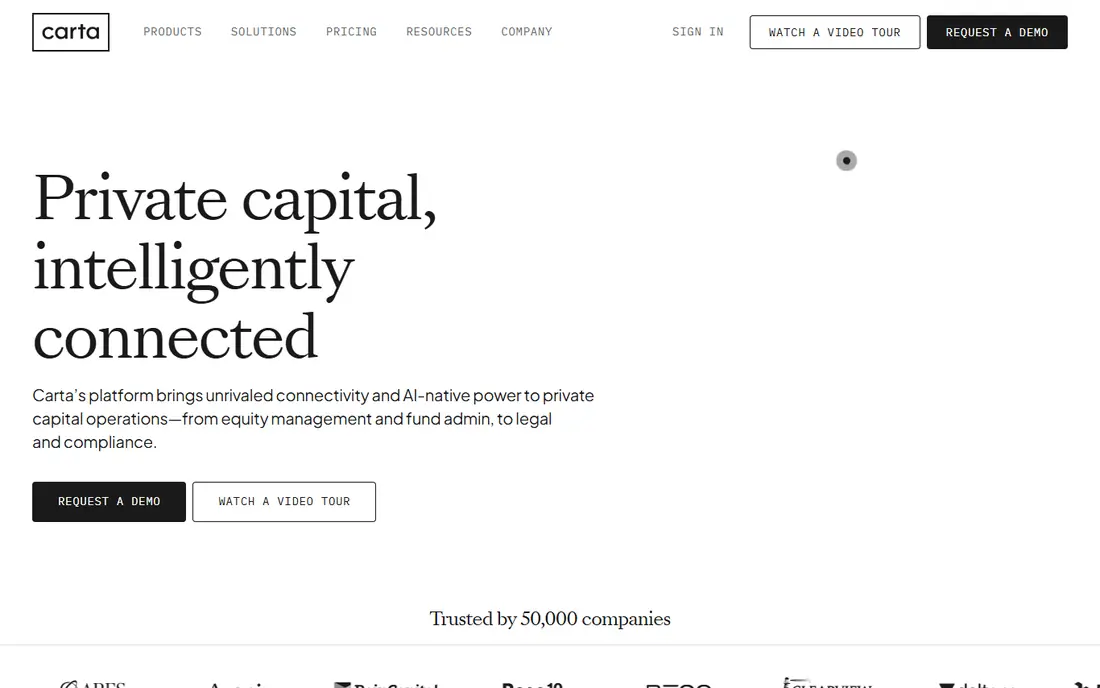
Carta is the default comparison point for startup cap tables. It handles shares, options, SAFEs, priced rounds, and valuations, and it adds fund administration for firms that manage capital. Many lawyers and investors already know its reports, which can smooth a financing round.
The Launch plan is free for eligible new firms with up to 25 stakeholders and up to 1 million dollars raised, which helps pre-seed teams start cleanly. Paid plans are quote-based, so later-stage pricing needs a sales conversation. For a firm expecting several rounds, that breadth is often worth it.
- Widest feature set in the category
- Free Launch plan for small firms
- Strong law-firm familiarity
- Paid pricing is mostly quote-based
- Breadth can feel heavy for a pre-seed team
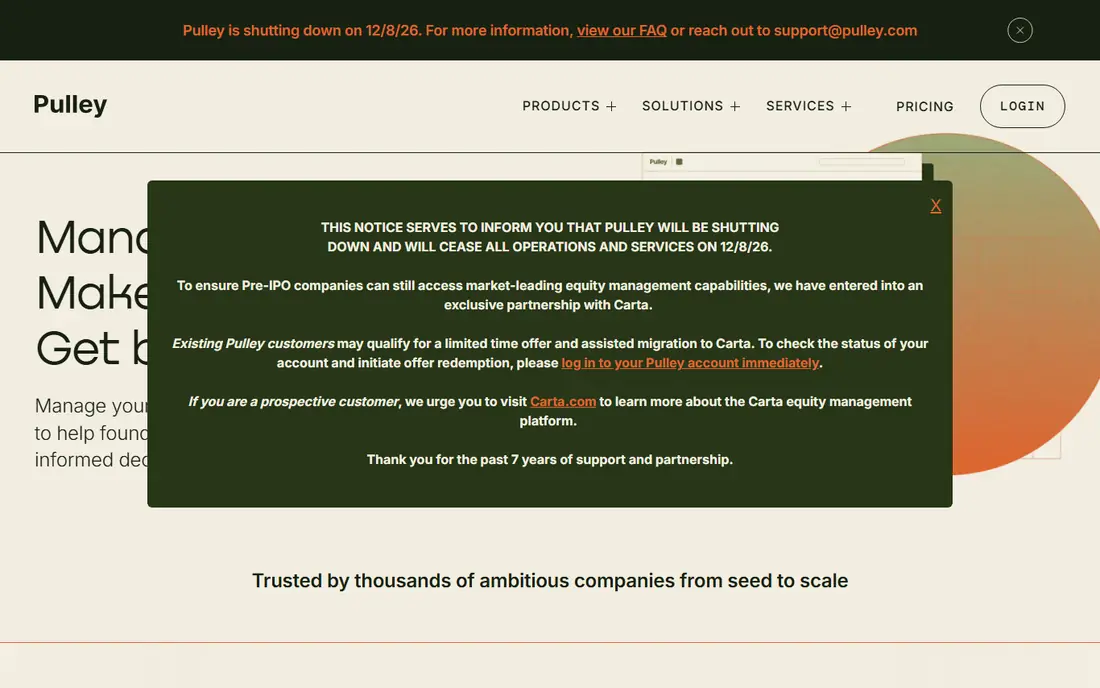
Pulley suits seed-stage founders who want predictable pricing and clear modelling. The Startup plan starts at 1,200 dollars per year for 25 stakeholders, and higher tiers add valuations and deeper compliance tools. Founders can model rounds, option pools, and SAFEs before talking to investors.
The lack of a full free tier is a drawback for a brand-new team with no funding yet. For a seed-stage firm that wants to model dilution and hiring plans without surprise pricing, Pulley is a strong, focused choice.
- Clear published pricing
- Strong fundraising modelling
- Clean interface
- No free tier beyond basics
- Some compliance features need higher tiers
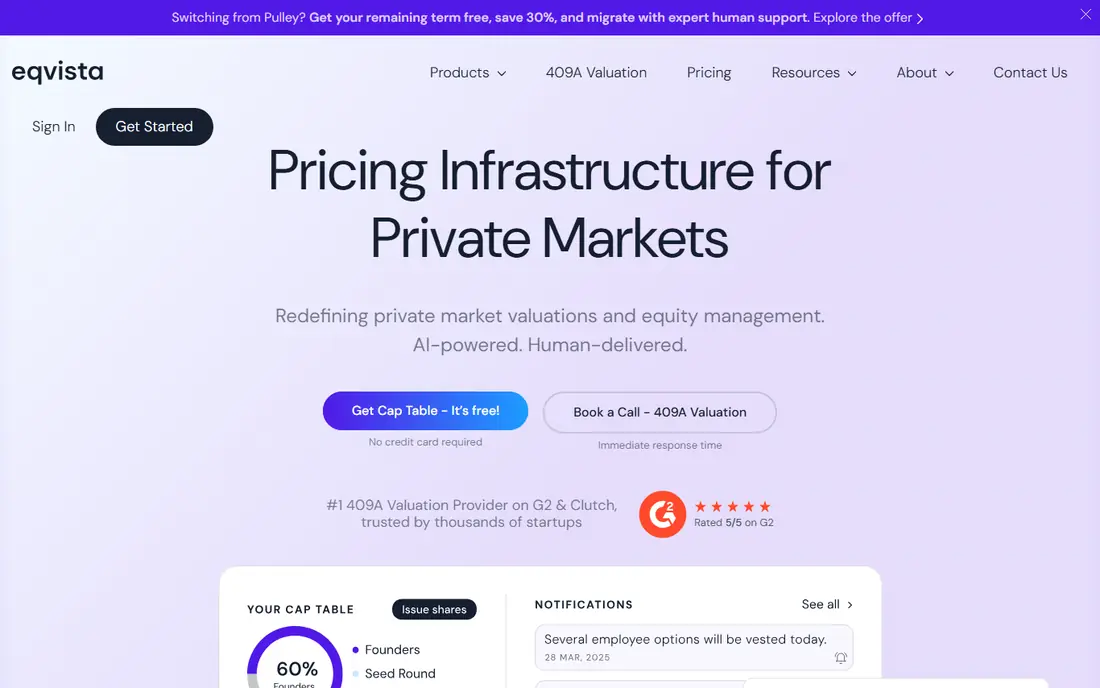
Eqvista appeals to startups that want low entry cost and clear per-shareholder pricing. The free plan covers up to 20 stakeholders, and paid plans charge per shareholder, which scales with the firm rather than jumping between large tiers. Valuation services are also available as bundles.
Brand familiarity is lower than Carta, so some investors or lawyers may need time to review its reports. For a cost-conscious startup that wants a clean cap table plus valuation help, Eqvista offers good value.
- Free for up to 20 shareholders
- Per-shareholder pricing
- Valuation bundles available
- Smaller brand presence than Carta
- Some features need paid plans
Cake Equity suits pre-seed and early-stage teams that want a simple, affordable start. The free plan covers up to 5 stakeholders, and paid plans add more stakeholders, valuations, and compliance reporting. Setup is quick, which helps a small founding team get organised before a first round.
Firms with complex US equity structures or many share classes should check fit closely, since Cake's strength is simplicity for early-stage work. For a small team that mainly needs a clean cap table and basic option tracking, it is a sensible low-cost pick.
- Free for up to 5 stakeholders
- Simple early-stage setup
- Good for APAC and global teams
- Advanced compliance features need higher tiers
- Less suited to very complex US structures
Ledgy suits startups with teams and investors across countries, especially in Europe. It handles multi-entity equity, local compliance workflows, and employee portals, which helps a firm with staff in several jurisdictions. The free Launch plan covers small startups, while Scale plans add valuations and deeper reporting.
US-only firms may find its global depth more than needed, and paid pricing is higher than some early-stage rivals. For a European or global startup, Ledgy is one of the strongest cap table choices available.
- Multi-country equity support
- Free Launch plan
- Good employee portals
- Paid Scale pricing is higher
- US-only firms may not need its global depth
Shareworks suits mature private firms and public companies with complex share plans, global payroll links, and strict governance needs. It handles large participant counts, multiple plan types, and reporting that smaller tools cannot match. Firms preparing for or operating after an IPO often use it.
It is not a seed-stage tool. Pricing is quote-based and setup is a major project, so early startups should only consider it if they already have complex equity admin needs. For later-stage firms, its governance depth is the main draw.
- Strong governance and global share plan admin
- Good for public companies
- Morgan Stanley backing
- Quote-based and costly
- Too heavy for most seed-stage startups
Astrella serves private companies that need solid equity administration plus exit modelling. Per-stakeholder pricing keeps costs tied to firm size, and tools for modelling exits help founders and boards plan for liquidity events. It also handles options, SAFEs, and multi-class shares.
Pricing needs a sales conversation for exact terms, and brand familiarity is lower than Carta or Pulley. For a growth-stage private firm that wants modelling without a full enterprise platform, Astrella is worth a trial.
- Per-stakeholder pricing
- Exit modelling
- Good for growth-stage private firms
- Pricing details need a quote
- Smaller brand than Carta
Vestd suits UK startups that need share schemes as well as a cap table. It handles EMI options, growth shares, and other UK scheme types, with workflows built around UK rules and filings. UK founders who want scheme help in the same platform often prefer it to a US-first tool.
US-only firms will find its UK focus less relevant, and pricing is quote-based. For a UK startup planning employee share schemes, Vestd combines cap table work and scheme admin in a useful way.
- UK share scheme expertise
- Clear for UK founders
- Good for EMI and growth shares
- UK-focused, so less suited to US-only firms
- Pricing is quote-based
How we picked these
We compared official product pages, pricing pages, and feature lists for cap table tools in active use in October 2026. We favoured tools with real cap table, option, SAFE, and share class handling, rather than generic spreadsheet templates. We left out tools that had closed to new customers or that only handle investor reporting without a cap table. Prices shown as See website mean the vendor uses quote-based pricing, so get a written quote for your stakeholder count. This article is general information only, not legal or financial advice.
What to check before you choose
Start with your current equity, not your hoped-for future round. List share classes, option holders, SAFEs, convertible notes, and any secondary transfers. Then check that each shortlisted tool handles those items natively, including vesting schedules and fully diluted views. A tool that forces workarounds for your main equity type will cause errors later.
Valuations, stakeholders, and migration
Check valuation needs separately from cap table needs. Some tools include 409A valuations on higher tiers, while others sell them as bundles or add-ons. Also check stakeholder limits on free plans and the cost when you pass them, and ask about migration help from spreadsheets or another platform. A clean migration matters, since cap table errors are costly to fix.
Lawyer and investor fit
Ask your lawyer and lead investors which reports they accept without extra work. Carta reports are widely familiar, while newer tools may need extra review. That familiarity can save time in a round, even if another tool looks cheaper on paper. Keep a backup export of your cap table regardless of platform.
Frequently asked questions
What is the best software for startup cap table management?
Carta, Pulley, and Eqvista are the most common picks. Carta suits broader and later-stage needs, Pulley suits seed-stage modelling with clear pricing, and Eqvista suits value-focused firms. Choose based on stage, stakeholder count, and valuation needs.
Is there free cap table software for startups?
Yes. Carta Launch is free for eligible firms with up to 25 stakeholders, Eqvista is free for up to 20 shareholders, and Cake Equity and Ledgy offer free launch plans. Check stakeholder limits, raised-amount limits, and what happens when you outgrow the free plan.
Do I need a 409A valuation with a cap table tool?
Many US startups need a 409A valuation to set option exercise prices, and some cap table tools include or sell valuations. Pulley, Carta, and Eqvista offer valuation options on paid tiers or as bundles. Check whether valuations are included, limited, or extra before you choose.
Can I move my cap table from a spreadsheet to software?
Yes, most tools here offer migration help or import tools for spreadsheets. Clean the spreadsheet first, check share classes and vesting dates, and reconcile the imported table with your legal records. Ask the vendor about migration time and support before you start.
Is cap table software legal or financial advice?
No. Cap table software is a record-keeping and modelling tool, and this article is general information only, not legal or financial advice. Check equity, tax, and scheme decisions with a qualified lawyer or accountant, especially before issuing shares or options.
Sources
See where you really rank - block by block
ProMapRanker scans Google Maps across a grid of your service area. Simple monthly plans from $19, white-label on every plan.
Start freeKeep reading
 zscaler alternatives
Best Zscaler Alternatives in 2026
Looking for zscaler alternatives? We compare 9 SASE and zero trust platforms on architecture, data protection, pricing, and fit for your network and team.
Read → zapier alternatives free
Best Zapier Alternatives Free in 2026
Nine automation tools for zapier alternatives free in 2026, all with genuinely free tiers, plus free plan limits, starting prices and upgrade paths explained.
Read → which platform is best for online reputation
Which Platform Is Best for Online Reputation in 2026
Wondering which platform is best for online reputation? We compare 8 review, listing, and response tools for small and multi-location businesses and agencies.
Read →