 ProMapRanker
Best Cap Table Management Software in 2026

Key takeaways
- Carta remains the default for US startups at Series A and beyond, with a free Launch plan for up to 25 stakeholders and up to $1 million raised.
- Eqvista is the value pick for cost-conscious US startups, with a free plan up to 20 shareholders and per-shareholder paid pricing from $2 per month.
- Ledgy is the strongest choice for European and cross-border teams, with multi-country equity plans and compliance coverage that US-first tools handle less well.
- Pulley is closing to new customers ahead of a December 2026 shutdown, so we have left it off this list even though older guides still recommend it.
Quick comparison
| Pick | Great for | Pricing starts at | Free tier | |
|---|---|---|---|---|
 Carta | US startups from Series A onward | Free | Yes | Visit |
 Eqvista | Cost-conscious US startups and LLCs | Free | Yes | Visit |
 Cake Equity | Early-stage and APAC startups | Free | Yes | Visit |
 Ledgy | European and cross-border teams | Free | Yes | Visit |
 Capboard | Cost-conscious European early-stage teams | $30 per month | Free trial | Visit |
 Shareworks by Morgan Stanley | Mature and public-company equity teams | See website | No | Visit |
 Fidelity Private Shares | Bank-backed startups heading toward IPO | Free | Yes | Visit |
 Vestd | UK startups and employee share schemes | See website | Free trial | Visit |
 Astrella | Private-company equity administration | See website | Free trial | Visit |
The best cap table management software options
A cap table records who owns what in a company: founders, employees with options, investors with preferred shares, and holders of SAFEs and convertible notes. Good software keeps that record accurate through every round, models what happens at an exit, and produces the reports lawyers and auditors ask for. We compared official pricing pages, feature documentation and public reviews, and we left out tools that no longer accept new customers.
This is general information only, not financial or legal advice. Cap tables affect tax, securities and employment questions, so have a lawyer review your structure before you issue shares or options.

Carta is the name most US founders meet first, and for good reason. It covers cap tables, SAFEs, priced rounds, option grants, 409A valuations and fund administration in one platform, and its reports match what US law firms and venture investors expect to see. The Launch plan is free for companies with up to 25 stakeholders and up to $1 million raised, which covers many pre-seed teams without a bill.
The catch is pricing opacity past Launch. Build, Grow and Scale plans are quote-based and priced by stakeholder count, so you will not see a firm number until you talk to sales. Carta can also feel like more tool than a two-founder team needs. For a US company heading toward Series A and beyond, though, its acceptance and breadth still make it our default pick.
- Widest feature coverage in the category
- Free Launch plan for early teams
- Accepted by most US law firms and investors
- Paid plans are quote-based
- Costs rise with stakeholder count
- Breadth can feel heavy for a pre-seed team
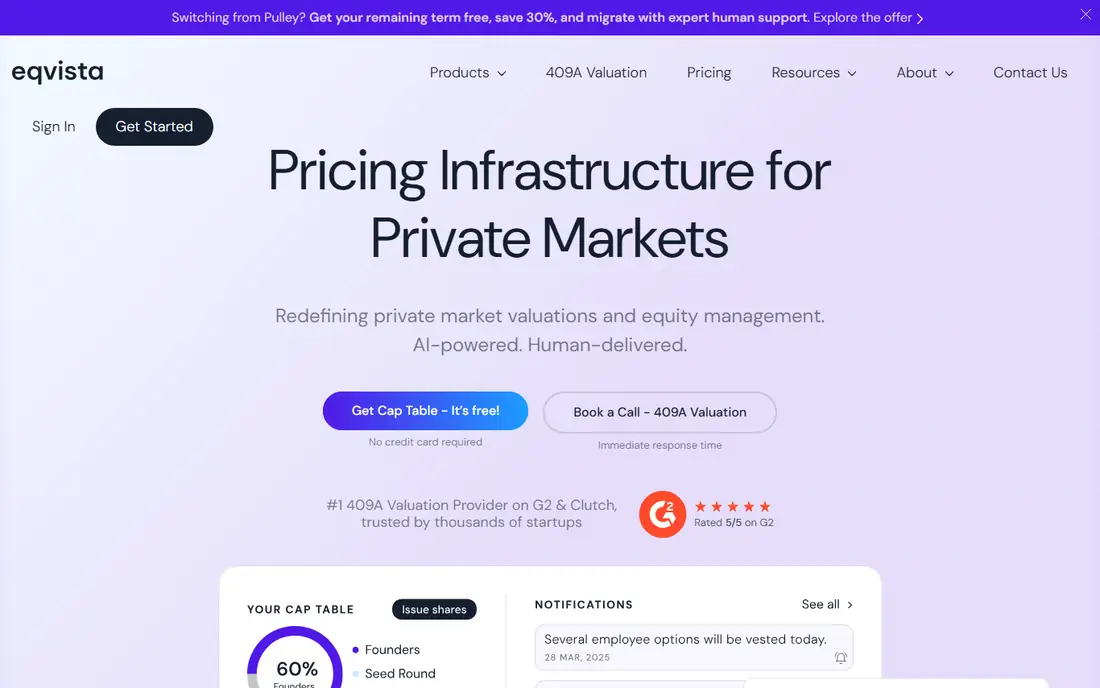
Eqvista is our value pick for US startups that want transparent pricing without a sales call. Its free plan covers up to 20 shareholders, and paid pricing starts at $2 per shareholder per month, which makes the monthly cost easy to forecast as the team grows. It also offers 409A valuations with an unlimited-valuation bundle from $990 per year, a figure that undercuts many rivals by a wide margin.
Eqvista handles multi-class shares, option pools, SAFEs and convertible notes, and it works for LLCs as well as corporations, which matters for founders who started as an LLC. It does not carry the same law-firm default status as Carta, so ask your lawyer whether they already work with Eqvista reports. For a budget-conscious team that still needs real compliance coverage, it is a strong choice.
- Free plan up to 20 shareholders
- Published per-shareholder pricing
- Bundled 409A valuations from $990 per year
- Smaller brand presence than Carta
- Some advanced features sit in higher tiers
- Support quality matters more at this price
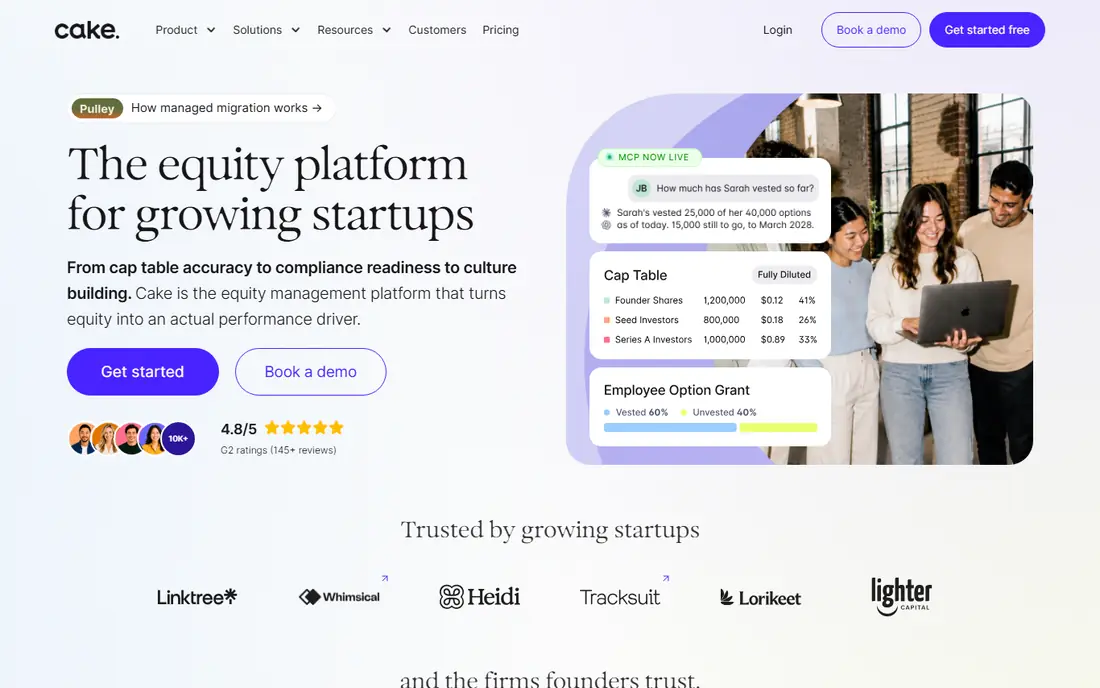
Cake Equity, often written as Cake, is built for early-stage teams and for startups with staff across borders, especially in Australia and the wider APAC region. Its free plan covers up to 5 stakeholders, and paid tiers start at $1,000 per year for the Build plan in recent comparisons, with Team and Pro tiers adding more 409A valuations and compliance reports. It tracks multi-class shares, SAFEs, warrants and ISO and NSO options.
The free plan is genuinely small, so most teams will move to a paid tier once employees join. Cake also shines brightest for international teams, while a purely US team may find Carta or Eqvista more familiar to its lawyers. For a pre-seed team with a global hiring plan, Cake deserves a close look.
- Free plan up to 5 stakeholders
- Clear annual tiers
- Strong APAC and cross-border ESOP support
- Free plan is small
- Some compliance features need higher tiers
- US law-firm familiarity varies
Ledgy is the European counterpart to Carta. It handles multi-entity structures, multiple currencies, and country-specific schemes such as EMI, VSOP and BSPCE, plus IFRS 2 reporting and 409A valuations on higher tiers. Its free Launch tier has covered up to 50 stakeholders in recent pricing summaries, which gives a growing European team room before paying.
Paid pricing is quote-based, with Scale previously listed around 5,000 euros per year, so budget for a sales conversation. Ledgy is less of a natural fit for a purely US cap table, where Carta or Eqvista will feel more native. For a team with staff, investors or entities in several European countries, Ledgy is our clear pick.
- Multi-country equity plan support
- EU compliance and reporting depth
- Free plan up to 50 stakeholders in recent pricing
- Paid plans are quote-based
- Entry pricing is higher than US value tools
- US-specific workflows are thinner
Capboard is the budget option for European early-stage teams that find Ledgy or Carta too expensive. Its entry pricing starts at $30 per month for 15 stakeholders in recent comparisons, with annual billing bringing the monthly equivalent down, and it covers the core cap table, vesting and stakeholder management a young company needs. That published price alone sets it apart in a category full of quote-based tiers.
The trade-off is depth. Capboard does not match Ledgy on multi-country compliance or Carta on fundraising workflows, and its modeling tools are simpler. For a pre-seed European team that needs a clean, accurate cap table without enterprise features, Capboard is a sensible, low-cost start that can be revisited at Series A.
- Low published entry price
- Per-stakeholder pricing
- Solid choice for simple EU cap tables
- Less breadth than Ledgy or Carta
- Fewer advanced modeling tools
- Smaller support footprint
Shareworks by Morgan Stanley
Great for: Mature and public-company equity teams
Shareworks by Morgan Stanley is aimed at the other end of the company journey: mature private companies and public companies managing large, global share plans. It handles governance-heavy administration, payroll integration, settlements across countries, and the reporting that public-company finance teams need. For a company approaching IPO, that operational depth matters more than a low entry price.
Early-stage founders should skip it. Pricing is custom, setup is heavier than a startup tool, and its strengths only pay off once equity administration becomes a full-time job. If your company is late-stage or public, or preparing for that step, Shareworks is one of the most capable platforms available.
- Built for public and late-stage private companies
- Global payroll and settlement support
- Morgan Stanley backing
- Quote-based pricing
- Complex setup for startups
- Overkill for early-stage cap tables
Fidelity Private Shares
Great for: Bank-backed startups heading toward IPO
Fidelity Private Shares, formerly Shoobx, gives startups a bank-backed route from early cap table management toward IPO readiness. Its free tier covers companies under $1 million raised with up to 25 stakeholders, matching Carta Launch on those thresholds, and it adds Fidelity Stock Plan Services backing plus transfer agent capabilities as companies grow.
Paid tiers are custom, so growing teams should expect a sales conversation. Fidelity Private Shares also has a smaller startup-community footprint than Carta, which can mean fewer peer templates and playbooks. For founders who value an established financial institution behind their equity platform, and who want a clear path to public-company administration, it is a credible alternative.
- Free plan under $1 million raised and 25 stakeholders
- Fidelity backing and IPO path
- Transfer agent services
- Paid pricing is tiered and custom
- Less startup-community presence than Carta
- Feature fit varies by stage
Vestd is a UK specialist that focuses on share schemes for startups and growing companies, including EMI options and growth shares. Its platform covers cap table management, employee portals, digital signing and Companies House filings, which removes several manual steps that UK founders otherwise handle through lawyers and spreadsheets. That local depth is its main selling point.
Vestd pricing is not published as a single simple tier, so expect a quote based on your scheme and headcount. It is also a poor fit for a purely US company, where its UK-specific workflows add little. For a UK startup setting up its first employee share scheme, Vestd is worth comparing directly against Ledgy.
- UK-focused share scheme expertise
- Employee portal and digital signing
- Companies House integration
- Pricing is not published as a simple tier
- UK focus limits US fit
- Smaller scale than Carta or Ledgy
Astrella is a private-company equity administration platform that has picked up teams looking for an alternative to Carta, including companies migrating from tools that have sunset. It offers cap table management, stakeholder portals and exit modeling, with per-stakeholder pricing that keeps costs tied to company size. Its Plus tier has been listed around $5 per stakeholder per month in recent comparisons, though current pricing should be confirmed on its site.
Astrella is less widely known than Carta, so law-firm familiarity will vary, and some features depend on the tier you choose. For a team that wants a modern, per-stakeholder-priced alternative with solid exit modeling, Astrella is a practical option to include in a shortlist.
- Per-stakeholder pricing model
- Exit modeling tools
- Serves as a home for teams migrating from sunset tools
- Pricing details vary by plan
- Brand is less known than Carta
- Feature depth depends on tier
How we picked these
We compared official pricing pages, feature documentation and public reviews, and we checked which tools still accept new customers in October 2026. We favored tools with a published free tier or entry price, support for multi-class shares and option pools, and valuation or compliance coverage that matches their home market. We excluded Pulley, which is closing to new customers ahead of a shutdown on 8 December 2026, and AngelList Stack, which stopped new sign-ups in August 2026. Prices and free-tier limits change, so confirm them on the vendor site before you commit.
What to check before you choose a cap table tool
Start with your home market and your next round, not just your current headcount. A US startup heading to Series A needs different lawyer familiarity and 409A coverage from a European team with staff in three countries. Ask your lawyer which reports they already accept, because a tool your counsel has never seen will cost you time at every round.
Next, model the cost at twice your current stakeholder count. Per-stakeholder pricing looks cheap at 10 people and very different at 40, and quote-based tiers can jump between funding stages. Check what is included: 409A valuations, ASC 718 or IFRS 2 reporting, and board consents are often separate line items. Finally, test the stakeholder portal with an employee in mind. If grants, tax forms and signatures are confusing for staff, you will spend more time answering questions than the software saves.
Frequently asked questions
What is the best platform for cap table management for a pre-seed startup?
For a US pre-seed team, Carta Launch or Eqvista free are both strong starts, with Carta offering wider law-firm familiarity and Eqvista offering clearer paid pricing later. For a European pre-seed team, Ledgy free or Capboard are better starting points because of their local compliance coverage.
How much does cap table software cost?
It ranges from free for small early teams to several thousand dollars per year once stakeholder counts and valuation needs grow. Eqvista publishes $2 per shareholder per month, Capboard starts around $30 per month, and Carta, Ledgy, Shareworks and others use quote-based tiers past their free plans.
Do I need a 409A valuation?
Most US startups need a 409A valuation before granting options, because it sets the fair market value used for strike prices and tax reporting. Some tools bundle valuations into higher tiers, while others sell them separately, so check whether your plan includes them or prices them as an add-on.
Can I move my cap table from a spreadsheet to software?
Yes, most tools on this list offer migration help, and several offer white-glove onboarding that imports your spreadsheet and checks it against your legal documents. Keep your signed agreements and board consents ready, because the software record should match the legal record exactly.
What happens if my cap table tool shuts down?
You should be able to export your full cap table, stakeholder records and reports before closure, and your lawyer should hold copies of the underlying legal documents. Pulley closing in December 2026 is a reminder to check export options before you commit, and to keep legal documents outside any single vendor.
Sources
See where you really rank - block by block
ProMapRanker scans Google Maps across a grid of your service area. Simple monthly plans from $19, white-label on every plan.
Start freeKeep reading
 zscaler alternatives
Best Zscaler Alternatives in 2026
Looking for zscaler alternatives? We compare 9 SASE and zero trust platforms on architecture, data protection, pricing, and fit for your network and team.
Read → zapier alternatives free
Best Zapier Alternatives Free in 2026
Nine automation tools for zapier alternatives free in 2026, all with genuinely free tiers, plus free plan limits, starting prices and upgrade paths explained.
Read → which platform is best for online reputation
Which Platform Is Best for Online Reputation in 2026
Wondering which platform is best for online reputation? We compare 8 review, listing, and response tools for small and multi-location businesses and agencies.
Read →