 ProMapRanker
Best CAFM Software in 2026

Key takeaways
- CAFM stands for computer-aided facility management: software that tracks space, assets, maintenance, and workplace services in one system, rather than in spreadsheets.
- Most enterprise CAFM platforms are quote-based, so total cost depends on portfolio size, modules, and implementation, not on a single published monthly price.
- Space-led teams should shortlist FM:Systems and Archibus, while maintenance-led teams should look first at Facilio, Corrigo, and eMaint.
- A successful CAFM purchase depends as much on clean floor plans and asset data as on the software itself, so budget time for data cleanup and onboarding.
Quick comparison
| Pick | Great for | Pricing starts at | Free tier | |
|---|---|---|---|---|
 Planon | Large global portfolios | See website | No | Visit |
 Archibus by Eptura | Space and CAD-led estates | See website | No | Visit |
 FM:Systems | Space use and workplace analytics | See website | No | Visit |
 Facilio | Multi-site connected operations | See website | No | Visit |
 Accruent | Healthcare, education, and government estates | See website | No | Visit |
 MRI Software | Property-led operators | See website | No | Visit |
 Spacewell | Hybrid workplace and smart offices | See website | No | Visit |
 Corrigo | Contractor-heavy portfolios | See website | No | Visit |
 eMaint | Preventive maintenance at scale | See website | Free trial | Visit |
The best CAFM software
CAFM software helps facility teams manage buildings as a system: who sits where, which assets need service, which work orders are open, and which spaces cost the most to run. The platforms below cover that ground from different angles, and the right pick depends on whether space, maintenance, or real estate leads your work.
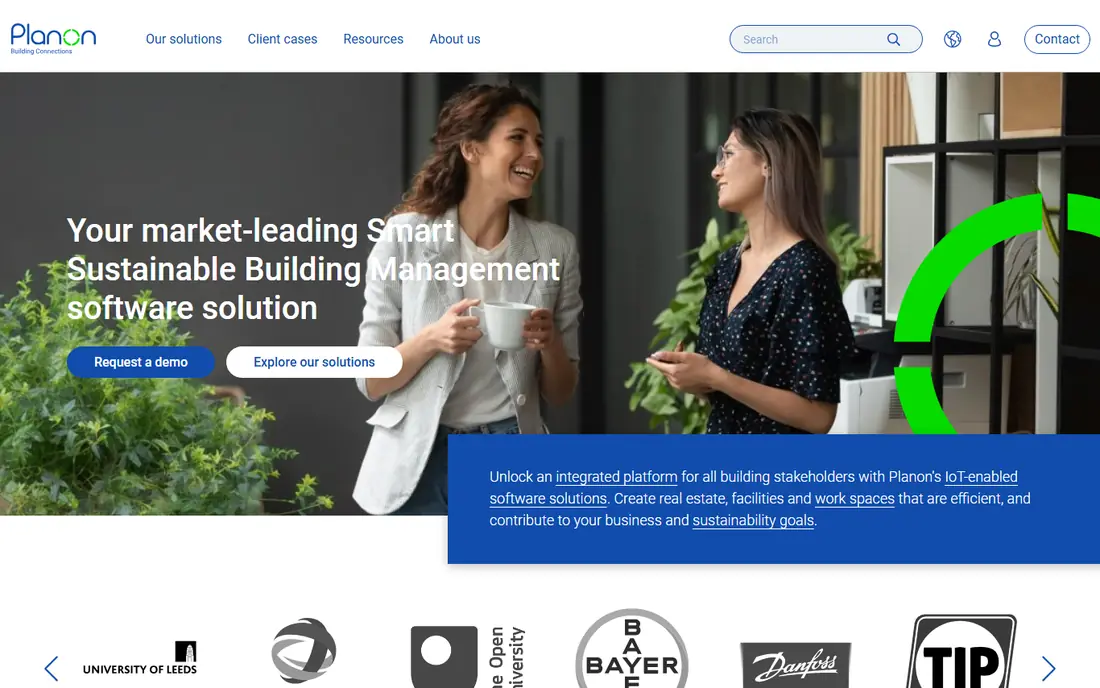
Planon is an integrated workplace management system that covers space, real estate, facility services, and sustainability in one platform. For a large operator, that breadth matters: leases, floor plans, maintenance, and energy data can live together, which makes portfolio decisions easier to defend. The platform supports global, multi-site operations with localization, and it connects to systems such as SAP and to IoT sensors for occupancy and energy data.
The trade-off is scale and cost. Planon does not publish standard pricing, and deals are scoped to portfolio size and modules, with implementation billed separately. Smaller teams often find the platform more than they need, and the setup time reflects that breadth. Planon suits multinational firms, government estates, and healthcare operators that need one governed system across many buildings.
- Broad workplace, real estate, and maintenance coverage
- Sustainability and energy reporting
- Integrations with ERP and IoT systems
- Quote-based enterprise pricing
- Long implementation on large estates
- Learning curve for smaller teams
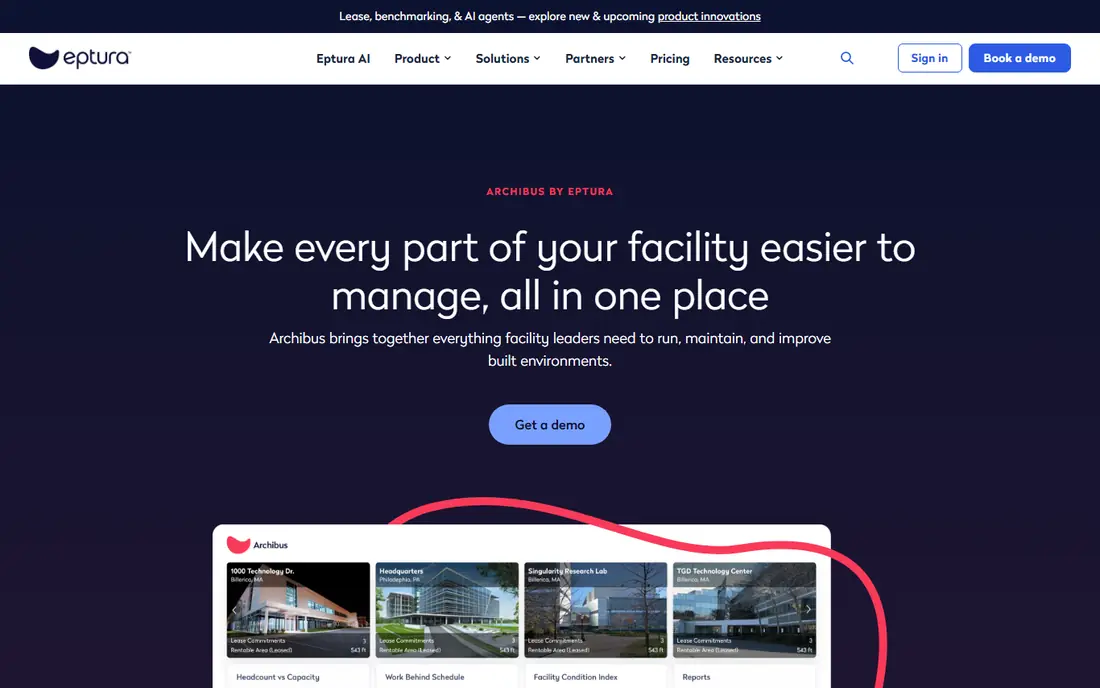
Archibus, now part of Eptura, is the long-standing space-first CAFM platform. Its strength is the floor plan: space inventory, occupancy, moves, and chargebacks all tie back to CAD and BIM drawings, which gives facility teams a reliable picture of every room and desk. Asset management, maintenance, and real estate modules build on that spatial base, and a FedRAMP authorized option serves government work with stricter compliance needs.
Archibus is also famously configuration-heavy. Getting value from it requires clean drawings, consistent space standards, and admin time, and pricing is quote-based with no public entry point. Teams that already work from CAD will feel at home, while teams without drawing discipline may struggle to keep the data current. Archibus suits large enterprises, universities, hospitals, and government estates where space accuracy drives real estate and move decisions.
- Deep floor-plan and space management
- Move management
- BIM and CAD integration
- FedRAMP authorized option for government work
- No public pricing
- Configuration-heavy setup
- Can be more than small teams need
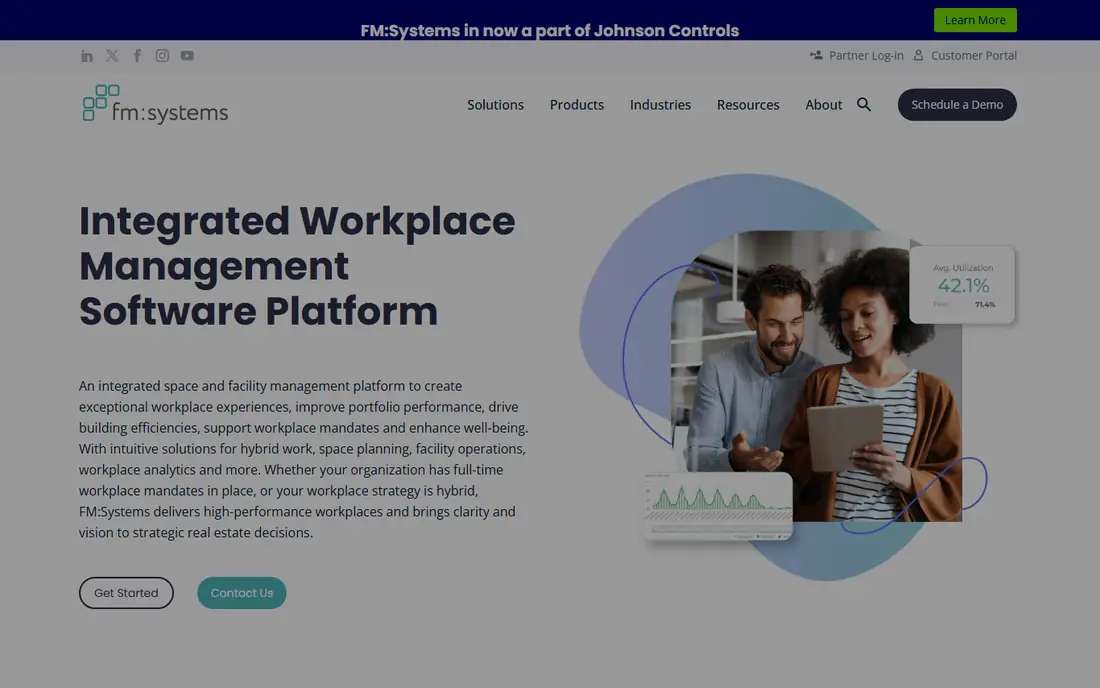
FM:Systems has been a CAFM fixture since 1984, and its core is space: space management, workplace sensors, reservation scheduling, utilization analytics, and visitor management. Published figures cite billions of square feet managed and tens of millions of reservations, which shows where the platform is tuned: knowing how desks, rooms, and floors are actually used. For hybrid-work planning, consolidation decisions, and real estate cases built on data, that focus is a real advantage.
Maintenance and work-order features exist but play a supporting role rather than leading the product, so a team whose main pain is reactive repair work should weigh that carefully. Pricing is quote-based, with no public entry price, and costs rise as sensor and analytics modules are added. FM:Systems suits corporate real estate teams, universities, and retail chains rethinking space after hybrid work.
- Space management and utilization analytics
- Workplace sensors and reservations
- Long track record since 1984
- Quote-based pricing
- Maintenance features are secondary to space
- Reporting depth varies by module
Facilio positions itself as a connected CAFM platform for owner-operators and facility service providers running many sites. It unifies work orders, assets, vendors, and IoT data, and it offers no-code configuration so teams can adapt workflows without heavy custom development. AI-assisted features help with triage and reporting, and the platform is built for portfolios where consistency across sites matters more than depth in a single building.
Facilio is younger than Planon or Archibus, so its enterprise reference base is thinner, and buyers should ask for references in their sector. Deep customization still needs a thoughtful discovery phase, even with no-code tools, since portfolio data rarely arrives clean. Facilio suits multi-site operators, retail and healthcare chains, and service providers that manage sites for clients.
- Connected platform unifying systems, IoT, and AI-assisted workflows
- Multi-site work orders and vendor coordination
- No-code configuration options
- Younger brand than legacy rivals
- Deep customization rewards a discovery phase
- Quote-based pricing
Accruent serves large, often regulated estates through products including FAMIS 360 for facility and maintenance management and EMS for room and desk booking. That combination fits hospitals, universities, and government bodies that need work orders, assets, compliance records, and space booking in one governed system. The platform handles the audit trail and reporting that public-sector and healthcare operators need, and it scales across many buildings and departments.
The honest drawbacks are pace and polish. The interface feels dated next to newer platforms, and onboarding on a large estate takes time, especially where asset data lives in older systems. Pricing is quote-based, so small teams will struggle to judge cost without a sales conversation. Accruent suits estates where compliance, booking, and maintenance must sit together under one vendor.
- FAMIS 360 for facilities work
- EMS room and desk booking
- Strong fit for regulated and public-sector estates
- Quote-based pricing
- Interface feels dated in places
- Onboarding can be slow on large estates
MRI Software is best known for property and real estate software, and its facility tools sit inside that wider family. For a property-led operator, that matters: lease data, financials, and maintenance can share one system, which reduces duplicate entry and gives a clearer view of cost per property. The platform supports multi-site portfolios, and its modules cover space, assets, work orders, and vendor handling in varying depth depending on the bundle chosen.
The bundle point is also the warning. Facility depth depends on which MRI products you buy, and customization tends to pull you deeper into the MRI ecosystem, which suits firms already committed to it and frustrates firms that want best-of-breed flexibility. Pricing is quote-based, and small operators may find the sales process heavier than a self-serve tool. MRI suits landlords, property managers, and real estate operators who want facilities data close to lease and financial data.
- Lease and financial management alongside maintenance
- Broad real estate software family
- Multi-site portfolio support
- Quote-based pricing
- Customization ties you to the MRI ecosystem
- Facility features vary by product bundle
Spacewell focuses on the hybrid workplace: how offices are used, which desks and rooms are booked, and how occupancy and energy data should shape space decisions. IoT sensors and analytics feed that picture, and desk booking, visitor handling, and workplace apps support the daily experience of office staff. For firms redesigning offices for hybrid work, Spacewell gives a clear, data-led view of what to keep, shrink, or reconfigure.
Heavy maintenance is not the lead here. Teams whose main workload is plant, equipment, and contractor repair will find a maintenance-led platform stronger, and Spacewell pricing is quote-based, so cost clarity needs a sales conversation. Spacewell suits corporate workplaces, smart offices, and firms with a hybrid-work question to answer.
- Workplace analytics with IoT data
- Hybrid work and desk booking
- Energy and occupancy insight
- Workplace-led, lighter on heavy maintenance
- Quote-based pricing
- Depth varies by region and bundle
Corrigo, part of JLL, is built for portfolios where outside contractors do much of the work. It handles work orders, vendor assignment, service-level tracking, and reporting across many sites, which helps operators see which vendors perform, where costs concentrate, and which sites generate repeat issues. For retail, restaurant, and multi-site operators with heavy outsourced maintenance, that vendor lens is the main reason to pick Corrigo.
Configuration is more predefined than on a fully open platform, and the product fits most naturally inside the JLL ecosystem, so firms with a different stack should test integrations early. Pricing is quote-based, and the value case depends on contractor volume: a portfolio with little outsourced work gains less from Corrigo than a contractor-heavy one. Corrigo suits outsourced, multi-site portfolios that need vendor discipline and consistent service data.
- Work-order and vendor management within JLL
- Contractor coordination across sites
- Reporting on service performance
- Predefined configuration in places
- Best inside the JLL ecosystem
- Quote-based pricing
eMaint, part of Fluke, is a maintenance-led platform that sits close to CAFM for multi-site teams. It offers configurable workflows, preventive maintenance scheduling, asset tracking, and mobile updates so field teams can close work orders on site. For teams moving from spreadsheets to a system, eMaint gives structure without the full weight of an enterprise IWMS, and its per-user subscription model is easier to scope than a portfolio-wide enterprise deal.
eMaint is lighter on space planning and lease management than Planon or Archibus, so space-led buyers should not expect the same depth there. Pricing is per user and quote-influenced, and the setup still rewards clean asset lists and consistent naming. eMaint suits manufacturing, healthcare support, and multi-site service teams whose main goal is fewer breakdowns and clearer maintenance history.
- Configurable maintenance workflows
- Mobile updates for field teams
- Preventive maintenance and asset tracking
- Maintenance-first, lighter on space and lease
- Quote and per-user pricing needs a sales call
- Setup rewards clean asset data
How we picked these
We compared official product pages, vendor documentation, and published CAFM comparisons checked in October 2026, and we kept only platforms that are live, sold to facility teams now, and cover space, asset, or maintenance management as a core function. We favored a mix of space-led, maintenance-led, and property-led platforms so different estates can find a fit. We left out pure point tools, such as standalone booking apps, and discontinued products. Because most vendors price by quote, we list starting price as See website where no public entry price exists, rather than repeating third-party estimates as fact.
What to ask in a CAFM demo
Start with your data, not the demo script. Bring a sample floor plan, an asset list, and a week of real work orders, and ask the vendor to show those records inside the system. Watch how space changes, asset history, and vendor performance appear together, and ask who owns data cleanup, how long onboarding takes, and what happens to your data if you leave. Check mobile use in the field, since a system technicians avoid will fail no matter how good the dashboard looks.
Frequently asked questions
What is CAFM software?
CAFM stands for computer-aided facility management. It is software that tracks space, assets, maintenance work, and workplace services in one system, replacing spreadsheets and separate tools. A CAFM platform typically covers floor plans, occupancy, work orders, preventive maintenance, vendors, and reporting, and larger suites add real estate, leases, and sustainability data.
What is the difference between CAFM and CMMS?
A CMMS, or computerized maintenance management system, focuses mainly on assets and maintenance work: work orders, preventive schedules, and repair history. CAFM covers a wider facility brief, adding space management, occupancy, and workplace services alongside maintenance.
How much does CAFM software cost?
Most enterprise CAFM platforms are quote-based, and published guides describe basic plans from around $1,000 per month for small teams, mid-tier systems from $5,000 to $15,000 per month, and enterprise platforms from $30,000 per month and above. Your price depends on sites, users, modules, integrations, and implementation.
Is CAFM software worth it for a small business?
A full enterprise CAFM system is often more than a small business needs, and a lighter maintenance or space tool may serve a single site better. CAFM earns its cost when you manage several sites, many assets, or a large workforce, and when spreadsheet errors start causing missed maintenance or wasted space.
Can CAFM software handle mobile field teams?
Most modern platforms offer mobile apps for technicians, with work orders, asset history, photos, and offline options varying by vendor. Test the mobile app on a real job during the trial, since field usability decides whether work data stays current.
How long does CAFM implementation take?
Implementation time varies from weeks for a focused maintenance rollout to many months for a large, multi-module enterprise deployment. The main drivers are data quality, floor-plan accuracy, integration scope, and training.
Sources
See where you really rank - block by block
ProMapRanker scans Google Maps across a grid of your service area. Simple monthly plans from $19, white-label on every plan.
Start freeKeep reading
 zoho inventory alternatives
6 Alternatives to Zoho Inventory, Compared on Price and Fit
Zoho Inventory alternatives: 6 tools compared on price, free plans and fit. Katana leads the list for manufacturers. Fit and flaws are laid out for each entry.
Read → zoho crm alternatives
Best Zoho CRM Alternatives (2026)
Need Zoho CRM alternatives? We compare 7 tools on cost, free access and who each suits. Every pick gets a straight assessment. Built for quick decisions.
Read → zelle alternatives
Best Zelle Alternatives in 2026
Compare the best Zelle alternatives for sending money to friends, paying sellers and moving funds abroad, with honest notes on fees, speed and safety in 2026.
Read →