 ProMapRanker
Best Business Activity Monitoring Software in 2026


Full stack business and IT observability · Pricing starts at: See website
Key takeaways
- Business activity monitoring software watches live business processes and KPIs, and alerts a team when a threshold, delay or exception is breached.
- Classic BAM platforms such as Oracle BAM and webMethods suit process heavy enterprises, while observability tools suit teams that track digital operations.
- The best choice depends on where the data lives: in a BPM system, in an integration platform, or across many apps and services.
- Most enterprise BAM pricing is quoted, so a team should budget for implementation and integration time, not just licences.
- A dashboard that no one acts on is decoration, so alerts, owners and response steps matter as much as charts.
Quick comparison
| Pick | Great for | Pricing starts at | Free tier | |
|---|---|---|---|---|
| Dynatrace | Full stack business and IT observability | See website | Free trial | Visit |
 Datadog | Unified dashboards and alerts | See website | Free trial | Visit |
 New Relic | Operational KPIs and insights | See website | Yes | Visit |
 Splunk | Real time analytics from machine data | See website | Free trial | Visit |
 IBM Instana | Automated cloud observability | See website | Free trial | Visit |
 Oracle BAM | Oracle process dashboards | See website | No | Visit |
 IBM webMethods | Integration plus process monitoring | $2,500 per month | Free trial | Visit |
 Pega Platform | Workflow and process visibility | See website | Free trial | Visit |
 TIBCO BusinessEvents | Event driven business monitoring | See website | No | Visit |
The best business activity monitoring software
Business activity monitoring, often shortened to BAM, is not the same as watching servers. It watches business outcomes in real time: orders stuck in fulfilment, claims waiting too long, payments failing, or service levels slipping. The tools below cover both classic BAM platforms and modern observability tools that teams now use for the same job, because the line between IT monitoring and business monitoring has blurred.
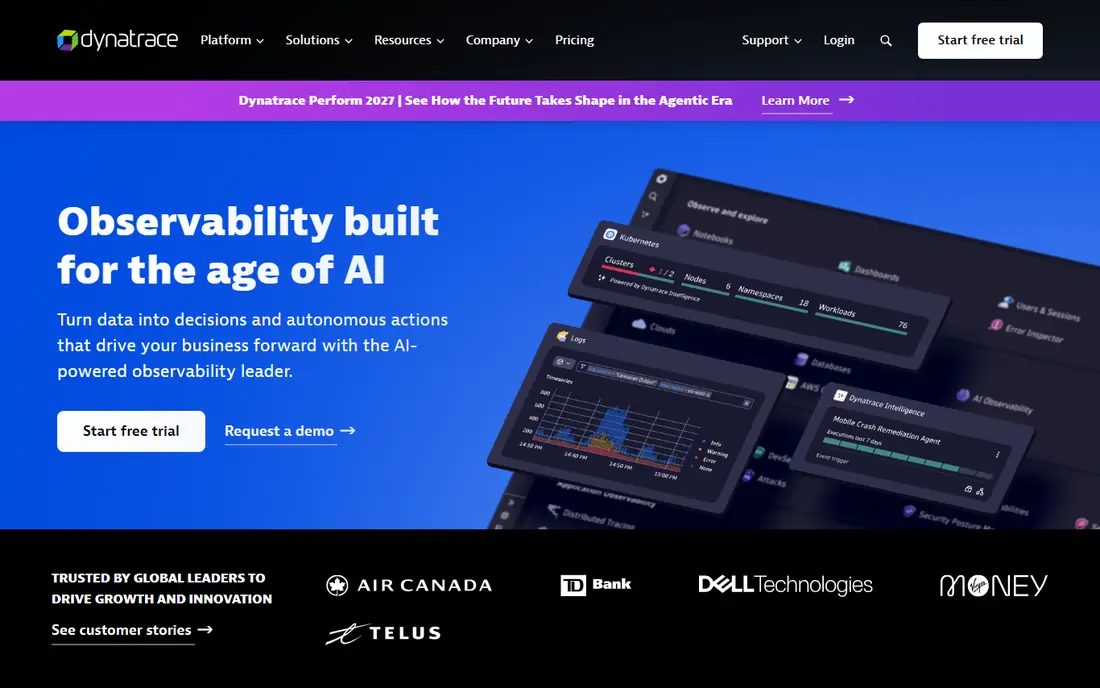
Dynatrace suits organisations that want business impact beside technical health, such as revenue affected by a slow checkout or orders delayed by a failing service. Its platform traces transactions across apps, infrastructure and user journeys, and its AI features help point to a likely cause rather than leaving a team to search logs by hand. Dashboards can show business KPIs, such as conversion or order flow, next to the technical signals behind them.
The cost and complexity are enterprise shaped. Pricing is quoted, and a team needs time to define business metrics, set thresholds and tune alerts so they signal real problems, not noise. For a large digital operation, Dynatrace is a strong BAM style choice, provided someone owns the business metrics, not just the infrastructure ones.
- AI assisted root cause analysis
- Business and technical metrics in one platform
- Broad cloud and app coverage
- Enterprise pricing is quoted
- Setup and tuning take platform time
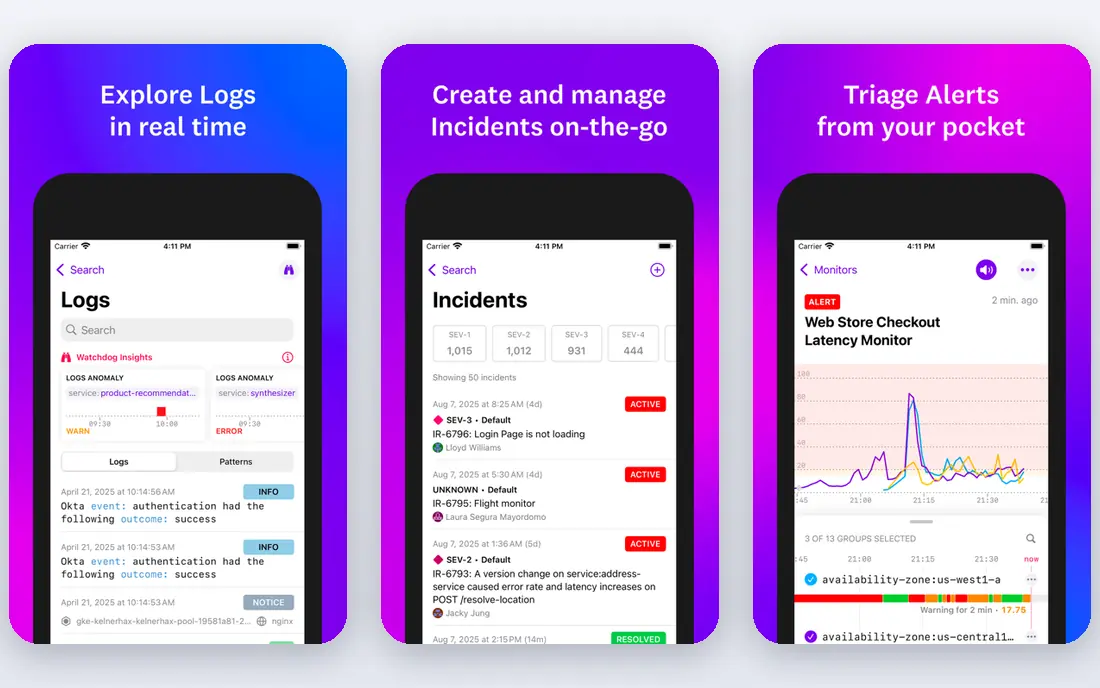
Datadog fits teams that run many services and want one place to watch business and operational signals together. Metrics, logs and traces can feed the same dashboard, so an operations manager can see order volume, error rates and latency side by side. Its integration library covers common clouds, databases and business apps, which shortens the time to a first useful dashboard.
Usage based pricing is the warning, since ingested logs and custom metrics can grow costs faster than expected. Teams should set retention, sampling and budget alerts early, and review the largest cost drivers monthly. For a cloud native team that already thinks in metrics and dashboards, Datadog is a practical BAM platform, even if it started as an infrastructure tool.
- Unified metrics, logs and traces
- Flexible dashboards
- Wide integration library
- Usage based pricing can grow quickly
- Alert tuning needs care to avoid noise
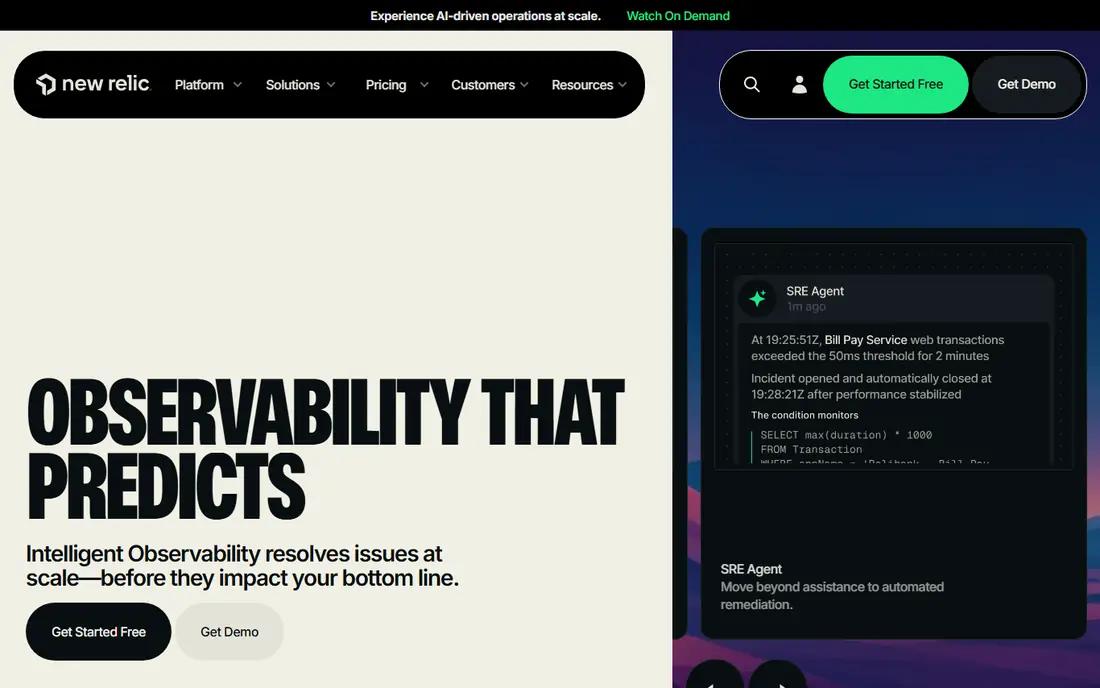
New Relic suits teams that want to move from application monitoring toward business KPIs without a large upfront licence. Its free tier lets a small team build dashboards and alerts, and its query language lets analysts turn raw telemetry into business views, such as checkout success or signup flow health. That path works well for product and operations teams that already use it for performance.
The free tier will not cover a large enterprise workload, and high data ingestion still costs money. Business KPIs also need deliberate design, since a technical dashboard does not become a business dashboard by renaming a chart. For a team growing into BAM from application monitoring, New Relic is a low friction starting point.
- Free tier for getting started
- Clear dashboards and alerting
- Strong application performance roots
- Advanced features and high data volumes cost more
- Business metric design still needs work
Splunk fits organisations with large volumes of machine data that need to ask ad hoc questions about business operations, not just view fixed dashboards. Its search language can correlate orders, logs, transactions and security events, and real time alerts can trigger when a business pattern breaks, such as a sudden drop in successful payments. That flexibility is why many operations centres still rely on it.
Complexity is the price. Licensing by data volume needs careful planning, and getting full value needs staff who can write good searches and maintain dashboards. Small teams may find a simpler dashboard tool faster to run. For a large operation with diverse data and a skilled team, Splunk remains a powerful BAM style platform.
- Powerful search across machine data
- Real time alerts and dashboards
- Strong security and operations use
- Licensing and data volume pricing are complex
- Needs skilled users to get full value
IBM Instana suits cloud native teams that want observability with less manual instrumentation. It discovers services and dependencies automatically, traces requests across them, and uses AI features to flag incidents and likely causes. That automation helps a team that deploys often and cannot update dashboards by hand for every change.
Pricing is quoted for enterprise use, and the tool is strongest for cloud native workloads rather than for classic BPM processes. Teams with a large legacy process estate may need a classic BAM platform beside it. For a modern, container based operation, Instana offers a fast route to live business and operational visibility.
- Automated discovery of services
- AI assisted incident detection
- Cloud native focus
- Enterprise pricing is quoted
- Best value inside IBM and cloud native stacks
Oracle BAM is the classic choice for organisations already running Oracle BPM and SOA systems. It lets business users build dashboards that watch process performance in real time, such as cycle times, bottlenecks and exceptions, without writing a new application for each view. That closeness to Oracle processes is its strength, because the data model already matches the work being monitored.
Outside an Oracle estate, the fit drops sharply. Licensing is enterprise shaped, and a team on other platforms will get more value from a general observability tool. For an Oracle shop that needs process KPIs for managers, not just IT metrics for engineers, Oracle BAM remains a relevant, if narrow, pick.
- Dashboards built for Oracle BPM processes
- Real time process KPIs
- Strong fit for Oracle estates
- Enterprise licence model
- Weak fit outside Oracle systems
IBM webMethods, formerly Software AG webMethods and now under IBM, suits enterprises that need to watch processes that cross many systems. As an integration platform, it already moves data between apps, APIs and files, so monitoring can sit on that same flow and show where a process stalls. Recent versions add anomaly detection, which helps flag unusual patterns before they become incidents.
The standard tier starting price reported in buyer comparisons is 2,500 dollars a month, which puts it out of reach for small teams, and implementation needs integration expertise. For a large enterprise with hybrid systems and a need for end to end process control, webMethods is a strong BAM platform, provided the team budgets for the integration work behind the dashboards.
- Integration and monitoring in one platform
- Hybrid cloud support
- Anomaly detection features
- Entry price is high for small teams
- Implementation needs integration skill
Pega Platform fits organisations where work itself is a case, such as a claim, an application or a service request, and managers need to see where each case sits. Because workflows are built in Pega, visibility into bottlenecks, aging cases and exceptions comes with the platform, rather than as a bolt on dashboard. That helps regulated teams that need audit trails beside operational views.
Pricing is quoted and enterprise shaped, and designing good cases takes training. A small team with simple dashboards will find a lighter tool faster. For a large operation built around case work, Pega gives business activity monitoring as part of the workflow, which is often more useful than a separate dashboard that must be kept in sync.
- Low code workflow with built in visibility
- Real time case and process insights
- Strong for regulated work
- Enterprise pricing is quoted
- Learning curve for case design is real
TIBCO BusinessEvents suits organisations surrounded by high volumes of events, where the risk is not a single failure but a pattern, such as stalled processes, fraud signals or failing equipment. Its complex event processing can spot those patterns in real time and trigger a response, such as an alert, a workflow step or an automated action. That event driven view is the classic BAM idea at its most powerful.
It is not a simple dashboard tool. Pricing is not published, and a team needs skill in event and rule design to use it well. For a bank, insurer, logistics operator or manufacturer with event heavy operations, TIBCO BusinessEvents is a serious BAM choice. For a small team, a dashboard tool above will be faster and cheaper.
- Complex event processing for business rules
- Real time responses to patterns
- Strong for high event volumes
- Pricing is not published
- Needs event and rule design skill
How we picked these
We compared official feature pages, pricing pages and published BAM comparisons for tools that monitor live business activity, KPIs and exceptions, not just tools that report on past months. We kept only tools that are live in October 2026, and we included both classic BAM platforms and observability tools that teams now use for business monitoring, with that distinction stated. Where pricing is quoted we wrote See website rather than guessing a figure.
Setting up BAM so alerts lead to action
A BAM project fails when dashboards look good and nothing changes. The steps below keep the focus on decisions, owners and response, not on chart count.
Start with five KPIs that have owners
Pick five business measures that matter, such as order fulfilment rate, claim cycle time or payment success rate, and name an owner for each. A KPI without an owner will be watched by no one when it breaches a threshold, no matter how good the dashboard looks.
Set thresholds from real history, not guesses
Look at normal variation for each KPI over several weeks, then set warning and critical thresholds outside that range. Thresholds set by guess will either fire constantly, which trains teams to ignore them, or never fire, which defeats the purpose of monitoring.
Pair every alert with a response step
An alert should say what is wrong, who acts, and what the first step is, such as checking a queue, rerunning a job or contacting a partner. If an alert cannot be acted on, remove it or change it into a report. Alert fatigue is a design failure, not a user failure.
Review dashboards with the business, not just IT
Hold a short monthly review with operations managers, not just engineers, and ask which KPIs changed behaviour. Retire charts that no one uses, and add views for new bottlenecks. A BAM system that does not change with the business will slowly become a museum of old charts.
Frequently asked questions
What is business activity monitoring software?
It is software that watches live business processes, KPIs and exceptions, and alerts teams when a process stalls, a threshold is breached or a pattern signals risk. It differs from historical reporting, which looks back at last month, and from server monitoring, which looks at infrastructure health alone.
How is BAM different from business intelligence?
Business intelligence usually analyses past data to find trends, while BAM watches current activity in real time and triggers alerts. Many organisations use both: BAM for today operations, and business intelligence for planning and deeper analysis.
Do small businesses need BAM software?
Most small businesses do not need an enterprise BAM platform. A dashboard tool such as Datadog or New Relic, or even a well built report in an existing system, can cover live KPIs for a small operation. Enterprise BAM suits process heavy organisations with many systems and high volumes.
What KPIs should BAM dashboards show?
Show measures tied to customer outcomes, such as order cycle time, fulfilment rate, payment success, claim aging and service level breaches. Avoid vanity metrics that look good but do not change decisions, and keep each dashboard to the measures its owner can act on.
Is Oracle BAM still available in 2026?
Oracle BAM remains part of Oracle BPM and SOA offerings for Oracle estates, though Oracle positioning and packaging change over time. Teams already on Oracle should confirm current packaging with Oracle, while teams outside Oracle should shortlist a general observability tool instead.
How much does BAM software cost?
Costs vary widely, from free tiers on observability tools to quoted enterprise licences and high monthly tiers on integration platforms. Implementation, integration and alert tuning often cost as much as licences, so budget for staff time as well as software.
Sources
See where you really rank - block by block
ProMapRanker scans Google Maps across a grid of your service area. Simple monthly plans from $19, white-label on every plan.
Start freeKeep reading
 zscaler alternatives
Best Zscaler Alternatives in 2026
Looking for zscaler alternatives? We compare 9 SASE and zero trust platforms on architecture, data protection, pricing, and fit for your network and team.
Read → zapier alternatives free
Best Zapier Alternatives Free in 2026
Nine automation tools for zapier alternatives free in 2026, all with genuinely free tiers, plus free plan limits, starting prices and upgrade paths explained.
Read → which platform is best for online reputation
Which Platform Is Best for Online Reputation in 2026
Wondering which platform is best for online reputation? We compare 8 review, listing, and response tools for small and multi-location businesses and agencies.
Read →