 ProMapRanker
Best Bot Detection and Mitigation Software in 2026

Key takeaways
- The strongest bot tools score each request, block or challenge only the risky ones, and leave real customers and good bots alone.
- Cloudflare is the easiest entry point for small sites, while DataDome, HUMAN, and Akamai suit larger sites with serious bot traffic.
- Fingerprint helps when device identity matters, and Arkose Labs helps when account abuse is the main problem.
- Every tool here is framed for defence: blocking abuse, fraud, and scraping, not for building bots or evading detection.
Quick comparison
| Pick | Great for | Pricing starts at | Free tier | |
|---|---|---|---|---|
 DataDome | Real-time bot blocking at scale | See website | No | Visit |
 Cloudflare Bot Management | Sites already on Cloudflare | See website | Yes | Visit |
 HUMAN Bot Defender | Sophisticated fraud and bot defence | See website | No | Visit |
 Akamai Bot Manager | Large-scale edge bot defence | See website | No | Visit |
 Imperva Advanced Bot Protection | Web apps with WAF needs | See website | No | Visit |
 F5 Distributed Cloud Bot Defense | Login and checkout protection | See website | No | Visit |
 Arkose Labs | Account takeover and fake accounts | See website | No | Visit |
 Fingerprint | Device identification signals | $200 per month | No | Visit |
 Radware Bot Manager | Enterprise bot defence with WAF links | See website | No | Visit |
The best bot detection and mitigation software
These tools detect automated traffic and decide what to do with it: allow it, challenge it, slow it down, or block it. We focused on detection quality, false positives, and coverage across web, mobile, and API traffic.
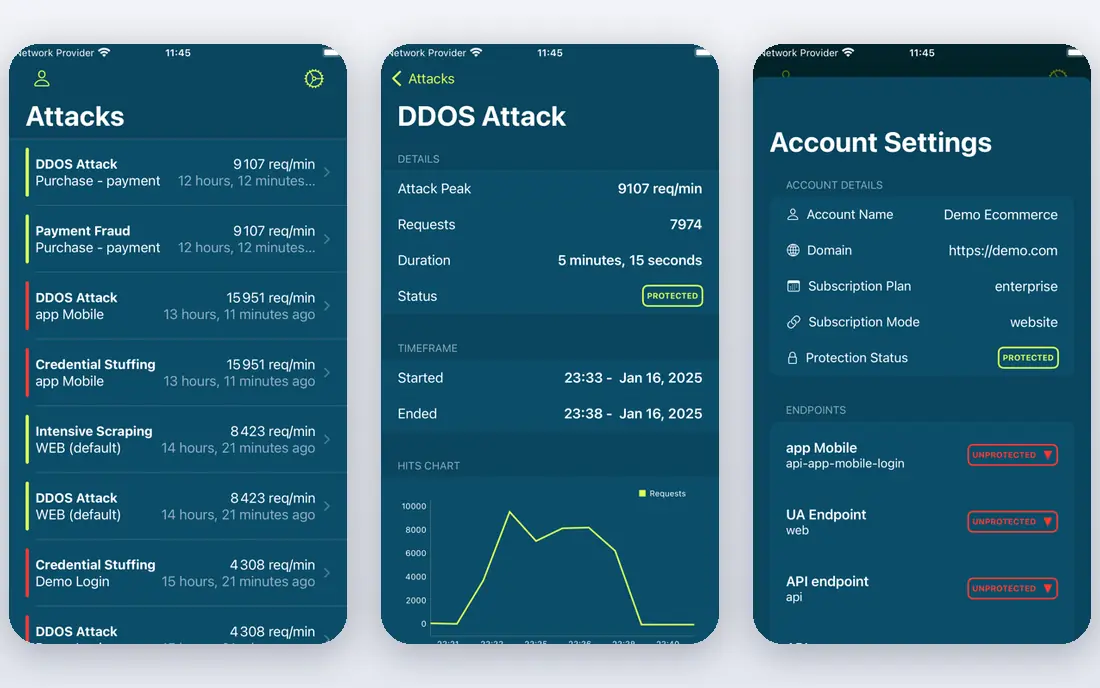
DataDome is built around speed. It inspects requests at the edge and aims to stop credential stuffing, scraping, scalping, and account takeover before those requests reach the origin server. That matters for retailers during drops and for media sites where scrapers can copy content at scale. Its dashboard gives teams a clear view of which bots were blocked, which were challenged, and why.
The main drawback is access. DataDome does not publish a starting price, so small sites cannot judge cost without a sales conversation. Complex sites may also need time to tune rules so legitimate tools, partners, and monitoring services are not caught. For high-traffic sites where bots directly cost revenue, that effort is usually worth it.
- Fast edge detection across web, mobile, and API
- Detailed bot analytics
- Managed detection rules
- Pricing is not published
- Tuning takes effort on complex sites
Cloudflare is the natural first check for any site already using its CDN or DNS. Even free and Pro plans include Bot Fight Mode, and Business adds Super Bot Fight Mode and bot analytics. The full Bot Management product, with per-request scoring and finer rules, is an Enterprise add-on, so teams should not assume a $20 Pro plan gives them the complete product.
That tiering is the catch, but the base is still useful. Small sites get basic bot blocking with no extra vendor to deploy, and larger sites can add full scoring without moving traffic elsewhere. If your site already runs on Cloudflare, start there and only add a dedicated vendor if the scoring and reporting gaps matter for your traffic.
- Bot controls inside a widely used CDN and WAF
- Free Bot Fight Mode on lower plans
- Large traffic signals
- Full bot scoring sits on Enterprise plans
- Pricing for that tier is by quote
HUMAN, formerly PerimeterX in part of its history and now under the HUMAN Security brand, focuses on human-like bots that simple rate limits miss. It looks at behaviour across a session, not just a single request, which helps with credential stuffing, fake account creation, and promo abuse. That session view is useful when attackers rotate IPs and headers to look ordinary.
The cost of that depth is complexity and price opacity. HUMAN is an enterprise product, priced by quote, and teams should plan for onboarding time. It suits companies where account fraud or ad fraud already shows up in support tickets, chargebacks, or skewed analytics, rather than small blogs with occasional comment spam.
- Session-level analysis across apps and APIs
- Strong fraud focus
- Adaptive decisioning
- Pricing is by quote
- Setup and rule management can feel complex
Akamai Bot Manager runs at the edge of a network that handles a very large share of web traffic, which gives its detection models a broad view of bot behaviour. It can score requests, serve challenges, delay responses, or block traffic, and it integrates with Akamai WAF and CDN products that many large sites already use. For global sites, that edge placement keeps latency low while blocking bad traffic early.
Akamai is not a small-site tool. Pricing is by quote, onboarding can be involved, and new administrators face a learning curve. Teams that already use Akamai for delivery or security will get the smoothest deployment. Others should weigh whether edge scale justifies the enterprise process.
- Edge scale from a huge CDN footprint
- Bot scoring informed by very large request volumes
- Flexible responses
- Enterprise pricing and onboarding
- Interface learning curve for new teams
Imperva pairs bot protection with its web application firewall, which suits teams that want one vendor for application security. Its detection uses many signals, including behaviour, device data, and request patterns, and it aims to cover the automated threats listed in the OWASP automated threat guide. That breadth helps when a site faces scraping, credential stuffing, and vulnerability scanning at once.
The honest catch is maintenance. Bot rules need review as attackers change tactics and as the site itself changes, so teams should budget staff time, not just licence cost. Pricing is also by quote. For organisations already standardising on Imperva for WAF, adding bot protection is a logical step.
- Multi-layer detection across many signals
- WAF integration
- Coverage for OWASP automated threats
- Policies can need ongoing tuning
- Pricing is by quote
F5 Distributed Cloud Bot Defense focuses on the flows attackers value most: login, account creation, and checkout. It uses behavioural analysis and client-side signals to spot bots that mimic human browsing, which helps stop credential stuffing and inventory hoarding without adding friction to every page. API coverage matters too, since many attacks now target mobile and API endpoints rather than web pages alone.
F5 is an enterprise product, so smaller teams may find the sales process and integration effort heavy. Larger teams with existing F5 infrastructure will find deployment more natural. The key question during a trial is false positives on login: a tool that locks out real customers during a sale costs more than it saves.
- Behavioural analysis for login and checkout flows
- Client-side telemetry
- API coverage
- Better suited to larger organisations
- Integration effort can be high
Arkose Labs is best known for its challenge approach. Instead of blocking every suspicious session outright, it can present adaptive challenges that are hard for bots and manageable for people, while feeding risk signals into fraud workflows. That model fits account creation, login, and promo flows, where a hard block can lose a real customer but a free pass can lose money.
Challenge design is the risk. Poorly tuned challenges frustrate real users, especially on mobile or with accessibility needs, so teams should test with real users and monitor completion rates. Pricing is by quote, and Arkose suits teams where account abuse is a measured problem, not a vague worry.
- Adaptive challenges for risky sessions
- Fraud workflow tools
- Focus on account abuse
- Pricing is by quote
- Challenge design needs care to avoid user friction
Fingerprint identifies browsers and devices with a persistent identifier, even when cookies are cleared or browsers change in small ways. That signal helps fraud and bot systems tell a returning device from a fresh bot farm, and it can feed rules in a WAF, bot manager, or in-house system. Integration is generally lighter than a full bot platform, which appeals to product teams that already have blocking logic.
Buyers should understand its role. Fingerprint alone does not replace a bot manager that challenges or blocks traffic at the edge, unless it is paired with enforcement. At $200 per month to start, it is also a real budget line for small sites. It earns its place when device identity is the missing piece in an existing fraud stack.
- Persistent visitor identification
- Easy integration for many teams
- Useful bot signals for fraud stacks
- It is a signal provider, not a full blocking platform on its own
- $200 per month starting point
Radware Bot Manager uses behavioural analysis and, in some flows, cryptographic challenges that do not require a visible puzzle, which can reduce friction for real users. It covers web, mobile, and API traffic and pairs with Radware WAF products, so teams can manage application security and bot defence together. That combination suits enterprises that already run Radware or want one application security vendor.
The drawback is setup polish. Some teams report that configuration feels less streamlined than rival dashboards, so plan for tuning time. Pricing is by quote, which is normal in this category but makes quick comparison harder. Radware is a solid enterprise shortlist entry, especially for API-heavy sites.
- Behavioural detection with challenge-free options
- WAF integration
- Web, mobile, and API coverage
- Pricing is by quote
- Setup can feel less streamlined than some rivals
How we picked these
We compared official product pages, category guides, and public pricing notes, and we kept only tools whose main job is legitimate defence against bots, scraping, and account abuse. We excluded tools built to create bots or to evade detection. We marked pricing as See website wherever the vendor does not publish it, and we noted where a headline plan does not include full bot scoring.
What to check before you buy bot protection
Start by naming the bot problem in plain terms. Scraping, credential stuffing, scalping, and fake accounts need different rules and different success measures, and a tool tuned for one may miss another. Measure current bot traffic first, using logs and analytics, so you can judge whether blocking actually improves conversion, support load, or infrastructure cost.
Next, test false positives with real traffic. Run the tool in monitor mode, review which good bots and real users were flagged, and confirm that search engines, payment providers, and monitoring tools still work. Check coverage for mobile apps and APIs, not just web pages, and confirm how quickly the vendor updates detection when attackers change tactics. Finally, confirm total cost, including request volume, add-ons, and managed service fees.
Frequently asked questions
What is bot detection and mitigation software?
It is software that spots automated traffic, scores its risk, and then allows, challenges, slows, or blocks it. Good tools protect login, checkout, and content without adding friction to ordinary visitors.
What is the best bot detection software for small websites?
Cloudflare is usually the practical start, since Bot Fight Mode is included on free and lower plans and full scoring is available on Enterprise. A small site with little bot traffic may not need a dedicated enterprise vendor at all.
How do these tools tell bots from real people?
They combine request signals, device data, behaviour across a session, and known bot patterns. No single signal is enough, which is why the better tools use many signals and adapt as attackers change.
Will bot protection block search engines?
It should not, if configured well. Good tools keep a list of verified good bots and let teams allow specific crawlers, monitors, and partners. Test search engine access during a trial and keep an allowlist under review.
Do I need bot protection if I already have a WAF?
A WAF helps, but bot attacks often use valid-looking requests that a WAF alone will pass. Bot tools add behavioural scoring and session analysis that a rule-based WAF does not provide on its own.
Sources
See where you really rank - block by block
ProMapRanker scans Google Maps across a grid of your service area. Simple monthly plans from $19, white-label on every plan.
Start freeKeep reading
 zscaler alternatives
Best Zscaler Alternatives in 2026
Looking for zscaler alternatives? We compare 9 SASE and zero trust platforms on architecture, data protection, pricing, and fit for your network and team.
Read → zapier alternatives free
Best Zapier Alternatives Free in 2026
Nine automation tools for zapier alternatives free in 2026, all with genuinely free tiers, plus free plan limits, starting prices and upgrade paths explained.
Read → which platform is best for online reputation
Which Platform Is Best for Online Reputation in 2026
Wondering which platform is best for online reputation? We compare 8 review, listing, and response tools for small and multi-location businesses and agencies.
Read →