 ProMapRanker
Best Blockchain Security Software in 2026


Smart contract audits with ongoing monitoring · Pricing starts at: See website
Key takeaways
- The best blockchain security software depends on whether you need a pre-launch audit, live monitoring, or transaction compliance checks.
- No audit or monitoring tool can guarantee that a protocol is safe, since new exploits, key mistakes, and governance risks remain.
- Teams building smart contracts should pair an audit with ongoing monitoring, not treat a single report as a permanent pass.
- Exchanges and payment firms usually need transaction screening and investigation tools, not just code audits.
- Pricing for audits and enterprise monitoring is often quote-based, so ask what is included, such as re-checks, support, and response help.
Quick comparison
| Pick | Great for | Pricing starts at | Free tier | |
|---|---|---|---|---|
| CertiK | Smart contract audits with ongoing monitoring | See website | No | Visit |
 Chainalysis | Transaction monitoring and crypto investigations | See website | No | Visit |
 Elliptic | Crypto compliance screening and wallet risk scores | See website | No | Visit |
 TRM Labs | Institutional crypto risk and fraud detection | See website | No | Visit |
 Halborn | Full-stack reviews beyond smart contracts alone | See website | No | Visit |
 Quantstamp | Protocol audits with economic risk review | See website | No | Visit |
 Trail of Bits | Deep technical audits and security research | See website | No | Visit |
 OpenZeppelin Defender | Operating and monitoring smart contracts after deployment | See website | Free trial | Visit |
 Forta | Decentralized, real-time threat detection | See website | Yes | Visit |
 Hacken | Audits, penetration testing, and compliance checks in one vendor | See website | No | Visit |
The best blockchain security software
Blockchain security covers code audits, live monitoring, and transaction screening, and different tools cover different parts of that work. We compared official product pages and service descriptions, and we focused on what each tool actually does, who it fits, and where its limits sit. This is not financial advice, and trading or holding crypto carries risk, including loss of funds from exploits and market moves.
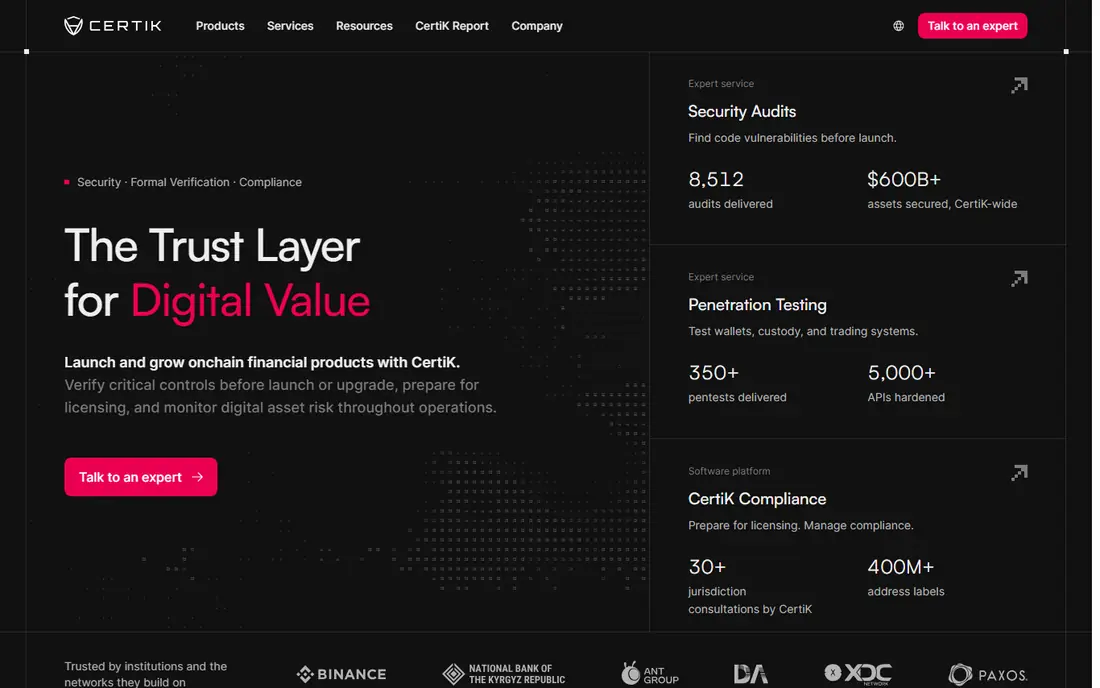
CertiK is one of the most widely used names in Web3 security, combining smart contract audits with formal verification and a monitoring product called Skynet. Formal verification uses mathematical methods to check certain properties of code, which can catch logic errors that a simple checklist might miss. Monitoring then watches deployed contracts for unusual activity, which matters because risks do not stop at launch.
The limits are important to state plainly. An audit reviews code at a point in time, and later upgrades, new integrations, or key handling mistakes can introduce fresh risk. CertiK also prices larger engagements by quote, so a small team should ask early whether a full audit, a lighter review, or monitoring alone fits the budget. For launch-ready protocols, though, CertiK is a natural first call.
- Formal verification work alongside manual audits
- Skynet monitoring for live threats
- Broad chain coverage
- Enterprise pricing is quote-based
- An audit does not prevent all exploits
Chainalysis serves a different job from an audit firm. Its KYT product screens transactions in real time, while Reactor helps investigators trace funds across wallets and services. Exchanges, payment firms, and compliance teams use these tools to spot sanctioned addresses, suspicious patterns, and links to known illicit activity, and to prepare reports for regulators and law enforcement where required.
Chainalysis is not the right pick if your main need is a code audit, since its strength is data and investigation, not contract review. Pricing and onboarding are enterprise-grade, so smaller projects should check whether a lighter screening tool or a partner service fits better. For a business that moves customer crypto funds, however, transaction screening is often a compliance necessity, not an optional extra.
- KYT transaction monitoring
- Reactor investigation tools
- Widely used by exchanges and agencies
- Enterprise pricing and onboarding
- Not a smart contract audit service
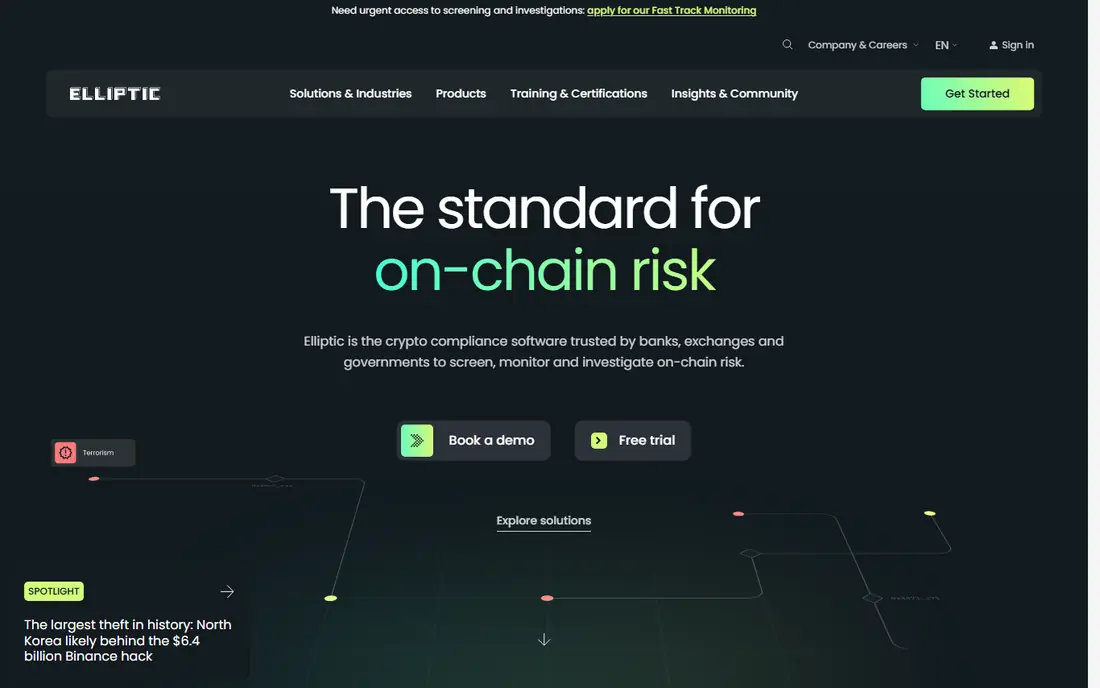
Elliptic provides risk scoring for wallets and transactions, plus screening tools that help firms meet anti-money-laundering and sanctions obligations. Its Navigator product is built for compliance teams that need to check customers, transactions, and counterparties against risk indicators, and to keep records of those checks. That focus makes it a strong fit for exchanges, brokers, and banks that touch crypto.
Screening quality depends on coverage, so a team should confirm which chains, tokens, and risk categories are included for its own volumes before signing. Elliptic is also a compliance platform, not an audit firm, so it should sit alongside code security work, not replace it. Used that way, it helps a firm show that it checked transactions rather than simply hoping they were clean.
- Wallet and transaction risk scoring
- Navigator screening tools
- Focus on compliance workflows
- Quote-based pricing
- Screening depends on data coverage for each chain and asset
TRM Labs offers transaction monitoring, risk intelligence, and investigation tools aimed at financial institutions, exchanges, and government users. Its platform links addresses to entities where possible, scores risk, and helps teams spot fraud, sanctions exposure, and unusual flows across chains. That cross-chain view matters as funds move between networks, bridges, and services.
TRM is built for institutions, so pricing, contracts, and onboarding reflect that audience. A small startup may get more value from a simpler screening integration or from a compliance partner that already runs TRM. For a larger firm with regulatory duties, though, TRM is a credible alternative to Chainalysis and Elliptic, and a pilot on your own transaction mix is the best way to compare them.
- Cross-chain transaction monitoring
- Entity and risk intelligence
- Tools for financial institutions
- Enterprise focus and pricing
- Smaller teams may find it more than they need
Halborn looks beyond contract code to the whole system around it, including infrastructure, cloud setup, key management, APIs, and operational processes. That breadth matters, since many real exploits involve a weak key, a misconfigured service, or a flawed process rather than a single line of contract code. Its teams also publish advisories and incident analysis, which helps buyers judge whether its view of risk matches current exploit patterns.
Because Halborn engagements are scoped per project, cost and timing depend on code size, chain coverage, and how much infrastructure is in scope. A team should define that scope clearly and ask what re-checks are included after fixes. For protocols with complex off-chain parts, Halborn is a strong choice, and it pairs well with a monitoring tool for the period after launch.
- Covers contracts, infrastructure, and operations
- Penetration testing expertise
- Published advisories
- Engagements are scoped and priced per project
- Lead times can be long for complex reviews
Quantstamp has audited protocols across many networks since 2017, and it is known for reviewing both code and economic risks, such as flash loan attacks and incentive flaws. That second lens matters for DeFi, where a contract can be technically sound yet still allow a profitable manipulation of prices or rewards. Its reports are aimed at teams that need a credible, independent review before launch or listing.
As with any audit, scope and follow-up matter. Ask how many engineers will review the code, how re-audits after fixes are handled, and what happens if a critical issue is found late. Quantstamp is a good fit for established protocols and institutional projects that want a thorough, multi-chain audit, while very small teams may start with a lighter review and monitoring instead.
- Long audit history across many chains
- Economic exploit analysis
- Institutional client base
- Audit pricing is project-based
- A report alone does not secure a live protocol
Trail of Bits is a security research firm that audits blockchains, smart contracts, and related systems, and it also builds open-source tools used by other security teams. Its work suits protocols with novel cryptography, complex consensus logic, or high value at stake, where a surface-level review would not be enough. Clients that need a second opinion on a hard design problem often turn to Trail of Bits for that reason.
The trade-off is price and availability. Research-led engagements are premium work, and the firm is not the cheapest route to a basic audit badge. A team should engage Trail of Bits when the technical risk justifies the cost, and use a more standard audit plus monitoring for routine launches. For critical infrastructure, that extra depth can be money well spent.
- Strong research reputation
- Cryptography and protocol expertise
- Open-source security tools
- Premium, research-led engagements
- Not a low-cost option for small projects
OpenZeppelin Defender
Great for: Operating and monitoring smart contracts after deployment
OpenZeppelin is known for its audited contract libraries, which many developers use as building blocks, and Defender extends that work into operations. Defender lets teams monitor contracts, set alerts for unusual activity, manage admin actions with controls, and automate responses such as pausing a contract. That operational layer is often missing after launch, when a team is focused on growth rather than watchfulness.
Defender fits best when developers are comfortable with its tooling and when contracts follow OpenZeppelin patterns. It is not a substitute for an independent audit, since it monitors and operates code rather than reviewing it from scratch. Paired with an audit, though, it gives a team a practical way to react quickly when something looks wrong on chain.
- Secure contract libraries
- Monitoring, alerts, and automated responses
- Admin controls for contract operations
- Best value for teams already using OpenZeppelin contracts
- Some features need developer setup
Forta takes a network approach to monitoring. Independent detection bots watch transactions and contracts for suspicious patterns, and subscribers receive alerts when a bot flags activity. That model can surface threats quickly across many protocols, and its open network means new detection ideas can be added by the community rather than waiting for one vendor roadmap.
The catch is that alert quality depends on the bots you subscribe to, and an alert is only useful if someone can act on it fast. A team should test Forta alerts on its own contracts, tune them to reduce noise, and pair them with a clear response plan, such as pausing or contacting an incident team. For technically strong teams, Forta is a useful extra layer alongside a commercial monitor.
- Network of detection bots watching contracts
- Real-time alerts
- Community-built detection coverage
- Detection quality varies by bot
- Setup needs technical skill to act on alerts
Hacken offers smart contract audits, penetration testing, and broader Web3 security reviews, which suits teams that want one vendor to cover both code and infrastructure. Its work spans token projects, exchanges, and DeFi protocols, and it also provides compliance-related checks for teams preparing for listings or regulatory review. That breadth can simplify procurement when a launch involves several security tasks at once.
As with other audit firms, the key questions are scope, team experience, and re-check policy. A quote that looks cheap but covers only a narrow code review may miss the infrastructure and economic risks that matter most. Ask Hacken to spell out what is in scope, what is excluded, and how fixes are verified, and compare that scope with a specialist firm before deciding.
- Smart contract audits
- Penetration testing
- Token and exchange security reviews
- Service scope varies by engagement
- Pricing is project-based
How we picked these
We compared official product and service pages for blockchain security tools that are actively offered in 2026, covering audits, monitoring, and transaction screening, and we left out firms with no public service description or no current offering. We favored tools with clear scope, published methods, and a record of work in their niche, and we noted where pricing is quote-based. We did not run hands-on tests for this roundup, and we did not invent audit counts, assets secured, or incident claims that vendor pages did not support in a verifiable way.
What to check before you buy
Start by naming the risk you are buying down. A pre-launch protocol needs an audit and a fix-and-recheck cycle, a live protocol needs monitoring and an incident plan, and an exchange needs screening and investigation tools. Buying the wrong category, however good the vendor, will not close the gap you actually face. Write down the chains, contracts, and transaction volumes in scope, and ask each vendor to quote against that exact list.
Next, check independence and follow-up. Ask who will do the work, how findings are rated, whether fixes are re-checked, and how long the team will support you after launch. For monitoring and screening, test alerts on real activity and measure false positives, since a noisy tool will be ignored. Finally, keep security as an ongoing budget line, not a one-time launch cost, and review it after every major upgrade or integration.
Frequently asked questions
What is blockchain security software?
It is a broad term for tools and services that reduce risk in crypto systems, including smart contract audits, live monitoring, and transaction screening for compliance. Audit firms review code before launch, monitoring tools watch deployed contracts for attacks, and screening tools check transactions against risk and sanctions data. Most serious projects need more than one of these layers.
Does an audit make a smart contract safe?
No audit can make a contract fully safe. An audit reduces risk by finding bugs and design flaws at a point in time, but later upgrades, new integrations, key mistakes, and governance attacks can still cause loss. Treat an audit as one control among several, alongside testing, monitoring, bug bounties, and a tested incident response plan.
What is the difference between CertiK and Chainalysis?
CertiK focuses mainly on auditing and monitoring blockchain code and protocols, while Chainalysis focuses mainly on transaction data, monitoring, and investigations for compliance. A protocol team preparing for launch is more likely to need CertiK or a similar auditor, while an exchange screening customer transactions is more likely to need Chainalysis or a similar compliance tool. Many larger firms use both kinds of tool.
How much does a blockchain audit cost?
Audit cost depends on code size, complexity, chain coverage, and the depth of review, and most firms price by project quote rather than a public list price. Small token audits may cost far less than a full protocol review with formal verification and re-checks. Ask for a scoped quote that lists what is included, and be wary of a very cheap audit that covers only a narrow part of the system.
Do I need monitoring after an audit?
Yes, in most cases. Deployed contracts face new attacks, changing integrations, and admin key risks that a pre-launch audit cannot predict. Monitoring tools such as CertiK Skynet, OpenZeppelin Defender, or Forta can alert you to unusual activity while you still have time to pause or respond. Pair monitoring with a written response plan so alerts lead to action, not just emails.
Sources
See where you really rank - block by block
ProMapRanker scans Google Maps across a grid of your service area. Simple monthly plans from $19, white-label on every plan.
Start freeKeep reading
 zoro.to alternatives
Best Zoro.to Alternatives in 2026
We compare the best zoro.to alternatives in 2026, listing only legal licensed anime streaming services, from Crunchyroll to free options for fans today.
Read → zip alternatives
Best Zip Alternatives in 2026
We compare the best zip alternatives for buy now, pay later in 2026, covering pay-in-4 plans, fees, spending limits, and credit reporting options today.
Read → yesware alternatives
Best Yesware Alternatives in 2026
Compare the best yesware alternatives for sales email tracking, templates, and sequences, with current pricing and honest tradeoffs for small sales teams.
Read →