 ProMapRanker
Best Blockchain Platforms for Enterprise Use in 2026


Private consortium networks · Pricing starts at: See website
Key takeaways
- Permissioned platforms such as Hyperledger Fabric and R3 Corda suit consortia where members are known and data must stay private between parties.
- Ethereum tooling through Hyperledger Besu or Polygon suits teams that want public network compatibility with private deployment controls.
- Governance matters as much as code, so check who runs the network, who approves changes, and how disputes are handled before you build.
- Most enterprise pricing is quote based, so budget for infrastructure, support, integration, and audit work, not just a licence fee.
- No platform removes regulatory, legal, or commercial risk, and none can promise returns or a token price outcome.
Quick comparison
| Pick | Great for | Pricing starts at | Free tier | |
|---|---|---|---|---|
| Hyperledger Fabric | Private consortium networks | See website | Yes | Visit |
 R3 Corda | Private financial agreements | See website | Yes | Visit |
 Hyperledger Besu | Private Ethereum networks | See website | Yes | Visit |
 Ethereum | Public smart contract apps | See website | Yes | Visit |
 Polygon | Lower cost Ethereum apps | See website | Yes | Visit |
 Canton Network | Regulated asset networks | See website | No | Visit |
 Hedera | Fast public ledger apps | See website | No | Visit |
 XRP Ledger | Payments and tokenisation | See website | Yes | Visit |
The best blockchain platforms for enterprise use
Enterprise blockchain work is less about public hype and more about control. The platforms below differ in who can join, who can see each transaction, how smart contracts run, and how much work your team must do to operate a network. We kept the focus on platforms with live enterprise use, active maintenance, and clear documentation in October 2026.
Fabric is the default shortlist pick for a group of known organisations that need to share records without sharing everything with everyone. Channels let two or more members transact privately within a wider network, and membership services control who joins. That design fits supply chain, trade, and cross-company record sharing where commercial terms must stay hidden from other members.
The trade off is operational weight. Your team, or a managed provider, must run peers, orderers, certificate authorities, and upgrades. Small pilots can feel slow because governance, identity, and data rules need agreement before code goes live. For a consortium with a clear shared problem and named members, Fabric remains a sound and well documented choice.
- Private channels for confidential data
- Modular consensus and membership
- Chaincode in Go, Java, and Node.js
- Running a network needs real operations skill
- Tooling feels heavier than a public chain for small teams
Corda takes a different view from shared ledger platforms. Instead of broadcasting transactions to all nodes, it shares data only with the parties involved, with a notary service checking uniqueness. Banks, insurers, and other regulated firms often prefer that model, since it mirrors how bilateral agreements already work and limits data exposure by design.
That privacy comes with a narrower ecosystem. Public developer content, libraries, and hiring are thinner than for Ethereum based platforms, and Corda is a poor fit if your product needs open participation or public liquidity. For private agreements, loans, trade finance, and asset servicing between known firms, the model is direct and easy to explain to compliance teams.
- Data shared only with transaction parties
- Strong fit for regulated finance
- Java and Kotlin contract code
- Less suited to public apps
- The developer pool is smaller than the Ethereum pool
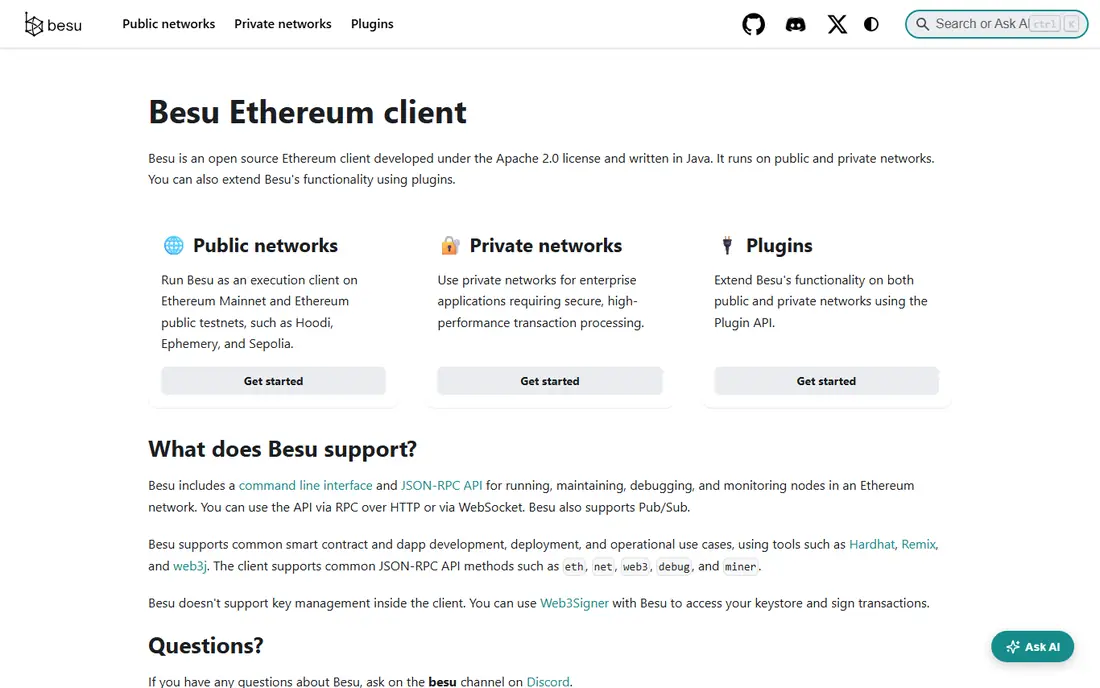
Besu gives Ethereum teams a path into private enterprise work without giving up Solidity, standard wallets, and familiar developer tools. It can run on public Ethereum and on private, permissioned networks, and it supports consensus options such as QBFT and IBFT 2.0 for private deployments. Teams moving from a public prototype to a controlled network often find this the least disruptive route.
Besu is an Ethereum client, not a managed service, so deployment, monitoring, and upgrades remain your responsibility. It also needs clear decisions on privacy groups, permissioning, and node hosting before production. If your developers already know Ethereum and your business needs private transactions, Besu deserves a serious look.
- Ethereum tooling with private network options
- Solidity contracts
- Multiple consensus options
- Private network operations still fall to your team
- Public mainnet fees do not apply in the same way on private networks
Ethereum remains the reference point for smart contracts because its ecosystem is the deepest. Auditors, wallets, libraries, token standards, and developer guides are widely available, and public settlement gives any observer a way to verify activity. For tokenised assets, public registries, and apps that benefit from open access, that openness is a real advantage.
Enterprise teams must handle the other side of that openness. Transactions and contract data on the public network are visible, so confidential commercial terms need off chain storage, encryption, or permissioned token standards. Fees also move with network demand, which complicates budgeting for high volume use. Ethereum fits best when public verifiability matters more than data privacy, or when a private layer handles the sensitive parts.
- Largest smart contract ecosystem
- Deep tooling and audit practice
- Strong public verifiability
- Public transaction data by default
- Mainnet fees vary with demand
- Privacy needs extra design work
Polygon offers Ethereum compatible networks that many teams use when mainnet costs or throughput become a problem. Existing Solidity contracts can often move with limited changes, and wallets and tooling carry over. That compatibility is the main reason it appears in enterprise shortlists for loyalty, ticketing, certificates, and consumer facing apps.
The name covers more than one network and product, so buyers should not treat Polygon as a single thing. Proof of stake, zero knowledge, and other options differ in finality, validator sets, and trust assumptions, and those details matter for regulated work. Check which network a vendor proposal actually uses, and confirm how bridges, custody, and upgrades are handled before committing.
- Ethereum compatible contracts
- Lower fees than Ethereum mainnet in normal use
- Growing enterprise and brand use
- Security and decentralisation differ by network option
- Teams must pick the right Polygon product for their risk profile
Canton is built for a specific enterprise problem: regulated assets that must move between institutions without exposing each deal to every participant. Applications synchronise only the parts of a transaction each party is entitled to see, which suits tokenised securities, collateral, and other financial workflows. Digital Asset, the company behind Canton, works with financial institutions on this model.
The audience is narrow by design. A retail app team will find less public tooling and fewer general guides than on Ethereum or Polygon, and Daml adds a learning step for teams new to it. For banks, custodians, and market infrastructure firms that need privacy plus interoperability, Canton is a credible specialist option rather than a general purpose chain.
- Privacy between participants with cross institution synchronisation
- Built for regulated assets
- Daml contract language
- Focused on institutions, so consumer app tooling is thinner
- Access and pricing need a direct conversation
Hedera is a public distributed ledger governed by a council of organisations, and it is pitched at enterprises that want speed and a clear fee structure. It supports tokens, smart contracts, and consensus services, and it has been used for supply chain, identity, and payment related pilots. Finality in seconds, rather than minutes, helps apps where users wait for confirmation.
It is still a public network at heart, so confidential business data should not be placed on it in plain form. Teams need a data design that keeps sensitive records off ledger and uses the ledger for hashes, tokens, or proofs. Hedera suits teams that want public verifiability with enterprise style governance, and that accept the trade offs of a public ledger.
- Fast finality and predictable fee model in normal use
- Council governance
- Token and smart contract services
- A public ledger, so private data needs separate handling
- Council governance may not suit every consortium
The XRP Ledger is a public ledger with native payment, token, and decentralised exchange features, and it has operated for many years. Enterprises looking at cross border settlement, stablecoin issuance, or tokenised assets often test it for speed and low transaction cost compared with older payment rails. Its built in features can reduce the amount of custom contract code a payments team must write.
Privacy and compliance remain the hard parts. Ledger data is public, so customer and commercial details need careful handling, and legal advice matters because rules for digital assets differ by country and by asset type. The XRP Ledger fits best for payment and token use cases where public settlement is acceptable and the compliance model has been checked in each market served.
- Fast, low cost payments in normal use
- Built in token and exchange features
- Long running public network
- Public by design, so privacy needs extra layers
- Regulatory treatment varies by jurisdiction and use case
How we picked these
We compared official feature pages, pricing pages, documentation, and public reviews for enterprise blockchain platforms, and we kept only platforms that are live and maintained in October 2026. We favoured permissioned frameworks for private consortia, Ethereum compatible options for teams with existing Solidity work, and public ledgers where public settlement or payments were the point. We did not claim hands-on testing, and we used See website for pricing where vendors publish quote based enterprise terms rather than a public list price.
How to choose without overcommitting to one network
Start with the data rule, not the chain. Write down who must see each transaction, who must never see it, and what a regulator or auditor will need to check later. That single decision often removes half the shortlist. A shared consortium record points toward Fabric or Corda, while a public asset or payment points toward Ethereum, Polygon, Hedera, or the XRP Ledger, with privacy handled in a separate layer.
Run a narrow pilot with real members
Pick one workflow, two or three real participants, and a clear success measure, such as settlement time, reconciliation effort, or audit time. Avoid a demo with invented data, since it hides the governance work that decides most enterprise projects. Agree who operates nodes, who pays for infrastructure, and how upgrades and incidents are handled before the pilot expands.
Price the whole operation
Enterprise blockchain costs include hosting, monitoring, key management, integration with existing systems, security audits, and support. Public networks add transaction fees that move with demand, while private networks shift cost toward operations staff. Ask vendors for a first year and third year cost view, and check what happens if a member leaves the network or a contract needs an urgent fix.
Check legal and custody questions early
Confirm how tokens, if any, are treated in each jurisdiction, who holds private keys, and how data protection rules apply to ledger records that cannot easily be deleted. These questions take longer than the technical build, and they are cheaper to answer before contracts are written. A platform choice that looks fast in a pilot can stall later if custody or data rules were left unchecked.
Frequently asked questions
What is the best blockchain platform for enterprise use?
There is no single best choice. Hyperledger Fabric and R3 Corda suit private consortia, Hyperledger Besu suits private Ethereum work, and Ethereum or Polygon suit public apps. Match the platform to your privacy, governance, and liquidity needs first.
Is a private blockchain more secure than a public blockchain?
Private and public networks protect different things. A private network controls membership and data visibility, while a public network offers open verification and a large validator set. Security depends on key management, contract audits, node operations, and governance, not on the label alone.
Do enterprise blockchain platforms need a token?
No. Fabric, Corda, and Besu private networks do not need a native token for internal use, and many enterprise systems use the ledger for records, proofs, or private agreements. Tokens matter mainly for public assets, payments, or incentive designs, where legal review is essential.
How much does an enterprise blockchain platform cost?
Most enterprise terms are quote based, so we list See website where vendors do not publish a list price. Budget for hosting, support, integration, audits, and ongoing operations, and ask for multi year costs before signing.
Can we move from a private network to a public network later?
Sometimes, but the move is rarely a simple switch. Contract code, privacy design, identity, and governance all change, and public data rules differ from private ones. Teams that may need public settlement later should test that path in the pilot, not assume it will work.
Sources
- https://www.hyperledger.org/projects/fabric
- https://www.corda.net
- https://besu.hyperledger.org
- https://ethereum.org
- https://polygon.technology
- https://www.canton.network
- https://hedera.com
- https://xrpl.org
- https://www.pixelwebsolutions.com/top-blockchain-platforms/
- https://idealogic.io/blog/enterprise-blockchain
See where you really rank - block by block
ProMapRanker scans Google Maps across a grid of your service area. Simple monthly plans from $19, white-label on every plan.
Start freeKeep reading
 worlds best local seo company
8 Worlds Best Local SEO Companies for Map Pack Growth in 2026
Compare the worlds best local seo company options for Google Business Profile work, citations, reviews, and multi-location rankings and reporting in 2026.
Read → world's best web hosting company
World's Best Web Hosting Company in 2026
Searching for the world's best web hosting company? We compared 10 hosts on price, renewal rates, speed, and support to help you choose well today in 2026.
Read → who's got the best nanny tax services
Who's Got the Best Nanny Tax Services in 2026
We answer who's got the best nanny tax services, comparing full filing, back taxes, software, and pricing so families can handle nanny taxes correctly.
Read →