 ProMapRanker
Best Birding Apps in 2026: 9 Apps Compared


Fast identification for beginners · Pricing starts at: Free
Key takeaways
- Merlin Bird ID is our first pick for most beginners because it is free and identifies birds by photo, sound and a short set of questions.
- eBird is the best place to log sightings and contribute to citizen science, while Audubon adds a full field guide for North American birds.
- BirdNET focuses on sound identification, and Sibley Birds and iBird Pro suit birders who want detailed artwork and offline field guides.
- iNaturalist, Birda and Warblr widen the picture, from general wildlife records to community lists and sound matching.
- No app is always right, so compare the suggestion with what you saw and heard, and use photos or notes for unusual birds.
Quick comparison
| Pick | Great for | Pricing starts at | Free tier | |
|---|---|---|---|---|
| Merlin Bird ID | Fast identification for beginners | Free | Yes | Visit |
 eBird | Checklists, life lists and citizen science | Free | Yes | Visit |
 Audubon Bird Guide | North American birds in one free guide | Free | Yes | Visit |
 BirdNET | Identifying birds from recorded sound | Free | Yes | Visit |
 Sibley Birds | Serious birders who want Sibley artwork | See website | No | Visit |
 iBird Pro | Offline identification in remote places | See website | No | Visit |
 iNaturalist | Birds plus other wildlife in one record | Free | Yes | Visit |
 Birda | Community birding with privacy controls | Free | Yes | Visit |
 Warblr | Automatic recognition of British bird song | See website | Free trial | Visit |
The best birding apps
Birding apps now cover three jobs: naming the bird, keeping a list, and finding where birds have been seen. The list below mixes free identification tools with deeper paid guides, so a beginner and a regular birder can both find a good fit.

Merlin Bird ID, from the Cornell Lab of Ornithology, is the easiest starting point for most people. A birder can answer a few questions about size, colour and behaviour, upload a photo, or record a song, and Merlin offers likely matches for that place and date. That local filter matters, because it stops a common garden bird from being confused with a distant species that looks similar. Bird packs can be downloaded before a walk, so identification still works in areas with weak signal.
The honest limit is certainty. Sound ID can struggle with wind, overlapping songs and mimics such as mockingbirds, and a photo taken at distance can mislead any tool. Treat Merlin as a strong suggestion, then check size, markings, behaviour and habitat before adding a bird to a life list. For rare or unusual birds, a photo, recording or written description carries far more weight than an app suggestion alone.
- Photo ID, Sound ID and step-by-step ID
- Free bird packs for regions
- Linked to Cornell Lab data
- Suggestions can be wrong in poor light or noisy places
- Large bird packs take phone storage

eBird is the record book behind much modern birding, and it pairs naturally with Merlin. A birder submits a checklist for a walk, notes counts where possible, and builds lists by place, year and lifetime. Hotspot pages show recent visits and species, which helps with planning a trip, though a hotspot with no recent checklists is not proof that birds are absent. Data from eBird also supports research and conservation work, so careful records have value beyond a personal list.
A birder can also explore hotspots before a trip, checking recent species without assuming that a quiet hotspot means no birds are present. That planning step makes eBird useful before leaving home, not only after a walk.
- Free checklists and life lists
- Hotspot explorer
- Sightings feed into research
- Identification help is limited compared with Merlin
- Needs care with accurate counts and locations
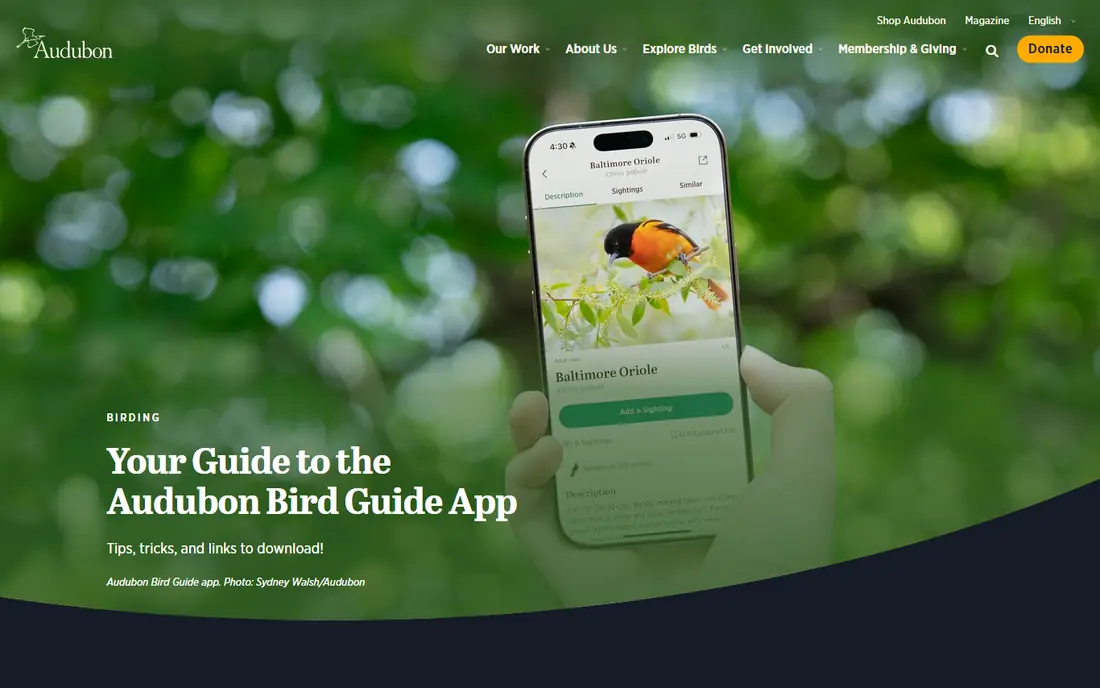
The Audubon Bird Guide is a full field guide in a phone, built around North American species. It holds photos, song and call recordings, range maps and text from experienced bird writers, and its Bird ID tool narrows matches from observed colour, size and other traits. A sightings feature keeps a personal record, and nearby hotspot and recent sighting views link to eBird data, so the guide and the record book sit close together.
For a birder in North America, Audubon is a strong free alternative to a printed guide, and its comparison tools help when two similar species are in play. Outside North America, its coverage is less useful, and a birder travelling elsewhere should check Merlin bird packs or a local guide first. Inside its region, though, it is hard to beat for depth at no cost, and it works well as a second opinion after Merlin.
- Guide to over 800 North American species
- Photos, songs and range maps
- Sightings and nearby hotspots
- Focus is North America
- Some users prefer Merlin for pure identification speed
BirdNET comes from a research project at the Cornell Lab of Ornithology and Chemnitz University of Technology, and it focuses on one job: naming birds from sound. Record a song or call, and BirdNET analyses the recording and suggests likely species. That focus suits dawn chorus walks, woodland birds that are heard more than seen, and learners who want to connect a song to a species name. It also helps users contribute recordings to research, when they choose to share them.
Sound identification has clear limits. Wind, traffic, overlapping birds and distant calls all reduce accuracy, and BirdNET cannot identify a bird that stays silent. A good habit is to record in a quiet spot, note the habitat and time, and compare the result with Merlin or a field guide before treating it as final. Used that way, BirdNET is a fine specialist tool, and it pairs well with a visual guide rather than replacing one.
- Research-backed sound identification
- Covers many common species worldwide
- Simple recording workflow
- Needs a clear recording
- Less useful for silent birds or visual identification
Sibley Birds brings the well-known Sibley guide artwork to a phone, with detailed species accounts, distribution maps and a large set of calls and songs. Smart search filters by size, colour, habitat, behaviour and location, and a side-by-side comparison helps separate similar species, such as confusing gulls or warblers. A personal list and location status by month add planning value for trips and seasonal birding.
The catch is price and scope. Sibley Birds is a paid app, with current pricing shown in its app store listing, and its strength is North American birds. A beginner may find Merlin faster for a first identification, while a birder who already knows the common birds will get more from Sibley detail. For that second group, the artwork and careful text justify the cost, and the app is a solid long-term field companion.
- Artwork from David Sibley guides
- Detailed maps and calls
- Side-by-side species comparison
- Paid app
- North America focus
- Larger download than a simple ID app
iBird Pro is built for places where signal is poor or absent, because its database lives on the phone. That makes it useful on remote trails, islands and rural reserves, where a cloud-based tool may stall. Its search covers many traits, including colour, size, bill shape, habitat and song type, and it mixes hand-drawn illustrations with photos, which helps when a bird is seen in different plumage or at an odd angle.
The app is paid, and its design feels less modern than Merlin or Audubon, so a new birder may need a short learning period. Its coverage also centres on North America, the UK and Hawaii, rather than the whole world. For a birder who travels off the grid, or who wants a self-contained guide that does not depend on a connection, iBird Pro remains a practical choice, and it is worth trying a free lite version first where one is offered.
- Built-in database works without internet
- Illustrations and photos
- Detailed search by many traits
- Paid app
- Interface feels older than Merlin
- North America, UK and Hawaii focus
iNaturalist is not only a birding app, and that breadth is its strength. A birder can log a bird, then add the plant it was feeding on, the insect nearby, or the mammal track on the path, and the community helps confirm identifications. Observations can reach research grade when the community agrees, which gives a casual walk a wider natural history value. Its photo suggestions help with a first identification, though they are not as bird-focused as Merlin.
The limit is speed and focus. iNaturalist does not offer the same instant bird song identification or bird-specific field guide depth, and a community identification can take time. For a birder who also enjoys general wildlife, or who wants to share records with a wider nature community, it is a useful companion to eBird. Use eBird for bird lists, and iNaturalist for the wider picture of a place.
- Free community identification
- Records for plants, insects and animals
- Research-grade observations
- Not a dedicated bird guide
- Identifications depend on community input and time
Birda is a newer birding community app that focuses on logging sightings, building life lists and joining challenges, with a clear eye on privacy. Users can hide sensitive locations and set privacy zones around a home, which matters for nesting birds and for personal safety. Birda can import sightings from eBird, Merlin and other tools, and export records, so a birder is not locked into one system. That import and export freedom is a real advantage for anyone who has years of records elsewhere.
The main drawback is scale. Birda has a smaller community than eBird, so hotspot data and social features may feel quieter in some regions. It also sits between a list tool and a social app, so a birder who only wants a private list may prefer eBird, while a birder who wants challenges and community may enjoy Birda. For a birder who values privacy controls and portable records, Birda is worth a trial alongside eBird.
- Life lists and challenges
- Imports from eBird and other tools
- Privacy zones for sensitive locations
- Smaller community than eBird
- Some features may need a paid option
Warblr is a bird song recognition app with a strong focus on birds found in the UK. Record a song, and Warblr analyses it and returns likely species, which helps a learner connect a sound heard in a garden or wood to a name. That single-purpose design makes it easy to use on a walk, and it suits beginners who find song learning hard from text alone. It can also help a birder check a hunch before opening a fuller guide.
As with other sound tools, Warblr needs a reasonably clear recording, and wind, traffic and several birds singing at once can confuse it. Its species strength is UK-centred, so a birder outside the UK should check coverage before relying on it. Pricing and trial terms are shown in its app store listing. For a UK birder who wants a simple song tool, Warblr is a useful addition to Merlin and eBird.
- Records and names birdsong automatically
- Simple for UK birders
- Useful for learning songs
- Strongest for UK species
- Accuracy falls with noise and overlapping songs
- Pricing varies
How we picked these
We compared official app pages, Cornell Lab resources, Audubon and Sibley materials, and app store listings, and we kept only apps that are live, genuinely bird-focused or useful for bird records, and clear about price and coverage. We favoured free identification tools for beginners, a strong logging tool for records, and deeper guides for experienced birders. We also noted where an app is region-specific, so a reader does not buy a guide that covers the wrong continent.
Choosing the right birding app
Start with the job you do most. If you mostly want a name for a bird you just saw or heard, Merlin is the first download, with BirdNET or Warblr as a sound specialist. If you want to keep a list, eBird is the standard, and Birda adds community and privacy controls. If you want depth, Audubon gives a free North American guide, while Sibley Birds and iBird Pro add artwork, maps and offline use for a price.
Field habits that help any app
Download bird packs and guides before you leave home, charge the phone, and carry a notebook for birds that stay uncertain. Avoid playing recorded calls repeatedly near birds, especially in breeding season, and follow local rules in reserves and national parks. When a sighting is unusual, add a photo, a recording or a clear written description, and mark uncertainty honestly in eBird. Good field habits make app suggestions more useful, and they protect the birds that draw people out in the first place.
Offline and travel notes
Merlin bird packs, Sibley Birds and iBird Pro all help when signal is weak, but they need storage space and a download before the trip. Check which region pack matches your destination, and delete packs you no longer use to free space. For international travel, confirm coverage in the app store listing, since a North American guide will not help much in Europe, Asia or Australia. A local guide or a Merlin pack for that region is a better travel pick.
Frequently asked questions
What is the best app for birding?
For most beginners, Merlin Bird ID is the best app for birding because it is free, covers photo, sound and question-based identification, and uses location and date to narrow matches. Pair it with eBird for logging sightings. Experienced birders may prefer Sibley Birds or iBird Pro for deeper artwork and offline guides.
Is Merlin Bird ID really free?
Yes, Merlin Bird ID is free, with no subscription needed for its core identification tools and bird packs, according to the Cornell Lab of Ornithology. It is funded as a public resource rather than by paywalled identification features. Storage is the main cost, since regional bird packs can be large.
Which birding app is best for identifying birds by sound?
Merlin Sound ID and BirdNET are both strong for sound, and Warblr is a useful UK-focused option. Merlin is best as an all-round tool, BirdNET is best as a sound specialist, and Warblr suits UK birders who want a simple song recorder. In all cases, a clear recording and a check against habitat and appearance improve accuracy.
Can I use eBird and Merlin together?
Yes, and that pairing is common. Use Merlin to help identify a bird, then log the confirmed sighting in eBird with a checklist, location and counts where possible. Merlin suggestions alone are not proof for a rare bird, so add a photo, recording or written notes for unusual records.
What is the best birding app for offline use?
iBird Pro is built for offline use, since its database lives on the phone, and Sibley Birds and Merlin bird packs also help without signal. Download the right region pack or guide before a trip, and check storage space first. Offline tools still need a clear photo or recording for accurate identification.
Do birding apps work outside North America?
Merlin, eBird, BirdNET, iNaturalist and Birda have broad or global coverage, while Audubon, Sibley Birds and iBird Pro are more region-specific. Warblr is strongest for UK species. Check the app listing for your destination before travel, and download the matching Merlin bird pack for that region.
Sources
See where you really rank - block by block
ProMapRanker scans Google Maps across a grid of your service area. Simple monthly plans from $19, white-label on every plan.
Start freeKeep reading
 zscaler alternatives
Best Zscaler Alternatives in 2026
Looking for zscaler alternatives? We compare 9 SASE and zero trust platforms on architecture, data protection, pricing, and fit for your network and team.
Read → zapier alternatives free
Best Zapier Alternatives Free in 2026
Nine automation tools for zapier alternatives free in 2026, all with genuinely free tiers, plus free plan limits, starting prices and upgrade paths explained.
Read → which platform is best for online reputation
Which Platform Is Best for Online Reputation in 2026
Wondering which platform is best for online reputation? We compare 8 review, listing, and response tools for small and multi-location businesses and agencies.
Read →