 ProMapRanker
Best Banking as a Service (BaaS) Software in 2026

Key takeaways
- BaaS platforms sit between your product and a licensed bank, handling accounts, cards, payments and much of the compliance work.
- Unit and Synctera suit teams that want a guided, all-in-one launch, while Treasury Prime suits teams that want a choice of bank partners.
- Card issuing specialists such as Marqeta and Galileo fit products where cards are the main feature, not full bank accounts.
- Pricing is almost always quoted or usage based, so ask for account, transaction and card fees in writing before you commit.
- This is general information only and not financial advice, and no platform here is ranked as a bank.
Quick comparison
| Pick | Great for | Pricing starts at | Free tier | |
|---|---|---|---|---|
 Unit | Fast US embedded finance launches | See website | No | Visit |
 Treasury Prime | Choosing among bank partners | See website | No | Visit |
 Synctera | Guided launches with partner banks | See website | No | Visit |
 Galileo | Card and account infrastructure at scale | See website | No | Visit |
 Marqeta | Modern card programs | See website | No | Visit |
 Railsr | Embedded wallets and cards globally | See website | No | Visit |
 Stripe Treasury | Platforms already using Stripe | See website | No | Visit |
The best banking as a service baas software
Banking as a service, usually shortened to BaaS, lets a software company or brand offer bank-style features inside its own product. A licensed partner bank holds the deposits and carries the regulatory responsibility, while the BaaS platform supplies the APIs, dashboards and controls that make those features work. The products below are framed as features across real platforms, not as a ranking of banks, and none of them is itself a bank for your customers.
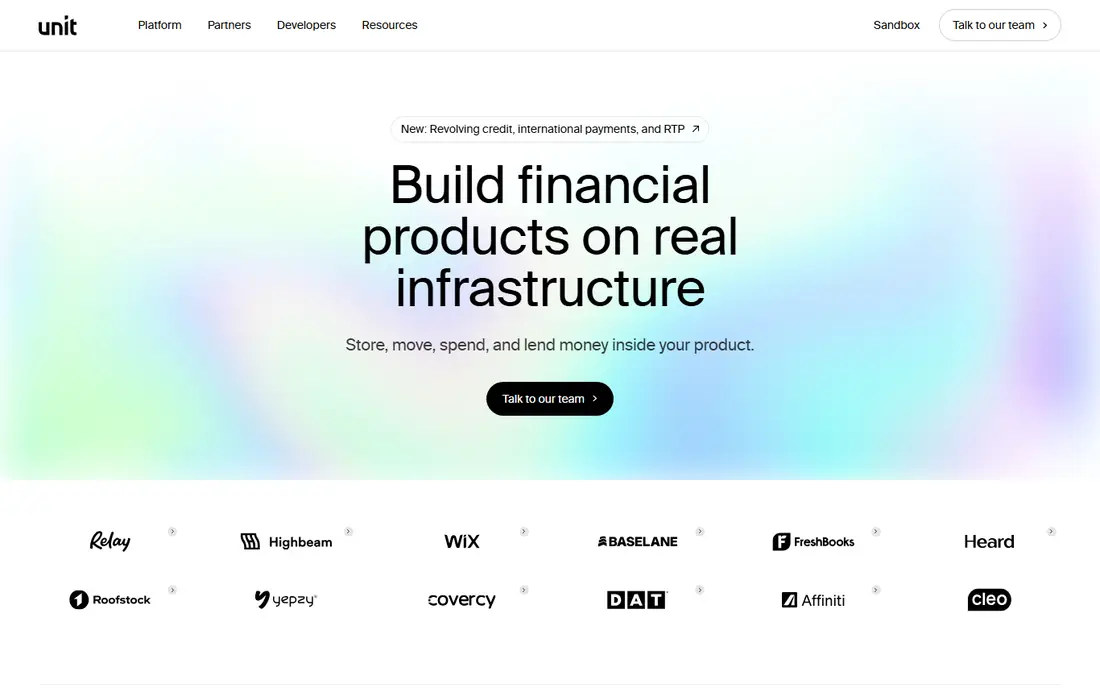
Unit is built for software companies that want to add accounts, cards and payments without stitching together several vendors. Its pitch is speed with structure, with pre-built components and a dashboard that shows accounts, transactions and customer activity in one place. For a US team with a clear product, that focus can shorten the path from idea to a working financial feature.
The honest catch is scope. Unit is US-centered, so a team planning an early move into Europe or other regions will need a second route. Pricing is also discussed rather than published, which means you should compare total fees across account creation, transactions and card use before signing. Ask how sponsor-bank oversight works in practice, and who reviews your compliance materials.
- Accounts, cards, payments and lending in one system
- US-focused bank partnerships
- Clear developer tools and dashboard
- US focus limits global plans
- Pricing is quoted rather than published
- Enterprise controls take time to set up well
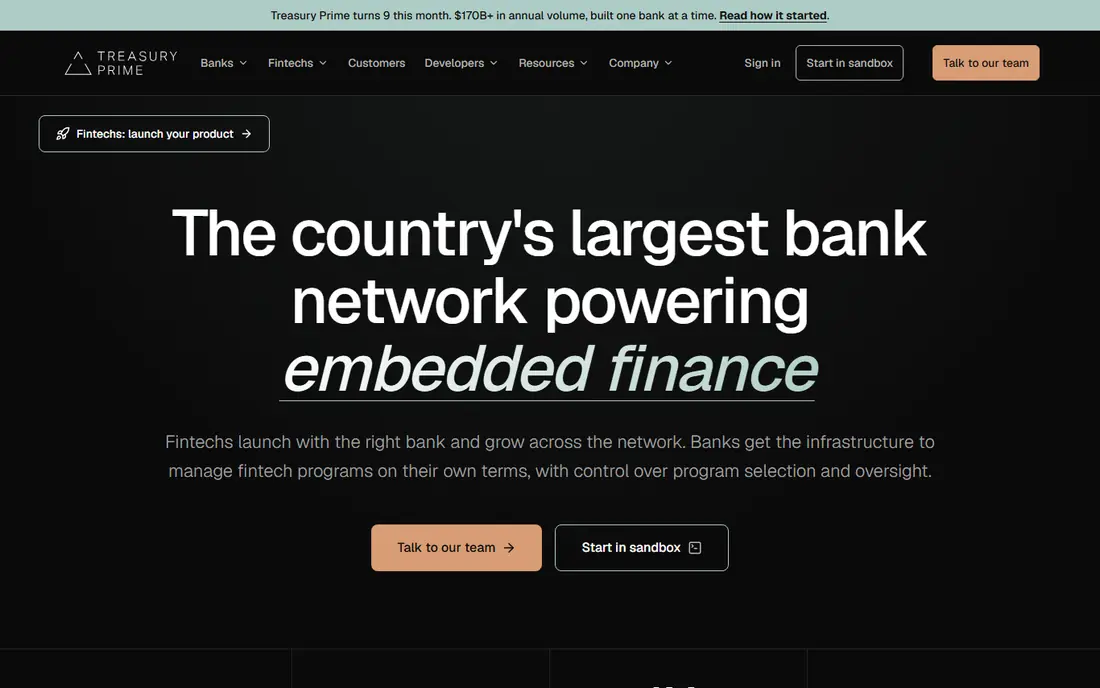
Treasury Prime takes a different approach from an all-in-one vendor. It connects fintechs and enterprise platforms with a network of banks, so you can look for a partner whose risk appetite and product range match your plans. Its API covers accounts, payments and cards, and it has a clear commercial angle for platforms that move money for businesses, workers or vendors.
That choice is both the strength and the work. You still need to understand who your bank partner is, what it expects from your compliance program, and how changes at that bank could affect your product. Teams that want a single vendor to decide everything for them may find this model heavier. Teams that want control over the banking relationship will see that same work as a benefit.
- Network of bank partners
- Accounts, payments and cards through one API
- Strong fit for commercial fintech products
- More partner decisions to manage
- US-centered coverage
- Quoted pricing makes early budgeting harder
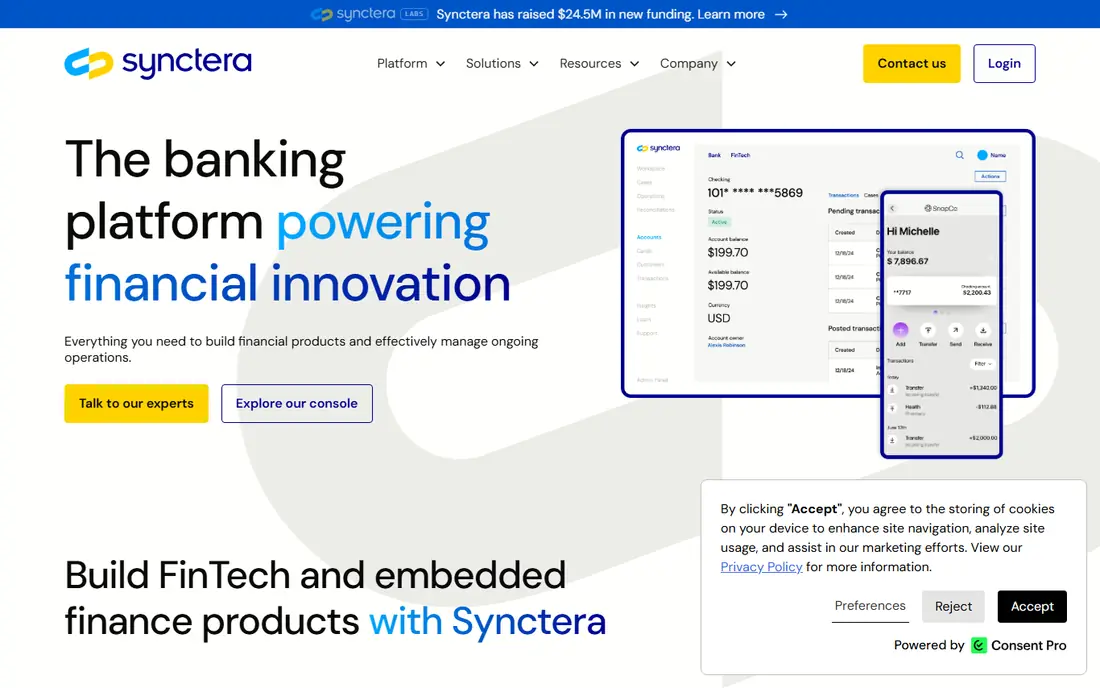
Synctera positions itself as a matchmaker and guide, pairing fintechs with partner banks and helping both sides through onboarding, compliance and launch. That structure can help a first-time fintech team avoid common mistakes, since the platform and the bank review the product together. Accounts, cards and payment features sit behind APIs that are meant to feel modern even when the underlying bank systems are older.
The trade-off is that you are not buying a self-serve tool. Bank approval, compliance checks and program reviews are real steps, and they take time. If your timeline is tight, ask for a realistic launch schedule and a list of what the bank will need from you at each stage. Synctera fits teams that value that guided process more than a quick, unguided start.
- Matchmaking with partner banks
- Compliance and launch support
- Accounts, cards and payments coverage
- Partner-bank approval can slow a launch
- Quoted pricing
- Smaller teams may find the process formal
Galileo is one of the established names behind many digital banking and fintech products, with APIs for accounts, cards and payments. Its strength is scale and depth in card issuing and processing, which matters when a product has to handle large transaction volumes without breaking. Larger teams often pick Galileo when they need proven infrastructure rather than a new, untested stack.
Smaller teams should be realistic about fit. Galileo works through an enterprise-style process, and pricing is quoted, so a small startup may not get the same attention as a large program. Ask about minimum volumes, support hours and how card program changes are handled. For a high-volume product, those answers matter more than a marketing page.
- Long track record in card processing
- Broad account and payment features
- Built for high-volume programs
- Enterprise sales process
- Quoted pricing
- Smaller startups may face higher minimum expectations
Marqeta is best known for modern card issuing, and it earns its place here for products where the card is the core feature. Its platform lets teams create physical and virtual cards, set spending controls and react to transactions in real time. That level of control suits expense products, payout cards, gig-worker payments and branded card programs.
Be clear about what Marqeta does not replace. A card program still needs a bank partner and, for full accounts, other infrastructure. Marqeta works well as the card layer in a wider BaaS stack, and less well as a single answer for every banking feature. Price it as part of that stack, and confirm which card networks, regions and controls your program will actually use.
- Flexible card issuing and controls
- Real-time transaction tools
- Strong developer documentation
- Card-first focus, not full BaaS alone
- Quoted pricing
- Complex programs need careful configuration
Railsr focuses on embedded finance for companies that want wallets, cards and accounts across more than one market. Its API-led approach and compliance tooling are designed to help brands add financial features without building bank connections country by country. For a product with customers in several regions, that breadth is the main reason to shortlist it.
Country coverage is the detail to verify first. A feature that works in one market may not be available in another, and local rules can change the product you can offer. Ask Railsr for a market-by-market list, including which partners hold funds in each place. That check protects you from a launch plan that looks global on a slide and narrow in practice.
- Wallets, cards and accounts for global products
- Compliance tooling included
- API-led design
- Coverage varies by country
- Quoted pricing
- Support depth should be checked for your markets
Stripe Treasury helps software platforms offer financial accounts and money movement to their own business customers, with partner banks holding the funds behind the scenes. If your product already runs payments on Stripe, the familiarity is a real advantage. Your developers already know the tooling, and your users stay inside a product flow they already trust.
The limit is ecosystem fit. Stripe Treasury makes most sense for platforms that are already committed to Stripe, and less sense for a team that wants a bank-agnostic stack. Fees are transaction based and discussed case by case, so model your expected volumes before you commit. Confirm which account features, payout options and regions your platform users will actually receive.
- Fits existing Stripe payments setups
- Accounts and money movement for platform users
- Strong developer experience
- Tied to the Stripe ecosystem
- Bank partners sit behind Stripe
- Pricing is transaction based and quoted
How we picked these
We compared official feature pages, pricing pages, developer documentation and public reviews for BaaS platforms that operate in October 2026. We looked for live account, card or payment features, a named banking model, and a product that a software company can actually integrate, rather than a bank that only sells its own consumer app. We left out providers that had shut down or were no longer taking new programs, and we wrote pricing as quoted where vendors do not publish it. No platform paid for a place on this list, and we did not claim hands-on testing.
What to check before you pick a BaaS partner
Start with the banking model, not the API demo. Ask who the partner bank is, what happens if that bank changes its appetite, and how your customer funds are held and protected. Then ask about compliance in plain terms: who handles identity checks, transaction monitoring, fraud controls and reporting, and what your team must still do itself. A platform that answers those questions clearly is usually a safer partner than one that only talks about launch speed.
Next, map your product to the features you truly need. An account product, a card product and a lending product have different partners, approvals and costs, and bundling them into one contract can hide fees. Price the full journey: account opening, transactions, card issuance, support and any minimums or monthly charges. Finally, run a small pilot with real compliance review before a full launch, and keep a written exit plan so customer accounts and data can move if the partnership ends.
Frequently asked questions
What is banking as a service?
Banking as a service is a model where a licensed bank provides regulated banking infrastructure, and a technology platform makes it available through APIs. Your customers see your brand and your product, while the partner bank holds deposits and meets banking rules. Your company still carries important duties for compliance, fraud controls and customer support.
Is a BaaS platform the same as a bank?
No. A BaaS platform is a technology and operations layer, not the bank itself. The partner bank is the licensed institution, and its name should appear in your customer terms and disclosures. Always check which bank holds funds before you launch a product.
How much does BaaS software cost?
Most BaaS pricing is quoted or based on accounts, transactions and card volumes, so public prices are rare. Ask for a written fee schedule that covers setup, monthly charges, per-account fees, transaction fees and card costs. Compare that schedule at your expected volumes, not at a demo volume.
How long does a BaaS launch take?
Timelines vary with bank approval, compliance review and product complexity, and they often run into months rather than weeks. A simple card program can move faster than a full account and lending product. Ask for milestones, review steps and what can delay approval.
Is BaaS safe for customer money?
Customer funds are held at a partner bank, which is a different question from whether your product is well run. Check deposit insurance arrangements, safeguarding rules in your markets, fraud controls and how customers can reach support. This article is general information only and not financial advice.
Can a small startup use BaaS?
Yes, but fit matters. Some platforms are built for enterprise volumes, while others welcome smaller teams with guided launches. Be honest about your volume, compliance capacity and support resources, and pick a partner that has launched products at your size.
Sources
See where you really rank - block by block
ProMapRanker scans Google Maps across a grid of your service area. Simple monthly plans from $19, white-label on every plan.
Start freeKeep reading
 worlds best local seo company
8 Worlds Best Local SEO Companies for Map Pack Growth in 2026
Compare the worlds best local seo company options for Google Business Profile work, citations, reviews, and multi-location rankings and reporting in 2026.
Read → world's best web hosting company
World's Best Web Hosting Company in 2026
Searching for the world's best web hosting company? We compared 10 hosts on price, renewal rates, speed, and support to help you choose well today in 2026.
Read → who's got the best nanny tax services
Who's Got the Best Nanny Tax Services in 2026
We answer who's got the best nanny tax services, comparing full filing, back taxes, software, and pricing so families can handle nanny taxes correctly.
Read →