 ProMapRanker
Best B2B Ecommerce Platforms in 2026

Key takeaways
- Shopify Plus and BigCommerce are the fastest routes to a working B2B store, while Adobe Commerce and SAP suit complex enterprises.
- OroCommerce is the most B2B first option here, with corporate accounts and approval workflows built in.
- The best ecommerce platform for b2b depends on ERP and CRM systems you already run, not on features alone.
- Implementation cost often exceeds licence cost, so get a full quote before you choose.
Quick comparison
| Pick | Great for | Pricing starts at | Free tier | |
|---|---|---|---|---|
 Shopify Plus | Unified B2B and B2C selling | $2,300 per month | No | Visit |
 BigCommerce | Mid-market B2B with built-in features | $39 per month | Free trial | Visit |
 Adobe Commerce | Complex enterprise B2B catalogues | See website | No | Visit |
 Salesforce B2B Commerce | CRM connected B2B selling | See website | No | Visit |
 WooCommerce | WordPress B2B stores with full control | Free | Yes | Visit |
 OroCommerce | B2B first commerce for manufacturers and distributors | Free | Yes | Visit |
 SAP Commerce Cloud | SAP connected enterprise B2B | See website | No | Visit |
 commercetools | Composable B2B commerce | See website | No | Visit |
The best B2B ecommerce platforms
B2B selling is not consumer selling with a different logo. Buyers need company accounts, price lists, quotes, bulk ordering and approvals, and those features decide which platform fits. We compared platforms on those B2B features, integrations and total effort, not just storefront design.

For readers who want unified b2b and b2c selling, Shopify Plus is a strong place to start. It suits brands that already sell direct to consumers and want to add wholesale without running a second platform. Its strength is speed to launch, with B2B catalogues, company accounts and price lists on a familiar Shopify base. Checkout extensibility, multi-store options and a huge app marketplace help teams add quotes, approvals and custom pricing. The catch is catalogue complexity and checkout limits may need apps or custom work for very complex B2B rules. Shortlist it when unified B2B and B2C operations matter more than deep custom workflows. Our pick for brands that want B2B live fast on a proven platform.
- Fast launch for a B2B store
- B2B catalogues, price lists and company accounts
- Large app ecosystem
- Checkout and catalogue complexity may need apps
- Enterprise cost rises with sales volume
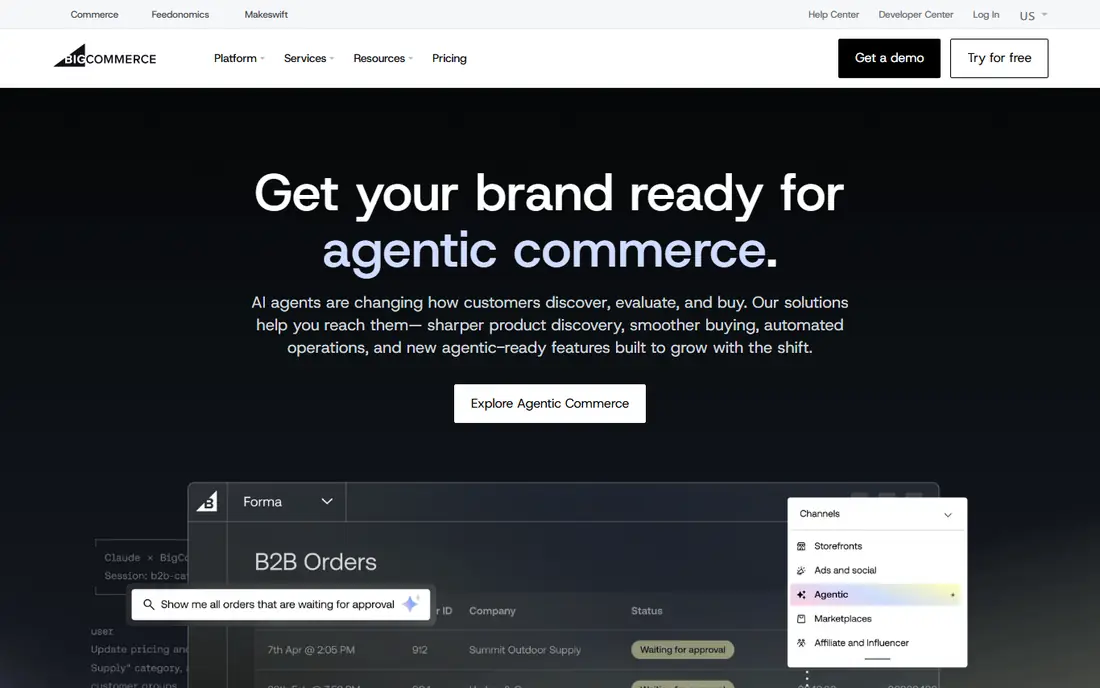
If mid-market b2b with built-in features matters most to you, BigCommerce deserves a close look. It fits mid-market brands that want strong B2B features built in, rather than assembled from apps. Its strength is built-in depth, with customer groups, price lists, quotes and B2B checkout features on higher plans. Headless commerce, multi-storefront and open APIs suit teams that need flexibility without a fully custom build. The catch is enterprise B2B pricing is custom, so total cost is hard to compare without a quote. Ask for a B2B Edition demo with your actual price lists and customer groups before you decide. A strong mid-market B2B choice, especially for brands outgrowing a basic store.
- Strong built-in B2B features without many apps
- Headless options
- Multi-storefront support
- Enterprise B2B pricing is custom
- Learning curve rises with headless setups
Start with Adobe Commerce when complex enterprise b2b catalogues is the main job to be done. It is the enterprise option for companies with complex buying rules, many catalogues and deep integrations. Its strength is customisation, with code level control over catalogues, pricing, approvals and workflows. B2B quotes, requisition lists, shared catalogues and multi-site support cover the hardest enterprise requirements. The catch is implementation and maintenance costs are high, and you need developer resources to run it well. Budget for implementation, hosting and ongoing development, not just the licence fee. Our pick for large enterprises with complex B2B needs and a technical team.
- Deep customisation for complex catalogues
- Multi-store and multi-site support
- Extensive extension marketplace
- High implementation and maintenance costs
- Needs developer resources
Salesforce B2B Commerce suits readers who put crm connected b2b selling first. It makes most sense when customer, order and service data already live in Salesforce. Its strength is CRM connection, so B2B storefronts, pricing and orders reflect the same customer record as sales and service. Self-service ordering, contract pricing, quotes and order management suit enterprise B2B teams. The catch is implementation can be long and costly, and value drops if you do not already use Salesforce. Shortlist it for Salesforce centred organisations, and compare total implementation cost carefully. The enterprise pick for Salesforce customers.
- Deep Salesforce CRM and data integration
- B2B storefronts tied to customer records
- Enterprise scale
- Best value sits inside Salesforce estates
- Implementation can be long and costly
When wordpress b2b stores with full control is the deciding factor, WooCommerce is worth shortlisting. It suits WordPress teams that want to own their store and add B2B features piece by piece. Its strength is control and cost, since the core plugin is free and you choose hosting and extensions. B2B extensions add wholesale pricing, quotes, customer groups and bulk ordering on top of WordPress content tools. The catch is you manage hosting, security and updates, and B2B features come from paid extensions. Budget for quality hosting and extensions, and test wholesale flows with real customer groups. Our pick for WordPress teams that value ownership over a managed platform.
- Free core plugin for WordPress
- Huge extension ecosystem
- Full control over hosting and code
- You manage hosting, security and updates
- B2B features need paid extensions
Consider OroCommerce first if b2b first commerce for manufacturers and distributors describes your situation. It is built for B2B first, rather than adapted from a consumer store, which shows in its workflows. Its strength is B2B depth, with corporate accounts, multiple buyers per account, quotes and approval workflows. Multi-website, multi-organisation and CRM features suit manufacturers, distributors and wholesalers. The catch is enterprise support and implementation are quote based, and the extension ecosystem is smaller than the largest rivals. Try the community edition to test workflows, then price enterprise support for production use. A strong B2B first option for mid-market and enterprise distributors.
- Built for B2B from the start
- Workflows, quotes and multi-organisation support
- Open source community edition
- Enterprise support and implementation need a quote
- Smaller app ecosystem than Shopify or BigCommerce
SAP Commerce Cloud is built around sap connected enterprise b2b, and that focus shows in daily use. It fits large organisations already running SAP, where commerce must connect to ERP, inventory and finance systems. Its strength is SAP integration, with product, pricing and order data flowing from the systems that already run the business. Headless storefronts, B2B and B2C commerce, and multi-market support cover global enterprise needs. The catch is cost and complexity are high, and implementation needs experienced SAP partners. Shortlist it only when SAP integration is a core requirement, not a nice extra. The enterprise pick for SAP customers.
- Deep SAP ERP integration
- Headless and composable options
- Enterprise scale across markets
- High cost and complexity
- Best fit is SAP estates with large teams
For composable b2b commerce, commercetools offers a practical and well documented option. It suits technical teams that want to assemble a commerce stack from best fit components, rather than accept one vendor suite. Its strength is composability, with APIs for products, carts, pricing and orders that teams can combine as needed. B2B features, multi-market support and cloud scale suit enterprises building custom storefronts. The catch is you need developer teams to build and maintain the storefront, so it is not a quick launch option. Budget for development and integration, and compare total assembled cost with a suite platform. Our pick for API first teams building a custom B2B stack.
- API first composable architecture
- Flexible B2B pricing and catalogues
- Cloud native scale
- Needs developer teams to build storefronts
- Total cost depends on assembled components
How we picked these
We compared official feature pages, pricing pages and app store listings, and we checked that each product still exists and fits the topic in October 2026. We did not claim hands-on testing that did not happen, and we left out products that did not fit, even when they were popular in a nearby category. Where a price or free tier could not be verified on the vendor site, we wrote See website instead of guessing, so you can confirm the current terms before you pay.
Choosing the best B2B ecommerce platform
Start with your buying rules. List your price lists, customer groups, quote steps and approval rules, then test each platform against that list. A platform that handles your hardest rule will handle the easy ones too. Next, map integrations. ERP, CRM, inventory and accounting connections decide whether orders flow cleanly or need manual work. Ask vendors for a live demo using your product data, not a polished sample catalogue. Finally, price the whole project. Licence fees are only part of the cost, with implementation, apps, hosting and maintenance on top. Get a written total for year one, and check what happens when order volume or catalogue size grows.
Frequently asked questions
Which ecommerce platform is best for b2b?
Shopify Plus and BigCommerce suit most mid-market B2B stores, while Adobe Commerce, SAP Commerce Cloud and Salesforce suit large enterprises. OroCommerce suits distributors that want B2B first workflows.
What is the best b2b ecommerce platform software for wholesale?
BigCommerce B2B Edition, Shopify Plus and OroCommerce all handle wholesale price lists, company accounts and bulk ordering. Test quote and approval flows with your real customer groups before you choose.
Is Shopify good for B2B?
Yes, Shopify Plus adds B2B catalogues, price lists and company accounts to the main Shopify platform. It works best for brands that also sell direct to consumers and want one platform for both.
How much does a B2B ecommerce platform cost?
Costs range from free core software such as WooCommerce, plus hosting and extensions, to thousands per month for enterprise platforms. Implementation often costs more than the first year licence, so get a full quote.
What is the best ecommerce platform b2b for manufacturers?
Manufacturers with complex catalogues and SAP or Salesforce systems often choose Adobe Commerce, SAP Commerce Cloud or Salesforce B2B Commerce. Smaller manufacturers may find OroCommerce or BigCommerce easier to launch.
Sources
- https://www.shopify.com/plus
- https://www.bigcommerce.com/
- https://business.adobe.com/products/magento/magento-commerce.html
- https://www.salesforce.com/commerce/b2b-commerce/
- https://woocommerce.com/
- https://oroinc.com/b2b-ecommerce/
- https://www.sap.com/products/scm/commerce-cloud.html
- https://commercetools.com/
See where you really rank - block by block
ProMapRanker scans Google Maps across a grid of your service area. Simple monthly plans from $19, white-label on every plan.
Start freeKeep reading
 best employee onboarding software
Best Employee Onboarding Software in 2026
We compared the best employee onboarding software in 2026 for new employees, from simple HR tools to global platforms, to help you pick by team size today.
Read → best ecommerce platform for small business
Best Ecommerce Platform for Small Business in 2026
We compared the best ecommerce platform for small business options on price, selling features, fees, and ease of use, so you can launch a store that grows.
Read → best crm software for startups
Best CRM Software for Startups in 2026
We compared the best crm software for startups on price, free plans, and setup time, so founders can choose a simple tool that grows with their growing team.
Read →