 ProMapRanker
Best Automated Investing Apps in 2026

Key takeaways
- Betterment and Wealthfront are our first picks for most hands-off investors, both charging 0.25 percent a year with strong tax-loss harvesting.
- Fidelity Go is the cheapest start for small balances, with no advisory fee under $25,000, while Schwab charges no advisory fee but holds a cash allocation.
- Vanguard Digital Advisor undercuts the 0.25 percent pair on price, at roughly 0.15 percent net, for investors happy with Vanguard funds only.
- Flat-fee apps such as Acorns and M1 suit small or growing balances differently, so compare the dollar cost at your balance, not just the headline rate.
Quick comparison
| Pick | Great for | Pricing starts at | Free tier | |
|---|---|---|---|---|
 Betterment | Most hands-off investors | 0.25% per year | No | Visit |
 Wealthfront | Tax optimisation and planning | 0.25% per year | No | Visit |
 Schwab Intelligent Portfolios | Zero advisory fee fans | Free | No | Visit |
 Fidelity Go | Small balances | Free | Yes | Visit |
 Vanguard Digital Advisor | Low-cost Vanguard investors | 0.15% per year | No | Visit |
 SoFi Automated Investing | SoFi customers | See website | No | Visit |
 Acorns | Round-up spare-change investing | $3 per month | No | Visit |
 M1 Finance | DIY investors wanting automation | $3 per month | No | Visit |
 E*TRADE Core Portfolios | Existing E*TRADE customers | 0.30% per year | No | Visit |
 Ellevest | Women-focused financial planning | $12 per month | No | Visit |
The best automated investing apps
Automated investing apps, often called robo-advisors, build and manage a diversified portfolio for you. You answer questions about goals, time horizon, and risk tolerance, the app invests in low-cost ETFs or index funds, and it rebalances as markets move. Some also harvest tax losses in taxable accounts. We compared provider pricing pages and recent robo-advisor comparisons, and we picked platforms that still operate in the United States in 2026.
This is not financial advice, and investing carries risk, including the possible loss of money you invest. Past performance does not guarantee future results, and the right portfolio depends on your goals, time horizon, and tolerance for risk. Check each provider current fees, minimums, and fund costs before opening an account, since terms change.
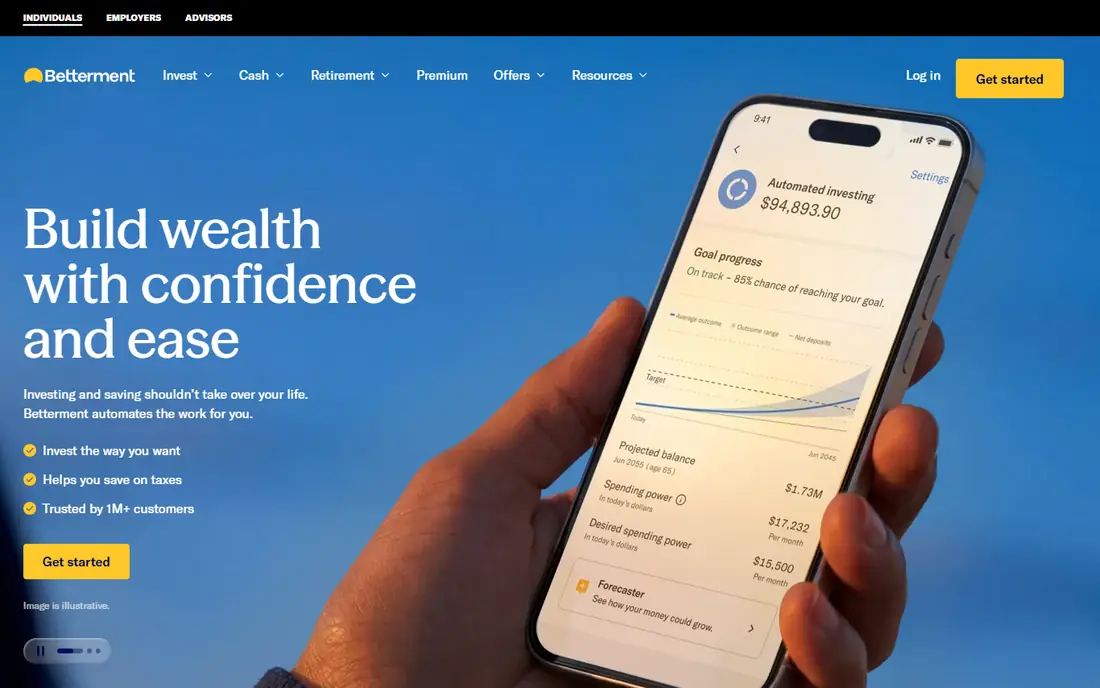
Betterment is our first pick for most hands-off investors, because it pairs a clear goal system with strong automation. You set goals for retirement, a house deposit, or a safety net, and Betterment builds a portfolio for each goal, rebalances it, and reinvests dividends automatically. Tax-loss harvesting runs on taxable accounts, which can improve after-tax results for investors in higher tax brackets.
Pricing is 0.25 percent a year for qualifying investing accounts, or a monthly fee for smaller balances without a regular deposit, so check the current threshold before opening. A Premium tier at 0.65 percent with a $100,000 minimum adds unlimited access to certified financial planners. Fund expenses sit on top of the advisory fee, as they do at every robo-advisor here.
- Goal-based portfolios
- Tax-loss harvesting on taxable accounts
- Premium tier with human advisors
- Lower balances pay a monthly fee without regular deposits
- Fund expenses sit on top
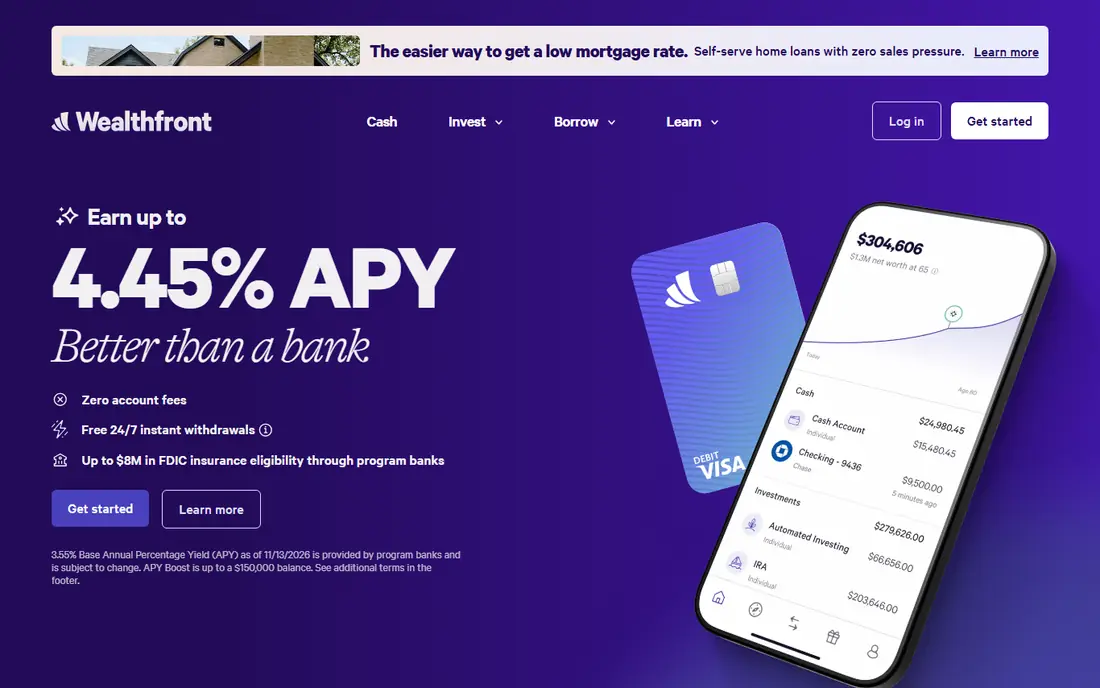
Wealthfront charges the same headline 0.25 percent a year as Betterment, with a $500 minimum, and it stands out for tax work and planning tools. Daily tax-loss harvesting runs on taxable accounts, and direct indexing, which holds individual stocks to harvest losses more precisely, becomes available at $100,000. Its free Path tool projects retirement readiness and major savings goals, even for people who do not invest through Wealthfront.
The platform suits investors who want sophisticated automation without paying for human advice, since no dedicated advisor is included. Portfolios use low-cost ETFs, and fund expenses sit on top of the advisory fee as usual. If tax efficiency in a large taxable account is your priority, Wealthfront is the strongest single choice here, and its planning tools help you judge whether your savings rate matches your goals.
- Daily tax-loss harvesting
- Direct indexing at higher balances
- Free Path planning tool
- $500 minimum
- No dedicated human advisor
Schwab Intelligent Portfolios charges no advisory fee, which makes it look free, but the cost sits elsewhere. Portfolios hold a required cash allocation, typically 6 to 10 percent, that earns bank interest rather than market returns, and that cash drag is the real price of the service. The $5,000 minimum is higher than free rivals, and tax-loss harvesting requires enrolment and a $50,000 balance.
For investors who already bank and invest with Schwab, the integration is convenient, and a Premium tier adds certified planner access for a monthly fee plus a higher minimum. The honest question is whether the cash allocation costs more than a 0.25 percent fee would at your balance and time horizon. In strong markets, cash drag can exceed that fee, so compare the full cost, not just the headline zero.
- No advisory fee
- $5,000 minimum is reachable
- Schwab banking and brokerage integration
- Required cash allocation drags returns
- Tax-loss harvesting needs $50,000
Fidelity Go is the cheapest genuine start for a new investor, with no advisory fee on balances under $25,000 and no minimum to open, though about $10 is needed to begin investing. Portfolios use Fidelity Flex funds with zero expense ratios, which keeps fund costs down as well as advisory costs. That combination makes it hard to beat for a first automated account.
The trade-off arrives at $25,000, where the fee jumps to 0.35 percent a year, the highest headline rate among the percentage-fee platforms here, and coaching calls and tax-loss harvesting also become available at that threshold. Investors who plan to grow well past $25,000 should compare the long-run cost against Betterment, Wealthfront, and Vanguard, rather than judging Fidelity Go on its free tier alone. For starting out, though, it is an excellent low-risk entry point.
- No advisory fee under $25,000
- No opening minimum
- Uses zero-expense Fidelity funds
- Fee jumps to 0.35% above $25,000
- Coaching and tax harvesting need $25,000
Vanguard Digital Advisor charges roughly 0.15 percent a year net, after credits for revenue from underlying Vanguard funds, which undercuts the 0.25 percent pair by a useful margin. The $100 minimum is low, and portfolios use only Vanguard index funds, which keeps fund costs low and the strategy simple. For investors who already hold Vanguard funds and want one unified automated strategy, the fit is natural.
The limit is choice. You cannot hold outside funds or individual stocks in the automated portfolio, and the digital-only service does not include a regular human advisor, though a separate personal advisor service exists at a higher fee and minimum. Tax-loss harvesting availability and account eligibility should be confirmed for your account type. If low cost and simplicity matter most, Vanguard is the price leader here.
- Lowest percentage fee here
- All-index Vanguard portfolios
- $100 minimum
- Vanguard funds only
- No dedicated human advisor on the digital service
SoFi Automated Investing builds diversified ETF portfolios from a risk questionnaire and rebalances them automatically, with access to certified financial planners included for members. That human access at a robo price is its main draw, along with integration with SoFi banking, lending, and other products for customers who already use SoFi. Sustainable portfolio options are available for investors who want that tilt.
Published fee terms for SoFi have varied across recent sources, so we list See website and recommend confirming the current advisory fee and minimum on the provider page before opening. Some specialised ETFs in its portfolios also carry higher fund expenses than core ETFs.
- Access to certified planners
- Broad ETF portfolios
- SoFi banking integration
- Fee terms have varied across sources
- Some specialised ETF costs are higher
Acorns takes a different route into automated investing: it rounds up everyday card purchases to the nearest dollar and invests the spare change in diversified ETF portfolios. That habit-building design suits people who struggle to set aside lump sums, and the app adds recurring deposits, retirement accounts, and banking features on higher tiers. Plans start at $3 a month for the Bronze tier, with higher tiers adding more features.
The flat fee cuts both ways. It gets cheaper in percentage terms as your balance grows, but $36 a year on a $500 balance is a high percentage, so Acorns suits savers who will deposit regularly and grow the account. It does not offer tax-loss harvesting, and its portfolios are simpler than those of Betterment or Wealthfront.
- Round-ups turn spare change into investing
- Very low barrier to start
- Simple portfolios
- Flat fee is expensive on tiny balances
- No tax-loss harvesting
M1 Finance lets you build a portfolio as a pie, with target percentages for each stock or ETF, and then automates deposits and rebalancing to keep those percentages on track. Every slice uses fractional shares, so a small deposit spreads across your whole portfolio, and expert pies offer pre-built themes for investors who want a starting point. There are no commissions on self-directed accounts, and a $3 monthly platform fee applies under $10,000, waived at higher balances.
M1 is not a robo-advisor in the classic sense, because you choose the pie rather than letting the platform choose for you, and trades execute in scheduled windows rather than in real time. That design suits long-term investors who know what they want to hold and want deposits invested automatically. Active traders, options users, and investors who want full tax-loss harvesting should look at the dedicated robo-advisors above instead.
- Pie-based portfolios automate rebalancing
- Fractional shares on every slice
- No commissions
- Trades run in scheduled windows
- $3 monthly fee under $10,000
- No tax-loss harvesting focus
ETRADE Core Portfolios, now part of Morgan Stanley, builds diversified ETF portfolios across risk profiles and rebalances them automatically when allocations drift. Investors can choose core, socially responsible, or smart beta variations, and can adjust the recommended risk level from the questionnaire. Existing ETRADE customers benefit from consolidated account views, unified tax reporting, and easy transfers between brokerage and managed accounts.
The fee is 0.30 percent a year with a $500 minimum, which sits above Betterment, Wealthfront, and Vanguard, and the platform does not include tax-loss harvesting at any tier, a notable gap against its rivals. For an existing E*TRADE customer who wants automation without opening a new account, the convenience may still win.
- Automatic rebalancing
- Socially responsible and smart beta options
- Morgan Stanley research access
- 0.30% fee is above rivals
- No tax-loss harvesting
- $500 minimum
Ellevest builds automated ETF portfolios around goal-based planning, with a focus on women financial lives, including pay gaps, career breaks, and longer life expectancy in its planning assumptions. Membership starts at $12 a month and includes planning tools, portfolio management, and access to coaching, depending on tier. The approach suits investors who want planning and investing in one membership rather than a bare portfolio manager.
The membership model means the dollar cost does not fall as a percentage in the same way a percentage fee does, and the portfolios themselves are simpler than the tax-optimised offerings from Betterment and Wealthfront. Investors who prioritise tax-loss harvesting or the lowest possible fee should compare those platforms first. Investors who value Ellevest planning lens and coaching access may find the membership worth it.
- Planning built around women financial lives
- Goal-based portfolios
- Coaching access
- Membership fee model
- ETF portfolios are simpler than tax-focused rivals
How we picked these
We compared provider pricing pages and recent robo-advisor comparisons checked in October 2026, and we kept platforms that still operate in the United States and still accept new automated investing accounts. Where sources conflicted on a fee, as with SoFi, we wrote See website rather than presenting one source figure as settled. We included percentage-fee, zero-fee, and flat-fee models, because the cheapest option depends heavily on your balance, and we flagged fund expenses and cash allocations that sit outside headline advisory fees.
How to compare fees at your balance
Turn every fee into dollars at your balance before choosing. A 0.25 percent fee costs $25 a year on $10,000 and $250 on $100,000, while a $3 monthly fee costs $36 a year at any balance, and a $12 monthly fee costs $144. That maths flips the ranking: flat fees punish tiny balances and reward large ones, while percentage fees do the opposite. Add fund expenses on top, and for Schwab, estimate the cost of the cash allocation as well.
Also match the account type to the feature. Tax-loss harvesting only helps in taxable accounts, not in IRAs where gains are already sheltered, so do not pay extra for it in a retirement account alone. Human advice matters most when your situation is complex, such as a business sale or a large windfall, and matters least for a simple retirement goal. Pick the cheapest platform that covers the features you will actually use, then automate deposits and leave the portfolio alone.
Frequently asked questions
What is the best automated investing app?
Betterment and Wealthfront are the best all-round picks for most hands-off investors, both charging 0.25 percent a year with tax-loss harvesting and automatic rebalancing. Fidelity Go suits smaller balances with no fee under $25,000, while Vanguard Digital Advisor suits cost-focused investors at roughly 0.15 percent net. The best app depends on your balance, account type, and whether you want human advice.
What is the best automated investing platform for beginners?
Fidelity Go is the best start for beginners, with no opening minimum and no advisory fee under $25,000, using zero-expense funds. Acorns suits beginners who want to start with round-ups and small deposits, though its flat fee is costly on tiny balances. Beginners should start with a small automated deposit, learn how rebalancing works, and increase deposits as income allows.
How much do automated investing apps cost?
Percentage-fee platforms charge 0.15 to 0.35 percent a year here, with Schwab charging no advisory fee but holding a cash allocation. Flat-fee platforms charge $3 to $12 a month, which costs $36 to $144 a year regardless of balance. Fund expenses sit on top at every provider, so compare the total dollar cost at your balance, not just the headline rate.
Are automated investing apps safe?
Automated investing platforms in the United States are registered investment advisers, and customer assets are typically held at a custodian with SIPC protection up to $500,000, subject to SIPC terms. That protection covers missing securities if a firm fails, not losses from market falls, which remain your risk. Check each provider registration, custodian, and disclosures before opening an account.
Do robo-advisors offer tax-loss harvesting?
Betterment and Wealthfront offer tax-loss harvesting on taxable accounts, Schwab offers it on enrolled accounts above $50,000, and Fidelity Go offers it on taxable accounts above $25,000. E*TRADE Core Portfolios and Acorns do not offer it. Tax-loss harvesting only helps in taxable accounts, since retirement accounts already shelter gains, so weigh it only for money held outside an IRA.
What is the difference between Betterment and Wealthfront?
Both charge 0.25 percent a year and offer tax-loss harvesting, but Betterment has no minimum and offers a Premium tier with human planners at higher balances, while Wealthfront has a $500 minimum and stronger planning tools with direct indexing at $100,000. Betterment suits goal-based savers who may want human advice later, while Wealthfront suits tax-focused investors who want sophisticated automation without an advisor.
Sources
See where you really rank - block by block
ProMapRanker scans Google Maps across a grid of your service area. Simple monthly plans from $19, white-label on every plan.
Start freeKeep reading
 zscaler alternatives
Best Zscaler Alternatives in 2026
Looking for zscaler alternatives? We compare 9 SASE and zero trust platforms on architecture, data protection, pricing, and fit for your network and team.
Read → zapier alternatives free
Best Zapier Alternatives Free in 2026
Nine automation tools for zapier alternatives free in 2026, all with genuinely free tiers, plus free plan limits, starting prices and upgrade paths explained.
Read → which platform is best for online reputation
Which Platform Is Best for Online Reputation in 2026
Wondering which platform is best for online reputation? We compare 8 review, listing, and response tools for small and multi-location businesses and agencies.
Read →