 ProMapRanker
Best Aurora Apps in 2026: 8 Apps Compared

Simple forecasts for beginners · Pricing starts at: Free
Key takeaways
- My Aurora Forecast is our pick for most first-time watchers because it keeps the forecast plain and readable.
- Hello Aurora suits travellers who want live sightings from other watchers alongside a forecast.
- SpaceWeatherLive is the better choice when you want solar wind detail rather than a simple yes or no answer.
- No app can promise clear skies, so check cloud cover and darkness separately on the night itself.
- AuroraWatch UK is the strongest free alert source for viewers in the United Kingdom.
Quick comparison
| Pick | Great for | Pricing starts at | Free tier | |
|---|---|---|---|---|
| My Aurora Forecast | Simple forecasts for beginners | Free | Yes | Visit |
 SpaceWeatherLive | Deep solar wind data | Free | Yes | Visit |
 Hello Aurora | Live community sightings | Free | Yes | Visit |
 AuroraWatch UK | UK alerts from local magnetometers | Free | Yes | Visit |
 Aurora Notify | Alaska focused alerts | Free | Yes | Visit |
 NOAA SWPC Aurora Dashboard | Official short range forecast | Free | Yes | Visit |
 Glendale Aurora Alerts | UK sighting reports and alerts | Free | Yes | Visit |
 Nordlysvarsel | Three day Norway forecasts | Free | Yes | Visit |
The best aurora apps
We compared forecast apps, alert tools and official dashboards, and kept only tools that were still live in October 2026.
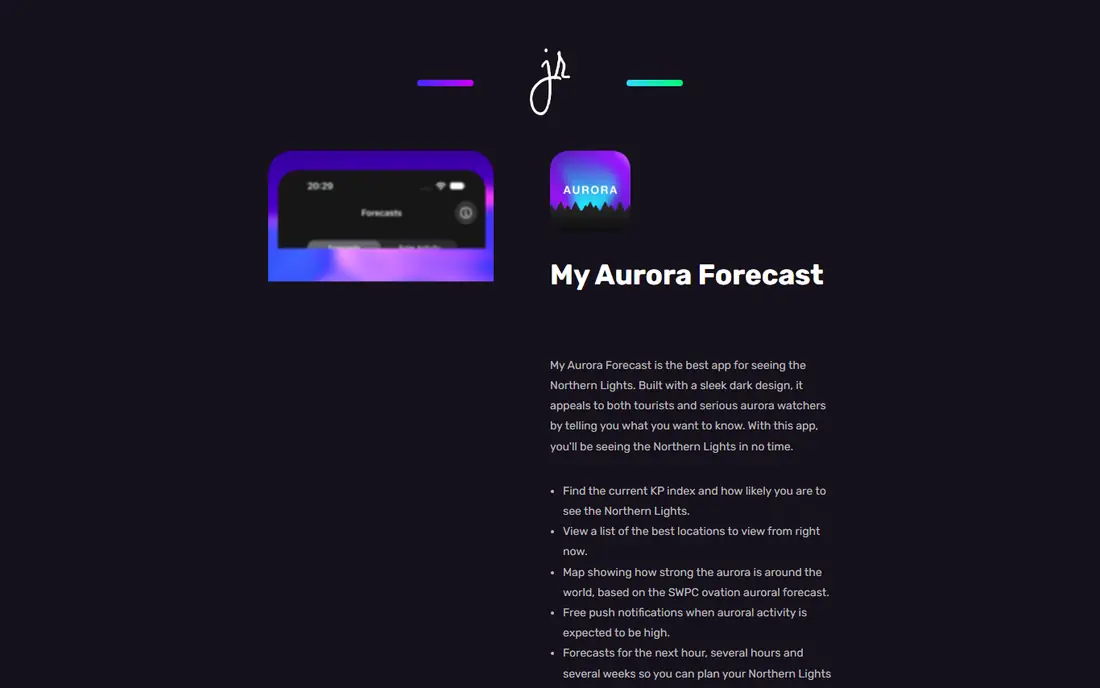
My Aurora Forecast starts with the question most people actually ask, which is how likely the lights are where they stand. It shows the Kp index, a local chance figure, an oval map and live webcams, all in a dark layout that is easy to read at night. That plain presentation is why we put it first for a first trip.
The catch is that simplicity can hide the detail behind the number. A high Kp value does not help if cloud moves in, so pair this app with a local cloud forecast before you drive out. The app is free with ads, and its store listing was updated in October 2026, which is a good sign that it is still maintained.
- Clear chance percentage
- Oval map
- Free push alerts
- Ad supported
- Long range outlook is only a guide, not a promise
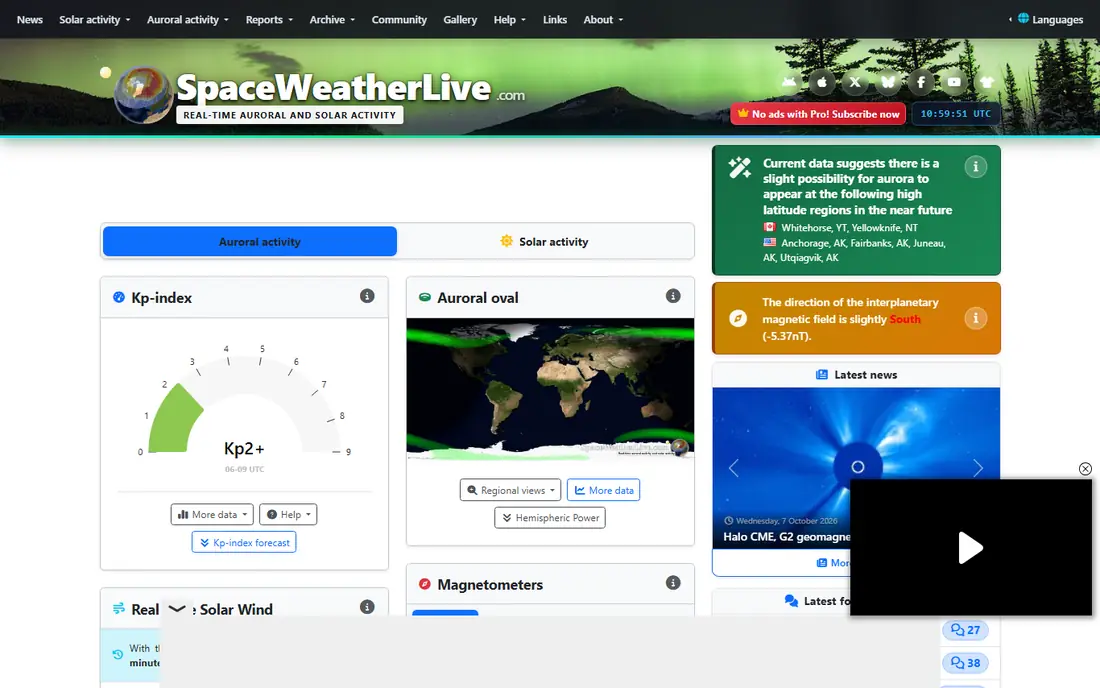
SpaceWeatherLive is the app to open when a simple percentage stops being enough. It gives solar wind speed, density, Bz direction and geomagnetic readings, with explanations that help you learn what each figure means. Photographers and keen watchers tend to prefer this depth because it shows change as it happens.
For a casual viewer, that same depth is the drawback. You may spend ten minutes reading charts when a short alert would have done the job. Use it as a second app beside a simple alert tool, and let it confirm a decision rather than make every decision for you.
- Solar wind speed, density and Bz detail
- Clear explanations
- Active community data
- More detail than casual viewers need
- Interface can feel busy
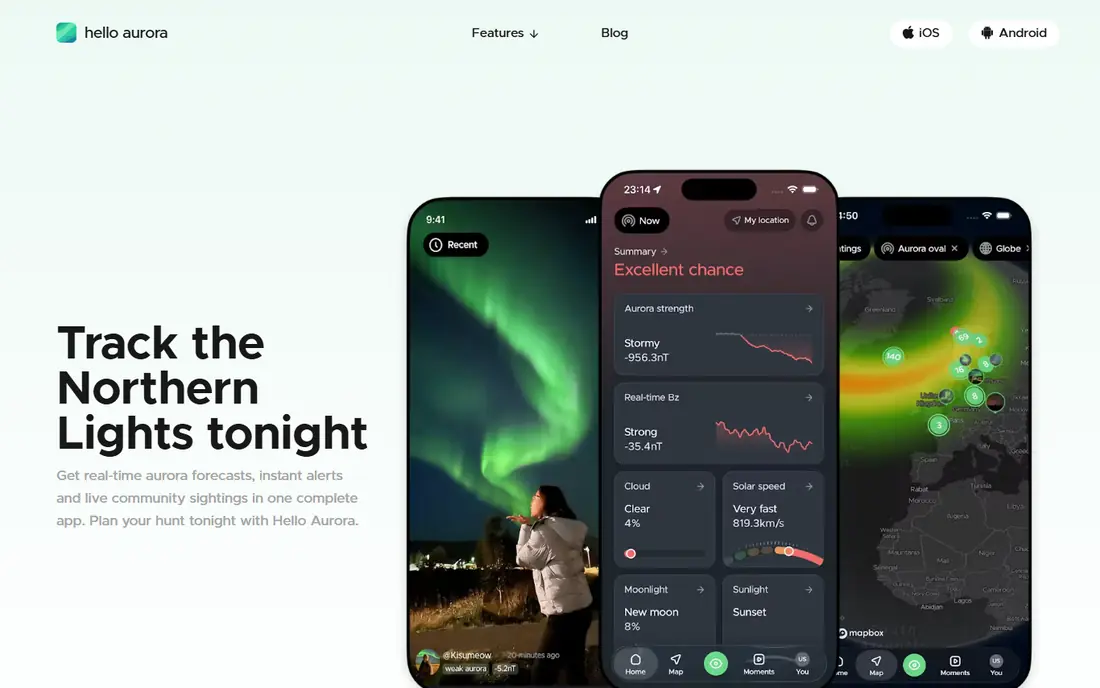
Hello Aurora stands out because it adds people to the forecast. Alongside a location based forecast, it shows sightings reported by other watchers, with photos and locations, so you can see whether the lights are really out near you. Alerts can be set by distance and intensity, which cuts down on alerts for activity far away.
The limit is obvious: on a quiet night in a thinly covered area, there may be few reports to read. The free plan covers the core forecast, alerts and community sightings, while Pro adds extras such as a 3D oval view and unlimited photo sharing. For travellers, the mix of forecast and live reports is hard to beat.
- Live sightings with photos
- Custom alerts by distance and intensity
- Cloud cover on the map
- Community reports depend on other users being out
- Some features need a Pro plan
AuroraWatch UK is run by scientists in the Space and Planetary Physics group at Lancaster University, and that origin shapes the whole service. Instead of relying only on a global index, it watches magnetic disturbance measured in the UK itself, then issues alerts when activity reaches levels where sightings become possible. For viewers in Britain, that local grounding matters.
The service is free and does not sell data or run on advertising revenue. Its weakness is geography: it is built for the UK, so travellers elsewhere need a different tool. Cloud cover, light pollution and your local horizon still decide whether you see anything, even on an alert night.
- Built on UK magnetometer data
- Free service
- Alerts tied to real measured disturbance
- UK only
- An alert does not guarantee a visible display
Aurora Notify is a specialist rather than a global app. It is designed around Fairbanks and interior Alaska activity, and it sends text or email alerts when conditions look promising there. If you live in Alaska or spend weeks there, that local tuning saves you from sorting global forecasts yourself.
Outside Alaska, the same focus becomes a limit. Travellers to Iceland, Norway or Canada will get more from a global forecast app on this list. For a long Alaska stay, though, a plain alert in your inbox at the right hour is exactly the right tool.
- Alerts tuned to Alaska and the interior
- Text or email delivery
- Simple setup
- Narrow geographic focus
- Less useful outside Alaska
The NOAA Space Weather Prediction Center dashboard is the source behind many of the apps on this list, so going straight to it removes one layer of interpretation. Its 30 minute aurora forecast shows the predicted oval, and its wider space weather pages explain the solar activity behind it. It costs nothing and needs no account.
What it lacks is the polish of a consumer app. There are no friendly push alerts tuned to your town, and the pages assume you are comfortable with scientific terms. We suggest bookmarking it as a final check on the night, after an alert app has told you to look up.
- Official OVATION model output
- 30 minute forecast view
- No account needed
- Not a polished consumer app
- No push alerts in the same way as a phone app
Glendale Aurora Alerts, known as the Glendale app, serves UK watchers who want alerts plus a sense of what other people are seeing. It sits in the same useful space as AuroraWatch UK: local alerts for a country where displays are rarer, so a timely warning matters more than a long range guess. The web access keeps it simple when you do not want another app install.
Its scope is the limit. If your trip is to the Arctic, this is not the tool to carry. For a UK based watcher who wants a second alert source beside AuroraWatch UK, it is a sensible backup, and two independent alerts are better than one on a borderline night.
- UK focused alerts
- Live sighting reports
- Simple web access
- UK focus only
- Smaller service than the official dashboards
Nordlysvarsel gives northern lights forecasts for Norway across three horizons: the next three days, the next four hours and the next hour. That layered view helps with both trip planning and the decision to step outside tonight. A three day outlook is useful for choosing which night to keep free, while the one hour view is the one to trust most.
The trade off is focus and honesty about lead time. It is most useful in Norway and nearby regions, and like every forecast here, its longer outlook is a guide rather than a promise. Check it again on the night, and check cloud cover too, before you set out.
- Forecasts for the next three days, four hours and one hour
- Norway focused detail
- Free to use
- Narrower value outside Norway
- Forecast skill falls with lead time
How we picked these
We compared official feature pages, app store listings and public descriptions, and we kept only tools that were live and maintained in October 2026. We favoured tools that state their data source, whether that is a global model, a magnetometer network or community sightings, because a forecast you can trace is easier to trust than a bare percentage. We also mixed simple alert apps with deeper data tools, since beginners and photographers need different things from the same sky.
Choosing the right aurora app
Start with one alert app
Pick one app that will wake you or ping you when activity rises, and let that be your main tool. My Aurora Forecast or Hello Aurora both do this well. Adding three alert apps at once usually means more noise, not better decisions, and you may start to ignore the alerts that matter.
Check cloud and darkness separately
An aurora forecast is only one gate. Cloud cover can hide a strong display, and moonlight or town lights can wash out a faint one. Before you travel, open a local cloud forecast and look for a dark site away from street lights. The best app in this list cannot fix a cloudy sky over your head.
Use a second source on big nights
When an alert arrives, confirm it with a second source, such as the NOAA dashboard or a local magnetometer service. If both agree and the sky is clear, go. If they disagree, trust the live measurement over the long range outlook, and remember that a display can fade and return within the same night.
Set alerts you will actually act on
Set thresholds that match your location and your patience. An alert for every small rise will train you to ignore the app, while a very high threshold may miss a display that is visible from a dark site. Start in the middle, then adjust after a few nights based on what you saw and what you missed.
Frequently asked questions
What is the best aurora app for beginners?
My Aurora Forecast is our pick for most beginners because it shows a plain chance figure, an oval map and free alerts in one readable screen. Hello Aurora is a close second if you also want live sightings from other watchers. Either one works as a first app, and you can add a deeper data tool later.
What is the best northern lights app for forecasts?
For a short range, official check, the NOAA SWPC Aurora Dashboard is hard to beat, since many apps draw on its OVATION model. For a phone friendly forecast with alerts, My Aurora Forecast and Hello Aurora are the more practical daily choices. Use the official dashboard as a confirmation step on the night itself.
What is the best aurora forecast app for the UK?
AuroraWatch UK is the strongest UK choice because its alerts come from magnetometers in the UK itself, run by Lancaster University. Glendale Aurora Alerts is a useful second source for UK watchers. Both are free, and using both on a borderline night gives you a better chance of catching a rare display.
Can an app guarantee I will see the northern lights?
No app can guarantee a sighting. Forecasts deal in probabilities, cloud cover changes quickly, and local light pollution matters a great deal. Treat an app as a timing aid: it tells you when to look, but clear dark skies and patience do the rest of the work.
Do I need a paid aurora app?
Most watchers do not. The free plans on this list cover forecasts, alerts and maps, and the official NOAA dashboard is free. Paid plans mainly add extras such as 3D views, unlimited photo sharing or finer alert controls. Try the free plan first and pay only if one of those extras solves a real problem for you.
Sources
See where you really rank - block by block
ProMapRanker scans Google Maps across a grid of your service area. Simple monthly plans from $19, white-label on every plan.
Start freeKeep reading
 zoho inventory alternatives
6 Alternatives to Zoho Inventory, Compared on Price and Fit
Zoho Inventory alternatives: 6 tools compared on price, free plans and fit. Katana leads the list for manufacturers. Fit and flaws are laid out for each entry.
Read → zoho crm alternatives
Best Zoho CRM Alternatives (2026)
Need Zoho CRM alternatives? We compare 7 tools on cost, free access and who each suits. Every pick gets a straight assessment. Built for quick decisions.
Read → zelle alternatives
Best Zelle Alternatives in 2026
Compare the best Zelle alternatives for sending money to friends, paying sellers and moving funds abroad, with honest notes on fees, speed and safety in 2026.
Read →