 ProMapRanker
Best Apps to Save Money in 2026

Key takeaways
- Acorns and Oportun suit savers who want money moved for them without thinking about it each week.
- Chime, SoFi, and Ally Bank suit savers who want a bank account that also pays interest on savings.
- Qapital suits goal-based savers who like rules, such as saving a set amount on payday or when they skip a purchase.
- Fees matter more than small rate differences for small balances, so check monthly charges before you pick.
Quick comparison
| Pick | Great for | Pricing starts at | Free tier | |
|---|---|---|---|---|
 Acorns | Round-ups and automatic investing | $4 per month | No | Visit |
 Oportun Set and Save | Hands-off automatic saving | $5.99 per month | Free trial | Visit |
 Chime | Free banking with automatic saving | Free | Yes | Visit |
 SoFi | High-yield banking and automation | Free | Yes | Visit |
 Ally Bank | High-yield savings buckets | Free | Yes | Visit |
 Qapital | Goal-based saving rules | See website | No | Visit |
 Rocket Money | Saving plus subscription control | See website | Yes | Visit |
 Current | Round-ups into savings pods | Free | Yes | Visit |
 Raisin | High-yield accounts from partner banks | Free | Yes | Visit |
The best apps to save money
This is not financial advice. Savings rates and terms change, and investing apps can lose value. Check the current rate, fees, and bank partner disclosure for any app before you move money, and keep emergency savings in an account you can reach quickly.

Acorns rounds up card purchases to the next dollar and invests the spare change, with an option for recurring deposits. That habit works well for people who struggle to save a lump sum but can spare small amounts often. The app keeps the process simple, which is the point for beginners.
The catch is the fee and the risk. A monthly charge eats into small balances, and investments are not savings accounts, so value can drop. Treat Acorns as a long-term investing habit, not as a safe place for rent money or an emergency fund.
- Automatic round-ups
- Recurring investments
- Simple portfolio options
- Monthly fee can outweigh gains on tiny balances
- Invested money can fall in value
Oportun Set and Save, formerly Digit, moves varying amounts into savings based on your cash flow, with a floor you set so it does not pull money you need for bills. Unlimited goals help separate an emergency fund from holiday or car savings. For uneven income, the varying amount can be more realistic than a fixed transfer.
The fee is the main question. At $5.99 per month, it costs about $72 a year, so it only makes sense if automation truly changes your behavior. If you can set a free recurring transfer on payday, a bank account will do the same job for less.
- Automatic transfers based on cash flow
- Multiple goals
- Balance floor controls
- Monthly fee
- Savings held at partner banks with no interest listed on the product page we checked
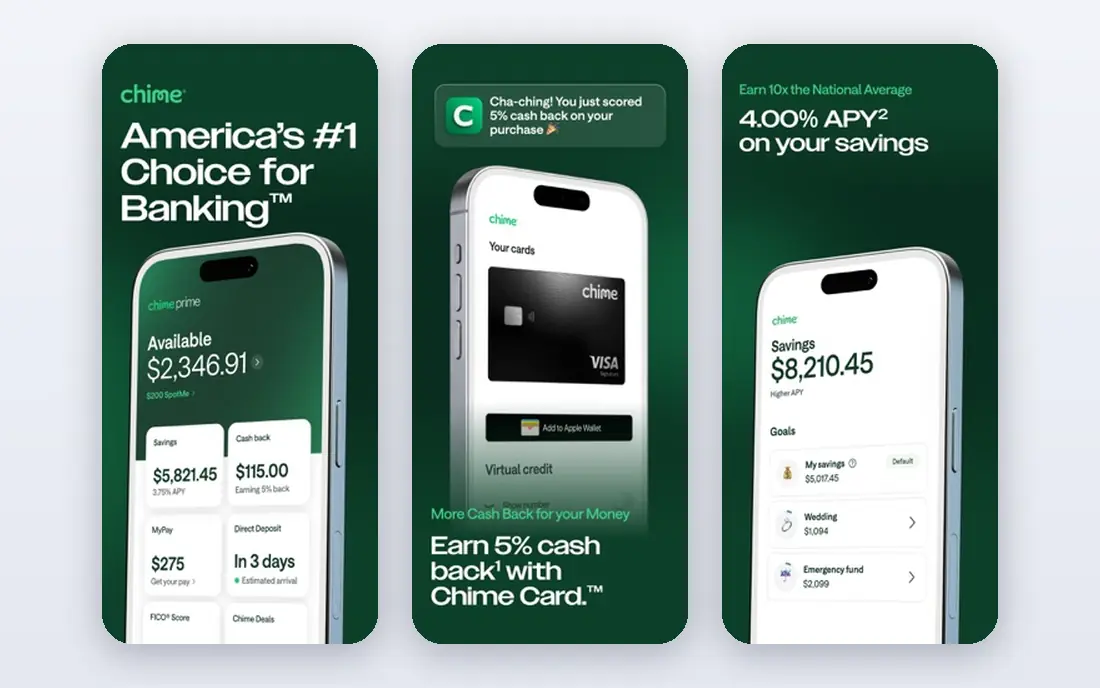
Chime is a financial technology company, not a bank itself. Banking services are provided by partner banks, and Chime discloses that deposit accounts are FDIC-insured through those partners up to the legal limit. Its saving tools are simple: round up purchases, or move a percentage of each paycheck into savings automatically.
That simplicity is ideal for everyday savers who want banking and saving in one app. It is less suited to savers who want branch service or complex account types. Check the current savings rate terms, since the top rate usually requires qualifying direct deposit.
- No monthly fees on core accounts
- Round-Ups and Save When You Get Paid
- Early direct deposit features
- Online-only support model
- Savings rate depends on qualifying direct deposit
SoFi combines checking, savings, and investing in one app, with vaults that let you split savings by goal. Automatic transfers on payday make saving the default rather than a decision you revisit each month. For savers who want one app for banking and a high-yield account, that combination is convenient.
SoFi is a bank holding company with SoFi Bank as its banking arm, and deposits are FDIC-insured up to the legal limit. As with other high-yield accounts, the advertised rate is variable and can change. Read the direct deposit terms before assuming you will earn the top rate.
- No account fees on checking and savings
- Automated transfers
- Vaults for goals
- Top savings rate usually requires direct deposit
- Investing products carry risk
Ally Bank is an FDIC-insured online bank with no monthly maintenance fees and no minimum balance on its savings account. Savings buckets let you track several goals inside one account, which keeps things tidy without opening many accounts. Recurring transfers and round-ups cover the basic automation most savers need.
It will not move money based on cash flow the way Oportun does, and it lacks some of the rule-based tricks in Qapital. For savers who value a straightforward, high-yield account from an established bank, that trade is often worth it.
- No monthly maintenance fees
- Savings buckets for goals
- Established online bank
- No branches
- Automation is simpler than specialist saving apps
Qapital lets you build rules around your own behavior, such as saving a set amount each payday, when you buy coffee, or when you hit a step goal. Visual goals and progress tracking help savers who need a clear target to stay motivated. Joint goals make it useful for couples saving for a shared trip or deposit.
Because Qapital is not itself a bank, savings sit with partner banks, and FDIC pass-through coverage depends on that arrangement. Check the current plan price and bank disclosure before signing up, since both have changed over time. It suits habit-driven savers more than rate chasers.
- Flexible saving rules
- Visual goals
- Joint goals for couples
- Paid plans for full features
- Funds held at partner banks, so check current disclosures
Rocket Money started as a subscription manager and added automatic saving, so it suits people whose main leak is recurring charges. Seeing subscriptions, bills, and savings in one place can free up money to save, even before automation starts. Its autopilot-style transfers move small amounts on a schedule you approve.
The free tier covers basic tracking, while premium saving and bill negotiation features cost more. If you only want a savings account, a bank app will be simpler. If subscriptions are eating your budget, Rocket Money tackles the cause as well as the habit.
- Automatic saving transfers
- Subscription tracking
- Bill review tools
- Premium features are paid
- Saving rate and account terms vary
Current offers Savings Pods that separate money by goal, plus Round-Ups that move spare change from debit purchases into a pod. That visual separation helps savers who mix spending and saving in one account and lose track of what is set aside. The app is built around everyday banking, so saving sits next to spending rather than in a separate tool.
Current is a financial technology company, and banking services are provided by partner banks, with FDIC insurance through those partners up to the legal limit. Check the current pod bonus terms, since bonus rates often require direct deposit or other qualifying activity.
- Savings Pods for goals
- Round-Ups on debit purchases
- No charge listed for pods
- Bonus rate terms apply
- Banking services via partner banks
Raisin is a marketplace rather than a single bank account. You compare savings products from partner banks, open an account through Raisin, and manage it from one dashboard. That makes it easy to chase a better rate without opening a new app for each bank, and partner deposits are FDIC-insured up to the legal limit per bank.
It does not automate saving in the way Acorns or Oportun do. You still need to set a recurring transfer or move money yourself. For rate-focused savers who are comfortable managing a marketplace account, it is a practical way to find a higher yield.
- Compare partner bank savings products in one place
- No platform fees listed
- FDIC-insured partner banks
- Rate depends on the partner product you pick
- Not an automatic saving app
How we picked these
We compared official pricing, fee pages, bank partner disclosures, and feature pages for saving apps that are live in the United States in October 2026. We favored apps with clear FDIC pass-through or partner bank disclosure where relevant, and we noted where an app invests money rather than holding it as savings. We did not include apps we could not confirm as currently available.
How to pick a saving app that actually sticks
Start with the friction that stops you now. If you never get around to transferring money, pick automation first, whether that is round-ups, payday transfers, or cash-flow-based moves. If you save but then spend it, pick goal separation, such as buckets or pods, so saved money is visible and harder to dip into by accident.
Next, compare the total cost, not just the rate. A $4 to $6 monthly fee can wipe out interest on a small balance, while a free high-yield account keeps every dollar of interest. For balances under a few hundred dollars, a free account with a modest rate often beats a paid app with a higher headline rate.
Finally, keep your emergency fund separate from investing. Money you may need in the next few months belongs in an insured savings account you can withdraw quickly. Investing apps suit long-term goals where you can ride out a fall in value. Mixing the two is the most common mistake we see in saving app choices.
Frequently asked questions
What is the best app to save money automatically?
Acorns suits round-up savers, Oportun suits hands-off cash-flow saving, and Chime or SoFi suit payday automation inside a bank account. Pick based on whether you want investing, pure saving, or banking in the same app.
Which saving app pays the most interest?
Rates change often, so no single app holds the top rate for long. SoFi, Ally Bank, and Raisin partner products are often competitive, but check the current rate and direct deposit terms on the day you open an account.
Are saving apps FDIC-insured?
Bank accounts are FDIC-insured up to the legal limit. Fintech apps such as Chime and Current rely on partner banks for that coverage, so check the partner disclosure. Investing apps such as Acorns are not FDIC-insured, since investments can lose value.
Is Acorns better than a high-yield savings account?
They serve different goals. Acorns invests spare change for long-term growth, while a high-yield account holds cash safely and pays interest. Many savers use both: a savings account for emergencies and Acorns for long-term investing.
Can I save money with no fees?
Yes. Chime, SoFi, Ally Bank, Current, and Raisin list no monthly fee for their core saving products. Paid apps only make sense if their automation truly helps you save more than the fee costs.
How much should I save each month?
A common starting point is a small payday transfer you will not miss, then raising it after a month if it felt easy. Even a modest automatic transfer beats a large plan you cancel after two weeks.
Sources
See where you really rank - block by block
ProMapRanker scans Google Maps across a grid of your service area. Simple monthly plans from $19, white-label on every plan.
Start freeKeep reading
 zoho inventory alternatives
6 Alternatives to Zoho Inventory, Compared on Price and Fit
Zoho Inventory alternatives: 6 tools compared on price, free plans and fit. Katana leads the list for manufacturers. Fit and flaws are laid out for each entry.
Read → zoho crm alternatives
Best Zoho CRM Alternatives (2026)
Need Zoho CRM alternatives? We compare 7 tools on cost, free access and who each suits. Every pick gets a straight assessment. Built for quick decisions.
Read → zelle alternatives
Best Zelle Alternatives in 2026
Compare the best Zelle alternatives for sending money to friends, paying sellers and moving funds abroad, with honest notes on fees, speed and safety in 2026.
Read →