 ProMapRanker
Best Apps for Identifying Birds in 2026


beginners and all-round identification · Pricing starts at: Free
Key takeaways
- Merlin Bird ID is the best app for identifying birds for most people, since it offers photo ID, sound ID and a step-by-step guide in one free app.
- BirdNET is the strongest sound-only choice, with detailed confidence scores for songs and calls, while Picture Bird suits photo-first users who want a polished interface.
- Offline field guides such as iBird Pro and Audubon Bird Guide matter on trails without signal, so download packs or guides before you leave home.
- No app is always right, so confirm a suggestion against size, shape, colour, location and season before you record it as a sighting.
Quick comparison
| Pick | Great for | Pricing starts at | Free tier | |
|---|---|---|---|---|
| Merlin Bird ID | beginners and all-round identification | Free | Yes | Visit |
 BirdNET | identifying birds by song and call | Free | Yes | Visit |
 Picture Bird | photo-first identification with rich profiles | See website | Yes | Visit |
 Audubon Bird Guide | free North American field guide | Free | Yes | Visit |
 eBird | logging sightings and finding hotspots | Free | Yes | Visit |
 iBird Pro | serious offline field guide use | $14.99 | No | Visit |
 Song Sleuth | learning bird songs in depth | $9.99 | No | Visit |
 Seek by iNaturalist | families and general nature identification | Free | Yes | Visit |
 ChirpOMatic | quick sound identification on the go | See website | No | Visit |
The best apps for identifying birds
A good bird identification app does more than name a bird. It narrows the options by your location and the time of year, shows photos and sounds for comparison, and helps you learn field marks for next time. The apps below cover photo ID, sound ID, field guides and logging, so you can pick one main app and add a second for the job your main app handles less well.
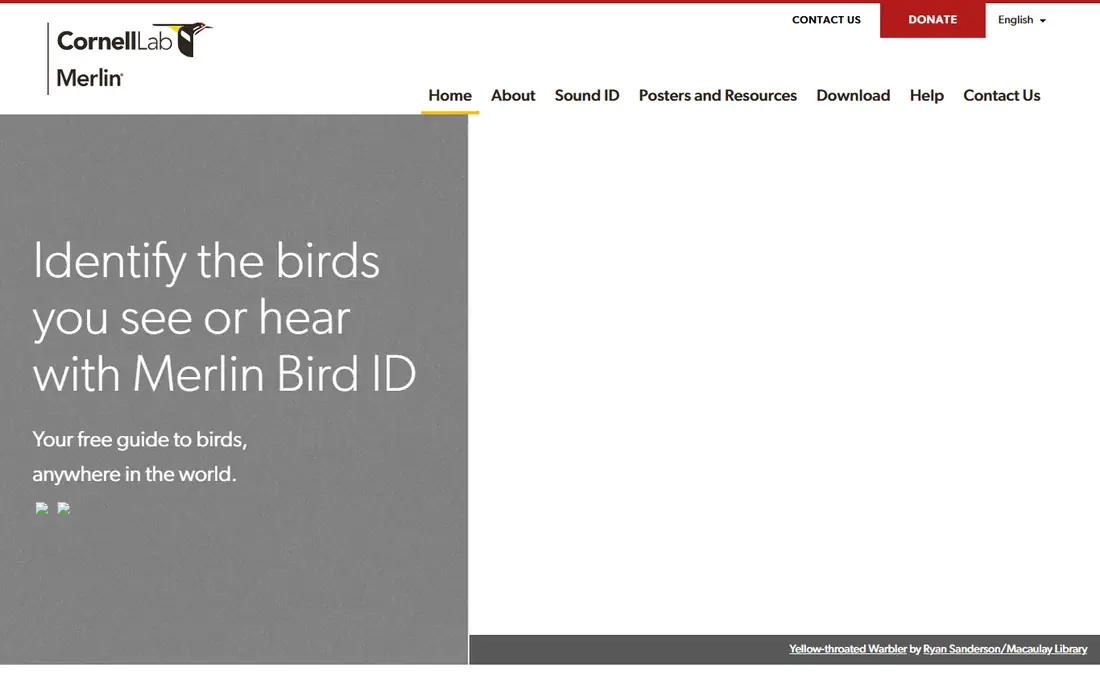
Merlin, from the Cornell Lab of Ornithology, is our pick for most people because it covers the three common identification paths in one place. If you saw the bird, answer a few questions about size, colour and behaviour. If you photographed it, use Photo ID. If you only heard it, open Sound ID and let it list likely species in real time. That range means one app covers a garden walk, a park visit and a trail hike.
Download a bird pack for your region before you travel, since packs include photos, sounds and range maps for offline use. Merlin also links to eBird data, which helps it favour species likely in your area on that date. Treat its top suggestion as a starting point, then check the photos and sounds against what you actually saw and heard.
- Photo ID, sound ID and step-by-step ID in one app
- Free with no paywall for core features
- Offline bird packs for travel
- Sound ID needs a reasonably clear recording
- Photo ID works best with a clear, close photo
- Coverage varies by region
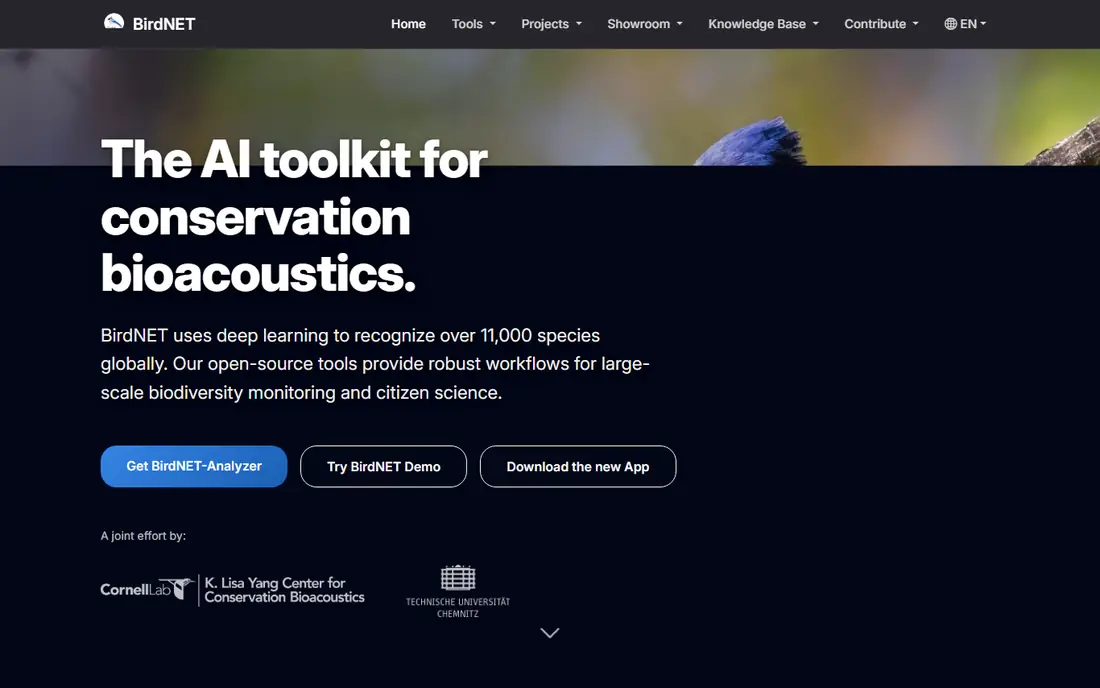
BirdNET is the app to open when you hear a bird but cannot see it. Record a short clip, and the app analyses the sound and ranks likely species with a confidence score. That score is useful, since a high score on a clear recording means more than a low score on a noisy one. BirdNET also works offline once the model is downloaded, which helps on remote walks.
The trade is scope. BirdNET does not identify photos, and it does not offer the same guided field guide experience as Merlin. Use it beside Merlin: let BirdNET handle the dawn chorus, then confirm the bird in Merlin or a field guide. If you record at night, point the phone toward open sky and keep handling noise low for a cleaner result.
- Focused sound identification from Cornell and Chemnitz University
- Shows confidence scores for each match
- Recordings support research
- No photo identification
- Background noise can confuse results
- The interface is more research-like than Merlin
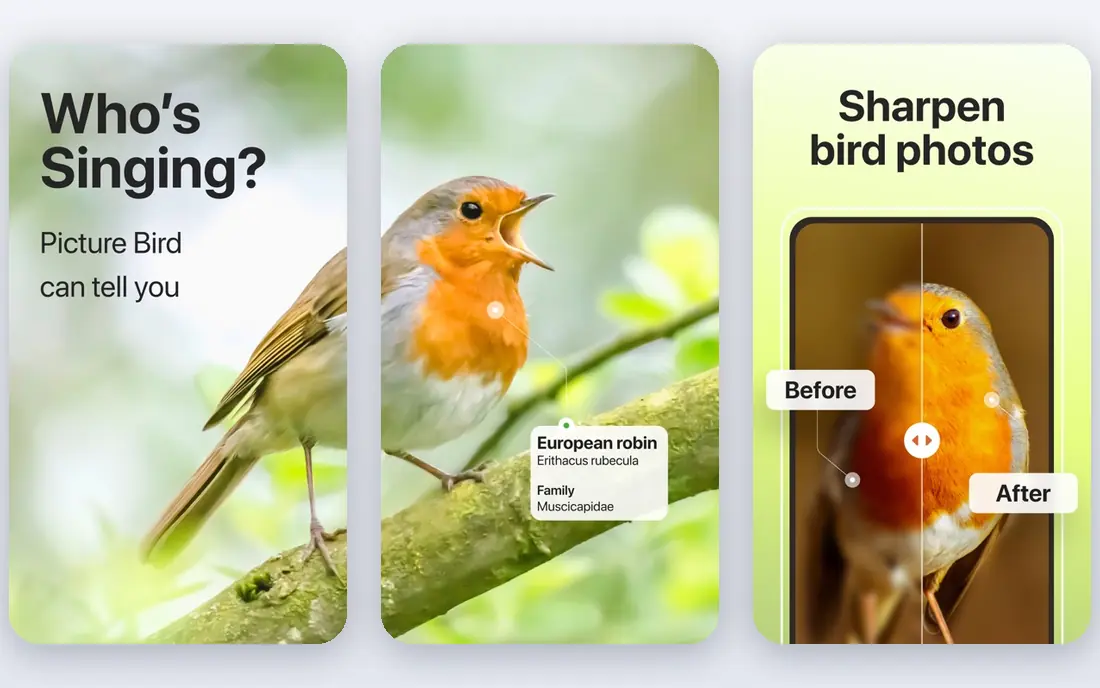
Picture Bird suits people who mainly photograph birds and want a quick, attractive answer with a species profile to read. The interface is simpler than a full field guide, and the collection feature lets you keep a visual record of birds you have identified. That makes it a pleasant companion for garden birding and casual walks.
The cost is the main question. Core identification is available free with limits, but regular use pushes you toward a subscription, so check the current price in the app store before you rely on it daily. If you want a free long-term tool, Merlin covers the same photo job at no cost, though with a plainer design.
- Fast photo identification with a clean interface
- Detailed species profiles and a personal collection
- Sound identification is also offered
- Full use requires a paid subscription
- Free use is limited
- Less depth for logging and citizen science than Merlin and eBird
The Audubon Bird Guide works as a pocket field guide rather than an AI identifier. Search by shape, colour and habitat, compare similar species side by side, and listen to songs and calls to confirm a guess. That comparison step is valuable when two species look alike, such as Downy and Hairy Woodpeckers, since the app lets you study field marks instead of accepting one answer.
Audubon also includes conservation news and birding articles, which suit readers who want context beyond identification. It does not replace Merlin for instant photo or sound ID, but it pairs well with it. Use Merlin for the first suggestion, then open Audubon to compare the bird against its closest lookalikes.
- Free guide to more than 800 North American species
- Photos, range maps and sounds in one place
- Articles and birding tips included
- Identification is guide-based rather than AI photo or sound ID
- North American focus limits use elsewhere
- Some users prefer a paid guide for depth
eBird is not an identifier in the same sense as Merlin, but it completes the identification workflow. Once you have a likely species, eBird shows whether other birders have reported it nearby and recently, which is a strong reality check. It also lets you log checklists, build a life list and explore hotspots before a trip, so you arrive with a shortlist of likely birds.
The quality of eBird depends on careful use. Only report a bird when you are confident, and note how you identified it if the sighting is unusual. Used well, eBird turns a single identification into a record you can revisit, and it helps the wider birding community track migration and range changes.
- Free checklists, life lists and hotspot maps
- Data supports Cornell Lab research
- Helps confirm what is likely nearby
- Not a photo or sound identifier on its own
- Checklist entry takes care to do well
- Hotspot data varies by region
iBird Pro is the paid field guide for birders who want depth without a signal. It includes detailed illustrations, multiple photos per bird, songs and calls, and tools for comparing two species on size, shape and markings. That depth matters for tricky groups such as warblers, sparrows and gulls, where a single photo rarely settles the question.
The price is a one-time purchase rather than a subscription, which suits people who dislike recurring charges. Casual birders may find Merlin and Audubon enough, but if you bird in remote areas or you want a single offline reference, iBird Pro earns its place. Download and explore it at home first, so the layout feels familiar in the field.
- Covers more than 1,000 species with illustrations and photos
- Works fully offline
- Comparison tools highlight differences between similar species
- One-time price is higher than free guides
- Interface feels dense for casual users
- Identification is guide-based, not AI-driven
Song Sleuth is for birders who want to understand songs, not just name them. It records a song, shows a spectrogram, and lets you compare your recording against reference songs. That visual view helps you learn patterns such as trills, pitch changes and repeated phrases, which makes the next song easier to recognise by ear.
For most users, Merlin Sound ID or BirdNET will answer the question faster and free. Song Sleuth earns its price when you are studying ear identification seriously, or when you want to check a difficult recording in detail. Think of it as a learning tool first and a quick identifier second.
- Detailed spectrograms show how a song is structured
- Side-by-side comparison with reference songs
- Tutorials explain spectrogram reading
- Paid app with no free tier
- IPhone focus limits Android users
- More detail than casual users need
Seek suits a walk where birds are only part of the interest. Point the camera at a bird, plant or insect, and Seek suggests an identification, then logs the observation as a challenge. That breadth makes it a good first app for children and for families who want one nature app rather than several specialist tools.
Do not rely on Seek alone for a tricky bird. Its bird coverage is broader than it is deep, and it lacks sound ID, so a heard-only bird will stay unidentified. Pair Seek with Merlin when birds are the main goal, and let Seek handle the wider nature walk around them.
- Free and easy to use
- Identifies birds beside plants, insects and other wildlife
- Challenges and badges keep younger users engaged
- Bird identification is less specialised than Merlin or BirdNET
- No sound identification
- Accuracy varies for similar species
ChirpOMatic is a compact sound identifier that focuses on one job: hear a bird, get a likely name quickly. Its sensitivity helps with faint or distant songs, and the simple workflow suits a walk where you do not want to manage packs, checklists or settings. Some birders keep it as a second opinion when Merlin and BirdNET disagree.
The paid price means it is hard to recommend as a first app when two strong free sound tools exist. It makes sense as a backup for keen birders, or for users who prefer its simpler interface. As with every sound app, confirm the result with the bird's appearance, habitat and season before you log it.
- Sensitive sound detection for quick field use
- Simple workflow for a fast answer
- Useful when Merlin sound ID is uncertain
- Paid app with no free tier
- Narrower feature set than Merlin
- Results still need confirmation against field marks
How we picked these
We compared official product pages, app store listings and public birding guides for each app, and we kept only apps that are actively offered for bird identification in October 2026. We weighed photo ID, sound ID, offline use, species coverage, price and citizen science value, rather than store ratings alone. We did not claim hands-on testing, and prices are shown as See website where the app store price varies by region or plan.
How to get a reliable identification
Start with the best evidence you can collect. A clear photo of the whole bird, a clean sound recording, and notes on size, shape, colour, behaviour and habitat will beat any single guess. Use location and date as filters, since many similar species do not overlap in range or season. If two apps disagree, compare their top suggestions side by side and look for the field mark that separates them.
Next, learn one new mark per outing rather than trying to memorise a whole guide. Notice bill shape, wing bars, tail pattern or song rhythm, and check that mark on your next walk. Keep a simple log in eBird or in your chosen app, and review it at home against a field guide. Over a season, that habit builds identification skill faster than collecting app answers alone.
Frequently asked questions
What is the best app for identifying birds?
Merlin Bird ID is the best app for identifying birds for most people, since it combines photo ID, sound ID and a step-by-step guide in one free app. BirdNET is a strong second choice for sound-only identification, and Picture Bird suits photo-first users who prefer a polished interface. Start with Merlin, then add a second app for the job you do most.
Can I identify birds by sound for free?
Yes, both Merlin Sound ID and BirdNET offer free sound identification, and both work offline once the relevant packs or models are downloaded. Record in a quiet spot, hold the phone steady, and keep the clip short and clear for the best result. Confirm the suggestion against the bird's appearance and location before you record it.
Do bird identification apps work offline?
Merlin works offline once you download a bird pack for your region, BirdNET works offline once its sound model is downloaded, and iBird Pro is built for offline use. Picture Bird and eBird need a connection for some features, so download packs and guides on Wi-Fi before a remote trip. Check storage space, since bird packs can be large.
Are bird identification apps accurate?
They are often accurate for clear photos and clean recordings of common species, but they can be wrong with distant birds, noisy recordings or similar species. Use the app suggestion as a starting point, then check field marks, range, season and behaviour. If you are unsure, do not report the bird as a confirmed sighting.
What is the best free bird identification app?
Merlin Bird ID is the strongest free option, with photo ID, sound ID and a step-by-step guide at no cost. Audubon Bird Guide is also free and works well as a North American field guide, while eBird is free for logging and hotspot research. A combination of Merlin and eBird covers most birding needs without paying.
Sources
See where you really rank - block by block
ProMapRanker scans Google Maps across a grid of your service area. Simple monthly plans from $19, white-label on every plan.
Start freeKeep reading
 zscaler alternatives
Best Zscaler Alternatives in 2026
Looking for zscaler alternatives? We compare 9 SASE and zero trust platforms on architecture, data protection, pricing, and fit for your network and team.
Read → zapier alternatives free
Best Zapier Alternatives Free in 2026
Nine automation tools for zapier alternatives free in 2026, all with genuinely free tiers, plus free plan limits, starting prices and upgrade paths explained.
Read → which platform is best for online reputation
Which Platform Is Best for Online Reputation in 2026
Wondering which platform is best for online reputation? We compare 8 review, listing, and response tools for small and multi-location businesses and agencies.
Read →