 ProMapRanker
Best Apps for Business Travel in 2026

Key takeaways
- Navan and Perk lead for growing companies that want booking, policy and expense in one app.
- SAP Concur and Egencia suit large enterprises with complex approval, reporting and duty-of-care needs.
- Ramp and Brex suit finance-led teams that want travel tied to cards, budgets and expense automation.
- TripIt remains the best pure itinerary app for travelers who book across many sites.
- Price the whole trip cost, including booking fees and support, not just the platform subscription.
Quick comparison
| Pick | Great for | Pricing starts at | Free tier | |
|---|---|---|---|---|
 Navan | Travel and expense in one app | Free | Yes | Visit |
 Perk | Flexible booking for growing firms | Free | Yes | Visit |
 SAP Concur | Large enterprise travel programs | See website | No | Visit |
 Egencia | Managed travel for global firms | See website | No | Visit |
 Spotnana | Modern booking with deep content | See website | No | Visit |
 TravelBank | Finance-led small and mid-size firms | See website | Free trial | Visit |
 Ramp | Card-led travel and spend control | Free | Yes | Visit |
 Brex | Startups and finance-led teams | Free | Yes | Visit |
 TripIt | Itineraries across booking sites | See website | Yes | Visit |
The best apps for business travel
We compared official product and pricing pages for apps that book, manage or organize business trips. These nine cover full travel platforms, card-led spend tools and a dedicated itinerary app, so both travel managers and frequent travelers can find a fit.
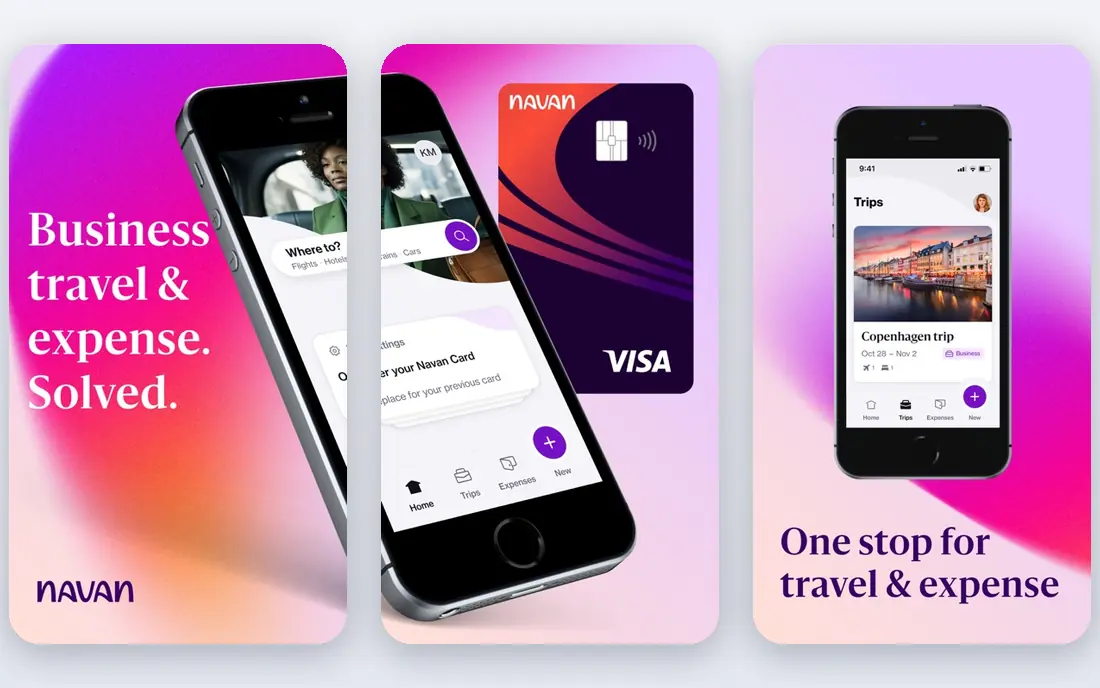
Navan, formerly TripActions, suits companies that want travelers to book in policy without a separate expense chase afterward. Business travel is free for eligible firms, while expense use is free for up to 5 active users and then $15 per active user per month. Travelers book flights, hotels and cars in one app, and managers see spend and policy compliance in the same place.
The catch is the split between travel and expense pricing. A firm that needs expense for the whole team should model that per-user cost, not just the free travel tier. For firms that book often and want one app for the trip and the receipt, Navan is a strong default.
- Booking, cards and expense in one system
- Policy controls at booking
- 24/7 travel support
- Expense features beyond a small free allowance cost extra
- Enterprise needs custom pricing
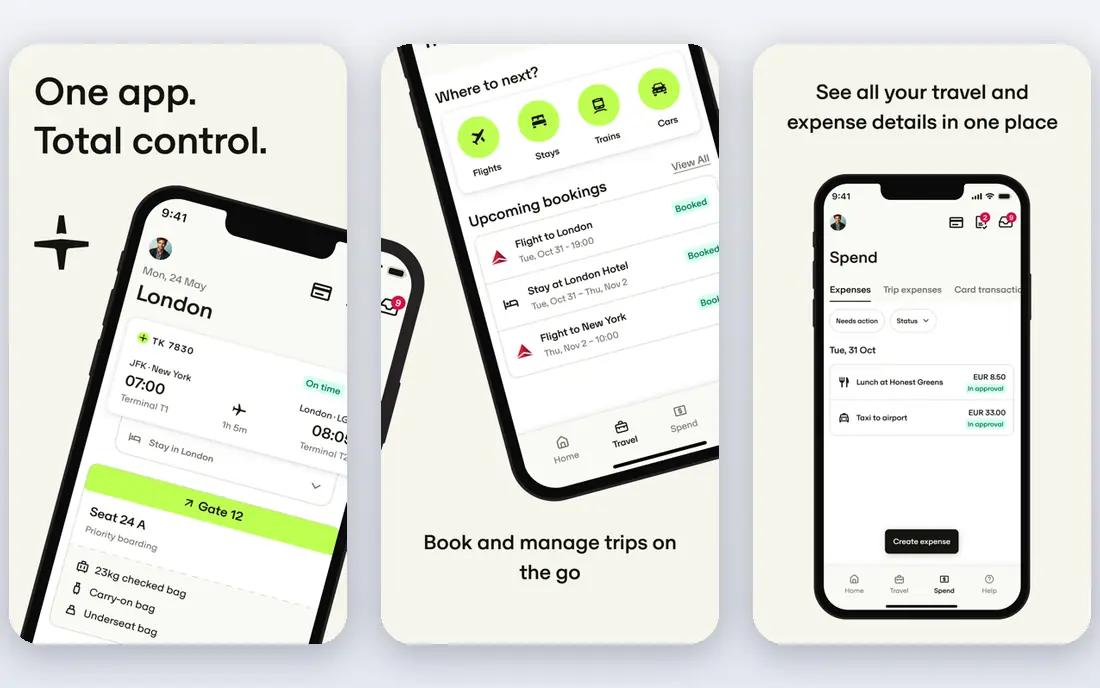
Perk, formerly TravelPerk, fits growing companies that want flexible booking without a heavy enterprise contract. The Starter tier is free with a per-booking fee, while paid tiers add lower booking fees and deeper controls. Flexible cancellation options help when plans change, which is a common pain for small teams booking close to departure.
Volume is the trade-off. Per-booking fees look small on one trip and large across hundreds of trips, so high-volume firms should compare paid tiers and negotiated rates. For a growing firm that values flexibility and a clean interface, Perk is easy to start and easy to explain to travelers.
- Free Starter tier
- Flexible cancellation options
- Modern booking interface
- Per-booking fees add up at high volume
- Premium tiers raise monthly cost
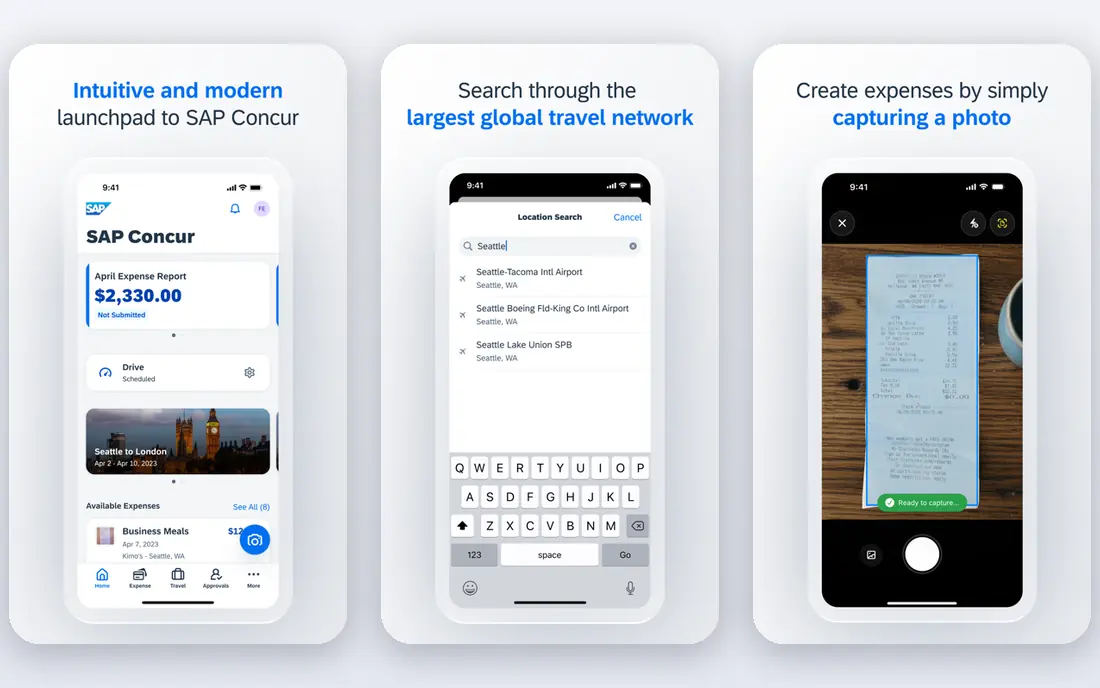
SAP Concur remains the enterprise standard for companies with complex travel programs. Travel booking, expense reporting, approvals and invoice handling connect to SAP and other ERP systems, and global reporting covers policy, spend and compliance in detail. For a multinational with many entities and approval layers, that depth matters more than a slick mobile screen.
The drawback is rollout effort. Configuration, policy setup and training take longer than a self-serve platform, and pricing is custom for travel programs. Firms already on SAP get the most value. Firms with simple needs will move faster on Navan or Perk.
- Deep travel, expense and invoice controls
- Strong ERP integration
- Global reporting
- Implementation takes time
- Interface feels dated to some users
Egencia, part of American Express Global Business Travel, suits global firms that want human travel support alongside online booking. Travel consultants help with complex itineraries, disruptions and group travel, while the platform handles policy, approvals and reporting. Duty-of-care features help travel managers locate travelers during disruptions.
Custom pricing and a managed-service model make it a poor fit for a small firm that just needs an app. For a global program with high travel volume, complex routes and a need for round-the-clock human help, Egencia offers a level of service that self-serve apps do not.
- Managed travel service with consultants
- Global coverage
- Duty-of-care tools
- Pricing is custom
- Less self-serve than newer platforms
Spotnana is a newer travel platform built for companies that want a modern booking experience without giving up enterprise controls. It offers broad flight, hotel and car content, policy enforcement, approvals and reporting, with a design that feels closer to a consumer booking site than a legacy corporate tool. That balance appeals to mid-size and large firms refreshing an older program.
The limits are maturity and pricing transparency. Pricing is custom, and the partner and integration ecosystem is still growing compared with Concur and Egencia. Firms should trial it on real routes, including complex multi-city trips, and confirm support coverage for their main travel regions.
- Modern booking experience
- Broad travel content
- Policy and reporting tools
- Pricing is custom
- Smaller partner ecosystem than Concur or Egencia
TravelBank suits finance-led small and mid-size firms that want travel and expense without enterprise complexity. Teams can book travel, track expenses and manage budgets in one system, and the platform can reward travelers for booking under budget. That incentive model helps firms that want cost control without strict, unpopular rules.
Enterprise depth is thinner than SAP Concur or Egencia, especially for global programs with many entities. Pricing varies by plan and scope, so ask for a quote tied to traveler count and expense volume. For a firm of 10 to 100 travelers, TravelBank hits a practical middle ground.
- Travel and expense in one finance-friendly tool
- Budgeting and rewards for savings
- Simple setup
- Pricing varies by plan
- Enterprise depth is thinner than Concur
Ramp starts from spend management, which makes it a good fit for finance teams that want travel inside the same controls as cards and expenses. The core plan is free, with a paid Plus tier for deeper features. Travel bookings flow into expense and accounting data, so finance teams spend less time matching receipts to trips.
Travelers who need complex managed-travel support may find Ramp thinner than Egencia or Concur. It is best for firms that already use Ramp cards or want one finance system, rather than firms whose main need is a travel agency. Check which travel features sit on each tier before switching a whole program.
- Free core plan
- Corporate cards with controls
- Travel booking tied to spend data
- Travel is part of a broader spend platform, not a standalone travel agency
- Some features need paid tiers
Brex suits startups and finance-led teams that want cards, travel booking and expense in one account. The Essentials plan is free, with a Premium tier at $12 per user per month for deeper software features. Setup is fast, and spend controls help young companies set budgets without a long implementation.
The trade-off mirrors Ramp: travel is one part of a finance platform, not a full managed-travel service. Complex global programs, group travel and heavy duty-of-care needs may still call for Egencia or Concur. For a startup scaling travel from zero, Brex gives control without an enterprise contract.
- Free Essentials plan
- Cards, travel and expense together
- Fast setup for startups
- Travel depth varies by plan
- Larger enterprises may need a dedicated travel platform
TripIt is different from the rest of this list: it does not book travel, it organizes it. Travelers forward booking confirmations, and TripIt builds a single itinerary with flights, hotels, cars and maps. That makes it ideal for travelers who book across many sites, use loyalty programs directly, or travel for firms without a managed booking tool.
Its limit is also its design. TripIt cannot enforce company policy, approve trips or report company spend, so travel managers should pair it with a booking or expense platform. For individual travelers and small firms, the free tier covers the core itinerary job well, and the paid tier adds alerts and extras.
- Builds one itinerary from forwarded confirmations
- Works across airlines, hotels and cars
- Simple traveler app
- Does not book or enforce company policy on its own
- Premium features need a paid plan
How we picked these
We compared official product and pricing pages, booking and expense features, and traveler tools for apps current in October 2026. To qualify, a product had to help with business travel in a concrete way: booking, policy and expense management, managed travel support, or itinerary organization. We kept prices as See website where vendors quote or price by program scope, rather than printing unverified figures.
How to choose a business travel app
Start with who controls the trip. If finance needs spend control, Ramp and Brex lead. If travel managers need policy and duty of care, Navan, Perk, Concur and Egencia lead. If travelers mainly need one itinerary, TripIt leads. That owner question narrows the list faster than a feature checklist.
Policy, support and total cost
Test booking on real routes your team flies, including multi-city trips, cancellations and changes. Check support hours and response times, since a travel problem at midnight matters more than a dashboard. Add booking fees, card fees and expense seats to the platform price, and compare the total at your actual trip volume.
Adoption and reporting
Pick the booking path travelers will use without prompting: a mobile app, a web portal or an agent phone line. Run a pilot with one team, track out-of-policy bookings and support tickets, and check whether reporting shows spend by team, project and traveler. A platform that travelers bypass will not improve policy compliance, no matter how good its controls look.
Frequently asked questions
What is the best app for business travel?
Navan leads for companies that want booking and expense in one app, while Perk leads for flexible booking at growing firms. SAP Concur and Egencia lead for large enterprises. The best pick depends on company size, policy needs and support expectations.
What is the best business travel software for small companies?
Navan and Perk are the strongest small-company picks, thanks to free starting tiers and self-serve setup. Ramp and Brex also suit small finance-led teams. Avoid enterprise platforms until trip volume and policy complexity justify a custom contract.
What is the best travel itinerary app for business trips?
TripIt is the best pure itinerary app, since it builds one trip plan from confirmations across airlines, hotels and car providers. Navan and Perk also show itineraries, but only for trips booked inside their platforms. Travelers who book in many places should use TripIt alongside a booking tool.
What is the best business travel platform for expense management?
Navan, Ramp and Brex lead here, since travel bookings flow into expense and accounting data in the same system. SAP Concur also covers expense deeply for enterprises. Check whether expense seats are free or paid, since that cost changes the total quickly.
Do business travel apps save money?
They can, through policy controls, negotiated rates, under-budget incentives and clearer spend data. Savings depend on trip volume, policy enforcement and traveler adoption. A platform that travelers bypass will not save money, so pilot with one team and measure out-of-policy bookings before rollout.
Sources
See where you really rank - block by block
ProMapRanker scans Google Maps across a grid of your service area. Simple monthly plans from $19, white-label on every plan.
Start freeKeep reading
 who has the best home internet service
Who Has the Best Home Internet Service in 2026
Who has the best home internet service in 2026? Compare fiber, cable, and 5G providers on speed, price, data caps, and availability at your address today.
Read → visio alternatives
Best Visio Alternatives in 2026
Compare 9 Visio alternatives for flowcharts, org charts, and network diagrams, with free plans, pricing, and the best pick for teams and solo users in 2026.
Read → top 10 logistics software
Top 10 Logistics Software in 2026
We compared the top 10 logistics software tools for transport, warehousing, visibility and shipping, for shippers, carriers and 3PL teams in 2026 today.
Read →