 ProMapRanker
Best App to Trade Stocks in 2026

Key takeaways
- The best app to trade stocks for most beginners is Fidelity, with $0 stock and ETF commissions, fractional shares from $1, and strong research.
- Robinhood is the simplest first app, while Webull suits traders who want charts and paper trading from the start.
- Charles Schwab suits investors who want education and the thinkorswim platform, and Interactive Brokers suits traders who need global markets.
- Commission-free does not mean cost-free, since options fees, spreads, transfer fees, and cash sweep terms still vary.
- This guide is not financial advice, and trading carries risk, including the risk of losing money you invest.
Quick comparison
| Pick | Great for | Pricing starts at | Free tier | |
|---|---|---|---|---|
 Fidelity Investments | Best overall for beginners | Free | Yes | Visit |
 Charles Schwab | Education and practice trading | Free | Yes | Visit |
 Robinhood | Simplest first trades | Free | Yes | Visit |
 Webull | Charts and paper trading | Free | Yes | Visit |
 E*TRADE | Balanced research and tools | Free | Yes | Visit |
 SoFi Invest | Simple plus automated investing | Free | Yes | Visit |
 Public | Simple multi-asset investing | Free | Yes | Visit |
 Interactive Brokers | Global platform for growth | Free | Yes | Visit |
 moomoo | Active learning with data | Free | Yes | Visit |
 Vanguard | Long-term index investors | Free | Yes | Visit |
The best apps to trade stocks
We compared apps on commissions, fractional shares, research, charting, account types, and ease of use. All ten offer $0 commissions on US stocks and ETFs, so the differences sit in tools, fees elsewhere, and account fit.
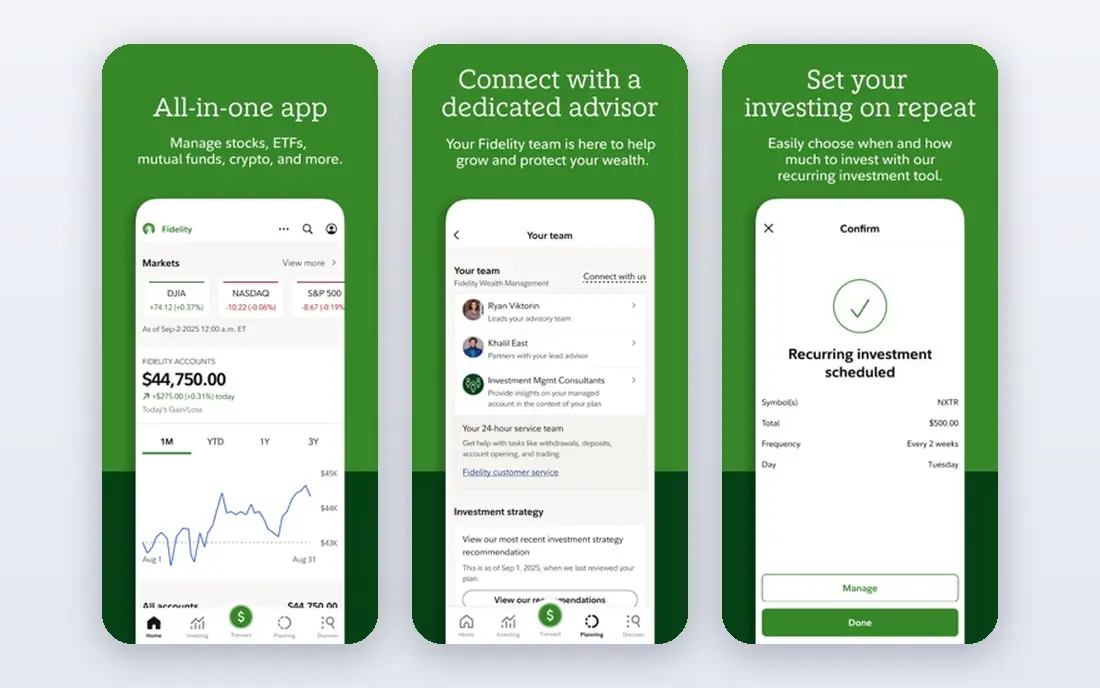
Fidelity is our pick for most people starting out, because it combines low costs with depth that lasts as an investor grows. US stock and ETF trades carry $0 commission, fractional shares start from $1, and retirement accounts such as IRAs sit beside brokerage accounts in the same app. Research, screeners, and educational content help new investors learn without paying for a separate service.
The main app can feel busy at first, with many menus and account types, and the most advanced trading tools live in a separate Active Trader Pro platform. That breadth is a strength over time, but a first-time trader may need a few sessions to find a comfortable setup. For a low-cost account that can grow from first trades to retirement saving, Fidelity is the strongest all-round choice.
- $0 stock and ETF commissions
- Fractional shares from $1
- Strong research and retirement accounts
- App can feel busy for brand-new traders
- Active trading platform is separate from the main app
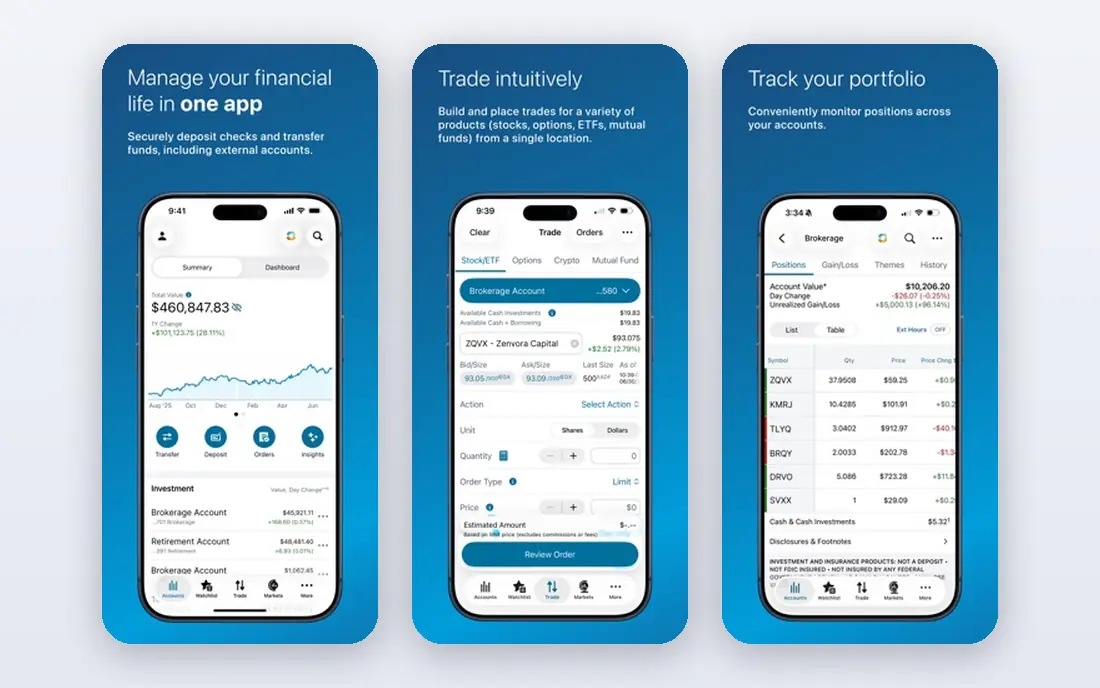
Charles Schwab suits beginners who want help learning and a serious platform to grow into. Online US stock and ETF trades carry $0 commission, there is no minimum to open a brokerage account, and education content covers investing basics through to options and retirement planning. The thinkorswim platform, now part of Schwab, adds professional charting and paper trading for practice.
Fractional share coverage is narrower than Fidelity or Robinhood, focusing mainly on S&P 500 stocks, so small investors in smaller companies should check availability. Schwab also offers several apps and platforms, which can confuse a new user at first. For education, practice trading, and long-term support, Schwab is a close second to Fidelity.
- $0 stock and ETF commissions
- Thinkorswim platform and paper trading
- Extensive education
- Fractional shares focus on S&P 500 stocks
- App range can confuse new users
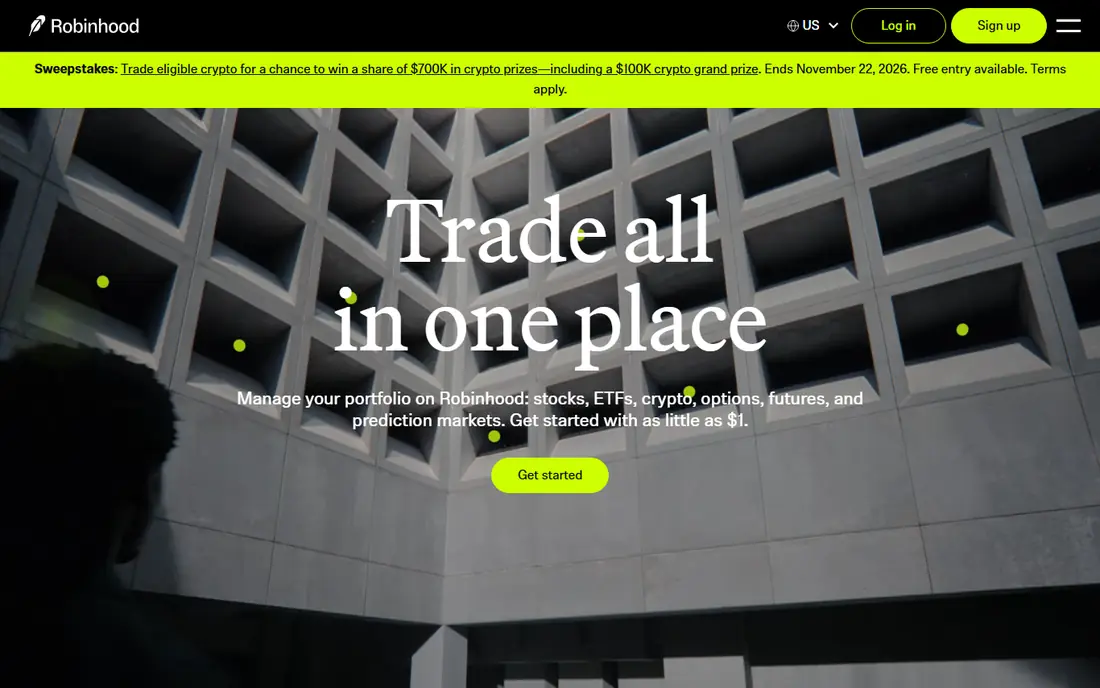
Robinhood remains the simplest first trading app, with a clean mobile design, $0 commissions on stocks and ETFs, fractional shares from $1, and no options contract fee. Stocks, ETFs, options, and crypto sit in one app, which suits mobile-first users who want to place a trade in a few taps. There is no account minimum for a standard brokerage account.
Research depth is the trade-off. Charts, screeners, and analyst content are thinner than at Fidelity, Schwab, or Webull, so traders who rely on research may outgrow Robinhood quickly. Transfer fees also deserve a check before funding a large account. For a first, simple trading account, Robinhood is hard to beat on ease of use.
- $0 stock and ETF commissions
- Fractional shares from $1
- $0 options contract fee
- Simple mobile design
- Research and charting are thinner than Fidelity or Schwab
- Transfer-out fee is higher than some rivals
Webull suits traders who want professional-grade charts without paying for a trading terminal. US stocks, ETFs, and options carry $0 commission, paper trading lets new users practice with virtual money, and the desktop and mobile apps offer detailed technical indicators, extended-hours trading, and community discussion. Fractional shares from $1 help small accounts start.
The interface can overwhelm a complete beginner, with many indicators, order types, and data panels on screen at once. Support is mainly digital, which suits self-directed traders but not everyone. For active beginners who want to learn charting from the start, Webull is the best free option.
- $0 stock, ETF, and options commissions
- Advanced charts
- Free paper trading and real-time quotes
- Interface can overwhelm beginners
- Customer support is mainly digital
ETRADE, part of Morgan Stanley, offers a balanced mix of research, tools, and account types for self-directed investors. Online US stock and ETF trades carry $0 commission, and the Power ETRADE platform adds advanced charting and options tools. Retirement accounts, banking features, and education content sit in the same ecosystem, which suits investors who want one provider for several needs.
Options traders pay $0.65 per contract, with a $0.50 rate for active traders, so frequent options traders should compare Webull and Robinhood on that fee. The range of apps and platforms can also feel fragmented at first. For a balanced broker with strong research and a serious options platform, E*TRADE is a solid choice.
- $0 stock and ETF commissions
- Power E*TRADE platform
- Strong research and education
- Options contract fee is $0.65, with a lower rate for active traders
- App range can feel fragmented
SoFi Invest suits people who want investing beside banking, loans, and financial planning in one app. Active investing carries $0 commissions on stocks and ETFs, with fractional shares from $5, while automated investing builds a diversified portfolio from $50. The design is clean, and the wider SoFi ecosystem appeals to users who want one login for several money tasks.
SoFi is not the best choice for active traders who need deep charts, screeners, or options tools. Its research is simpler than Fidelity, Schwab, or Webull. For a beginner who wants simple self-directed trading plus an automated option, SoFi Invest is a practical all-in-one pick.
- $0 stock and ETF commissions
- Fractional shares from $5
- Automated investing alongside banking and loans
- Research and advanced charting are thinner than dedicated brokers
- Automated investing starts from $50
Public suits investors who want several asset types in one simple app, with a social feed for learning from other investors. Stock and ETF trades carry $0 commission, fractional shares are available, and the app covers crypto, bonds, and options alongside stocks. AI-assisted research summaries help new investors read through company news without opening many tabs.
The social features are a double-edged tool. They can teach, but they can also encourage copying trades without independent research. Charting and screening are lighter than Webull or thinkorswim. For a simple multi-asset account with a community feel, Public is a good fit, as long as users treat social posts as ideas, not advice.
- $0 stock and ETF commissions
- Stocks, ETFs, crypto, bonds, and options in one app
- Social learning features
- Charting and research are lighter than dedicated trading platforms
- Social feed can encourage herd trading
Interactive Brokers suits traders who plan to grow beyond US stocks. IBKR Lite offers $0 commissions on US stock and ETF trades, while the wider platform covers stocks, options, futures, forex, and bonds across many global markets. That breadth, plus low margin rates for qualified accounts, makes it the professional choice for serious traders.
Complexity is the main drawback. The platforms, order types, and account settings assume experience, and beginners may find the learning curve steep. For a first account, Fidelity or Schwab is easier. For a trader who wants global access and room to grow, Interactive Brokers is the strongest platform in this list.
- IBKR Lite with $0 US stock and ETF commissions
- Access to global markets
- Low margin rates for qualified traders
- Platform complexity can overwhelm beginners
- Full feature set suits experienced traders
moomoo suits active learners who want market data, charting, and community discussion in a free app. US stock and ETF trades carry $0 commission, paper trading lets users practice, and the app packs earnings calendars, analyst data, and technical tools that rival paid terminals. Fractional shares and extended-hours trading add flexibility for small and active accounts.
moomoo is a newer US brand than Fidelity or Schwab, and its data-rich interface can overwhelm a first-time investor. Support and brand familiarity also trail the legacy brokers. For traders who want data depth and learning tools without paying commissions, moomoo is a strong alternative to Webull.
- $0 stock and ETF commissions
- Rich market data and charting
- Paper trading and community learning
- Newer US brand than Fidelity or Schwab
- Advanced data can overwhelm beginners
Vanguard suits long-term investors who plan to hold index funds and ETFs for years. Most US stock and ETF trades carry $0 commission, Vanguard funds are known for low expense ratios, and IRA and retirement support is strong. The app keeps the focus on saving and holding rather than frequent trading, which matches its audience.
Active traders will find Vanguard tools basic. Charting, screeners, and options features lag Webull, Schwab, and E*TRADE, and the app is not built for day trading. For a buy-and-hold investor who wants low costs and a trusted fund provider, Vanguard remains a sensible choice.
- $0 commissions on most US stocks and ETFs
- Low-cost index funds
- Strong retirement account support
- Trading tools and charting are basic
- App suits long-term holders more than active traders
How we picked these
We compared official fee schedules, app store listings, and October 2026 broker comparisons for apps that trade US stocks and ETFs. We favored apps with $0 stock and ETF commissions, no or low account minimums, and live US availability. Where a fee varied by account type or activity, we noted the standard figure and advised checking the current schedule before funding an account.
What to check before you fund an account
Start with the fees beyond commission. Check options contract fees, transfer-out fees, margin rates, and cash sweep terms, since those costs matter more than a $0 stock commission once you trade options or move money. Confirm fractional share rules, extended-hours access, and whether the app supports the account types you need, such as an IRA or joint account.
Next, test the app with paper trading or a small deposit before committing a large sum. Check order types, charting, research, and support hours during a market session, not just on a quiet weekend. Finally, set a plan for risk: decide how much you can afford to lose, avoid trading on margin until you understand it, and remember that no app guarantees returns.
Frequently asked questions
What is the best app to trade stocks?
Fidelity is the best app to trade stocks for most beginners, with $0 commissions, fractional shares from $1, and strong research. Robinhood suits the simplest first trades, Webull suits chart-focused traders, and Schwab suits investors who want education and thinkorswim.
What is the best app for stock trade for beginners?
Fidelity and Charles Schwab are the strongest beginner apps, thanks to $0 commissions, education, and retirement accounts. Robinhood is simpler, SoFi Invest adds automated investing, and Webull adds paper trading and charts for learners who want more tools.
Is trading stocks with an app safe?
Brokerage accounts at SIPC member firms carry SIPC protection up to $500,000 in securities, including a $250,000 cash limit, if a member firm fails. That protection does not cover losses from market moves, and FDIC insurance does not apply to stocks or funds.
How much money do I need to start trading stocks?
Many apps need no minimum to open an account, and fractional shares let you start from $1 at Fidelity, Robinhood, and Webull, or from $5 at SoFi Invest. Start small, learn order types, and only invest money you can afford to lose.
Are stock trading apps really commission-free?
Stock and ETF trades are $0 at the apps in this list, but other costs still apply. Options fees, spreads, transfer fees, and margin interest vary by broker, so read the full fee schedule before funding an account.
Can I trade stocks, ETFs, and options in one app?
Yes, most apps in this list support stocks, ETFs, and options, and several add crypto, bonds, or mutual funds. Check options fees and approval requirements, since options trading needs a separate approval and carries added risk.
Sources
See where you really rank - block by block
ProMapRanker scans Google Maps across a grid of your service area. Simple monthly plans from $19, white-label on every plan.
Start freeKeep reading
 zscaler alternatives
Best Zscaler Alternatives in 2026
Looking for zscaler alternatives? We compare 9 SASE and zero trust platforms on architecture, data protection, pricing, and fit for your network and team.
Read → zapier alternatives free
Best Zapier Alternatives Free in 2026
Nine automation tools for zapier alternatives free in 2026, all with genuinely free tiers, plus free plan limits, starting prices and upgrade paths explained.
Read → which platform is best for online reputation
Which Platform Is Best for Online Reputation in 2026
Wondering which platform is best for online reputation? We compare 8 review, listing, and response tools for small and multi-location businesses and agencies.
Read →