 ProMapRanker
Best App to Learn Greek in 2026

Key takeaways
- Duolingo is the best free starting point, but it works best alongside a speaking or grammar resource for real conversation.
- Pimsleur suits listeners who want to speak early, while Rosetta Stone suits learners who like immersion and visual repetition.
- Drops and Memrise are strong for vocabulary, but they do not replace a full course with grammar and conversation.
- Learn the Greek alphabet early, even if an app offers transliteration, because reading signs, menus and messages depends on it.
Quick comparison
| Pick | Great for | Pricing starts at | Free tier | |
|---|---|---|---|---|
 Duolingo | Free daily lessons | Free | Yes | Visit |
 Drops | Vocabulary in short sessions | $13 per month | Yes | Visit |
 Babbel | Structured beginner lessons | See website | No | Visit |
 Memrise | Vocabulary with native video | $9 per month | Yes | Visit |
 Mondly | Conversation phrases | $9.99 per month | Yes | Visit |
 Pimsleur | Speaking and listening | $19.95 per month | Free trial | Visit |
 Rosetta Stone | Immersive foundation | $19.99 per month | No | Visit |
 Mango Languages | Phrase chunks and culture | $7.99 per month | No | Visit |
 Language Transfer | Free audio introduction | Free | Yes | Visit |
The best app to learn greek
We compared Greek courses on alphabet teaching, vocabulary, grammar, speaking practice, lesson structure and price. The list covers free apps, subscription courses and one fully free audio course, so a learner can start at any budget.
Duolingo is the easiest way to start Greek today. Lessons are short, free and game like, with speaking, listening, reading and writing tasks in small steps. The Greek alphabet appears alongside words and audio, so a beginner learns to recognize letters while building a basic vocabulary.
The limits show up as you progress. Grammar is taught mainly through examples, not clear explanations, and advanced conversation needs another resource. Paid Super Duolingo, listed at $12.99 per month in third party summaries, removes ads and adds offline lessons, but it does not add a deeper Greek course. Start free, build a habit, then add a speaking tool.
- Free Greek course with bite size lessons
- Alphabet introduced alongside vocabulary
- Streaks and reminders support a daily habit
- Grammar explanations are limited
- Conversation practice for Greek is thinner than for larger languages
Drops focuses on words, not grammar. Each session pairs a Greek word with an image and native audio, which helps visual learners remember vocabulary fast. Sessions are short, so Drops fits a commute or a lunch break, and topics cover travel, food, family and daily life.
It is not a complete Greek course. Learners will know many words but still need grammar and conversation practice to form sentences. Use Drops as a vocabulary supplement to Duolingo, Babbel or Pimsleur, rather than as the only tool, and check the current monthly price on the Drops site before subscribing.
- Visual vocabulary with native audio
- Short five minute style sessions
- Topic based word lists for travel and daily life
- Little grammar or sentence building
- Vocabulary depth is limited compared with a full course
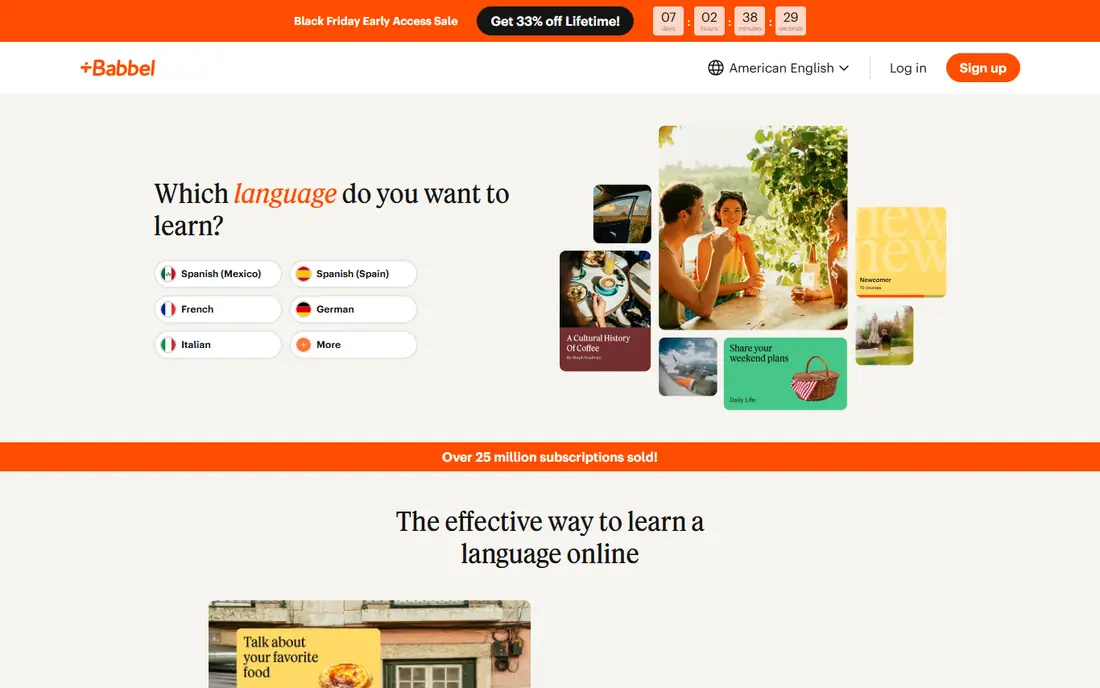
Babbel takes a more classroom like approach than Duolingo, with lessons built around dialogues and practical situations. A learner works through greetings, travel, shopping and daily routines, with review sessions to lock in vocabulary. That structure helps people who find open ended game lessons too loose.
Greek is not one of Babbel's largest courses, so advanced content is thinner than for Spanish or French. Pricing also varies, so the Babbel site is the right place to confirm the current plan for Greek. For a beginner who wants order and explanation, Babbel is still a solid paid starting point.
- Clear structured lessons for beginners
- Dialogues for everyday situations
- Review tools for vocabulary and grammar
- Greek depth is less than Babbel's largest languages
- Pricing varies by plan and region
Memrise pairs vocabulary with short videos of native speakers, which helps learners hear natural pronunciation and rhythm. Spaced repetition schedules reviews at increasing intervals, a method that suits long term word retention. The free tier covers basic learning, while Pro, listed around $9 per month in third party summaries, adds full activities.
Like Drops, Memrise is mainly a vocabulary tool. It will not teach Greek grammar in depth or carry a learner through full conversation. Pair it with a structured course or a tutor for speaking, and use the native videos to check pronunciation against a real speaker.
- Native speaker video clips for real pronunciation
- Spaced repetition for vocabulary
- Free tier for basic learning
- Grammar and conversation depth are limited
- Full features need a Pro subscription
Mondly introduces Greek writing alongside vocabulary and phrases, with a phonetic option to bridge the gap to the alphabet. Lessons feel conversational, with guided dialogues and corrections that highlight the part of a sentence that needs work. Speech recognition gives a learner a chance to practice pronunciation without a tutor.
The course is phrase heavy, so grammar rules are learned mainly by example. That works for travel and basic conversation, but a learner aiming for reading or formal Greek will need a grammar resource. Mondly pricing is listed at $9.99 per month and $47.99 per year in third party summaries, with a free trial path on the site.
- Greek script introduced alongside phrases
- Conversation style practice
- Speech recognition for pronunciation
- Grammar explanations are light
- Some learners find the phrase focus too shallow for long term study
Pimsleur is an audio first course. Lessons ask the learner to listen, recall and speak, with repetition spaced to build spoken confidence. That method suits travelers and commuters who want to speak Greek early, even before they can read it well. Newer AI speaking tools add pronunciation feedback between core lessons.
The trade off is breadth. Reading, writing and grammar depth are limited, and the price, listed at $19.95 per month for Premium in third party summaries, is higher than Duolingo or Drops. For a learner whose main goal is speaking, Pimsleur is worth the cost. For reading and writing, pair it with Duolingo or a grammar book.
- Audio lessons built around speaking and recall
- Pronunciation feedback tools
- Hands free learning for driving and walking
- Reading and writing are limited
- Higher monthly price than most apps on this list
Rosetta Stone teaches Greek through images, audio and repetition, without translating every phrase into English. That immersion helps learners start thinking in Greek for everyday words, and speech recognition checks pronunciation. Alphabet help can be turned on for beginners who are still learning letters.
The same approach frustrates learners who want a clear grammar rule when a phrase does not make sense. Rosetta Stone pricing is listed at $19.99 per month, $159 per year and a lifetime option when offered, in third party summaries. It works best for beginners who enjoy learning by context and repetition.
- Immersive visual lessons with speech recognition
- Steady vocabulary building
- Alphabet help settings for beginners
- Little direct grammar explanation
- Some learners find the no translation approach frustrating
Mango Languages teaches Greek in chunks, highlighting parts of a phrase in color so a learner sees how words combine. That approach helps beginners move from memorized phrases to flexible sentences, without a heavy grammar lecture. Cultural notes add context for travel and family visits.
Depth is the limit. Advanced learners will run out of new material sooner than with a larger course, and grammar is still light. At $7.99 per month in third party summaries, Mango is a good value supplement, and many public libraries also offer Mango free to card holders, which is worth checking before paying.
- Color coded phrase chunks that show language patterns
- Cultural notes
- Clear audio for each phrase part
- Course depth is limited for advanced learners
- Grammar focus is light
Language Transfer offers a free Introduction to Greek audio course that teaches by thinking through language patterns, not by memorizing lists. The teacher guides the listener to build sentences step by step, which helps learners understand how Greek works. There is no subscription, and lessons can be streamed or downloaded from the site.
It is not a full app experience. There are no games, streaks or interactive drills, and vocabulary is limited compared with Duolingo or Babbel. As a free starting point, or as a companion to an app, Language Transfer is excellent, especially for learners who want to understand Greek structure before drilling words.
- Completely free audio course
- Clear thinking based teaching for Greek
- No subscription or account needed for core lessons
- Audio only, with no app style drills or progress tracking
- Limited vocabulary compared with paid courses
How we picked these
We compared official course pages, app store listings and third party course reviews for October 2026. We kept only apps and courses with a current Greek course, not a general language tool that lists Greek without content. Where pricing differed across sources, we used the most widely reported figure and advised checking the vendor site, because language app prices change by region and promotion.
How to build a Greek routine that sticks
Learn the alphabet in the first week, even if an app offers transliteration. Greek letters appear on signs, menus, messages and place names, and reading them opens far more input than transliteration alone. Spend ten minutes a day on letters and sounds, then move to a main course for vocabulary and sentences.
Pair one main course with one supplement. Duolingo plus Pimsleur covers reading and speaking. Babbel plus Drops covers structure and vocabulary. Add Language Transfer for grammar thinking, and practice speaking aloud, even alone, because silent study does not build pronunciation. A short daily session, repeated for months, beats a long weekend of study followed by silence.
Frequently asked questions
What is the best app for learning Greek?
Duolingo is the best free starting point, Pimsleur is best for speaking, and Rosetta Stone is best for immersive beginners. The best app depends on your goal: travel phrases, conversation, reading or family heritage.
What are the best apps to learn Greek for free?
Duolingo and Language Transfer are the strongest free options. Duolingo offers daily interactive lessons, while Language Transfer offers a free audio introduction that explains Greek patterns clearly.
Is Greek hard to learn?
Greek has a new alphabet and different grammar from English, but its pronunciation is fairly regular once letters are learned. A structured app, daily practice and speaking aloud make the early stage much easier than it first looks.
How long does it take to learn Greek?
Basic travel Greek can take a few months of daily practice, while conversational Greek usually takes a year or more of steady study. Progress depends on daily time, speaking practice and exposure to real Greek media.
Should I learn the Greek alphabet first?
Yes, learn the alphabet early, even if an app offers transliteration. Reading Greek letters helps with signs, menus, messages and further study, and most apps on this list introduce the alphabet alongside vocabulary.
Can I learn Greek with only an app?
An app can build a strong foundation, but conversation with a tutor, language partner or class helps most learners move from app sentences to real dialogue. Use an app daily, then add speaking practice as soon as basic phrases feel solid.
Sources
See where you really rank - block by block
ProMapRanker scans Google Maps across a grid of your service area. Simple monthly plans from $19, white-label on every plan.
Start freeKeep reading
 zscaler alternatives
Best Zscaler Alternatives in 2026
Looking for zscaler alternatives? We compare 9 SASE and zero trust platforms on architecture, data protection, pricing, and fit for your network and team.
Read → zapier alternatives free
Best Zapier Alternatives Free in 2026
Nine automation tools for zapier alternatives free in 2026, all with genuinely free tiers, plus free plan limits, starting prices and upgrade paths explained.
Read → which platform is best for online reputation
Which Platform Is Best for Online Reputation in 2026
Wondering which platform is best for online reputation? We compare 8 review, listing, and response tools for small and multi-location businesses and agencies.
Read →