 ProMapRanker
Best App to Learn Chinese for Free in 2026

Key takeaways
- HelloChinese is our pick for free beginners because it teaches pinyin, tones, characters, and grammar in one structured course.
- Duolingo is a good free habit builder, but it is weaker on tones and characters than HelloChinese or Pleco.
- Pleco, Anki, and Wordbrush are free tools that cover dictionaries, flashcards, and vocabulary, and they pair well with a course app.
- No single free app covers everything. A course app plus a dictionary plus reading practice gives the best free setup.
- Focus on tones and pinyin first. A wrong tone can change meaning, so early tone practice prevents habits that are hard to fix later.
Quick comparison
| Pick | Great for | Pricing starts at | Free tier | |
|---|---|---|---|---|
 HelloChinese | Free structured Mandarin course | Free | Yes | Visit |
 Duolingo | Free daily habit for beginners | Free | Yes | Visit |
 Pleco | Free Chinese dictionary | Free | Yes | Visit |
 Anki | Free spaced repetition flashcards | Free | Yes | Visit |
 Du Chinese | Free graded reading | Free | Yes | Visit |
 Wordbrush | Free HSK vocabulary drilling | Free | Yes | Visit |
 HanziHero | Free character learning with mnemonics | Free | Yes | Visit |
 Skritter | Character writing practice | See website | Free trial | Visit |
 HelloTalk | Free exchange with native speakers | Free | Yes | Visit |
The best free apps to learn Chinese
Chinese, usually Mandarin for beginners, needs several skills at once: tones, pinyin, characters, listening, and speaking. A free app that only teaches words will leave gaps, and a paid course is not the only way to fill them. The free apps below each cover a different job, and together they form a complete free setup. We focus on tools with a genuinely useful free tier, not a short trial dressed up as free.
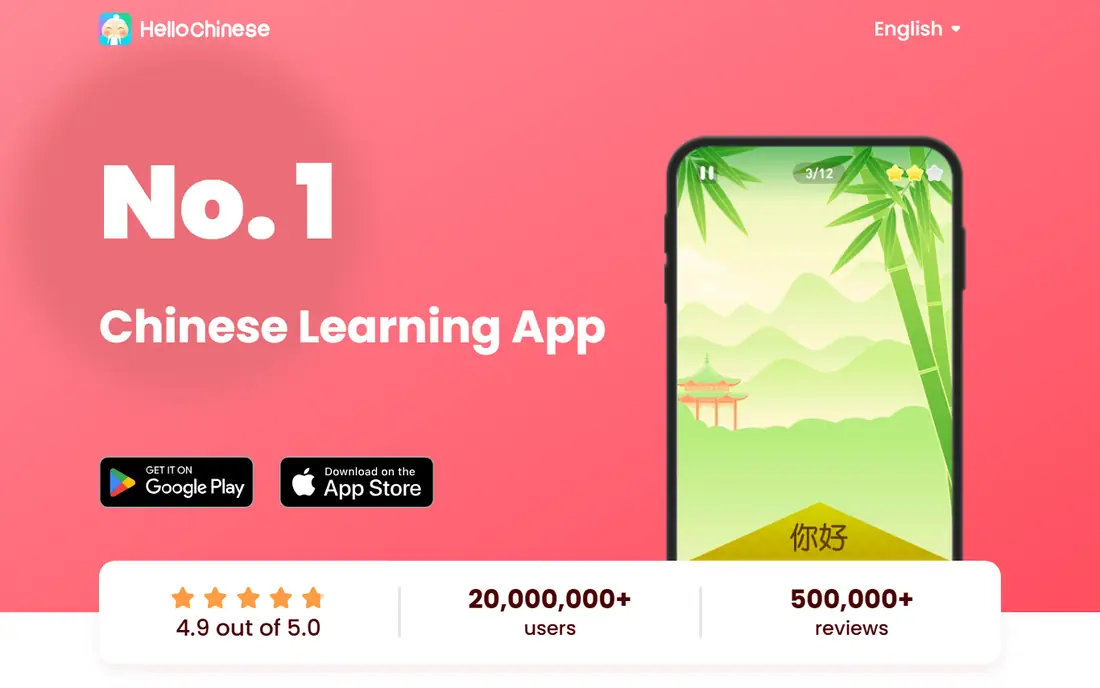
HelloChinese is the strongest free starter app for Mandarin, and our pick for most beginners. It teaches pinyin and tones from the start, then builds listening, speaking, reading, and writing through short, game-like lessons. The course follows HSK levels, so you can see progress in a standard framework rather than guessing where you stand.
The free tier covers a large part of the beginner course, with no ads in the older course according to public listings. Paid access opens more advanced lessons and offline features, but a beginner can learn a lot before paying. If you only download one free Chinese app, make it HelloChinese, then add Pleco as a dictionary.
- Structured course from beginner level
- Pinyin and tone teaching
- Character, listening, and speaking practice
- Full access needs a paid plan
- Advanced content is thinner than beginner content
Duolingo offers a free Mandarin course that is unmatched for building a daily habit. Lessons are short, the app reminds you to practise, and the streak system keeps many beginners coming back. For a learner who struggles to study regularly, that habit value is real, and it costs nothing to start.
The limits matter for Chinese specifically. Tone practice and character teaching are less thorough than in HelloChinese, and Duolingo does not publish an HSK level for its Mandarin course. Use Duolingo to build a habit and basic vocabulary, then add HelloChinese for tones and characters, or use Duolingo alongside it rather than instead of it.
- Completely free course with ads
- Short lessons
- Strong streak and reminder system
- Tone teaching is weaker than HelloChinese
- No published HSK level for its Mandarin course
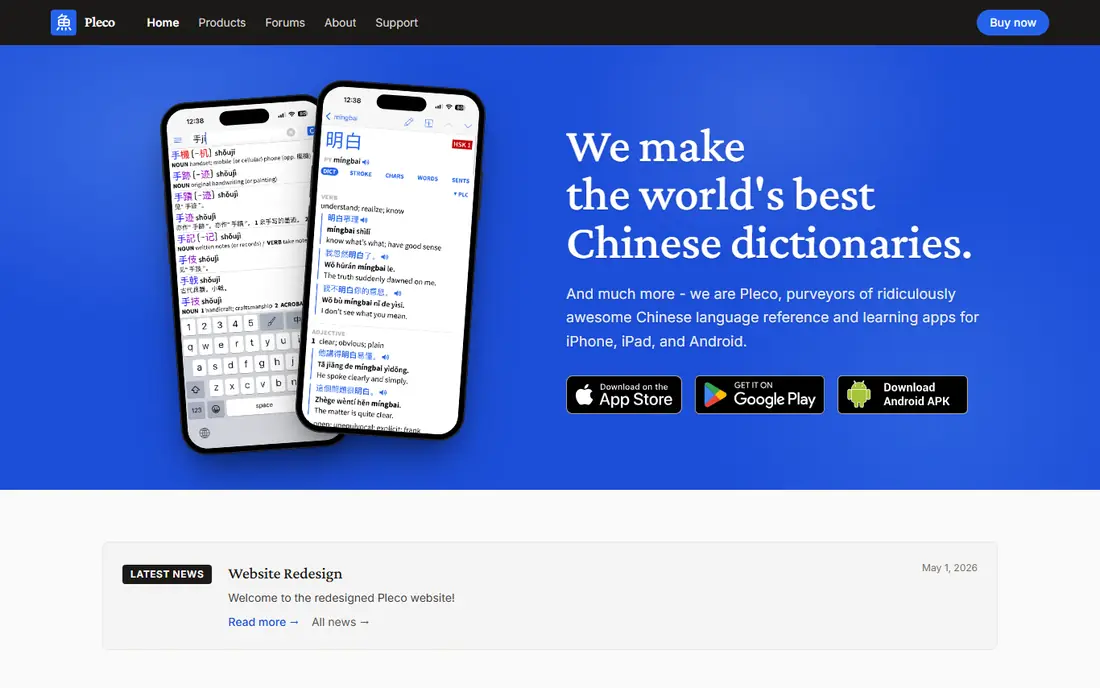
Pleco is the standard free dictionary for Chinese learners, and every serious learner should have it installed. You can look up words by pinyin, character, or handwriting, hear pronunciation, and see example sentences. Camera and handwriting lookup help when you meet a character you cannot type, which happens often in the first months.
Pleco is not a course, so it will not teach you grammar or guide your study. Its power is as a reference tool that supports every other app in this list. When HelloChinese or Du Chinese introduces a new word, Pleco lets you check its meaning, tone, and usage in seconds. Some add-on dictionaries are paid, but the core dictionary is free.
- Strong free dictionary
- Handwriting and camera lookup
- Audio pronunciation
- Not a course
- Interface can feel dense for new learners
Anki is a free spaced repetition flashcard app that helps you remember characters and vocabulary over time. It schedules reviews just before you would forget a card, which is far more efficient than re-reading lists. Shared decks for HSK vocabulary, characters, and sentences are available from the community, so you do not need to build everything yourself.
The catch is setup. Anki is powerful but plain, and new users may need a short guide to set up decks and card types. The iPhone app is paid, while desktop and Android versions are free, and the free web version can cover iPhone users who do not want to pay. For long-term vocabulary retention, no free tool in this list beats Anki once it is set up.
- Free on desktop and Android
- Spaced repetition scheduling
- Huge shared Chinese decks
- Setup takes effort
- IPhone app is paid, though the web version is free
Du Chinese is a graded reading app that lets beginners read real Chinese at their level, which is a skill many course apps neglect. Stories are graded by level, you can tap words for translations, and many lessons include audio. Reading in context helps characters and grammar stick in a way that isolated flashcards cannot.
Free access covers a useful sample of lessons, while full access needs a subscription. That limit is worth knowing, but the free tier is enough to test whether graded reading suits you. Pair Du Chinese with HelloChinese for grammar and Pleco for lookups, and reading becomes a regular part of study rather than an afterthought.
- Graded stories at your level
- Tap for translations
- Audio for many lessons
- Free access is limited
- Not a full course for grammar or speaking
Wordbrush is a free app for iPhone, iPad, and Android that drills HSK 1 to 3 vocabulary into long-term memory. Every word comes with Mandarin audio, an example sentence, and a breakdown of its characters, scheduled by a spaced repetition system. It works offline, needs no account, and has no paid tier, which makes its free claim unusually clear.
The limit is scope. Wordbrush teaches vocabulary, not grammar, tones in a full course, or conversation. It is also focused on HSK 1 to 3, so advanced learners will outgrow it. As a free vocabulary companion to HelloChinese, it is excellent, especially for learners who want a simple, offline drill tool.
- Fully free with no paid tier
- HSK 1 to 3 vocabulary
- Offline use with no account needed
- Vocabulary only, not a course
- Covers HSK 1 to 3, not advanced levels
HanziHero teaches Chinese characters through mnemonics and spaced repetition, breaking characters into components so they are easier to remember. That approach suits learners who find characters intimidating, because it gives a story or image for each form rather than asking for rote copying alone. Progression is structured, so you learn common characters first.
HanziHero does not teach conversation, listening, or grammar as a full course. It is a character tool, and it works best alongside HelloChinese or Duolingo. The free tier lets you test the method, while a paid upgrade opens more content. If characters are your main block, HanziHero is a focused free start.
- Mnemonics for characters
- Spaced repetition
- Structured character progression
- Character focused, not a full language course
- Paid upgrade for full access
Skritter is the specialist writing app in this list, giving stroke-by-stroke feedback as you write characters by hand. It supports HSK lists and breaks characters into radicals, which helps you understand structure rather than just copying shapes. For learners who need to write by hand for exams or work, that feedback is hard to replace.
Skritter is not free in the same way as the apps above. It offers a free trial, then a subscription, so we include it as a writing specialist rather than a free course. Learners who only need to read and recognise characters can skip it and use HelloChinese and HanziHero instead. Learners who must write should try the trial first.
- Stroke-by-stroke writing feedback
- HSK lists
- Character and vocabulary decks
- Paid after trial
- Writing focus may not suit learners who only want to read and speak
HelloTalk lets you practise Chinese with native speakers for free through language exchange. You help partners with English, they help you with Chinese, and built-in correction tools let them fix your messages. Voice messages and calls add speaking and listening practice that course apps cannot fully replace.
The limits are structure and consistency. HelloTalk has no curriculum, and the quality of correction depends on your partner. It works best after a few weeks of HelloChinese, when you can hold a simple conversation and benefit from real feedback. Use it as a free speaking supplement, not as your only study tool.
- Free exchange with native speakers
- Correction tools
- Voice and text chat
- Not a course
- Partner quality varies
- Tone correction depends on partner
How we picked these
We compared official app pages, app store listings, and recent free-app guides checked in September 2026. We kept apps with a genuinely useful free tier or free trial for a specific skill, that exist and work in October 2026, and that cover Mandarin learning rather than a single phrasebook. We left out apps whose free tier was only a few lessons, and we did not count paid-only courses as free options.
How to build a free Chinese study routine
Start with HelloChinese for 20 minutes a day, focusing on pinyin and tones in the first weeks. Add Pleco for every new word, and use Anki or Wordbrush for 10 minutes of vocabulary review. When you can read simple sentences, add Du Chinese for graded reading a few times a week.
Do not try to learn handwriting for every character at first. Recognition matters more for reading and daily use, and writing can come later with Skritter if you need it. Speak early, even if it feels awkward, through HelloTalk or by repeating HelloChinese audio aloud. A short daily routine with tones, characters, and speaking beats a long irregular session.
Frequently asked questions
What is the best free app to learn Chinese?
HelloChinese is the best free app for most beginners because it teaches tones, pinyin, characters, and grammar in one course. Duolingo is a good free alternative for habit building, but it is weaker on tones. Pair HelloChinese with Pleco for the strongest free setup.
Can I learn Chinese for free with apps alone?
You can build a strong foundation for free with a course app, a dictionary, and reading and exchange tools. Free apps cover beginner to intermediate levels well, but advanced conversation and exam preparation may later need a tutor or paid course. Free tools are enough to test whether you enjoy learning Chinese.
What is the best free Chinese learning app for characters?
HanziHero and Wordbrush are strong free character tools, with mnemonics and spaced repetition. HelloChinese also teaches characters in context, and Pleco helps you look up any character you meet. For handwriting, Skritter offers a trial, but it is paid after that.
Is Duolingo good for learning Chinese for free?
Duolingo is good for a free daily habit and basic vocabulary, and its short lessons suit busy learners. It is less strong on tones and characters than HelloChinese, so use it alongside a Mandarin-specific app if you want solid pronunciation. Do not rely on Duolingo alone for tones.
How long does it take to learn Chinese with free apps?
Basic conversation can take many months of daily study, and Mandarin is rated as a hard language for English speakers. Tones, characters, and listening all need time. A daily routine of 30 to 45 minutes, plus speaking practice, gives steady progress over 12 to 18 months for many learners.
Sources
See where you really rank - block by block
ProMapRanker scans Google Maps across a grid of your service area. Simple monthly plans from $19, white-label on every plan.
Start freeKeep reading
 zscaler alternatives
Best Zscaler Alternatives in 2026
Looking for zscaler alternatives? We compare 9 SASE and zero trust platforms on architecture, data protection, pricing, and fit for your network and team.
Read → zapier alternatives free
Best Zapier Alternatives Free in 2026
Nine automation tools for zapier alternatives free in 2026, all with genuinely free tiers, plus free plan limits, starting prices and upgrade paths explained.
Read → which platform is best for online reputation
Which Platform Is Best for Online Reputation in 2026
Wondering which platform is best for online reputation? We compare 8 review, listing, and response tools for small and multi-location businesses and agencies.
Read →