 ProMapRanker
Best App to Buy Stocks in 2026

Key takeaways
- Most major US brokers now charge $0 commission on online US stock and ETF trades, so the real differences are in research, retirement accounts, fractional shares and extra fees.
- Fidelity is our pick for most people because it pairs $0 trades with broad research, fractional shares and retirement accounts in one place.
- Robinhood and Webull suit mobile-first traders, while Schwab and E*TRADE suit investors who want more guidance and desktop tools.
- Fractional shares let you start with a small amount, but check minimums and which stocks are eligible before you open an account.
- This is not financial advice. Investing carries risk, including loss of principal, and past performance does not guarantee future results.
Quick comparison
| Pick | Great for | Pricing starts at | Free tier | |
|---|---|---|---|---|
 Fidelity | Most investors | Free | Yes | Visit |
 Charles Schwab | Guidance and retirement planning | Free | Yes | Visit |
 Robinhood | Simple mobile trading | Free | Yes | Visit |
 Webull | Active traders and charting | Free | Yes | Visit |
 E*TRADE | Research and Power E*TRADE tools | Free | Yes | Visit |
 SoFi Invest | Investing alongside banking | Free | Yes | Visit |
 Public | Social and multi-asset investing | Free | Yes | Visit |
 Interactive Brokers | Global and active traders | Free | Yes | Visit |
The best app to buy stocks
We compared official fee pages, account features, app store listings and public reviews to find apps that work well for ordinary US investors. The eight below cover simple starters, active traders and long-term retirement savers.
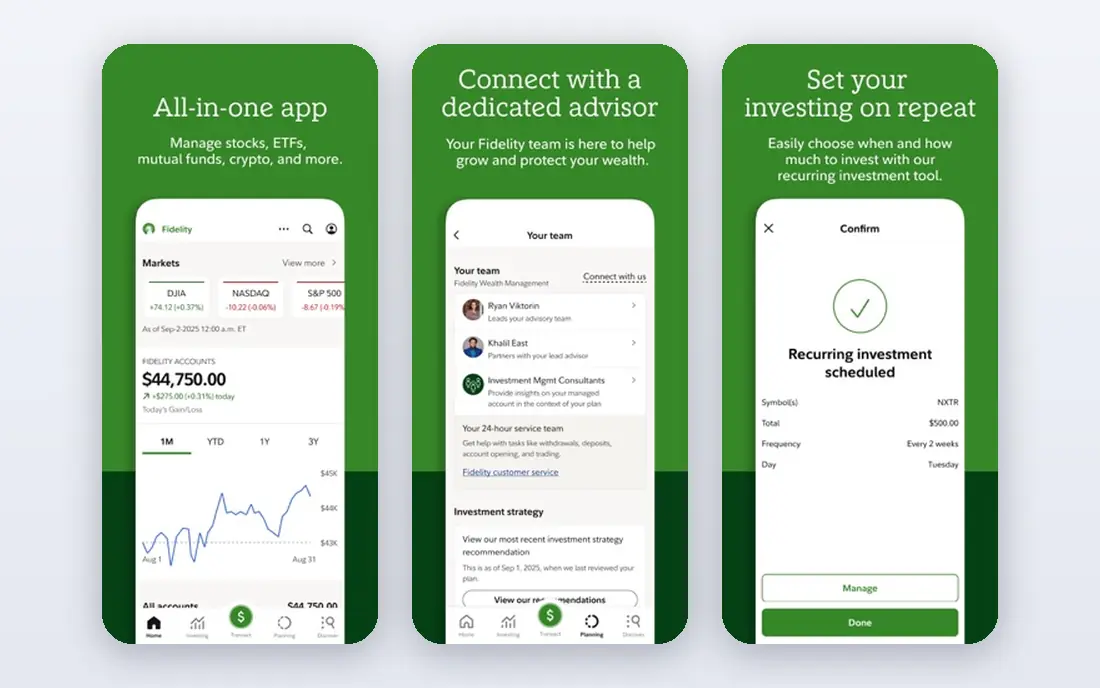
Fidelity is our pick for most people, and the reason is breadth rather than one flashy feature. You can buy stocks and ETFs with $0 commission, open an IRA, set up recurring investments and read research without juggling several accounts. Fractional shares from $1 also make it easier to start with a modest amount and build a position over time.
The trade-off is choice. Fidelity offers a large set of tools, account types and research reports, and new investors may need a few sessions to find the parts they actually use. That is a fair price for an app that can grow with you, from a first stock purchase to retirement planning, without forcing a switch later.
- $0 commissions on US stocks and ETFs
- Fractional shares from $1
- Broad research and retirement accounts
- App can feel busy at first
- Some advanced tools take time to learn
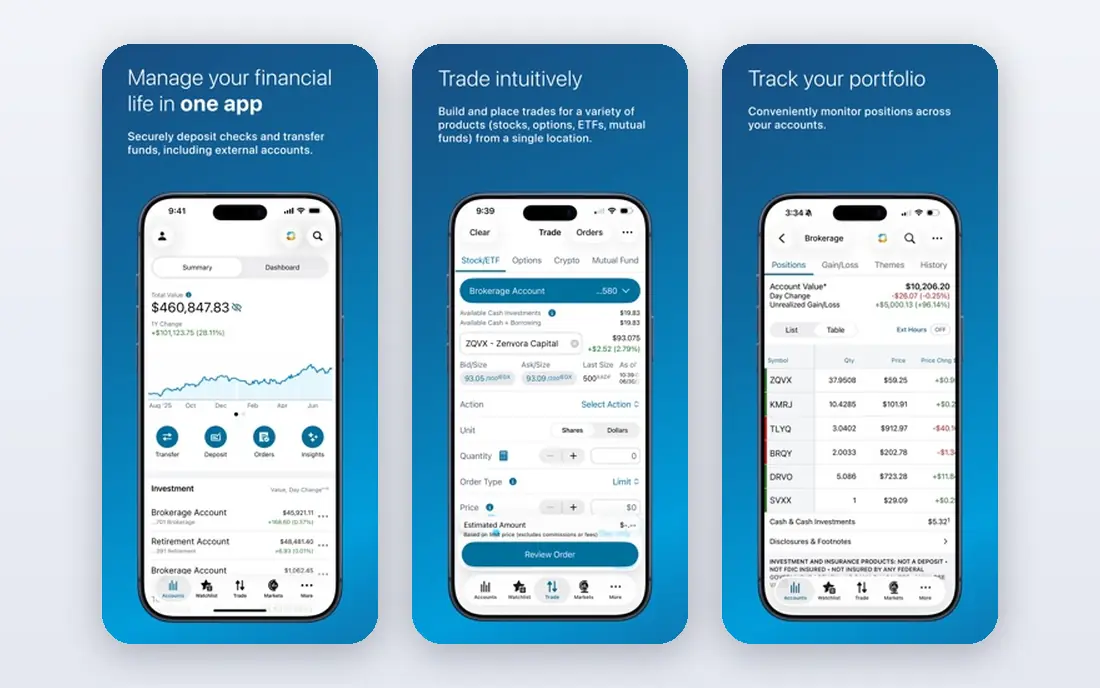
Schwab suits investors who want a full-service broker at do-it-yourself prices. Its $0 commission structure matches the other leaders here, and its education material explains concepts in plain steps rather than jargon. Support options, including branches in the US, help when a question is easier to settle with a person.
Thinkorswim, now part of Schwab, gives active traders charting and analysis tools that go well beyond a basic app. The catch is fractional share coverage, which is narrower than Fidelity or Robinhood, so check whether the stocks you want are eligible. If you mainly buy large, well-known companies and value guidance, Schwab is a strong choice.
- $0 commissions on online US stock and ETF trades
- Thinkorswim platform
- Strong education and support
- Fractional shares are limited to S&P 500 stocks
- Desktop tools can feel complex
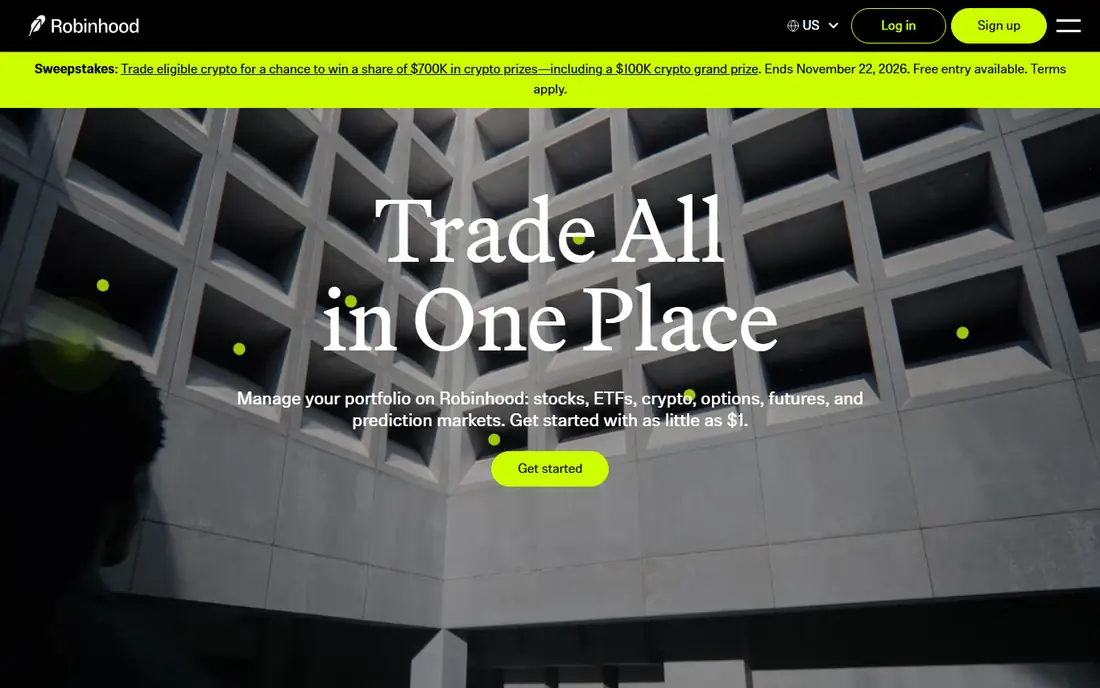
Robinhood remains the easiest app on this list to open and use on a phone. Buying a stock takes a small number of taps, fractional shares start at $1, and the app keeps fees and order details visible before you confirm. For a beginner who wants to learn by doing, with small amounts, that simplicity matters.
The weakness is depth. Robinhood offers less research and fewer account types than Fidelity or Schwab, and its Gold subscription adds features that other brokers include for free. It works best as a straightforward trading app, not as a complete financial planning service, and investors should keep position sizes modest while they learn.
- Clean mobile app
- $0 commissions on stocks and ETFs
- Fractional shares from $1
- Research is lighter than full-service brokers
- Some features sit behind a paid Gold tier
Webull gives active traders professional-looking charts, screeners and extended-hours trading without a commission on US stocks and ETFs. Paper trading is a genuine benefit, since you can test an approach with virtual money before risking real funds. That combination makes it a popular second step after a simpler starter app.
Beginners should be ready for a busier screen. Webull packs indicators, news and order types into a small space, and learning the layout takes time. If you trade often and want data at your fingertips, the effort pays off. If you buy a few ETFs each month, a simpler app will feel calmer.
- $0 commissions on stocks, ETFs and options
- Free real-time quotes
- Paper trading for practice
- Interface can overwhelm beginners
- Customer support is mainly digital
ETRADE, now part of Morgan Stanley, balances a friendly core app with a more powerful platform for active traders. Power ETRADE adds charting, strategy tools and paper trading, while the main app handles everyday buying, retirement accounts and research. That split lets you start simple and move up without changing brokers.
The split is also the drawback, since features live in different places and it is not always obvious which app holds the tool you need. Options traders should also check contract fees, which are separate from the $0 stock commission. For stock and ETF investors who value research, E*TRADE is a solid middle ground.
- $0 commissions on US stocks and ETFs
- Power E*TRADE platform
- Broad research and education
- Some tools are split across two apps
- Options contract fees still apply
SoFi Invest fits people who already use SoFi for banking or loans and want investing in the same app. Active investing starts from a small amount, automated investing builds a diversified ETF portfolio based on your goals, and the interface avoids the clutter that puts beginners off. It is a calm place to start regular investing.
Serious traders will find the limits quickly. Charting and order types are simpler than Webull or thinkorswim, and the product range is narrower than Fidelity. Treat SoFi as a good home for steady, hands-off investing rather than a platform for frequent tactical trades.
- $0 commissions on stock and ETF trades
- Automated investing option
- Fractional shares from $1
- Fewer advanced trading tools
- No mutual fund trading in the same way as full-service brokers
Public stands out because it explains investing in public, with company profiles, community discussion and analyst context alongside the buy button. You can hold stocks, ETFs, crypto and bonds in one account, which suits investors who want a broad view without several apps. Fractional shares keep entry costs low.
The social feed needs discipline. Seeing what others buy can be useful for ideas, but it can also push you toward popular trades at the wrong time. Use Public for research and convenience, make decisions on your own plan, and check its fee disclosures for crypto spreads and other charges that differ from stock commissions.
- $0 commissions on stocks and ETFs
- Fractional shares
- Stocks, ETFs, crypto and bonds in one app
- Social features can encourage herd trading
- Charting is less deep than specialist platforms
Interactive Brokers is the choice for traders who outgrow a simple app and need global reach. IBKR Lite gives $0 commissions on US stocks and ETFs, while the Pro platform adds tiered pricing, advanced order types and access to exchanges around the world. For investors with international holdings or complex strategies, few rivals match its scope.
That scope comes with complexity. Trader Workstation has a steep learning curve, and data subscriptions and exchange fees need careful checking before you trade a new market. Beginners can still use the mobile app for basic trades, but most people should only move here when they have a clear reason to need its extra power.
- IBKR Lite offers $0 US stock and ETF commissions
- Access to many global markets
- Low margin rates for qualified accounts
- Platform can feel intimidating
- Some data and market access carries extra fees
How we picked these
We compared official pricing pages, account minimums, fractional share rules, retirement account options, research tools and app store listings. We favored brokers that are regulated in the US, publish clear fee schedules and offer $0 commissions on US stocks and ETFs, and we kept a mix of simple apps and full-service brokers. We did not claim hands-on testing; our comparison rests on vendor documentation, pricing pages and public reviews.
What to check before you choose a stock app
Start with cost beyond the headline commission. A $0 stock trade does not remove regulatory fees, options contract fees, margin interest, account transfer fees or crypto spreads, so read the full fee schedule for the trades you actually plan to make. Check whether fractional shares cover the stocks you want, and whether recurring investments and dividend reinvestment are available.
Next, match the app to your habits. Long-term investors need retirement accounts, research and automatic investing more than advanced charts. Active traders need fast quotes, order types and paper trading. Beginners need clear education and a calm interface. Finally, confirm account protection and security features, including two-factor authentication, and keep your login details private.
Frequently asked questions
What is the best app to buy stocks for beginners?
Fidelity is a strong starting point because it combines $0 stock and ETF trades, fractional shares from $1, retirement accounts and broad education. Schwab is a close alternative if you want more guided help. Robinhood suits beginners who want the simplest mobile experience, as long as they accept lighter research.
Which stock app has the lowest fees?
Most apps on this list charge $0 commission on online US stock and ETF trades, so the lowest total cost depends on extras. Options contract fees, margin interest, transfer fees and crypto spreads vary, so compare the full schedule for your own trading pattern rather than the headline alone.
What are the best stocks apps for fractional shares?
Fidelity, Robinhood, SoFi Invest and Public all offer fractional shares from $1 on many stocks and ETFs. Schwab offers fractional shares on S&P 500 stocks. Check eligibility for each stock you want, since coverage differs by broker.
What is the best trade app for active traders?
Webull and Interactive Brokers suit active traders, with deep charting, screeners and advanced order types. Thinkorswim through Schwab is another strong choice, especially for traders who want paper trading and options analysis. Simple apps are fine for occasional trades but lack the same data depth.
Are stock market apps best used for retirement accounts too?
Many are. Fidelity, Schwab and E*TRADE offer IRAs alongside taxable brokerage accounts, which lets you keep retirement and general investing in one place. Check contribution limits, withdrawal rules and tax treatment before you open an IRA, and consider professional advice for retirement planning.
Is it safe to buy stocks through an app?
Reputable US brokers are regulated and offer SIPC protection up to $500,000 for securities, subject to limits, but that protection does not cover market losses. Use strong passwords, two-factor authentication and a broker with clear security disclosures. Remember that investing carries risk, and this article is not financial advice.
Sources
See where you really rank - block by block
ProMapRanker scans Google Maps across a grid of your service area. Simple monthly plans from $19, white-label on every plan.
Start freeKeep reading
 youtube alternatives
Best YouTube Alternatives in 2026
Looking for youtube alternatives in 2026? We compare Vimeo, Dailymotion, Twitch, Rumble, and more on price, audience, monetization, control and privacy.
Read → what's the best ai tool for photo editing
What Is the Best AI Tool for Photo Editing in 2026
What is the best AI tool for photo editing? We compare ten tools for 2026, from Photoshop and Lightroom to Luminar, Topaz, Canva and mobile editors today.
Read → twitter alternatives
Best Twitter Alternatives in 2026
Compare the best twitter alternatives for 2026, from Bluesky, Threads, and Mastodon to Reddit, Tumblr, and Micro.blog, with free plans and audience notes.
Read →