 ProMapRanker
Best Apps to Avoid Overdraft Fees in 2026

Key takeaways
- Chime, Varo, Ally, Capital One, and SoFi avoid overdraft fees by charging no overdraft fee at all, rather than by covering every payment.
- SpotMe, CoverDraft, and similar features cover some debit purchases up to a limit, but the limit depends on direct deposits and account history.
- Dave and Brigit work differently: they send low-balance alerts and small advances that can top up a balance before a payment hits.
- This is not financial advice. No app promises zero fees in every case, so read the eligibility rules and the fee schedule for your account.
Quick comparison
| Pick | Great for | Pricing starts at | Free tier | |
|---|---|---|---|---|
 Chime | Fee-free SpotMe coverage | Free | Yes | Visit |
 Varo | No overdraft fees plus advances | Free | Yes | Visit |
 Ally Bank | CoverDraft plus savings transfers | Free | Yes | Visit |
 Capital One 360 | No overdraft fees with choice of cover | Free | Yes | Visit |
 SoFi | No-fee overdraft cover for members | Free | Yes | Visit |
 Current | Alerts and early pay | Free | Yes | Visit |
 Dave | Low-balance alerts and advances | Free | Yes | Visit |
 Brigit | Balance alerts and cash advances | See website | No | Visit |
The best apps to avoid overdraft fees
We compared official sites and fee pages for banking apps live in October 2026 that reduce or remove overdraft fees. Our pick for most people is Chime for its simple no-fee structure and SpotMe, with Ally as a strong bank alternative. This is not financial advice: read each account terms page, since limits and eligibility change.
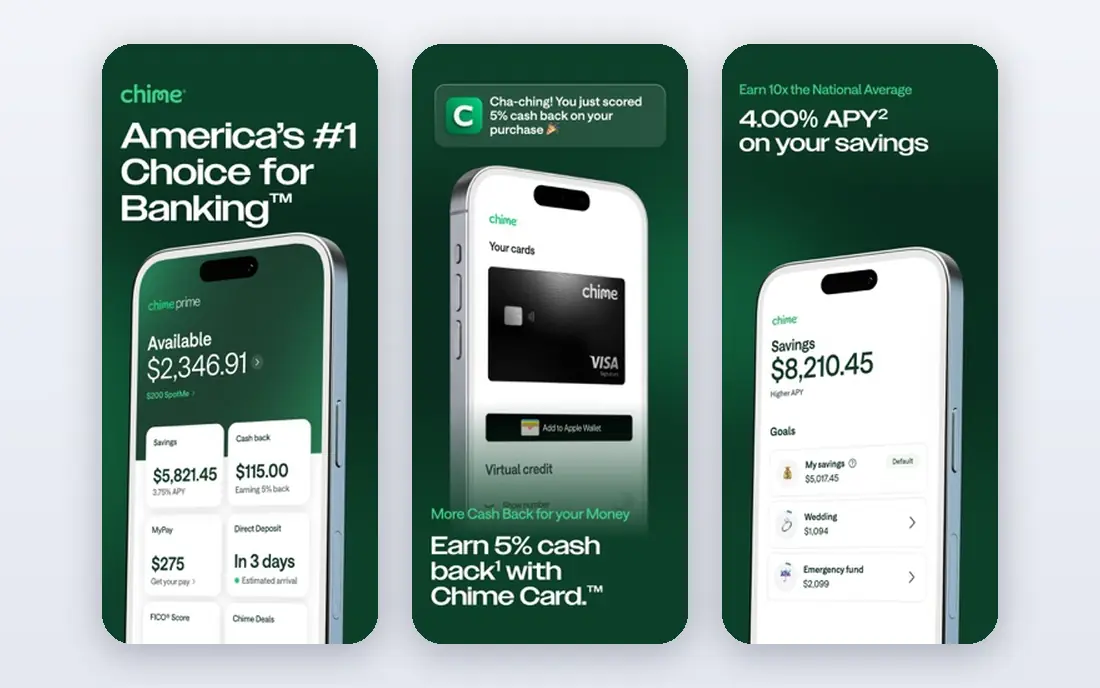
Chime avoids overdraft fees in two ways. First, its checking account charges no monthly fee and no overdraft fee as a standard term. Second, SpotMe covers eligible debit purchases and ATM withdrawals that push your balance below zero, up to a limit that starts at $20 and can grow to $200 based on account history and activity. The covered amount is repaid from your next deposit, with no fee and no interest.
SpotMe is not automatic for every account. You need $200 or more in qualifying direct deposits each month, and the limit is set by Chime, not guaranteed at $200. Cash deposits go through retail partners, which can carry a fee, and support is online only. For app-first banking with a clear no-fee structure, Chime remains the simplest choice here.
- No monthly fees and no overdraft fees
- SpotMe covers eligible debit purchases up to $200
- Early direct deposit
- SpotMe needs $200 or more in qualifying monthly direct deposits
- Limit starts at $20 and grows over time
- No physical branches
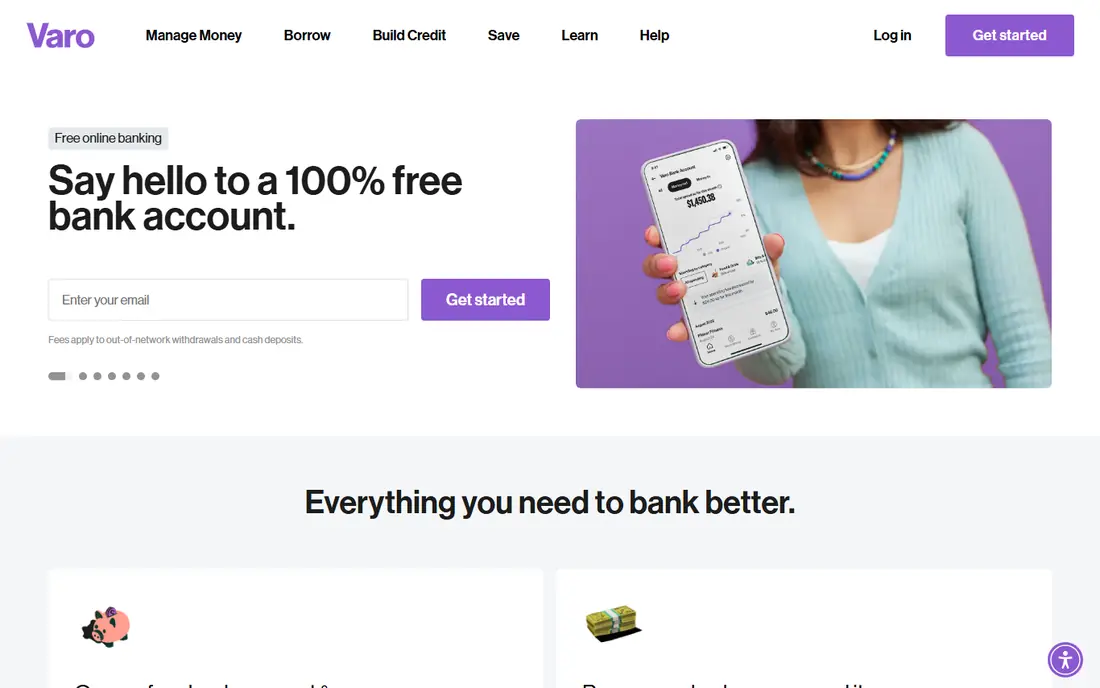
Varo Bank charges no monthly fee and no overdraft fee on its checking account, which removes the fee itself rather than just softening it. On top of that, Varo Advance offers small cash advances, starting with limits that can grow over time with direct deposit history, to top up a balance before a payment. Advances carry a flat fee shown in the app before you confirm, with fees ranging from $1.60 to $100 depending on amount.
That flat fee matters: an advance is not free, even though the account has no overdraft fee. Eligibility needs qualifying direct deposits and a positive balance history, and new accounts may start with no advance offer. Use Varo for the no-fee account first, and treat an advance as a short-term bridge, not a regular income source.
- No monthly or overdraft fees
- Varo Advance offers small advances
- Early payday with direct deposit
- Advance carries a flat fee based on amount
- Advance eligibility needs qualifying deposits
- Advance limit starts low
Ally Bank avoids overdraft fees with two layers. The Overdraft Transfer Service moves money from a linked Ally savings account when checking runs low, which prevents a negative balance without a fee. CoverDraft may then cover overdrafts up to $250 for eligible accounts, again with no fee charged for the cover itself.
Both layers have limits. The transfer only helps if your linked savings holds enough money, and CoverDraft eligibility depends on your account history. Ally also has no monthly maintenance fee and a large fee-free ATM network. For savers who keep a buffer in savings, Ally is one of the most practical no-fee setups here.
- No overdraft fees
- Overdraft Transfer Service from linked savings
- CoverDraft covers up to $250 for eligible accounts
- CoverDraft eligibility varies
- Transfer needs a linked savings balance
- No physical branches
Capital One 360 Checking charges no monthly fee, no minimum balance fee, and no overdraft fee, and it lets you choose how overdrafts are handled. Options include auto-decline, which refuses a payment that would overdraw the account, a free savings transfer from a linked Capital One savings account, and a no-fee overdraft option for eligible customers.
Choice is the strength and the catch. Auto-decline avoids fees by refusing payments, which can be awkward if a bill fails, while the no-fee cover option depends on eligibility. With Capital One Cafes and a large fee-free ATM network, it suits users who want a no-fee account with some in-person access. Read the overdraft settings page and pick the option that matches how you pay bills.
- No monthly or overdraft fees
- Three overdraft choices including auto-decline
- Free savings transfer option
- No-fee overdraft cover needs eligibility
- Auto-decline means a payment may be refused
- Cash deposits need a branch or partner
SoFi avoids overdraft fees by charging none on its checking account, and it offers overdraft cover up to $50 for eligible members who set up direct deposit. That cover is smaller than SpotMe or CoverDraft, but it can absorb a small shortfall, such as a subscription or a coffee, without a fee. Early paycheck access with direct deposit also helps timing.
The smaller limit means SoFi is best as a safety net for small gaps, not for large bills. Direct deposit is needed for the cover, and the full SoFi feature set works best when you use SoFi as your main account. If your shortfalls are usually small and your pay is regular, the no-fee structure plus the $50 cover is a clean fit.
- No overdraft fees
- Overdraft cover up to $50 for eligible members with direct deposit
- Early paycheck access
- Cover limit is smaller than Chime or Ally
- Cover needs direct deposit
- Some features need a SoFi membership setup
Current offers a checking account with no overdraft fees, instant alerts for every transaction, and early direct deposit, which together help you catch a low balance before a payment hits. Alerts are the real tool here: a real-time notice when a payment clears lets you move money or pause spending before the next charge.
Its overdraft cover itself is thinner than SpotMe or CoverDraft, so Current suits users who mainly need visibility and timing rather than a large cover limit. Some premium features, such as teen accounts and credit tools, sit behind paid plans. If alerts and early pay are your main defenses, Current is a strong, simple option.
- No overdraft fees on its checking account
- Instant transaction alerts
- Early direct deposit
- Overdraft cover is thinner than Chime or Ally
- Some premium features need a paid plan
- No physical branches
Dave works differently from a bank account: it connects to your existing bank, watches your balance, and warns you before a payment may overdraw it. ExtraCash offers small advances to eligible members, which can top up a balance before a bill clears. That alert-plus-advance model helps even if you keep your main bank account elsewhere.
Advances are not free in every form. Standard delivery may be free, but faster delivery can carry an optional fee, and some Dave features need a monthly membership. Eligibility and advance limits vary by user and bank history. Use Dave for warnings and short bridges, and check the fee for your chosen delivery speed before you confirm.
- Low-balance alerts
- ExtraCash advances for eligible members
- Budgeting and side-hustle tools
- Advances may carry optional fees for faster delivery
- ExtraCash eligibility and limits vary
- Monthly membership for some features
Brigit monitors your bank balance and sends alerts when a shortfall looks likely, then offers cash advances to eligible members to cover the gap. That early warning is valuable, since many overdraft fees come from a payment you forgot was due. Budgeting tools and credit-building features sit alongside the advance service.
The catch is price. Full advance features need a paid plan, so Brigit costs more than a free bank account with no overdraft fees. Advance limits vary, and Brigit does not replace a bank account: it works with the account you already have. It fits users who want alerts plus advances and are willing to pay a subscription for that combination.
- Balance alerts before a shortfall
- Cash advances for eligible members
- Budgeting and credit tools
- Full advance features need a paid plan
- Advance limits vary
- Not a bank account replacement
How we picked these
We compared official fee pages, overdraft terms, and app listings for services live in October 2026. We favored accounts with no overdraft fee, clear cover limits, and honest eligibility rules, and we stated plainly how each app avoids fees, whether by no-fee terms, a cover limit, a savings transfer, an alert, or an advance. We did not invent rates, limits, or savings figures, and we used See website where a price was not confirmed.
Building a no-fee routine around your app
Pick the mechanism that matches your shortfall pattern. If you often dip slightly below zero, a no-fee account with a cover limit, such as Chime or Ally, is the simplest fix. If your problem is timing, early direct deposit plus alerts, as in Current or Dave, may help more. If you keep savings, a linked savings transfer, as in Ally or Capital One, turns your own buffer into automatic cover.
Set up defenses in order. Turn on low-balance alerts first, then set a personal floor, such as $50, below which you pause non-essential spending. Link a savings buffer if your bank offers it, and check your overdraft setting: auto-decline avoids fees but refuses payments, while a cover option lets payments through up to a limit. Review statements monthly for any fee you did not expect, and contact the bank at once if one appears.
Finally, treat advances as a bridge, not income. An advance or a cover limit must be repaid from your next deposit, which shrinks the next pay cycle. If you need an advance every month, the underlying gap is a budget problem, not a fee problem. In that case, list fixed bills, move due dates closer to payday where a biller allows it, and seek free budgeting help before adding another subscription.
Frequently asked questions
What is the best app to avoid overdraft fees?
Chime is our pick for most people, with no monthly or overdraft fees and SpotMe cover up to $200 for eligible users. Ally Bank is a strong alternative, with no overdraft fees, savings transfers, and CoverDraft up to $250 for eligible accounts. The best choice depends on your direct deposit pattern and savings buffer.
How does SpotMe actually avoid fees?
SpotMe covers eligible debit purchases and ATM withdrawals up to your limit when your balance goes below zero, with no fee and no interest, and the covered amount is repaid from your next deposit. You need $200 or more in qualifying monthly direct deposits, and your limit starts at $20 and can grow to $200. It does not cover every transaction type.
Can an app guarantee I will never pay an overdraft fee?
No. Even no-fee accounts have rules: cover limits, eligible transaction types, and direct deposit needs all apply. An alert app can warn you, but it cannot stop a payment you already authorized. Read your account terms and check your balance before large payments.
Do I need to switch banks to avoid overdraft fees?
Not always. Alert and advance apps such as Dave and Brigit work with your existing bank, and some banks let you change your overdraft setting to auto-decline or a savings transfer without switching. Switching helps most when your current bank charges high fees and offers no no-fee option.
What should I do if I already paid an overdraft fee?
Contact your bank promptly, explain the situation, and ask whether the fee can be waived as a one-time courtesy, especially if it is your first fee. Then change your overdraft setting, turn on low-balance alerts, and set up a savings buffer. If fees repeat, compare no-fee accounts such as Chime, Ally, or Capital One 360.
Sources
See where you really rank - block by block
ProMapRanker scans Google Maps across a grid of your service area. Simple monthly plans from $19, white-label on every plan.
Start freeKeep reading
 zscaler alternatives
Best Zscaler Alternatives in 2026
Looking for zscaler alternatives? We compare 9 SASE and zero trust platforms on architecture, data protection, pricing, and fit for your network and team.
Read → zapier alternatives free
Best Zapier Alternatives Free in 2026
Nine automation tools for zapier alternatives free in 2026, all with genuinely free tiers, plus free plan limits, starting prices and upgrade paths explained.
Read → which platform is best for online reputation
Which Platform Is Best for Online Reputation in 2026
Wondering which platform is best for online reputation? We compare 8 review, listing, and response tools for small and multi-location businesses and agencies.
Read →